How to Use AI in Marketing for Golf Clubs

You're reviewing the club's next membership campaign, the visitor offer needs updating, and someone on the committee asks whether AI could take some of the marketing workload away. It's a reasonable question. The harder decision is which work to automate, what information the system should use, and how you'll know whether it helped.
Learning how to use AI in marketing starts with choosing a commercial job, not buying a writing tool. For a golf business, that might mean attracting independent golfers, improving junior-family communications, filling suitable visitor slots or supporting renewals. Our starting point is to identify the current constraint, then give AI a tightly defined role that staff can supervise and management can measure.
Why AI Marketing Stalls Inside the Average Club
Consider a familiar operational scenario: a membership enquiry reaches a shared inbox, nobody clearly owns the next action, and the prospect receives a generic campaign email weeks later. Meanwhile, the team is discussing an AI chatbot. Adding another communication channel won't resolve the uncertainty about who should act or what should happen next.
The same applies elsewhere in the business. AI-generated visitor promotions aren't useful if they advertise unavailable tee times, and society emails won't help if staff haven't agreed package inclusions. AI needs an operating process around it, not just access to a mailing list.
Adoption isn't a commercial outcome
UK Government AI adoption research reported that around 16% of UK businesses used at least one AI technology, a further 5% planned to adopt it, and 80% neither used it nor planned to do so; among organisations using or planning AI, 61% used natural-language processing and text-generation tools. These are broad business findings, not golf-club benchmarks.
The practical implication is that text-based tasks are a sensible entry point. But producing emails faster doesn't establish whether those emails attract suitable golfers or help them choose the club.
Practical rule: Define the customer action you want before deciding what AI should produce.
A useful project brief should establish:
- The constraint: Is the club struggling to generate relevant demand, explain its offer, convert interest or retain members?
- The intervention: Specify what AI will draft, classify, summarise or recommend.
- The accountable person: Name the member of staff who checks outputs and handles exceptions.
- The outcome: Choose a recorded action, such as a booked visit, completed application, visitor booking or renewal.
For example, if suitable local golfers aren't discovering your flexible membership, campaign production and audience analysis may deserve attention. If prospects visit but rarely join, the proposition or sales conversation may need work instead.
Our commercial approach is ATTRACT → NURTURE → CONVERT → RETAIN. Demand generation matters, but a strong conversion process needs enough demand to work with. AI should support the stage that currently limits growth, rather than spreading automation across every activity.
Auditing Your Club's Data Before Choosing a Tool
Before booking demonstrations, inspect the information staff use. A CRM may contain useful contact details but little reliable evidence of playing interests, visits or joining outcomes. A populated database isn't necessarily an analysable one.
The UK Government's historical study of AI activity estimated that around 15% of UK businesses, approximately 432,000 companies, had adopted AI by 2020, with adoption at 68% of large businesses, 34% of medium businesses and 15% of small businesses. Published in 2022, those figures illustrate the size gap, rather than describing today's golf market.
A smaller club should therefore scope its project around the records and staff capacity it has. A tightly controlled drafting assistant may be appropriate before any attempt at predictive modelling.
Check the records and the process together
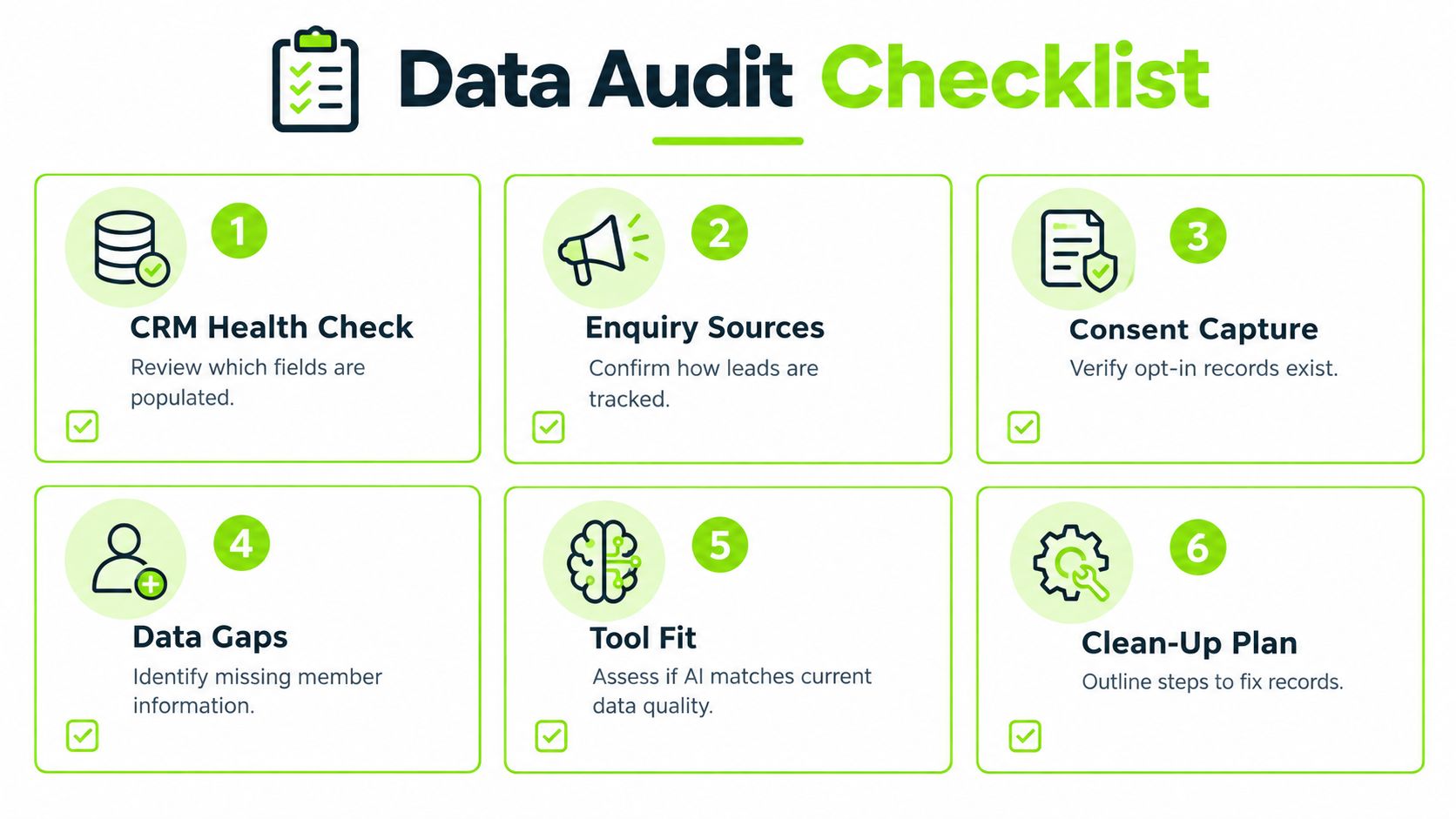
- CRM health: Check which fields staff consistently populate. Look for duplicate contacts, outdated membership categories and conflicting records.
- Enquiry sources: Confirm whether website forms, telephone calls, referrals, paid campaigns and walk-ins retain their original source.
- Contact standards: Compare the expected response process with recorded first-contact dates and actual staff ownership.
- Permission records: Locate communication preferences and the information supporting the club's lawful use of each contact.
- Journey gaps: Check whether visits, trials, applications, joining and renewal are connected to the same customer record.
- Clean-up ownership: Assign responsibility for fixing missing fields and preventing the same problems recurring.
For the analytical side of this exercise, PlotStudio AI's guide to auditing datasets for analysis is a resource to consult alongside your own field review. Keep that review connected to the club's day-to-day golf club database marketing, rather than treating data preparation as a separate technical project.
Match ambition to evidence
If the club has approved product information but weak customer histories, start with supervised campaign drafts. If enquiry notes and outcomes are reliable, classification and conversation summaries become more realistic.
Retention prediction needs more: consistent member histories, meaningful usage records and recorded renewal outcomes. Don't ask AI to compensate for information the club never collected.
The readiness decision is straightforward: can staff verify the inputs, understand the output and record what happens afterwards? If not, improve the workflow before adding another system.
Highest Value AI Use Cases for Golf Clubs
The highest-value use case depends on the club's constraint. A general manager struggling to maintain campaign production has a different requirement from an operator trying to understand why new members disengage.
Text-based work is a sensible starting point, consistent with the adoption pattern noted earlier. It lets staff inspect the output directly, whereas a prediction about future member behaviour requires stronger evidence and more careful validation.
AI Use Cases Ranked by Effort vs Commercial Impact
These are practical prioritisation judgements, not measured performance benchmarks. Impact describes the potential when the relevant bottleneck exists.
| Use Case | Effort | Impact | Best When |
|---|---|---|---|
| Approved campaign drafts | Lower | Moderate | Staff lack production time but the offer is clear |
| Conversation summaries | Lower to moderate | Moderate | Several staff handle the same prospect |
| Playing-profile segmentation | Moderate | High | Different audiences need different routes |
| Enquiry qualification and routing | Moderate | High | Staff need to distinguish questions from buying intent |
| Behaviour-led nurture | Moderate to higher | High | Reliable actions can trigger appropriate communications |
| At-risk member identification | Higher | Potentially high | Usage and renewal histories are consistent |
Lead qualification should establish what someone wants, not decide whether they deserve attention. An assistant could identify interest in flexible membership, extract a requested visit date and flag that the prospect wants a call from the membership team.
Conversation summaries can support handovers between the office and PGA professional. Require the summary to separate stated facts, unanswered questions and suggested actions, so an inference doesn't become a supposed customer commitment.
Where simple rules beat AI
For nurture, use explicit triggers where possible. A recorded taster-round attendance can start an approved follow-up journey without needing a model to infer intent.
Similarly, falling playing frequency might justify a friendly staff check-in, but it doesn't prove someone intends to resign. Predictive churn is a poor first project if staff can't explain the underlying records.
When reviewing how systems connect, Stamina's resource on how to unify your marketing stack with AI can sit alongside your integration requirements. Ask whether any proposed setup preserves customer records, communication preferences and completed actions across the systems you already use.
Choose the least complicated method that can do the job reliably. AI is useful where interpretation is needed, not where a clear rule already works.
An indoor facility, for example, could begin by classifying enquiries as coaching, leagues, practice or group bookings. It shouldn't copy a traditional membership funnel if its immediate commercial priority is repeat bay bookings.
Building a Human-in-the-Loop Campaign Workflow
A useful AI campaign workflow begins with a controlled source sheet. For a membership open day, that sheet should contain the approved date, eligibility, membership options, joining terms, visit arrangements and named contact.
UK advertiser research on generative AI adoption reported that live use cases increased from 9% in April 2024 to 41% in July 2025, while 62% identified efficiency rather than effectiveness as their primary strategic focus and 97% of marketers edited AI-written copy before publication. The commercial lesson is to separate faster production from better results.
Control the draft before it reaches customers
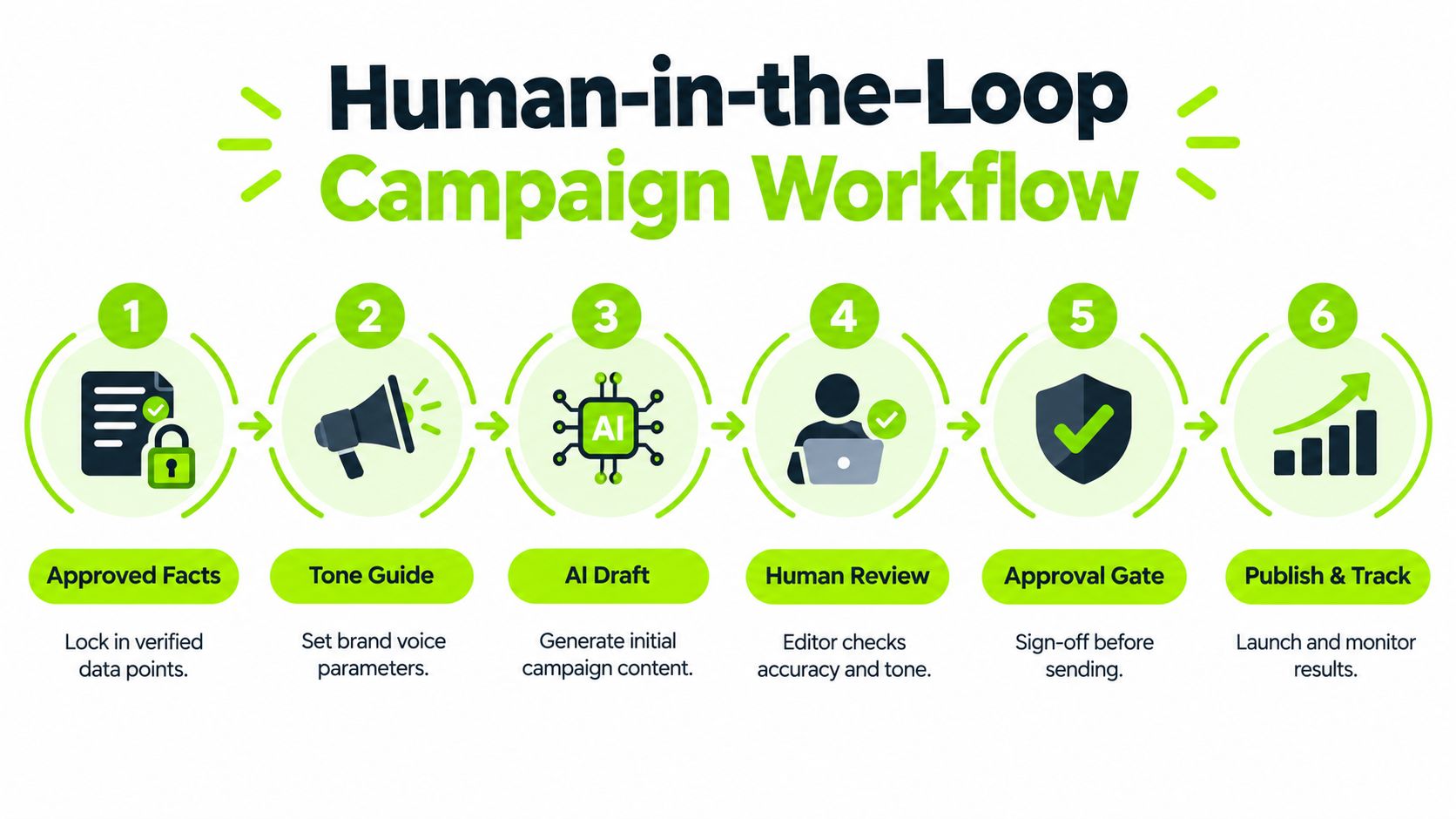
- Supply approved inputs. Give the assistant verified club facts, current pricing, tone guidance and exclusions. Explicitly prohibit invented testimonials, availability claims and discounts.
- Request structured outputs. Ask for the audience, subject line, offer, main copy, call to action and a separate list of factual claims.
- Validate against the source sheet. Check every price, inclusion and eligibility statement. Require uncertain details to be flagged rather than completed by guesswork.
- Apply human review. The appropriate staff member checks brand voice, inclusivity, privacy, sensitive wording and commercial suitability before approval.
- Test against a genuine control. Compare the AI-assisted variant with the existing campaign, keeping the audience, offer and delivery conditions comparable.
- Retain a commercially useful winner. Judge the result by the intended customer action, not the subject line's click performance.
A practical drafting instruction could ask the assistant to create an email for independent golfers interested in regular play, using only approved flexible-membership facts. Staff should still decide whether that proposition is suitable and whether the invitation accurately reflects the club experience.
Keep authority with the right people
The membership lead approves eligibility and joining language. The general manager signs off unusual offers, while the PGA professional checks coaching descriptions or beginner pathways.
If a campaign concerns junior participation, the relevant staff should also check parent-facing information and safeguarding arrangements. AI shouldn't improvise either.
Keep a record of the approved source sheet, draft, edits and final version. That makes it easier to trace an incorrect claim and update future campaigns without repeating the same mistake.
Publish control matters more than prompt cleverness. A polished email with the wrong joining fee is still a poor campaign.
Matching AI Outputs to the Real UK Membership Mix
A single full-membership pitch is a weak default for an audience with different playing needs. The useful role for AI is to interpret expressed interests and suggest an appropriate route, not to assume every golfer wants the same commitment.
England Golf's participation figures reported by Glenmuir recorded 750,071 club members in 2025, up 2.66% from 730,602 in 2024; junior membership increased from 46,028 to 61,483, more than 34%, while iGolf grew by more than 34% to 72,921 users. These are England figures, not a UK-wide membership total.
Separately, England Golf membership reporting published by The Golf Business showed average member age falling from 56.18 to 54.99. That change is useful context, but age alone shouldn't determine someone's offer.
Route by stated needs rather than assumptions

| Participation Route | Information to Establish | Appropriate Next Step |
|---|---|---|
| Conventional full-member prospect | Playing frequency, competition interests and preferred access | Membership discussion and club visit |
| Junior-family enquiry | Junior's experience, family objectives and relevant eligibility | Parent-facing information and junior-team handover |
| Independent or casual golfer | Desired frequency, access needs and interest in club life | Suitable visitor, trial or flexible route |
| Beginner | Experience, confidence and coaching needs | PGA-led introduction or beginner session |
These routes should reflect what the facility offers. Don't let an assistant promise flexible membership at a club without that category, or imply guaranteed access to junior coaching.
Build classification rules staff can challenge
Start with questions such as what the person wants from golf, how often they expect to play and whether they're enquiring for themselves or a junior. Use age only where it's relevant to an approved category, with appropriate data controls.
Record a primary interest and any secondary interests. An independent golfer may want occasional visitor rounds now and membership later; a beginner may also be interested in indoor practice.
Our explanation of market segmentation for golf businesses provides broader context for organising these audiences. Within the AI workflow, include an uncertain classification option so unclear enquiries reach staff rather than an unsuitable automated sequence.
The recommendation is to tailor the next step, not manufacture a detailed personal profile. Staff should be able to see the customer's original words and override the suggested route.
Measuring Whether AI-Assisted Marketing Creates Members
Attribution is where club AI pilots overclaim. A member may have received an automated follow-up, but the deciding factor could have been a PGA conversation, a junior parent's deadline, an iGolf handicap milestone or a casual round that finally felt worth committing to. The measurement job is to separate “touched by automation” from “helped by the journey”.
YouGov's research into UK SME AI adoption found that 31% of SMEs used AI in 2025, with another 15% planning adoption; among adopters or planned adopters, 54% cited task automation and 45% marketing or advertising, while 48% worried about damage to employees' critical-thinking skills. Treat that warning as operating practice: staff should challenge the report before the committee spends money on the next prompt sequence.
Follow the customer through the whole journey

Keep one record connected from enquiry to booked visit, trial, joining and renewal, even when a junior enquiry skips the visit stage or an iGolf player asks for a flexible route first. Preserve source, consent status and enquiry text as the record moves; losing those fields makes later reporting look cleaner while making the decision weaker.
Compare AI-assisted activity with a matched control where feasible. A prior-period comparison can help, but name the distortions: season, price changes, competition capacity, staff availability and whether the campaign targeted casual players rather than likely joiners.
- Incremental conversion: Compare joining conversion between comparable groups, split by junior, iGolf and casual-start journeys where the club offers them.
- Days to contact: Track elapsed time to meaningful staff contact, not just an automated acknowledgement.
- Show-up rate: Divide attended visits by booked visits.
- Joining value: Record realised joining revenue and expected servicing costs against limited capacity.
- Retention: Review 12-month retention when the cohort has matured, using the journey framework described in the YouGov SME adoption research cited above.
Make a keep, change or stop decision
Use the club's marketing effectiveness measurement to keep the reporting consistent. Include tool costs, staff review time and integration maintenance when assessing value, because an automation that saves drafting time but adds checking time has only shifted the cost.
Stop condition: Simplify or remove an automation when it creates more activity without a credible improvement in commercially useful outcomes.
Don't declare failure after an unsuitable comparison or success after a favourable seasonal period. Check whether the test had enough comparable opportunities to support a decision, report uncertainty, and keep a human override visible for the next cycle.
A Lightweight Governance and Trust Checklist
Automation doesn't transfer responsibility away from the club. The ICO's direct marketing guidance explains that direct marketing includes promoting aims and ideals as well as selling products and services, requires a lawful basis for personal-data use, and gives people an absolute right to object to direct marketing at any time.
Trust also deserves explicit attention: UK consumer research reported by Enterprise Times found that 57% had little or no trust in brands using AI responsibly and 76% lacked confidence in AI data privacy. These are consumer findings, not a survey of golf-club members.
Give the committee a clear approval checklist
- Purpose and permissions: Document the intended use, lawful basis and applicable communication requirements. Don't treat every historic contact as permission to market.
- Data minimisation: Restrict access to relevant fields. Keep unrestricted member databases and sensitive personal details out of drafting prompts.
- Transparency: Explain automated assistance clearly and make a human contact route easy to find.
- Retention: Agree how long prompts, conversations and decision logs are kept, and who can access them.
- Escalation: Send complaints, safeguarding concerns, sensitive circumstances and disputed recommendations to staff.
- Opt-outs and oversight: Test suppression across connected channels, assign an accountable owner and review complaints alongside commercial results.
For shared enquiry handling, Sift AI's resource on AI governance for unified inbox teams can support the committee's review of ownership and oversight. The resulting policy should be short enough for staff to use during everyday work.
Transparency may be more commercially sensible than invisible personalisation when someone is considering a long-term membership relationship. That's a recommendation, not a proven golf-sector performance claim.
Use AI to support relevant marketing and informed staff action. Keep product judgement, sensitive decisions and accountability with the people running the club.
We help golf businesses connect customer acquisition, AI-supported qualification, CRM, sales processes and retention to measurable revenue outcomes. Visit GolfRep if you'd like help choosing a practical AI pilot, checking the data it needs and defining how your club will judge its value.
Ready to tap into our proven growth system?