How to Get More Members at My Golf Club: A UK Playbook

The most common advice on how to get more members at my golf club is to push harder on marketing. Run more ads. Post more on social media. Sponsor another local event. Send another email.
That advice is incomplete.
At GolfRep, we see the same pattern repeatedly across UK clubs. The issue usually isn't that nobody is interested. It's that enquiries sit in inboxes, follow-up depends on whoever happens to be on shift, and nobody can clearly see which leads booked a visit, went cold, or were never contacted properly in the first place. Clubs don't have a lead problem as much as they have a conversion system problem.
If your process is manual, your results will be inconsistent. If your process is visible, tracked, and automated where it should be, membership growth becomes far more predictable.
The Real Problem with Membership Growth
Many clubs still assume the answer is simple. Generate more enquiries and membership will grow.
That sounds sensible until you look at what's happening in the market. Industry reporting cited by NGCOA shows that in 2023, new organic leads fell 5% versus 2022, member referrals dropped 7.5%, and average resignations increased by 63%. That combination changes the job completely. Clubs now need to replace more lost members while doing it with weaker passive demand.
Old habits don't hold up well in that environment. Waiting for word of mouth, replying to enquiries when someone gets a moment, and assuming interested golfers will chase you back is no longer enough.
Why more enquiries won't fix a weak process
A weak pipeline hides in ordinary admin.
An enquiry form arrives on Friday afternoon. Someone means to reply on Monday. A prospect opens the email but doesn't respond. No one calls. No reminder goes out. A week later, the lead has gone cold and the club says, “we need more leads”.
What they needed was a proper system.
Practical rule: Fix the leaks before you pour more budget into the top of the funnel.
The clubs that grow steadily don't rely on memory, shared inboxes, or handwritten call-back lists. They use a defined sequence. Every enquiry gets logged. Every lead gets acknowledged quickly. Every prospect gets followed up until they either book a visit, say no, or stop engaging after a clear nurture process.
That's a very different mindset from occasional marketing activity.
The shift from campaigns to a pipeline
Membership growth works better when clubs stop treating it like a one-off promotion and start treating it like an operational process.
That means knowing where enquiries came from, what happened next, who owns the next action, and how many prospects moved from enquiry to visit to application. Without that visibility, even a decent volume of interest can produce weak results.
We've unpacked that challenge in more detail in why most golf clubs struggle to attract new members, but the short version is this. Struggling clubs usually have more demand than they realise and less process than they need.
First Stop Auditing Your Current Performance
Before you spend anything on marketing, audit what's happening now.

The UK golf economy supports billions in annual activity and there is already a large base of active, non-member golfers in local areas. The opportunity is often conversion, not discovery. Prospects also tend to need 7 to 9 touchpoints before they commit, which is why a structured follow-up process matters so much according to this private club membership analysis.
If you don't know what happens after someone enquires, you can't improve it.
Start with four practical questions
Most club audits can begin with a whiteboard and an honest discussion.
Ask these questions:
- Where do enquiries come from. Website form, phone, email, walk-in, social media, referral, visitor play, event attendance.
- How fast do you respond. Not what you hope happens. What happens in practice.
- How many enquiries become visits. If you don't track visits, start there.
- How many visits become members. This tells you whether your issue is follow-up, sales conversation, or product fit.
A surprising number of clubs can't answer those four questions confidently. That isn't a criticism. It's the normal result of manual handling.
Audit the handover points
Most leakage happens between steps, not within them.
A prospect submits a form. Reception sees it, but the membership person is off. Someone replies, but doesn't book a call. A visit is discussed, but no one confirms it. The prospect says “maybe after the summer” and then disappears because there is no nurture sequence.
Create a simple table for the last few months of enquiries.
| Stage | What to check |
|---|---|
| Enquiry received | Was it captured in one place every time? |
| First response | Was there a reply the same day? |
| Follow-up | Was there a scheduled next action? |
| Visit booked | Was the visit confirmed and attended? |
| Outcome | Joined, deferred, lost, or unknown? |
If you have a large “unknown” category, that's your first warning sign.
The clubs losing the most opportunities are often not the clubs with weak demand. They're the clubs with weak visibility.
Measure staff effort, not just lead volume
A manual process has a cost even if it doesn't appear on a marketing report.
If staff are checking inboxes, chasing notes, forwarding leads internally, and trying to remember who needed a callback, that time adds up. It also creates inconsistency. One staff member is diligent, another is busy, and a third writes excellent emails but never follows up by phone.
That's why we advise clubs to document the current process before changing it. Once you can see the gaps, the next step becomes obvious. How most golf clubs lose 30% of enquiries without realising is a useful reference point if your current process feels familiar.
Define Your Ideal Member and Value Proposition
A club that markets to “any golfer” usually ends up with vague messaging and weak enquiries.

The better question is not just how to get more members at my golf club. It's which member are you trying to attract, and why would they choose your club over the other options within driving distance?
UK golf demand is shifting towards more flexible participation. Clubs are responding with membership options such as weekday, seasonal, and family categories, and the primary growth lever is often product design plus the way the club presents accessibility and social belonging, as discussed in this article on membership retention and flexible offers.
Stop selling one product to everyone
Different golfers join for different reasons.
One prospect wants regular weekday access because they work flexible hours. Another wants a family-friendly environment and a social calendar. Another is serious about improving and cares about practice facilities, competitions, and coaching. If all three receive the same message about “great value membership”, you're leaving relevance on the table.
A useful planning exercise is to define a small set of member profiles.
- The weekday player wants convenience, pace of play, and a category that fits working patterns.
- The family joiner responds to belonging, food and beverage, junior pathways, and a welcoming atmosphere.
- The committed improver notices coaching access, competitions, practice routines, and standards.
If your current offer only speaks clearly to one of those groups, your acquisition will reflect that.
Build the value proposition around lived experience
Most clubs over-focus on the course and under-sell the club.
Course condition matters. So do tee times. But membership decisions are also shaped by whether people feel they'll fit in, use the place regularly, bring guests comfortably, and build a routine there. Community is not soft language. It's commercial language when someone is deciding whether to commit.
For clubs that want a clearer framework, these customer segmentation methods are worth reviewing because the logic transfers well. The point is to group prospects by motivation and behaviour, not just age or handicap.
A membership category should remove friction for the buyer without diluting the club's core offer.
New tier or better retention
This is a genuine trade-off.
If your full membership is strong but hesitant prospects keep stalling, a trial, seasonal, or weekday route can create a lower-friction entry point. If your existing members already feel under-served, adding more categories may complicate the product before you've fixed the experience.
A sensible rule is this:
- Create a new tier when a clear segment wants to join but resists the commitment structure.
- Focus on retention first when current members are unclear about value, communication, or belonging.
- Avoid blanket discounting because it can weaken positioning without solving the actual objection.
The strongest clubs don't just promote a fee. They present a membership journey that fits different lives.
Build Your Membership Growth Engine
At this stage, most clubs either become organised or stay reactive.
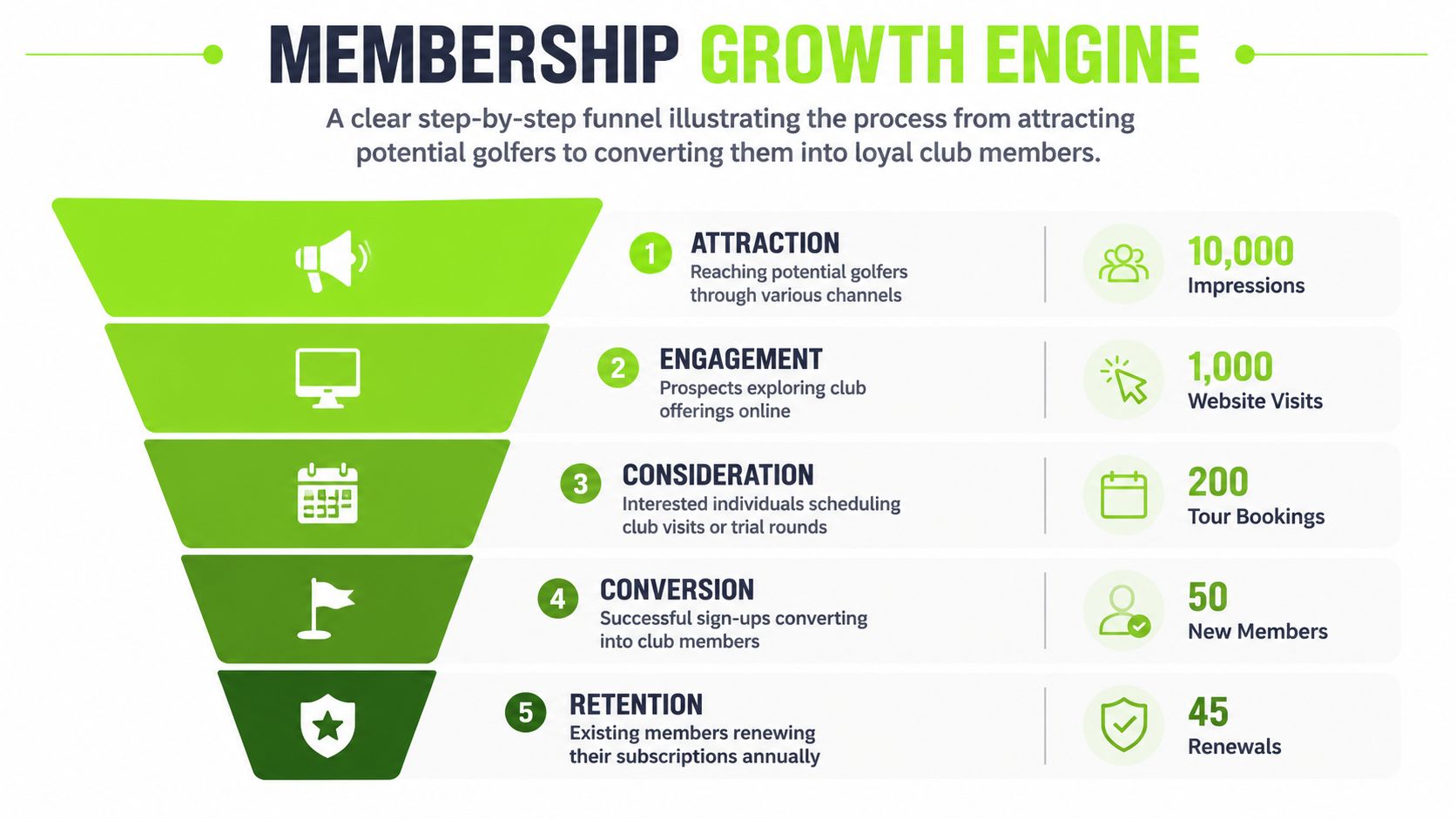
A membership engine has two parts. The first is attraction. The second is conversion. Most clubs spend too much time discussing the first and far too little time building the second.
According to the GCMA, top-performing clubs achieve 100% follow-up on membership enquiries, while average clubs are around 20%. That gap is the clearest sign that consistent follow-up, not just lead volume, drives better outcomes according to GCMA guidance on strengthening membership strategy.
Attraction needs targeting, not spray-and-pray marketing
Attraction still matters. It just needs to be disciplined.
Good clubs focus locally. They target realistic catchment areas, tailor messages by audience, and send prospects to pages built for membership rather than generic homepages. Paid channels can help if the traffic is relevant and the next step is clear.
That can include:
- Local Google search campaigns for people actively looking for golf membership, golf clubs near them, or flexible golf options.
- Social campaigns by postcode aimed at golfers who know the area but haven't considered the club seriously.
- Partnership activity with nearby businesses, residential developments, and community networks that already serve likely prospects.
Local search visibility also matters, especially when a prospect moves from awareness to comparison. If that part of your presence is weak, Review Overhaul local SEO services offers a useful example of what a local-first search approach looks like.
Conversion needs a system
The moment an enquiry arrives, the system should take over.
At minimum, a proper setup should do the following:
Capture every lead in one place
Website forms, Facebook leads, email enquiries, phone notes, and walk-ins should all land in the same CRM.Send an immediate acknowledgement
Prospects should know their enquiry has been received and what happens next.Assign the next action automatically
Someone should own the lead, with a call task or follow-up reminder already scheduled.Run a nurture sequence
Email and text follow-up should continue if the prospect doesn't book immediately.Track outcomes properly
Booked visit, no response, not qualified, deferred decision, signed up. Every lead needs a status.
If staff have to remember what to do next, the process is already weaker than it should be.
This is where a CRM stops being “software” and starts being operational infrastructure. It makes the pipeline visible. It shows bottlenecks. It reduces reliance on memory. It also lets committees and managers see facts instead of anecdotes.
What works and what doesn't
Here's the practical difference.
| What works | What doesn't |
|---|---|
| Dedicated membership landing pages | Sending everyone to a generic homepage |
| Instant acknowledgement emails or texts | Letting enquiries sit unanswered |
| Task-driven CRM follow-up | Shared inboxes and handwritten notes |
| Clear visit booking process | Vague “let us know if you'd like to come in” replies |
| Defined lead stages | Guessing which leads are still live |
Some clubs build this internally with tools they already use. Others use specialist support. GolfRep, for example, combines lead generation with CRM-based follow-up and conversion tracking for golf clubs, which is the right shape of solution when a club needs both demand capture and a structured nurture process rather than disconnected marketing activity. If you want to compare models first, GolfRep's guide to golf club lead generation outlines the moving parts clearly.
Leverage Your Greatest Asset Your Current Members
Many clubs underuse the warmest source of future members they already have. Their existing membership.

Word of mouth remains one of the strongest drivers of membership growth. Referral programmes work best when they are simple, easy to use, and offer tangible rewards. Automating the tracking and reward process also helps members feel recognised and more likely to refer again, as outlined in this guide to boosting golf club membership through referrals.
Informal referrals are not enough
Most clubs say they get members through word of mouth.
That's good, but it's not yet a strategy. Informal advocacy only goes so far because there is no prompt, no clear offer, and no tracking. A member may happily recommend the club to a friend, but if nobody follows up properly or credits the referral, the momentum disappears.
A structured referral programme is stronger because it removes ambiguity.
- Make the ask specific. Don't say “bring a friend sometime”. Say exactly who you'd like introduced and how.
- Offer a tangible benefit. Discounted membership, event entry, or pro shop credit can all work if they fit the club.
- Track every introduction. If a member refers someone, the club should know and acknowledge it quickly.
Pair referrals with community visibility
Referrals work better when members are proud to bring people in.
That means your club needs visible social energy. Guest days, open events, beginner-friendly gatherings, family moments, and a welcoming arrival experience all make it easier for members to invite others confidently. If the club feels closed, cliquey, or hard to understand, referrals slow down no matter how loyal the members are.
The strongest referral programmes don't start with incentives. They start with a club experience that members want other people to share.
This is also where retention and acquisition overlap. A member who feels connected is more likely to stay and more likely to advocate. A member who feels ignored does neither.
A simple referral loop
A referral loop doesn't need to be complicated.
- Member receives a clear invitation to refer.
- They submit details through a simple form or named contact.
- Prospect receives a fast, professional follow-up.
- The club logs the outcome in the CRM.
- The referring member is thanked and rewarded if the prospect joins.
That's manageable for most clubs. The important part is consistency. Once it becomes part of normal operations, referrals stop being accidental.
Measure and Optimise for Predictable Growth
The clubs that grow consistently don't rely on feel.
They measure the pipeline, review where leads are getting stuck, and improve one stage at a time. That's how membership growth becomes more stable instead of swinging between busy periods and long quiet spells.
The metrics that actually matter
You don't need a complicated dashboard. You do need clarity.
Track these figures every month:
- Enquiry volume by source
- Response performance across all lead channels
- Enquiry to visit rate
- Visit to member rate
- Reasons lost such as price, timing, location, product fit, or no follow-up
- Member retention trend alongside acquisition activity
Those numbers tell you where to work. If enquiry volume is healthy but visits are low, the follow-up process needs fixing. If visits happen but sign-ups are weak, your sales conversation or membership product may be the issue. If acquisition improves but total membership doesn't, retention needs attention.
Predictable growth comes from control
Most clubs don't need more random activity. They need more control.
Control means every lead is visible. Every stage has an owner. Every outcome is tracked. Every improvement is based on what the numbers are showing, not what the committee thinks might be happening.
That's the difference between reactive marketing and a proper growth system. One creates bursts of noise. The other creates a pipeline.
If you're serious about how to get more members at my golf club, stop asking only how to generate attention. Ask how your club captures, follows up, converts, and learns. That's where the actual gains are made.
GolfRep is a UK golf club growth partner that helps clubs build predictable membership pipelines through targeted lead generation, CRM setup, automated follow-up, and conversion tracking. If your club is generating interest but struggling to turn enquiries into visits and sign-ups, GolfRep is one option to consider when you want a clearer, more structured system.
Ready to tap into our proven growth system?