How to Fill a Golf Club Waiting List: Guide for 2026

The most common advice on waiting lists is also the most damaging. Clubs are told that a long list proves demand, protects exclusivity, and solves the membership problem on its own.
It doesn't.
A waiting list only has value if the club can identify who is serious, who fits the membership, who is likely to join quickly, and who has gone cold. Without that, the list becomes a pile of ageing enquiries, half-complete forms, missed calls, and uncertain follow-up. That isn't an asset. It's an operational risk.
At GolfRep, we see the same pattern repeatedly. The issue usually isn't a lack of interest. It's what happens after the enquiry lands. If your club still relies on inboxes, spreadsheets, handwritten notes, or one person remembering to call people back, your waiting list isn't protecting revenue. It's leaking it.
Your Waiting List Is a Liability Not an Asset
A lot of committees still treat the waiting list like a trophy. The longer it gets, the better everyone feels. But from an operating perspective, a waiting list is only impressive if it is organised, qualified, and actively managed.
The UK market gives useful context. There are roughly 1,800 golf facilities across the UK, yet strong waiting lists are better understood as a sign of constrained supply than simple popularity. Independent club-industry reporting cited by MemberSplash's analysis of club waitlists says 49% of golf country clubs now have waitlists, up from 25% in 2019, with median initiation fees doubling from $25,000 to $56,000 over the same period. That matters because it changes the job. Clubs don't need passive admin. They need disciplined intake, qualification, and communication.
A neglected list decays quickly. Someone enquires with genuine intent. They wait days for a reply. They get a vague email. Nobody logs their details properly. No one knows whether they wanted a full membership, a five-day category, or a family option. By the time a place opens, the club is trying to revive a lead that should have been handled properly at the start.
Practical rule: Every waiting list enquiry should be treated like a high-value sales lead, not a names-on-a-page admin task.
The clubs that struggle most usually don't have a marketing problem. They have a process problem. That's why so many clubs never turn demand into predictable joins, a point that also sits behind why most golf club marketing fails.
What makes a waiting list risky
- Poor visibility: Staff can't see who enquired, when, or what happened next.
- Slow response: Interest drops while the club decides who should reply.
- No qualification: Serious buyers and casual browsers sit in the same pile.
- No nurture: Prospects hear nothing until a place appears, if it appears at all.
The waiting list is not the finish line. It's the start of the conversion process.
Shift from Passive Queue to Active Sales Pipeline
Most clubs still manage waiting lists as a queue. Name comes in. Name goes on list. Time passes. An opening appears. Staff work from the top and hope the person still wants to join.
That method sounds fair, but it often produces poor outcomes. Waiting lists don't move in neat order, and membership demand doesn't arrive in neat order either. Some prospects are financially ready now. Some need six months. Some fit the club perfectly. Some don't. If you treat all of them the same, you make the list harder to manage and the openings harder to fill well.

Why the queue model breaks down
Industry guidance is clear that a waitlist works best as a controlled demand-management system, not a passive list. Clubs need a hard capacity ceiling, a central CRM, and segmented prospects because manual list management becomes error-prone as volume rises, as outlined in Capstone Hospitality's waitlist management guidance.
That means the primary question isn't who asked first. It's who should be advanced when a scarce opening appears.
A useful way to think about this is through funnel stages. If you want a plain-language overview, Click Click Bang Bang's sales funnel explanation is a good primer on how interest moves from initial awareness to a committed decision. For golf clubs, the same logic applies. An enquiry is not a member. It is the top of a process.
What an active pipeline looks like
A proper waiting list pipeline usually separates prospects by two factors:
| Prospect factor | What the club needs to know |
|---|---|
| Fit | Does this person suit the club, category, and culture? |
| Readiness | Could they join quickly if a place opened? |
That creates a more useful operating view than a simple date stamp.
For example:
- High fit, high readiness: Prioritise for tours, conversations, and immediate offers when capacity opens.
- High fit, lower readiness: Keep warm with updates and invitations.
- Lower fit, unclear intent: Gather more information before giving them the same attention as stronger prospects.
The best waiting lists are curated, not merely accumulated.
Capacity first, marketing second
A club can't fill a waiting list properly without deciding what “full” means. That includes total membership, category mix, playing pressure, and how much access waitlisted prospects can reasonably receive without harming the member experience.
Once that ceiling is defined, the list becomes much easier to manage. You stop chasing volume for its own sake and start building a structured pipeline around likely future openings. That's the difference between a backlog and a growth system. If you want a deeper operational view, this guide to a golf club sales pipeline is the right model to follow.
Attracting and Capturing High-Quality Enquiries
A waiting list filled with vague, low-intent contacts creates work, not value. If you want to understand how to fill a golf club waiting list properly, the first task is to attract people who suit the club and then capture their details in a way the team can act on.
That starts with the offer. “Join our waiting list” is too weak on its own. Prospective members need a clear reason to enquire now rather than later. That reason might be club culture, course quality, member experience, family use, competition calendar, practice access, or the simple fact that places are limited and managed carefully.
Focus on fit, not reach
The strongest enquiry campaigns are usually local and specific. Broad awareness can help, but clubs often get better results from targeted Google Search campaigns, local Facebook and Instagram campaigns, referral prompts to current members, and landing pages built around real membership intent.
The message should filter as much as it attracts. A serious prospect responds well to clarity. A casual browser usually disappears when they see a proper process.
Use copy that answers real questions:
- Membership category: Is this aimed at full, weekday, younger, family, or corporate interest?
- Club character: Is the club competitive, social, family-led, traditional, or modern in feel?
- Next step: Is the prospect requesting a brochure, a callback, a tour, or a waiting list conversation?
Your form is part of the sales process
Many clubs still use a generic contact page for membership interest. That's a mistake. A waiting list should have its own dedicated form and destination.
At minimum, capture:
- Basic identity: Name, email, mobile number.
- Membership intent: Preferred category or usage pattern.
- Timeframe: Ready now, considering soon, or researching.
- Relevant context: Current club status, handicap if appropriate, and who the membership is for.
The point isn't to make the form long. The point is to gather enough detail to route the lead correctly.
A short, well-designed form beats a generic inbox every time because it starts qualification before a staff member touches the lead.
What good capture looks like in practice
A strong capture setup has three parts working together:
Traffic source
Targeted ads, organic search, email referrals, or member introductions.Dedicated membership page
One page focused on waiting list interest, expectations, and clear next steps.CRM-connected form
The enquiry doesn't sit in email. It goes straight into a live system.
That last part is essential. If the form submission doesn't feed a CRM, someone is going to copy and paste details manually, and that's where follow-up starts to fail. Clubs that want a stronger front-end process should build around the same principles used in effective golf club lead generation.
Designing Your Automated Enquiry Management Workflow
A waiting list fails at the handoff, not at the point of interest.
Clubs usually have enough demand. The breakdown happens after the form is submitted. An enquiry lands in a shared inbox, someone means to reply later, a note sits in a spreadsheet, and the prospect hears nothing useful for days. That is how a waiting list becomes dead admin instead of a live sales pipeline.
Build around stages, not inboxes
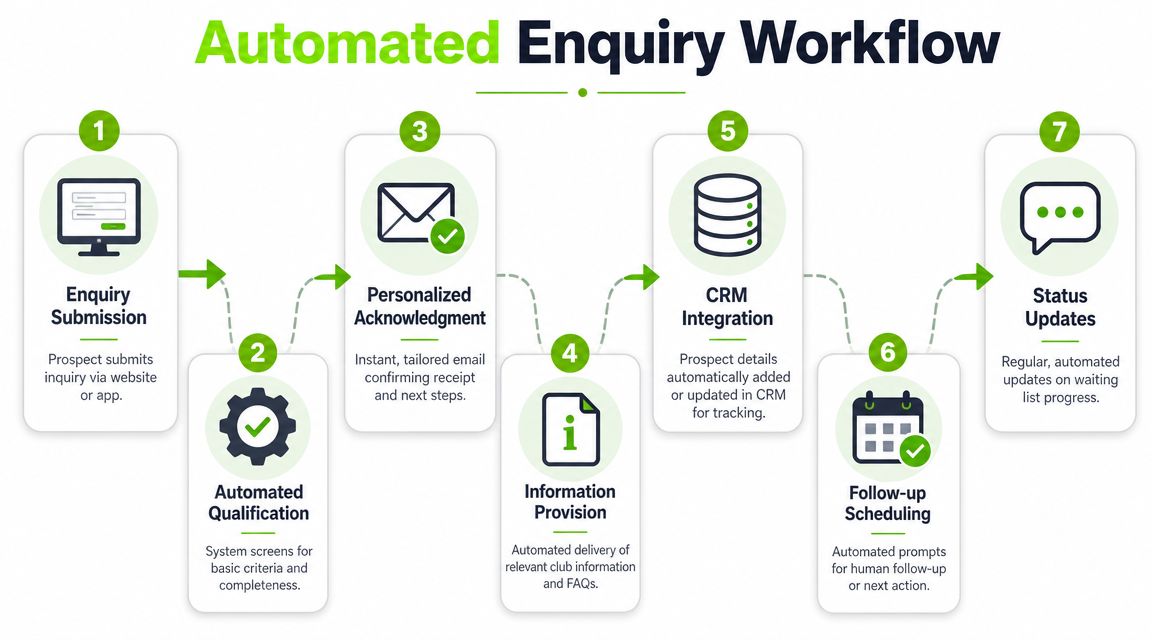
The right setup starts with a central CRM and a fixed workflow. Every enquiry should enter the same system, follow the same stages, and trigger the same core actions. If staff are relying on memory, personal inbox folders, or handwritten notes, response quality will vary and leads will be lost.
A practical workflow usually looks like this:
| CRM stage | What happens |
|---|---|
| New enquiry | Form submission enters CRM automatically |
| Qualification review | System checks completeness and tags the enquiry |
| Acknowledged | Instant email confirms receipt and next steps |
| Human contact due | Staff task created for call or personalised email |
| Tour or meeting booked | Visit arranged and tracked |
| Waiting list active | Prospect stays in nurture with clear status |
| Opening available | Offer process begins |
That structure gives the membership team a working pipeline, not a pile of names. It also gives management something they rarely get from manual processes. A clear view of who is waiting, who has been contacted, who is engaged, and where momentum is being lost.
The first reply should be instant
Speed matters most in the first few minutes.
A prospect who submits an enquiry should receive an immediate acknowledgement, even if the club cannot provide a personal response until later that day or the next morning. The purpose is simple. Confirm the enquiry arrived, explain what happens next, and show that the club runs a professional process.
A useful acknowledgement email should do four things:
- Confirm receipt: The prospect knows the form worked.
- Set expectations: Tell them when a team member will contact them.
- Give context: Include membership categories, waiting list process, or relevant FAQs.
- Reduce uncertainty: Remove the need for the prospect to chase.
The standard is straightforward:
We've received your membership enquiry and a member of the team will contact you shortly. In the meantime, here's an overview of membership categories, waiting list process, and what happens next.
That email will not close the sale. It keeps the lead alive long enough for your team to do proper follow-up.
Automate the handoffs
Automation should handle repeatable actions and leave staff to handle judgment, conversation, and closing.
If a prospect selects an immediate joining timeframe, the system should flag that record for priority follow-up. If they ask about a family category, the next email should reflect that interest. If a tour is booked, the CRM should update the stage automatically and remove the record from any generic callback queue. Good workflow design prevents duplicate outreach, missed tasks, and awkward gaps between teams.
The systems also need to talk to each other. If your form captures data but your email platform is disconnected, records become fragmented and follow-up becomes inconsistent. Clubs that want cleaner execution should integrate collected data for email lists so every enquiry can trigger the right sequence, tags, and staff alerts without manual copying.
Define ownership at each stage
This is the part clubs often skip.
Every stage needs an owner, a response standard, and a clear next action. Who reviews new enquiries? Who calls high-intent prospects? Who books visits? Who updates status after a tour? Who makes the offer when a place opens? If those answers are vague, the workflow will look organised on paper and fail in practice.
I usually recommend clubs set service rules such as same-day acknowledgement, next-business-day personal follow-up, and immediate escalation for ready-to-join prospects. The exact timing depends on staff capacity. The point is consistency. A smaller club can run a tight process with limited resource if roles are clear and the system prompts the work.
What weak workflows have in common
The failure points are predictable:
- Shared inboxes with no ownership
- Spreadsheets updated by hand
- No response standard
- No automatic task creation
- No stage movement after key actions
- No record of calls, replies, or tours
Those setups survive for a while because demand masks the weakness. Then an opening appears, the club scrambles to work out who is still interested, and the best prospect has already joined elsewhere.
A waiting list should reduce uncertainty, not create more of it. If the process is built properly, staff know what to do next, prospects hear from the club at the right time, and management can see whether the pipeline is moving. That is how enquiry handling starts producing memberships instead of admin.
Nurturing Waiting List Prospects to Keep Them Warm
Prospects don't stay interested just because your club is desirable. They stay interested because the club stays present.
Waiting lists are dynamic. Movement is created by turnover events such as relocation, health changes, or membership category changes. That's why transparent communication and proactive nurturing matter so much, as explained in North Oaks Golf Club's article on joining a wait list. If a place appears unexpectedly, the club needs an engaged prospect who is ready to act.

Two six-month outcomes
Consider two versions of the same prospect.
In the first, someone joins your waiting list in January. They receive a basic confirmation email. Then nothing. By June, they've forgotten who replied, they're unsure where they stand, and another club has already spoken to them properly. When an opening comes up, your offer lands cold.
In the second, the prospect receives a clear acknowledgement, a welcome sequence, occasional club updates, invitations to relevant events, and sensible status communication. By June, they still recognise the club, they understand the process, and they can picture themselves there. The opening arrives to someone who is already half-converted.
The difference isn't the waiting list. It's the nurture.
What to send while they wait
A good nurture flow shouldn't feel like repeated chasing. It should feel like useful, low-friction contact.
A balanced sequence often includes:
- Status updates: Confirm that the enquiry is active and explain what movement depends on.
- Club news: Share course improvements, competition highlights, dining updates, or member stories.
- Useful information: Membership category explanations, joining process notes, etiquette guidance, or visitor information.
- Selective invitations: Open days, dining evenings, beginner clinics, practice sessions, or member-hosted introductions where appropriate.
Keep the club visible without becoming noisy. Silence loses people. Over-contact irritates them.
Use taster access carefully
Limited access can work well when it is controlled. The purpose is not to give away the membership experience for free. It is to help the right prospects feel the club before a formal offer is made.
Examples might include:
| Taster option | Why it helps |
|---|---|
| Clubhouse event invitation | Lets prospects experience atmosphere and service |
| Dining access on selected days | Builds familiarity with the social side of the club |
| Practice or introductory session | Useful for prospects still comparing clubs |
The key is consistency. If some prospects receive access and others hear nothing, the process will feel arbitrary. Set rules, log invitations in the CRM, and keep the member experience protected.
Keep status communication honest
Prospects don't expect certainty where certainty isn't possible. They do expect clarity.
Tell them:
- whether they are active on the waiting list
- what the next likely milestone is
- what can affect timing
- who to contact if their circumstances change
That last point matters more than most clubs realise. A prospect who was “researching” in February may be “ready now” in May. If your system never asks, you won't know.
Using Pricing and Tiers to Drive Conversions
When a place opens, many clubs make the same mistake. They panic about losing the lead and start softening the offer. Waived fees, discounted joining, informal concessions. That usually weakens positioning and creates inconsistency.
Discounting isn't the best answer to a waiting list conversion problem. Better structure is.
Match the offer to the prospect
If your list is segmented properly, you should already know what the prospect is likely to want. A full seven-day category suits one buyer. A five-day membership may be the right starting point for another. Corporate and family structures may bring in the best-fit household or business relationship without forcing a one-size-fits-all sale.
That doesn't mean unlimited flexibility. It means a clear range of categories with clear rules.
Use a simple decision framework:
- Availability: Which category has room right now?
- Fit: Which option matches the prospect's stated use?
- Progression: Can this category lead naturally to fuller membership later?
Protect value while making the decision easy
The club's job is to communicate value clearly, not to haggle.
That means the offer should include:
| Offer element | What the prospect should understand |
|---|---|
| Membership category | What is included and who it suits |
| Joining terms | What commitment is required to secure the place |
| Timing | When the prospect needs to confirm |
| Next actions | Payment, induction, documentation, and activation |
If you need urgency, use deadlines and clarity, not discounts.
A disciplined offer process also helps internally. Staff know what can be offered, committees don't revisit each case from scratch, and prospects receive a consistent message. That consistency protects the club's premium position far better than ad hoc deals ever will.
Building Your Predictable Membership Engine
A full waiting list is not the objective. A controlled, visible, conversion-ready pipeline is.
Clubs that perform well don't just collect interest. They define capacity, attract the right prospects, capture proper data, respond quickly, automate handoffs, and keep people engaged until the moment a place becomes available. That's how to fill a golf club waiting list without turning it into an administrative burden.
The underlying shift is simple. Stop treating the waiting list as a queue. Start running it like a membership sales pipeline.
That change usually has less to do with spending more on promotion and more to do with building a system that staff can use. Once the process is structured, the club gains visibility, consistency, and far better control over who joins next.
If your club wants a more reliable way to turn membership enquiries into joins, GolfRep helps golf clubs build structured pipelines with lead generation, CRM setup, automation, and follow-up systems designed specifically for the realities of club membership sales.
Ready to tap into our proven growth system?