Golf Club Society Bookings: Boost Your Growth

The most common advice on golf club society bookings is still wrong. Clubs are told to get more enquiries, run sharper offers, and stay competitive on price. That sounds sensible until you look at what breaks in most society pipelines.
The failure point usually comes after the enquiry.
A society organiser fills in a form, sends an email, or leaves a voicemail. Then the club replies late, replies vaguely, or replies without a clear next step. Details sit in inboxes. Pricing lives in PDFs. Follow-up depends on who is on shift. By the time someone chases the lead properly, the organiser has already moved on to a club that looked easier to deal with.
That's why golf club society bookings should be treated as a revenue system, not a diary task. The clubs that handle societies well don't just advertise a package. They define an offer clearly, remove friction from the booking journey, respond quickly, track every enquiry, and manage delivery tightly enough to earn repeat business.
Crafting Society Packages That Sell on Value Not Price
Too many clubs price society golf as if they're trying to clear old stock. That approach attracts organisers who compare only on headline cost, ask for extras late, and often create the most admin. It also makes it harder to protect your green fee position with members, visitors, and other group buyers.
A stronger approach is to treat the society day as a designed product.
Golfshake's UK society-golf survey shows organisers are aware of price increases, but they still travel for the right experience. 57% of organisers said the average package price had increased by £5-£10, and 22% said it had increased by £10-£20. At the same time, 51% said they were willing to travel one to two hours for a society golf day, according to Golfshake's society booking research. That matters because it tells you the decision isn't based on price alone. The package has to feel worth the journey.

Build packages people can understand quickly
Most society pages are too vague. They list “coffee and bacon roll”, “18 holes”, and “one-course meal”, then ask the organiser to enquire for details. That creates work before the club has earned any trust.
Clearer package design usually works better:
- Named package options such as Captain's Day, Corporate Classic, or Midweek Society Saver
- A defined ideal fit for each package, such as casual groups, annual away days, or client entertainment
- Included extras that feel useful, not random, such as reserved registration area, scorecards prepared in advance, nearest-the-pin markers, or prize table setup
- Operational detail that reduces uncertainty, including arrival time, meal timing, and what the organiser needs to confirm in advance
The point isn't to add fluff. It's to remove guesswork.
Price for margin and perceived value
Cost-plus pricing often leads clubs into weak positioning. If you build the package by adding up the meal, the golf, and a small buffer, you end up with a number that may cover cost but doesn't reflect the value of a well-run day.
A better pricing discussion starts with three questions:
| Consideration | Weak approach | Better approach |
|---|---|---|
| Buyer view | “What's the cheapest we can sell?” | “Why would this organiser choose us?” |
| Offer design | Loose inclusions | Fixed package with useful options |
| Margin control | Discount first | Protect base price, upsell selectively |
A club with a stronger location, course condition, catering reputation, or smoother group handling shouldn't price itself like a commodity venue.
Practical rule: If your package can only win when it's cheaper, the package isn't strong enough yet.
Use tiers without creating confusion
Most clubs don't need a long menu. They need three sensible choices.
One entry package sets a clear starting point. One mid-tier package becomes the most popular because it includes the practical extras organisers usually ask for. One premium package serves groups that want less hassle and a better hosted experience.
That gives the organiser a decision framework. It also gives the club a consistent quoting model. If every enquiry becomes a bespoke pricing exercise, margins drift and staff waste time rebuilding the same proposal.
For clubs reviewing package structure more broadly, GolfRep's article on golf club upsell strategy is useful because it shows how to add value without cheapening the core offer.
Designing a Frictionless Online Booking Funnel
A society organiser doesn't experience your club in the order your team thinks about it. They don't start with your internal diary, your catering notes, or your preferred admin process. They start with one question. Can I understand this quickly and book it without hassle?
If the answer is no, the enquiry leaks out of the funnel.

What the page must do
Your society booking page has one job. It must help an organiser move from interest to action without needing a phone call just to decode the basics.
The page should include:
- Package summaries in plain English so visitors can compare options fast
- Good photography of the course, food, and group experience, not just empty fairways
- A clear booking route with one primary call to action
- Useful reassurance such as how the club handles group scoring, catering, and organiser support
Clubs often hide society information under visitors, functions, or club diary pages. That creates uncertainty. A dedicated page usually performs better because it matches the organiser's intent.
Keep the form short enough to finish
In this scenario, many clubs lose viable business. The organiser is willing to enquire, but the form feels like a homework assignment.
Ask only for the information needed to qualify and route the lead:
- Name and contact details
- Preferred date or date range
- Approximate group size
- Package interest or event type
- Any essential notes
Don't ask for full handicap breakdowns, menu selections, exact final numbers, or invoice details at first contact. Those belong later in the process.
If your website platform is limited, a practical starting point is to create online booking forms that capture the right data cleanly and send it to the correct inbox or system.
Instant confirmation matters
A good online funnel doesn't end at form submission. It confirms that the club has received the enquiry and explains what happens next.
That's one reason digital booking systems tend to outperform manual processes. PGA.info says these systems provide 24/7 booking availability, clearer tee-time selection, and reduced phone calls and admin. It also cites Golfmanager's report of conversion improvements of up to 300% when clubs implement online booking systems, as explained in PGA.info's coverage of digital booking systems.
That doesn't mean every club needs a complex platform on day one. It does mean the organiser should get an immediate response, a clear expectation, and an easy next step.
The online journey should feel organised before a member of staff ever speaks to the organiser.
For clubs reviewing their wider booking experience, GolfRep's guide to golf course online booking is a practical reference point.
Mastering the Art of Rapid Enquiry Response
Most clubs underestimate how much confidence is created by the first reply. Organisers are not only judging price. They are judging whether the day will be easy to run.
A slow or vague response signals future problems. A fast and structured response signals control.
The first response should do three things
The first message doesn't need to sell aggressively. It needs to reduce uncertainty and move the organiser forward.
A useful reply usually includes:
- Confirmation that the enquiry has been received
- A direct answer on likely availability or the next availability check
- A named next step such as a call, package recommendation, or provisional hold process
Keep the tone practical. Avoid sending a wall of attachments before you know what the organiser wants.
A simple structure works well:
Thanks for your enquiry about a society day at the club. We're checking your preferred date and group size now. I'll come back to you shortly with suitable options and the best package fit. If it helps, I can also hold a short call today to run through timings, catering and format.
That message feels professional because it sets expectation.
Ask qualifying questions that help the organiser
The goal isn't interrogation. It's diagnosis.
Good qualifying questions usually cover:
- whether the date is fixed or flexible
- whether the group is price-led, experience-led, or convenience-led
- who else is involved in the decision
- whether catering and competition setup matter
- whether the organiser has run the event before or is planning it for the first time
That last point matters more than clubs think. A first-time organiser often needs more guidance. An annual organiser usually needs speed, clarity, and confidence that your club won't create extra admin.
Don't rely on inbox memory
One of the simplest fixes is assigning ownership. Every society enquiry should have one person responsible for the next action, even if operations later involve multiple departments.
Without ownership, enquiries drift:
- the pro shop thinks the office replied
- the office assumes catering will follow up
- the organiser hears nothing useful
- the club blames low demand
That isn't a demand problem. It's a handling problem.
Fast response wins trust before price becomes the main conversation.
Strong clubs also avoid the trap of answering only what was asked. If the organiser asks, “Do you have availability in May?”, the club should reply with options, package direction, and a path to reserve. The best responses move the sale forward while staying helpful.
Building Your Automated Follow-up and CRM Engine
Spreadsheets are still common in society sales. So are notebook diaries, flagged inboxes, and verbal handovers. Those methods can work for a small volume of enquiries, but they break quickly once bookings, changes, deposits, and reminders start overlapping.
That's where a CRM engine changes the economics of golf club society bookings. It creates visibility, assigns ownership, and makes sure the next step happens even when staff are busy.

Why manual systems fail under pressure
The biggest stress point in society operations isn't always the initial booking. It's everything that changes afterwards.
The NGCOA reports that cancellations and modifications can account for up to 30% of all bookings, which is why payment terms, waitlist handling, and structured communication matter so much. It also supports the case for upfront payment and digital systems that reduce no-show risk and support future marketing, as outlined in NGCOA's analysis of booking changes and revenue protection.
That operational drag is exactly where manual systems lose money. One missed deposit reminder or one untracked amendment can turn a healthy booking into a problem.
What a workable CRM process looks like
A simple CRM setup doesn't need to be complicated. It needs to answer five questions:
| CRM stage | What the club needs to know |
|---|---|
| New enquiry | Who submitted it and what do they want? |
| Qualified lead | Is it a fit, and what matters most to the organiser? |
| Proposal sent | What package or option was offered? |
| Deposit pending | What must happen before the booking is secure? |
| Confirmed and managed | What operational actions are still due? |
This gives the team a shared view of the pipeline. It also exposes where leads stall. If many organisers receive proposals but few pay deposits, the issue might be pricing clarity, follow-up timing, or friction in the payment process.
Automate the moments that are easy to forget
The best automations are not flashy. They remove routine failure points.
Useful automations include:
- Immediate acknowledgement when an enquiry arrives
- Follow-up prompts if no one has responded personally
- Proposal chase emails when an organiser has gone quiet
- Deposit reminders with a clear payment deadline
- Final detail requests for numbers, dietary needs, and timings
- Post-event messages that ask for feedback and invite rebooking
A club can build this in several ways. Some use booking software, some use general CRM platforms, and some use sector-specific systems. GolfRep also helps clubs structure enquiry routing, automate follow-up, and track pipeline stages inside a golf-focused growth system. For clubs comparing options, its article on golf club CRM software is a useful overview of what to look for.
If staff have to remember every follow-up manually, some of them won't happen.
Clear payment terms protect everyone
Automation only works if the underlying rules are clear. Society terms should define when a provisional hold becomes a confirmed booking, when deposits are due, what happens if numbers change, and how the club handles cancellations.
That isn't about being rigid. It's about reducing ambiguity. Organisers often appreciate structure because it tells them exactly what they need to do next.
The Operational Playbook for a Flawless Society Day
A confirmed booking can still go wrong in the final week. That usually happens when information sits in separate places and each department only sees part of the picture.
The organiser experiences one club, not three departments.
Lock in the pre-event details early
The final pre-event communication should be deliberate, not improvised. The club needs one clean record covering the day from arrival to departure.
A practical checklist includes:
- Final numbers and any likely movement
- Food choices and dietary requirements
- Arrival and first tee timing
- Competition format if the club is helping administer it
- Buggies, prizes, nearest-the-pin markers, and extras
- Billing and organiser contact details for the day
Send this in one structured message. Don't scatter it across multiple emails from different team members.
If the event includes a meal, prizegiving, or mixed-use room layout, it also helps to visualise the room plan in advance. Tools that help organisers plan seating for professional events can remove confusion around table layout and flow, especially for corporate groups or larger society presentations.
Run the day as one joined-up operation
Most organisers remember the details that looked small to the club. Were they greeted properly? Did staff know who they were? Was signage obvious? Did lunch start when they were told it would?
The clubs that earn repeat society business usually coordinate these moments well:
Arrival
The organiser should know where to go and who is meeting them. Registration should feel ready, not improvised.
Handover
The pro shop, food and beverage team, and office should all be working from the same version of the booking.
Pacing
If tee timings shift or food service needs to move, one person should own communication back to the organiser.
Finish
Prizegiving, tabs, and departures should feel closed off cleanly, with no last-minute confusion over charges or missing details.
A smooth society day is usually the result of preparation, not rescue work.
The post-event message matters
Many clubs treat the day itself as the finish line. It isn't.
A short thank-you message sent soon after the event does three useful things. It shows professionalism, invites feedback while the experience is fresh, and opens the door for next year's date before competitors get involved.
That message doesn't need a discount. It needs relevance. Thank the organiser, ask if anything could have been improved, and offer to discuss preferred dates for the next outing while the diary is still flexible.
Measuring Success and Driving Repeat Bookings
If you only measure how many society days took place, you won't know where growth is coming from or where leakage is hurting you. A club can be busy and still run an inefficient society pipeline.
The better question is whether your process turns interest into profitable, repeatable revenue.
Healthy market participation doesn't solve weak conversion. The R&A's 2023/24 participation report says Great Britain and Ireland had about 3.7 million golfers, while England Golf reported a record 986,000 registered golfers in 2024. The practical issue for clubs is converting that underlying interest into booked society days through a better operating system, as noted in this discussion of participation demand and conversion gaps.
Track the points where bookings are won or lost
Most clubs don't need a huge reporting suite. They need a short list of numbers and observations they can review consistently.
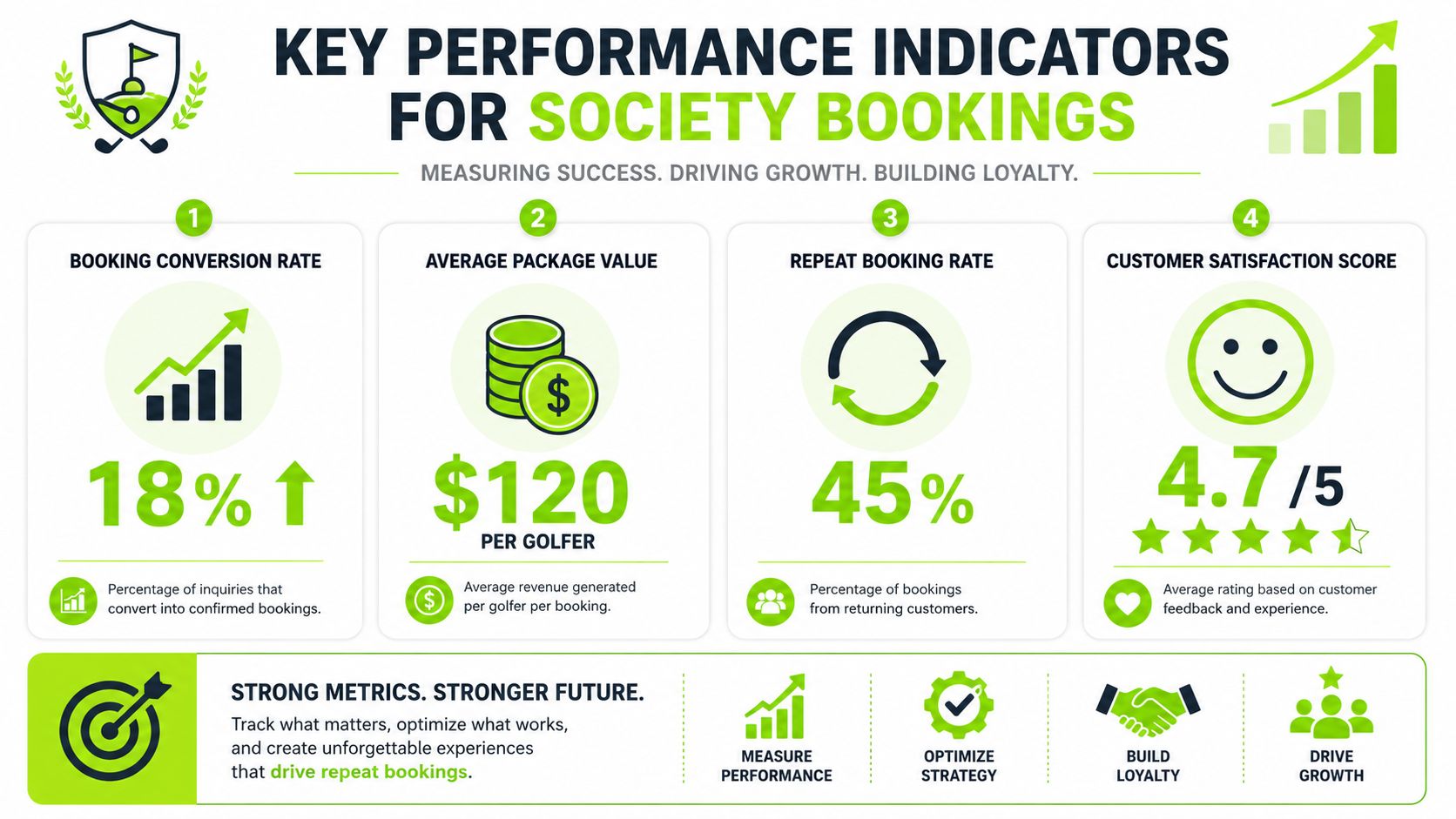
Focus on:
Enquiry-to-booking conversion
How many society enquiries turn into confirmed business?Average package value
Are you selling the right mix of packages and extras?Speed to first response
Are leads getting handled while intent is still high?Deposit conversion
How many provisional bookings fail before payment is received?Repeat booking rate
Which organisers come back, and what did those events have in common?
These measures tell a fuller story than total booking count alone.
Use your data to improve the system
Measurement only matters if someone acts on it. If conversion is weak, inspect the offer and the response process. If package value is low, review how staff present the mid-tier and premium options. If repeat bookings are patchy, look at on-the-day execution and post-event follow-up.
A simple review table can help:
| Metric | If performance is weak | Likely area to review |
|---|---|---|
| Enquiry conversion | Too many leads go cold | Response speed, quoting clarity |
| Package value | Buyers choose entry option only | Offer design, upsell logic |
| Deposit completion | Provisional bookings stall | Payment process, reminder workflow |
| Repeat bookings | Few organisers rebook | Event delivery, post-event follow-up |
Build next season before this one ends
The strongest society pipelines are not rebuilt from scratch every year. They are renewed.
That means tagging past organisers properly, recording what type of group they ran, noting preferred timings and package choices, and contacting them at the right point in the planning cycle. A committee society, a corporate golf day, and a casual annual group don't all book in the same way. Your follow-up shouldn't treat them as if they do.
Golf club society bookings become more predictable when clubs stop thinking in terms of isolated enquiries and start thinking in terms of pipeline stages, operational consistency, and repeat demand. That's the difference between hoping the phone rings and knowing what the next booked revenue should come from.
If your club wants a more reliable society pipeline, GolfRep helps build the systems behind it, from enquiry capture and routing to follow-up, CRM visibility, and conversion tracking, so society demand is handled properly rather than left to inboxes and memory.
Ready to tap into our proven growth system?