Golf Course Managers: Grow Predictably, Retain Members

Most advice aimed at golf course managers is wrong at the point where it matters most.
You don’t usually have an enquiry problem. You have a conversion problem.
Clubs keep asking how to get more leads, more traffic, more attention. Meanwhile, existing enquiries sit in inboxes, get scribbled into notebooks, get passed between the office and the pro shop, or get followed up when someone finally has time. By then, the prospect has cooled off or joined somewhere else.
That isn’t a marketing issue. It’s an operations issue.
At GolfRep, we’ve seen the same pattern across UK clubs again and again. Managers are busy, staff are stretched, committees want growth, and everyone assumes the answer is another campaign. It usually isn’t. If your club can’t see every enquiry, respond properly, and track what happens next, more lead generation just pours water into a leaky bucket.
Predictable growth comes from building a system that handles interest properly from first enquiry to first tee time and beyond. That means better visibility, faster follow-up, cleaner data, and a clear process for conversion.
The Real Reason Your Club Is Losing Members
The popular advice says your club needs more exposure.
More social posts. More ads. More offers. More “awareness”.
That sounds sensible, but for most golf course managers it misses the problem. The club isn’t losing members because nobody is interested. It’s losing members because interest is being handled badly.
A prospect fills in a form. Someone means to call them. The day gets busy. A committee meeting gets in the way. A staff member is off. The follow-up slips. Then the enquiry goes stale.
That’s the breakdown.
Most clubs don’t have an empty pipeline. They have an unmanaged one.
If you’re relying on memory, spreadsheets, inbox folders, and whoever happens to be on shift, you don’t have a membership process. You have a patchwork of manual habits. Those habits fail under pressure.
This is why some clubs feel constantly busy but still struggle to grow. Activity is high. Visibility is low. Nobody can answer simple questions with confidence:
- Which enquiries came in this week
- Who has been contacted
- Who booked a visit
- Who went quiet
- Which source produced members, not just clicks
Golf course managers need to stop treating membership growth as a top-of-funnel problem only. The commercial leak usually happens after the prospect raises their hand.
If that sounds familiar, you’re not alone. We’ve unpacked that wider issue in why most golf clubs struggle to attract new members, but the uncomfortable truth is simpler. Even when clubs do attract attention, many still fail to turn that attention into revenue.
The leaky bucket sits in your follow-up
A club can spend money generating enquiries and still underperform if no one owns the next step.
That’s why the fix isn’t just “do more marketing”. The fix is to create a system where every enquiry is seen, logged, responded to, and moved forward properly.
Without that, retention suffers too. New members who joined through a messy process often arrive with weak engagement and low confidence in the club.
What to do first
Start with an audit of your current process.
Ask these questions:
- Where do enquiries land. Email, website, social media, phone, paper forms, or all of them.
- Who responds first. Name the role, not the department.
- How is progress tracked. If the answer is “we usually know”, that means it isn’t tracked.
- What happens if nobody follows up. If there’s no trigger or alert, leads will keep slipping.
Golf course managers who fix this stop guessing. They build a reliable path from interest to membership.
Rethinking the Role of the Modern Golf Manager
The job has changed.
Golf course managers are no longer just responsible for turf, rotas, suppliers, and keeping the day running. You’re also expected to support membership growth, retain members, handle pressure from committees, and make sense of club performance with incomplete information.
That old split between “operations” and “commercial” no longer works. At many clubs, the manager sits in the middle of both whether the job description admits it or not.

You’re not just running a course
A modern manager needs to think like an operator and a pipeline owner.
That means you need line of sight across:
- Enquiry flow from website, phone, referrals, and campaigns
- Response handling so no lead disappears into an inbox
- Tour booking and attendance so interest turns into real conversations
- Membership conversion so results are tracked properly
- Retention signals so problems are spotted before renewals are at risk
If that sounds commercial, good. It is.
Too many clubs still act as though growth belongs to “marketing” and service belongs to “operations”. In practice, prospective members experience one club, not two departments. If the handover between interest and action is poor, they feel it immediately.
Leadership now means system ownership
The strongest golf course managers don’t chase every task personally. They build a process that still works when they’re pulled elsewhere.
That requires three things.
Clear accountability
Someone must own the first response. Someone must own follow-up. Someone must own reporting. If those responsibilities are vague, performance will be vague too.
A single view of the pipeline
You need one place where enquiries are visible and current. Not half in email, half in a spreadsheet, and half in somebody’s head.
Measurable commercial discipline
You don’t need to become a full-time marketer. You do need to know where leads come from, what happens next, and where they drop out.
Practical rule: If you can’t see the status of every active enquiry in one place, you can’t manage growth properly.
The modern role is about leverage
Golf course managers already carry too much manual work. The answer isn’t to add more admin and call it strategy. The answer is to enable greater efficiency.
Advantage stems from systems that remove repeat tasks, standardise follow-up, and give you visibility without chasing staff for updates. That’s how a manager shifts from reactive firefighting to control.
The clubs that grow predictably usually have one thing in common. The manager stops acting as the final safety net for every loose end and starts building a process that catches those loose ends earlier.
The Key Performance Indicators That Actually Drive Growth
Most clubs track what’s easy to count, not what matters.
Website visits look nice in a report. Social engagement looks busy. Email opens can create false confidence. None of those tell you whether the club is converting interest into members.
Golf course managers need operational KPIs, not vanity metrics.
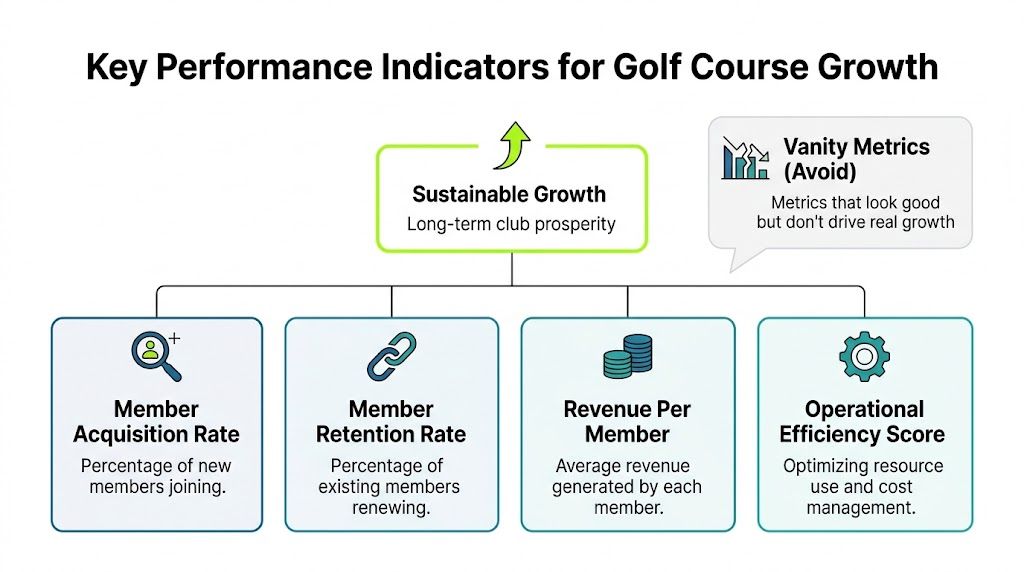
Stop admiring traffic
A full website report doesn’t pay subscriptions, improve cash flow, or strengthen renewals.
What matters is whether a prospect moved forward.
Use this test. If a metric can’t lead to a clear action, it probably belongs in the background.
| KPI | What it tells you | Why it matters |
|---|---|---|
| Enquiry Response Time | How quickly the club replies to new interest | Slow responses kill momentum |
| Lead-to-Tour Ratio | How many enquiries turn into visits or conversations | Shows whether follow-up is working |
| Tour-to-Member Conversion Rate | How many visits become paying members | Reveals sales quality and offer clarity |
| Retention by Segment | Which member groups stay and which drift | Helps protect long-term revenue |
The KPI most clubs ignore
Enquiry Response Time is one of the clearest signals of whether your process is healthy.
If a lead arrives and nobody responds quickly, everything else gets harder. The prospect has to chase. Staff lose context. Enthusiasm fades. The club looks disorganised before a relationship has even started.
That’s why system design matters more than good intentions.
What retention data tells you
Acquisition gets attention because it feels urgent. Retention gets ignored because it feels gradual.
That’s a mistake. After the post-2025 wet winter, which saw 20% above average rainfall, 25% of UK courses pivoted to family events, boosting retention by 18% according to analysis on the underserved private golf market. The lesson isn’t just about events. It’s about tracking retention by segment so you can see what keeps people engaged.
If your club treats all members as one lump of data, you’ll miss obvious patterns.
A better dashboard for golf course managers
Track fewer numbers, but track the right ones.
Use a weekly view for pipeline movement and a monthly view for conversion and retention. Keep it simple enough that the manager, secretary, committee, and membership lead can all understand it.
A useful dashboard should answer:
- How many new enquiries came in
- How fast they were contacted
- How many booked a visit
- How many joined
- Which member groups are holding and which are slipping
If you’re still measuring activity instead of outcomes, you’re not managing growth. You’re observing noise.
For a wider commercial view of what clubs should measure, this piece on the real ROI of golf club marketing is worth reading alongside your own reporting.
The right KPI doesn’t just describe performance. It points to the next operational fix.
Solving Your Biggest Operational Headaches
Most membership problems start as operating problems.
The club says it wants growth, but the day-to-day setup makes growth hard. Staff are stretched. Data is scattered. Follow-up depends on who remembered to do it. The committee wants answers, but nobody has a clean view of what’s happening.
That pressure lands on golf course managers.
Staffing gaps break good intentions
The labour issue is not abstract. The 2023 BIGGA Salary Survey revealed that 68% of UK greenkeepers report staffing shortages, with 42% citing recruitment difficulties, as referenced in the USGA discussion of golf course maintenance challenges.
That matters beyond greenkeeping.
When clubs are short of capable people, every department starts borrowing time from somewhere else. Admin gets delayed. Enquiries wait. Membership calls happen late or not at all. Staff spend hours on low-value tasks because no system is doing the repetitive work for them.
The result is predictable. Important prospects get treated like interruptions.
Manual clubs create inconsistent experiences
A prospective member doesn’t care whether your office is busy, your committee is slow to decide, or your team is covering three roles each. They care whether the club responds clearly and professionally.
Manual processes usually create these problems:
- Patchy follow-up because one person owns too much of it
- Poor lead visibility because information sits in different places
- No conversion tracking because nobody updates records consistently
- Weak handovers between office, manager, and membership contact
- Uneven member experience because every enquiry gets handled differently
That inconsistency is expensive, even if nobody writes it down that way.
Committee-led clubs face a separate drag
Many UK clubs also carry a governance problem. Decisions move slowly, ownership is blurred, and volunteers mean well but don’t always have time to support execution.
That creates an awkward middle ground. The club wants commercial performance, but still runs key parts of member acquisition like a favour-based admin process.
If membership growth depends on whoever has a spare half hour, it isn’t a growth strategy.
What the operational fix looks like
The answer isn’t to ask already stretched staff to “try harder”. That just creates more variation.
Golf course managers need to remove friction at the system level.
Build one source of truth
Every enquiry should enter one visible pipeline. If someone calls, emails, fills in a form, or responds via social, that contact needs to end up in the same place.
Standardise the next step
Every lead should trigger the same baseline process. Acknowledgement, qualification, follow-up, visit invitation, and clear status tracking.
Protect staff time
Your best people should spend their time speaking to serious prospects, supporting members, and improving the club. They should not spend their mornings chasing old emails to find out who replied to what.
When clubs fix those basics, headaches don’t vanish. They become manageable. More importantly, growth stops depending on individual heroics.
A System for Predictable Membership Acquisition
One-off campaigns don’t build reliable clubs.
They create spikes of attention, a short burst of admin, and then confusion if the club isn’t set up to handle the response. That’s why some managers feel underwhelmed even after a campaign brings in interest. The issue wasn’t traffic. The issue was what happened next.
A proper membership system should work the same way every time.

Build the journey, not just the advert
Think of the process as a sequence, not a campaign.
A prospective member moves through stages. If any stage is vague or delayed, conversion drops. Golf course managers need a system that controls each step.
Stage one is immediate acknowledgement
The club should respond as soon as the enquiry lands. Not eventually. Not when someone gets back from lunch.
An immediate response sets expectations, confirms the enquiry was received, and starts gathering context. It also prevents the common failure where a lead wonders if the form worked and moves on.
Stage two is qualification
Not every enquiry is equal.
Some people want seven-day membership. Some are exploring family options. Some are comparing clubs. Some are price shopping. You need enough information early on to route the prospect properly and avoid generic responses.
That doesn’t require a hard sales script. It requires structure.
Stage three is guided follow-up
Most clubs are too passive after the first exchange.
A prospect asks for details, receives a brochure, and then hears nothing unless they chase. That’s poor process dressed up as politeness.
Follow-up should be planned. If someone hasn’t booked a visit, they should receive the next relevant prompt automatically or be flagged for a personal call. That keeps momentum alive without depending on memory.
What a predictable pipeline includes
The strongest setups usually include a mix of automation and human contact.
Use systems for speed and consistency. Use people for judgement and relationship-building.
A practical pipeline should include:
- Instant first response so no lead sits unattended
- Lead capture in one CRM so visibility is centralised
- Structured nurture sequences for people not ready to act immediately
- Clear sales stages so every enquiry has a current status
- Visit booking prompts to move interest into real-world action
- Re-engagement triggers for prospects who go quiet
- Conversion reporting so managers know what works
Why discounts are usually the wrong answer
When conversion is weak, clubs often reach for offers.
That feels decisive, but it usually masks process failures. If the underlying issue is slow follow-up, poor visibility, or weak nurture, a discount won’t fix it. It just lowers perceived value and trains the market to wait.
A well-run pipeline does the opposite. It builds confidence in the club, keeps communication clear, and helps prospects choose based on fit rather than price pressure.
Good systems remove the need for desperate tactics.
The handover matters too
Predictable acquisition isn’t finished at sign-up.
If the joining process is messy, if induction is unclear, or if early engagement is weak, you create retention risk from day one. New members need a joined-up experience, not a form and a card and silence.
That means your system should continue after payment. Welcome communication, first-visit guidance, introductions, and light-touch check-ins all matter because they shape whether a member settles in or drifts.
Golf course managers who understand this stop thinking in separate silos of marketing, operations, and retention. They build one coherent member journey.
The Essential Tech Stack for a Modern Golf Club
Technology shouldn’t make a club feel more complicated. It should remove avoidable work.
Too many golf course managers have been sold software that looks impressive in a demo and then becomes another disconnected tool nobody really uses. The answer isn’t more platforms. It’s the right stack, with each tool doing a clear job.
Start with the core functions
You need three things working together.
CRM
A CRM holds your enquiries, member prospects, status updates, notes, and follow-up history in one place.
Its job is visibility.
If someone asks what happened to an enquiry from last week, the answer should be on screen in seconds. Not hidden in an inbox, a spreadsheet, or someone’s memory.
If you’re comparing options, look for a system built around usability, pipeline stages, and reporting. This guide to choosing a golf CRM system covers the practical criteria clubs should focus on.
Automation
Automation handles repeatable communication and internal prompts.
That includes enquiry acknowledgements, reminders, follow-up sequences, reactivation messages, and task alerts for staff. Done properly, it removes delay without removing the human touch.
The key point is this. Automation should support judgement, not replace it.
Advertising and lead capture
Clubs still need demand generation. Advertising platforms help you reach local golfers and drive interest. But those platforms only do their job if the lead data enters your pipeline cleanly and triggers the right next step.
A campaign without a connected system just creates admin.
Tech also matters on the operational side
Modern golf management software isn’t only about membership.
According to Swoop Golf’s overview of modern golf course operations, integrated software can reduce water usage by up to 30% and maintenance costs by 15-20% by enabling data-led irrigation and maintenance schedules based on player traffic and turf health sensors. That matters because the same principle applies commercially. Better systems improve resource allocation, reduce waste, and help managers make decisions based on live information rather than guesswork.
What a joined-up stack should do
A sensible setup should give you this:
| Tool category | Main job | What managers gain |
|---|---|---|
| CRM | Centralise lead and member data | Clear pipeline visibility |
| Automation | Run consistent follow-up and reminders | Faster response and less admin |
| Advertising platform | Generate relevant local demand | Better quality enquiries |
| Operations software | Support scheduling and resource planning | Stronger control over time and costs |
Avoid the common buying mistake
Don’t buy software because it has the longest feature list.
Buy it because your team will use it every day and because it connects properly to the rest of your process. A simple, connected stack beats a bloated system that nobody updates.
One practical option in this category is GolfRep, which combines data-led advertising, AI-driven automation, and CRM-enabled nurture systems to help clubs track enquiries, follow up consistently, and build a clearer membership pipeline.
That kind of setup is useful because it treats growth as a managed system, not a collection of disconnected tasks.
How the GolfRep Growth System Delivers Results
The reason most clubs struggle isn’t lack of effort. It’s fragmentation.
Marketing sits in one place. Follow-up sits somewhere else. Lead data is incomplete. Reporting is delayed. The committee sees outcomes, but not the process issues causing them.
A proper growth system fixes that by connecting attraction, response, nurture, and conversion into one operating model.

What the system changes
The biggest shift is simple. Clubs stop relying on manual chase-ups and start using a process that works every day.
That means:
- Leads are captured cleanly
- Responses happen immediately
- Prospects are nurtured in a structured way
- Managers can see where each enquiry sits
- Conversion can be tracked rather than guessed
This matters because every one of those points affects whether interest becomes revenue.
Why the post-enquiry phase matters most
Most agencies talk about reach. That’s not where clubs usually break down.
The gap appears after someone raises their hand.
If the prospect waits too long, receives inconsistent communication, or gets no clear next step, the opportunity weakens fast. A system-led approach fixes that by making sure no enquiry depends on one busy person remembering to follow up later.
Clubs don’t need more noise. They need a process that converts attention into action.
What the examples tell us
The strongest proof of a system is whether it changes outcomes over time, not whether it produces a short burst of leads.
The publisher information behind this article notes that Bidston Golf Club achieved more than double membership after adopting the kind of structured, automation-led pipeline GolfRep implements, and that Addington Palace saw steady pipeline growth from a performance-led approach. Those examples matter because they point to the same conclusion. Consistency beats sporadic effort.
The lesson for golf course managers is not that every club should copy the same campaign. It’s that every club needs the same underlying discipline. Clear lead capture. Fast response. Structured nurture. Full visibility.
Where managers benefit most
A good system doesn’t just help prospects. It helps the manager.
It reduces admin chasing. It gives committees cleaner reporting. It makes staff handovers easier. It exposes bottlenecks before they become bigger problems. Ultimately, it turns growth from a hopeful ambition into a process you can manage.
That’s the difference between being busy and being in control.
Your Path to Sustainable Club Growth
Golf course managers don’t need another vague instruction to “do more marketing”.
You need a system that stops good enquiries from going cold, gives your team a clear follow-up process, and shows exactly where prospects move or stall. That’s what sustainable growth looks like in practice.
The clubs that grow predictably aren’t always the loudest. They’re usually the most organised.
They know who enquired. They know who responded. They know who visited. They know who joined. And they know which parts of the process need tightening. That level of visibility changes everything because it replaces assumption with control.
If your club is still relying on inboxes, memory, spreadsheets, and ad hoc follow-up, the next step is obvious. Don’t start by asking how to generate more leads. Start by asking whether your current process deserves more leads in the first place.
That’s the mindset shift that matters.
Build the system first. Then scale what works.
If your club wants a clearer, more reliable way to turn enquiries into members, GolfRep helps golf clubs build structured pipelines with lead capture, follow-up automation, CRM visibility, and conversion tracking so growth doesn’t depend on manual chasing.
Ready to tap into our proven growth system?