Boost Membership: Marketing for Private Members Golf Clubs

Most advice on marketing for private members golf clubs gets the problem backwards. It tells clubs to post more on social media, run a few ads, host an open day, and hope enquiries turn into members.
That isn't the hard part.
The hard part is what happens after someone shows interest. If an enquiry sits in a shared inbox, gets answered two days later, or receives a vague response with no next step, the club hasn't got a marketing problem. It has a conversion problem. For many private clubs, that's where growth stalls.
The clubs that grow consistently usually aren't doing magic. They've built a system. Enquiries are captured properly, assigned quickly, followed up automatically, and tracked all the way to visit, proposal, and sign-up. That is the difference between occasional success and a predictable pipeline.
The Real Growth Challenge for Modern Golf Clubs
Private clubs are not short on marketing ideas. They are short on a working system.
Managers hear the usual recommendations. Post more often. Raise visibility. Run campaigns around open days. Those activities can produce interest, but they do not fix the point where growth usually breaks down. A membership enquiry arrives, nobody owns it, the response is delayed, the follow-up depends on memory, and the club cannot see which enquiries become visits, proposals, or signed members.
In England, participation stayed healthy after the COVID-era spike, with 5.2 million adult rounds recorded in 2022, up from 4.7 million in 2021, as noted in this NGCOA industry review. That gave many clubs enough demand to mask weak processes for a while. Once demand becomes less forgiving, the clubs with no pipeline discipline feel it first.
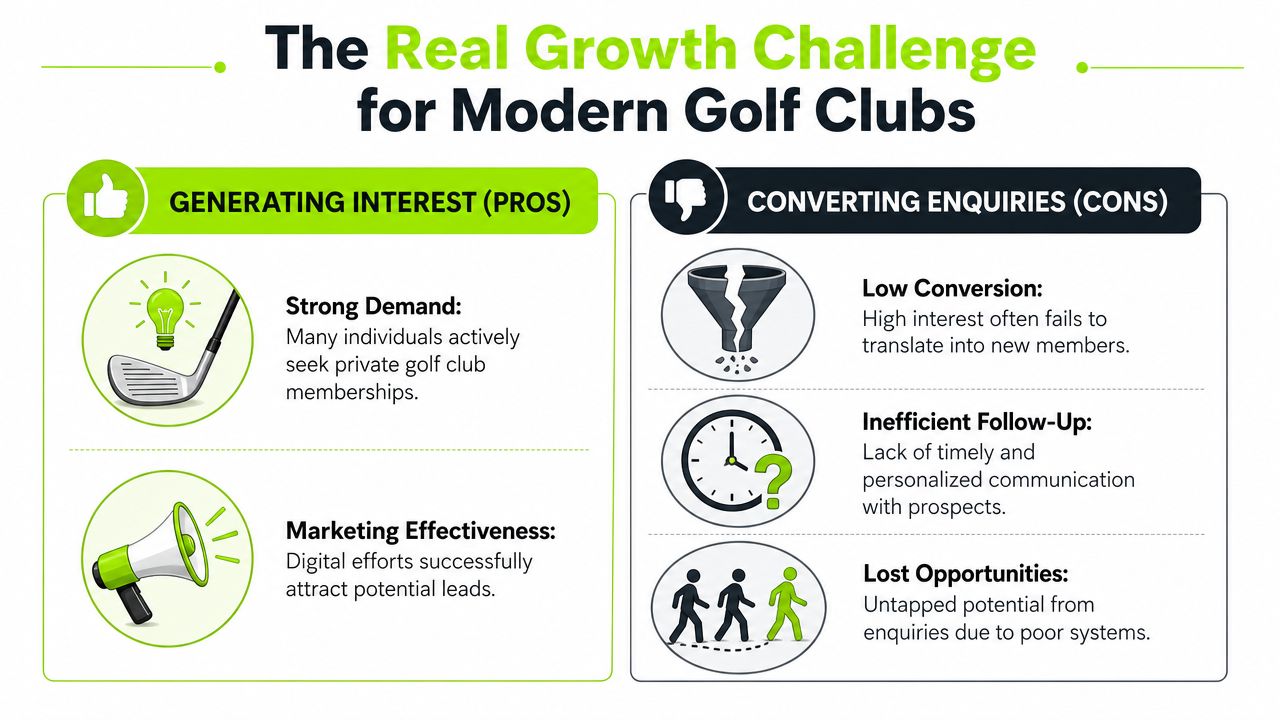
More enquiries are useless if the club cannot manage them
A full diary can hide poor conversion habits. Then conditions tighten and the same habits become expensive.
Industry reporting in 2024 noted that new organic leads fell 5% versus 2022 and member referrals dropped 50% versus 2021, according to Golf Business News coverage of current golf consumer and facility trends. Clubs that had relied on reputation and passive demand were left exposed. The issue was not only lead volume. It was the lack of a process to capture, qualify, and move each prospect forward while interest was still warm.
That breakdown usually appears in familiar operational problems:
- Slow first response: An enquiry comes in during a busy competition week and waits in a shared inbox.
- Poor lead visibility: Staff cannot tell who replied, what was sent, or whether a tour was offered.
- Manual follow-up: Membership calls compete with tee sheet issues, events, and member admin.
- No conversion tracking: The club counts enquiries but cannot trace them through to joining fee and recurring revenue.
Practical rule: If your club cannot see every enquiry, owner, status, and next action in one place, demand is leaking.
I see the same trade-off repeatedly. Clubs invest time and budget into generating interest, but they still depend on manual handoffs once a prospect raises a hand. That creates inconsistency. It also creates risk, because committees often judge marketing by signed members, not by the number of forms submitted.
The shift clubs need to make
A private club does not need more disconnected tactics. It needs one growth system.
That means lead generation, CRM, follow-up, and reporting have to work together. The website should capture the right information. The CRM should assign ownership immediately. Automation should handle the first response and the next steps. Staff should know which prospects need a call, which need a tour booked, and which have gone quiet.
Prospects notice this faster than committees do. They judge the club by the speed of reply, the clarity of the invitation, and whether the process feels organised enough to justify the fee level. If the journey feels clumsy, the club looks harder to join and harder to trust.
Our analysis of why clubs fail to convert new member interest into sign-ups covers that pattern in more detail. The same principle applies here. Growth comes from handling demand properly, not by creating more of it.
The discipline is the same one publishers use to find your ideal readers. Define the audience clearly, build the path they take, and remove friction at each step. For private golf clubs, that means treating membership growth as an end-to-end operating system, not a collection of campaigns.
Identifying Your Ideal Member Segments
A lot of clubs still market to “golfers” as if that's one audience. It isn't. That's one of the biggest reasons messaging becomes generic and pricing conversations drift towards discounting.
The UK market gives a clear reason to segment properly. England Golf counted 725,000 affiliated club golfers in 2024, while the Sports Marketing Surveys R&A report said 700,000 adults played only off-course formats such as driving ranges and simulators, highlighted in this private club membership analysis. Those are not the same people, and they should not receive the same message.

Segment by motivation, not just age
Demographics help, but they don't close memberships on their own. Clubs get better results when they define segments by what prospects want from membership.
A simple working model looks like this:
| Segment | What they care about | What usually puts them off |
|---|---|---|
| Young professionals | Flexibility, convenience, social value, networking | Rigid culture, unclear pathways in, feeling unwelcome |
| Families | Safety, family events, community, time together | A members-only image that feels too formal or adult-only |
| Committed golfers | Course quality, tee access, competitions, club standards | Weak golfing identity, vague benefits, over-social messaging |
| Off-course players | Easy entry, progression, coaching, belonging | Complex membership options, intimidating language, immediate full commitment |
The mistake is trying to sell all four groups with one membership page and one brochure.
Clubs that say “something for everyone” often end up saying nothing clearly to anyone.
Protecting price without discounting
Many clubs drop into offers too early because they haven't defined value clearly enough for each audience. That attracts the wrong conversations.
For committed golfers, value often sits in standards, course access, competition structure, and the quality of the membership base. For families, it may sit in community and use of the club as part of weekly life. For younger members, convenience and pathway matter more than tradition-heavy messaging.
That means your job is to answer one question better: why choose this club over another?
A practical way to sharpen that is to find your ideal readers using audience signals, motivations, and behavioural traits rather than broad labels. The same thinking applies to golf clubs. If you know who you're speaking to, your membership proposition gets stronger without needing to cut fees.
Build a local segment list you can actually use
Most clubs don't need a complex strategy deck. They need a usable list inside their CRM and marketing system.
Start with:
- Current best-fit members: Look at who stays, participates, and refers others.
- Lapsed or stalled prospects: These often show where your messaging is missing the mark.
- Local feeder audiences: Practice range users, simulator users, nearby business communities, and households within easy driving distance.
- Membership-fit categories: Group by likely route in, not just by age band.
If your data is scattered, even a clean source of local contact data helps shape outreach and targeting. That's one reason clubs often start by organising their audience in a structured golf club database rather than jumping straight into campaigns.
Designing Your Lead Generation Engine
A club doesn't need isolated tactics. It needs a steady engine that creates qualified interest from several directions at once.
That engine usually has four inputs. Paid traffic, organic visibility, referrals, and local partnerships. The mistake is treating each one as a separate activity with a different owner and no shared process.
Industry guidance is consistent on this point. Referral and community marketing work best when they sit inside a continuous, multi-channel system, not one-off campaigns or discount pushes, as outlined in NGCOA's marketing strategies coverage.
What a working engine looks like
A practical lead generation engine for private clubs should run in the background every week.
That usually includes:
- Targeted paid social: Facebook and Instagram can work well when creative is tied to a clear audience segment, such as younger members, families, or golfers seeking better course access.
- Local search visibility: If someone searches for private golf club membership in your area, your website needs to appear and the page needs to convert.
- Referral prompts: Existing members should be reminded to introduce suitable guests, not just told once at renewal time.
- Event-driven capture: Open evenings, member-guest days, and clubhouse events should collect details and trigger follow-up immediately.
- Partnership channels: Local businesses, property networks, and golf-related venues can introduce warm prospects if the club gives them a clear story to share.
Many clubs underperform here. They may do some of these activities, but they don't connect them.
The difference between activity and a system
Here is the practical distinction:
| Activity-led approach | System-led approach |
|---|---|
| Runs a campaign when membership feels soft | Maintains always-on visibility |
| Collects enquiries in different places | Sends every enquiry into one pipeline |
| Posts social content without a next step | Uses content to drive a clear action |
| Asks members for referrals informally | Builds referral prompts into routine communications |
A useful reference for paid acquisition is how marketers can boost lead ad ROI, particularly around tightening the link between ad creative, form quality, and follow-up. For clubs, that matters because poor lead quality often starts with weak targeting or vague offers, not just bad sales handling.
If your ads, referrals, and events all create enquiries but none of them feed the same process, you haven't built an engine. You've built separate taps.
What clubs should stop doing
Some common tactics create noise without building a pipeline:
- One-off open days with no nurture path afterwards
- Generic social posts that showcase the club but ask for nothing
- Referral schemes nobody remembers exist
- Discount-led campaigns that weaken fee confidence
- Membership pages with forms that disappear into a general inbox
A stronger approach is to give every channel one job. Paid media creates targeted demand. Organic content builds trust. Referrals create warmth. Events let prospects experience the club. Then all of them push into one structured workflow.
If a club is trying to build that from scratch, mapping channels into a defined golf club lead generation process is usually more valuable than spending more on ads.
Building Your Automated Conversion System
Once someone enquires, speed and structure matter more than polish. A beautiful campaign can still fail if the lead lands in the wrong inbox and waits for a manual reply.
High-performing clubs build around first-party data capture, a CRM, and rapid automated follow-up. Industry guidance recommends segmenting prospects into groups such as active leads, lapsed members, and young families, then running targeted weekly email cadences, as explained in Capstone Hospitality's membership sales guidance.
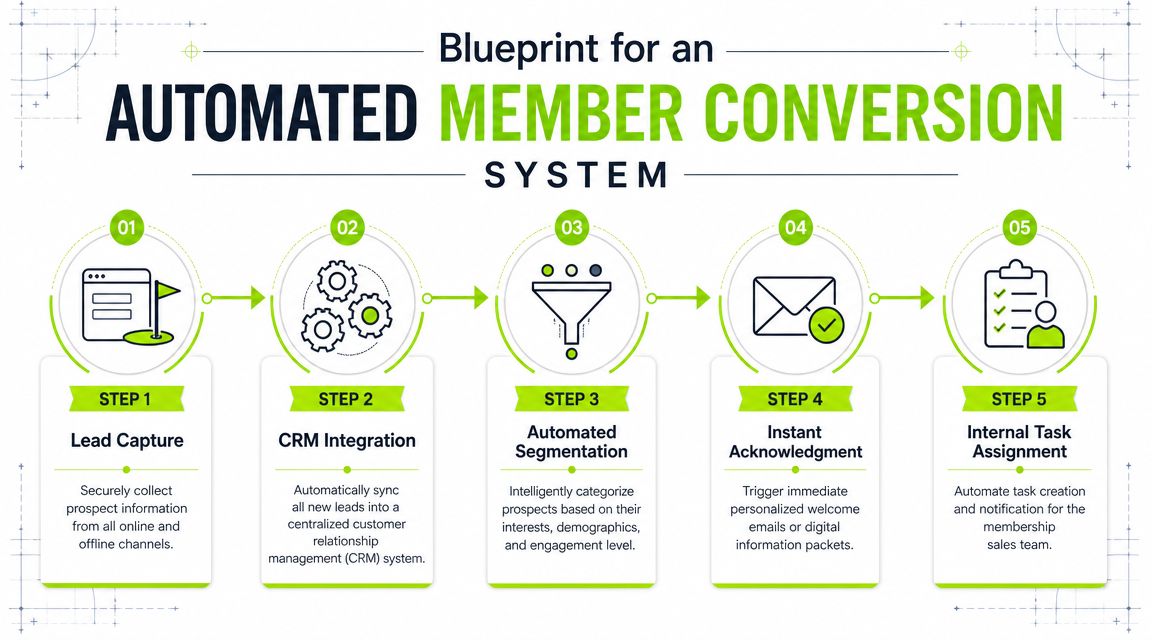
The five parts that matter
Most clubs don't need a complicated stack. They need the right basics connected properly.
Capture every enquiry cleanly
Your website forms, landing pages, event sign-ups, and ad forms should all collect useful information in a consistent format. Name, email, phone, membership interest, preferred contact, and key intent signals are usually enough to start.Push everything into one CRM
If some leads live in email, some in spreadsheets, and some in a committee member's notebook, follow-up will always be patchy. A central CRM gives one view of every prospect and their current stage.Segment automatically
Not every prospect should get the same message. A family lead should not receive the same nurture path as a handicap golfer focused on competitions.Respond immediately
The first response should acknowledge the enquiry, reflect the prospect's interest, and set the next step. It doesn't need to be long. It does need to be instant.Assign ownership internally
Someone in the club must own the next human step. Automation should support staff, not replace responsibility.
What the workflow should actually do
An effective automated sequence is operational, not decorative.
A new lead should trigger:
- An acknowledgement email with the right membership context
- A CRM record with source and segment attached
- A task for the membership contact to call or email personally
- A short nurture sequence that shares relevant club information
- A visible status update so the club knows whether a visit is booked, pending, or lost
At this point, clubs often realise the problem wasn't lack of effort. It was lack of process. Staff were trying to do the right things manually in between everything else.
Common failures behind the scenes
Capstone also points to a less obvious issue. Many operators under-invest in the data structure and creative assets needed to make follow-up effective. In plain terms, that means poor forms, weak email content, outdated photography, and no content calendar.
That matters because automation magnifies whatever you feed into it.
Operational check: Don't automate confusion. Fix the form fields, lead stages, email content, and ownership rules first.
A simple stack might include your website, a CRM, email automation, calendar booking, and a dashboard for lead stages. Some clubs build this with general tools. Others use a golf-specific partner. GolfRep, for example, combines lead generation with CRM setup, automated follow-up, and pipeline tracking for clubs that want those elements connected instead of managed separately.
The important point isn't the vendor. It's the architecture. Every enquiry should be visible, segmented, acknowledged, and progressed without relying on memory.
The Nurture Framework That Turns Enquiries into Members
A prospect rarely joins because of one email. They join because the club keeps momentum, answers the right questions, and makes the next step easy.
Most clubs lose that momentum in the quiet period after the first enquiry. They reply once, attach a brochure, and wait. From the prospect's side, that often feels like indifference.
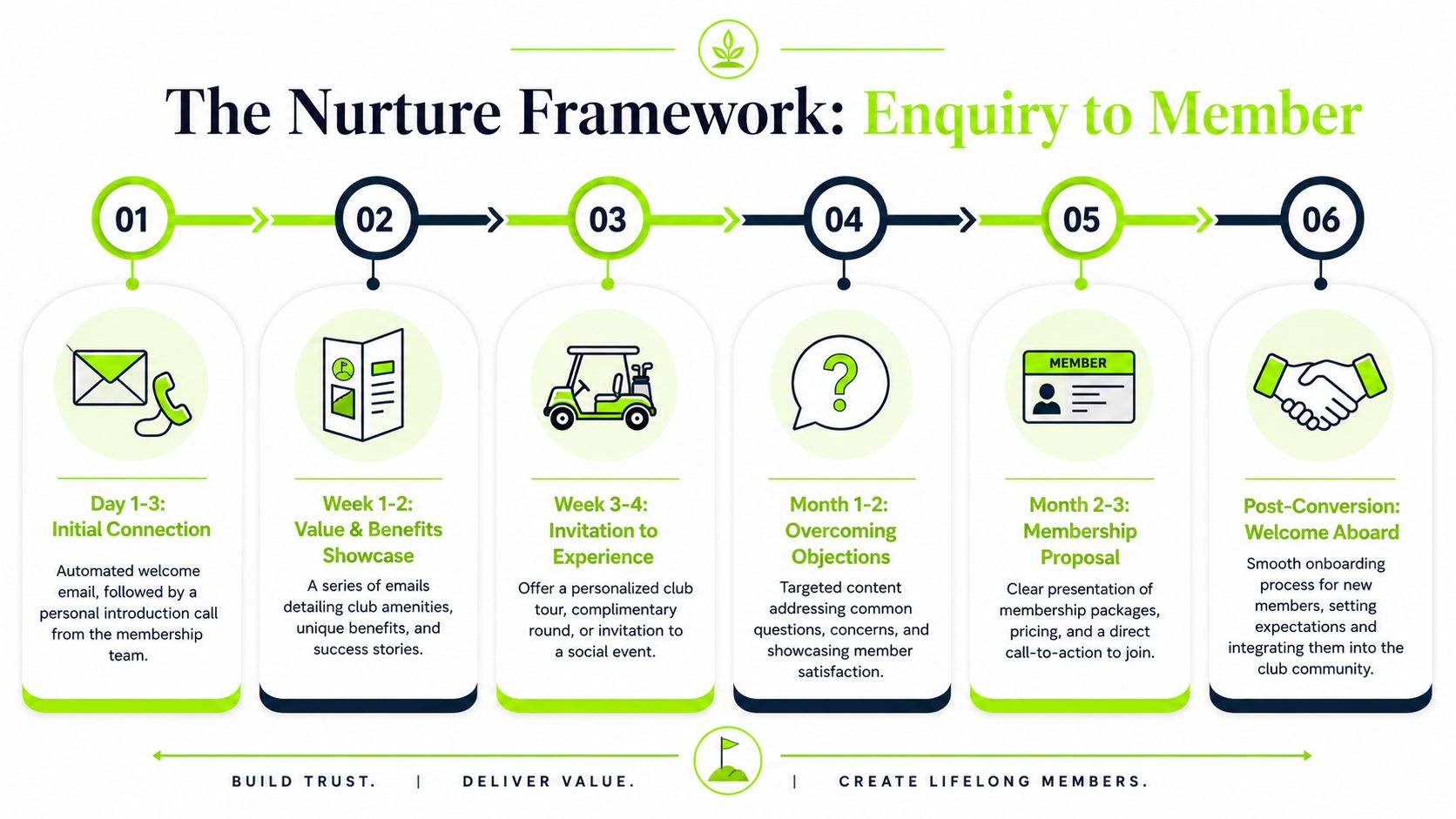
A practical sequence that keeps movement
A good nurture flow doesn't need to be long. It needs to be relevant and timely.
Here is a practical example of how a private club can handle a new membership enquiry.
Day 0
The prospect submits a form asking about membership. They receive an immediate email confirming the club has received the enquiry, naming the appropriate contact, and outlining what happens next. If the club offers multiple pathways, the message reflects the relevant one.
Day 1
A personal follow-up is sent or called through by the membership contact. Not a generic “just checking in”, but a useful note. It might invite the prospect to a visit, suggest a short call, or ask one simple qualifying question about what they are looking for.
Day 3
The club sends a value email. This should not just repeat pricing. It should explain what membership feels like. Course access, competitions, social life, family fit, practice facilities, or member culture, depending on segment.
The strongest nurture messages don't sell harder. They reduce uncertainty.
What the middle of the sequence should do
After the first few days, the club should help the prospect picture themselves inside the membership.
That usually means content such as:
- Member stories: Why people joined and what they value
- Club experience: Course, clubhouse, events, coaching, practice, community
- Common questions: Joining process, categories, expectations, introduction routes
- Invitation to experience: Tour, coffee meeting, open event, hosted round if appropriate
Many clubs get too formal. They write like a committee minute instead of a club people want to join. The language should be clear, warm, and confident.
Example message angles that work better
Instead of broad statements like “we offer an exceptional golf experience”, use specific lines of thought:
- For a golfer-focused prospect: “If regular competition golf and dependable tee access matter to you, we can show you how members use the calendar across the week.”
- For a family segment: “Many families use the club as part of their weekly routine, not just for golf. A visit gives you a better feel for that than a brochure ever will.”
- For a younger professional: “If you're weighing flexibility and community, a short visit is the easiest way to see whether the club fits your working week and social life.”
By this point, the CRM should show engagement. Who opened emails. Who clicked. Who replied. Who booked.
The final move is not the proposal
Clubs often think the close happens when pricing is presented. Usually, the actual close happens earlier, when the prospect agrees to visit.
That is the main objective of nurture. Move the enquiry from curiosity to a real-world experience of the club.
Once that visit is booked, the system should continue. Confirmation, reminder, internal preparation, then post-visit follow-up while the experience is still fresh. The handover from marketing to membership sales should feel smooth because, to the prospect, it is one process.
Measuring and Optimising Your Growth Pipeline
If a club only measures clicks, impressions, and enquiry totals, it will keep making the wrong decisions. Those numbers can be useful, but they don't tell you whether your membership system is healthy.
The key question is simpler. Which enquiries become visits, and which visits become members?
The numbers that matter operationally
Most private clubs need a short set of pipeline measures they can review consistently.
That usually includes:
- Enquiry to visit rate: Are prospects taking the next real step?
- Visit to membership rate: Are visits converting, or is the club experience failing to close?
- Response speed: How quickly does the club acknowledge and handle new interest?
- Lead source quality: Which channels produce serious prospects rather than casual form fills?
- Cost to acquire a member: Are paid channels justified by actual sign-ups?
- Member value over time: Does the club attract people who stay and participate?
A helpful general guide to this wider discipline is Polaris Marketing Solutions on marketing ROI. The principles transfer well to golf clubs because they shift the conversation away from surface-level marketing activity and towards revenue and retention outcomes.
How to use the data without overcomplicating it
You don't need a board pack full of charts. You need enough visibility to spot where leads are stalling.
For example:
| Pipeline stage | What to ask |
|---|---|
| New enquiry | Did we respond quickly and clearly? |
| Qualified lead | Do we know what type of member this person could be? |
| Visit booked | Which source produced this prospect? |
| Visit completed | Did the club follow up while interest was high? |
| Membership won or lost | Why did they decide either way? |
A pipeline becomes manageable the moment the club can see where movement stops.
That visibility changes decision-making. If paid social produces plenty of enquiries but few visits, the issue may be message quality or targeting. If visits happen but sign-ups stall, the problem may sit in membership presentation, follow-up, or proposition clarity.
The point of measurement isn't reporting for its own sake. It's to improve the system week by week, with less guesswork and fewer dropped opportunities.
GolfRep helps golf clubs build that kind of pipeline. Not just more enquiries, but the CRM, automation, follow-up, and tracking that turn interest into booked visits and new members. If your club wants a clearer, more predictable approach to growth, you can learn more at GolfRep.
Ready to tap into our proven growth system?