Growing Golf Club Visitor Revenue: A Practical Playbook

UK golf clubs generated an average of £189,240 in green fees in 2025, a 17% year-on-year increase, while 67% of casual green fees were booked online. Online bookings represented about 34% of total green-fee revenue, according to the Hillier Hopkins Golf Clubs Survey Report 2025-26. Those figures point to a commercial reality that many clubs still avoid: visitor revenue is a tee-sheet yield problem before it's a marketing problem.
A Tuesday slot that sits empty between late morning and early afternoon isn't just a missed advertising opportunity. It's perishable inventory. Once that tee time passes, the club can't sell it again, regardless of how many followers, website visitors or enquiries it has accumulated.
GolfRep's view is straightforward. Visitor revenue is decided by price, placement and follow-up before a single advert is purchased. The clubs that perform consistently match each acquisition channel to a specific tee slot, rate and next action. They don't treat every round as equally valuable, and they don't judge every booking channel by headline volume.
Why Visitor Revenue Has Become a Yield Problem
The first mistake is using total visitor income as the main measure of performance. It tells the committee whether money came in, but not whether the club used its available tee sheet intelligently. A course can increase visitor income while losing access, protecting member periods and reducing the number of visitor rounds, provided the remaining inventory carries a stronger yield.
UK coverage illustrates that tension. In a sample of leading clubs, 23 of the Top 25 allowed winter visitor play in 2019, but only 7 did so in 2024, and some clubs were planning to remove Friday visitor play in 2026. At the same time, visitor fees at 26 clubs rose 11.8%, while member subscriptions increased 4.8%, as reported in UK Golf Guy's analysis of 2025 summer green fees. Restricted access doesn't automatically mean declining revenue. It means the club has to manage scarce inventory more carefully.
That changes the boardroom question. Don't ask, “How do we attract more visitors?” Ask, “Which visitor rounds should we accept, at what price, in which slots, and what will we do to make those golfers return?”
Commercial rule: An empty tee time is lost inventory. A poorly priced occupied tee time can also be lost value.
A practical revenue view
The useful measure is revenue against available visitor inventory, not revenue in isolation. Start by separating tee times into member-protected, visitor-eligible and commercially flexible periods. Then review occupancy and realised rate by day, time, booking lead time and group size.
The GolfRep guide to golf course revenue management provides a useful framework for treating occupancy, rate and available rounds as connected decisions rather than separate reports.
The verified industry data doesn't provide quartile benchmarks for visitor revenue, so don't manufacture a neat bottom, median and top-quartile table for a committee pack. Build the table from your own tee-sheet history instead:
| Metric | Lower-performing periods | Typical periods | Highest-performing periods |
|---|---|---|---|
| Visitor occupancy | Slots with repeated gaps | Slots that fill at standard rate | Slots that fill early or command a premium |
| Realised rate | Discounted or last-call bookings | Published base rate | Premium or demand-led rate |
| Net contribution | High commission or low ancillary spend | Standard contribution | Strong rate and attached spend |
| Repeat value | One-off visitor with no follow-up | Identified customer | Visitor returning or referring others |
The five questions a GM should answer
- Which weekday slots remain empty after the normal booking window?
- Which periods fill early enough to support a higher rate?
- Which channels produce full four-balls rather than isolated singles?
- Which visitors buy food, buggies, lessons or other services?
- Which first-time visitors return, and how quickly?
Those answers tell you where to invest. If Tuesday afternoons are empty, the problem may be placement or price. If Saturday mornings fill quickly, more advertising is wasteful. If visitors book once and disappear, the commercial constraint is retention rather than acquisition.
The Five Levers That Move Visitor Revenue
A club doesn't need a longer list of initiatives. It needs ownership for the five levers that determine yield from visitor rounds. Set a target for each, record the current position, and assign one person responsibility for explaining movement every week.

1. Tee-sheet allocation
Protect member periods first, then allocate visitor inventory to the times the club can sell profitably. Use 80% weekday utilisation and 95% weekend utilisation as management targets, not automatic promises. The owner should be the GM or secretary, the diagnostic question is “Which available periods are being held back without a member or operational reason?”, and the proof metric is occupancy by daypart.
A slot below target needs a decision. Release more inventory, change the rate, add a partner channel or protect it for another commercial use.
2. Dynamic green-fee pricing
Create a published floor and ceiling, then vary the rate by demand, day, time and booking lead. A sensible target is a 12% uplift in revenue per available slot, measured against the club's own baseline. The owner is the commercial manager or PGA professional, the 30-day question is “Are we charging the same for materially different demand?”, and the proof metric is realised revenue per available visitor slot.
3. Online booking conversion
The booking journey should move a golfer from search to payment without a phone call or staff intervention. The plan target is to improve checkout completion from the 22% industry baseline to 35%, but the club must first measure its own funnel and confirm that the baseline applies to its platform and traffic mix. The owner is whoever controls the website and booking system, and the diagnostic question is “Where do golfers abandon the journey?” The proof metric is completed bookings divided by eligible booking sessions.
4. Ancillary spend
Green fees are only the first transaction. Track buggy hire, club hire, food and drink, coaching and other relevant purchases against visitor IDs. Set a working target of £28 ancillary spend per visitor round, then test whether the club can achieve it without forcing unwanted offers. The owner is the clubhouse or commercial manager, the question is “What can a visitor buy before, during and after the round?”, and the proof metric is ancillary revenue per visitor.
5. Repeat visitation
A first booking becomes commercially useful when the club captures permission to communicate, records preferences and offers a relevant next visit. Set a target of 30% of first-time visitors returning within 90 days through CRM activity. The owner is the visitor-revenue lead, the diagnostic question is “What happens after the confirmation email?”, and the proof metric is the 90-day return rate.
Score each lever red, amber or green. Don't approve a new acquisition campaign while the weakest lever is still leaking value. A club with strong occupancy but poor rate needs pricing work. One with good online conversion but weak repeat visitation needs segmentation and retention, not more traffic.
Acquisition Channels Matched to Tee Inventory
Every acquisition channel has a job. The mistake is asking one channel to fill every type of tee time.
For soft weekday and twilight inventory, OTAs and Meta advertising can be useful when occupancy is below 65%. Their role is to create incremental demand where the slot is likely to expire unsold. Google Business Profile and organic content suit premium weekend inventory because they can capture high-intent golfers without paying a commission on every booking.
Corporate outbound is different. It protects shoulder periods from Tuesday to Thursday by selling blocks of eight or more players. Local hotel partnerships and society relationships can give dormant Mondays a reason to exist commercially, particularly when the offer includes food, transport or a structured package.
The right comparison is net contribution per completed round:
Cost per booked round = media or platform cost + commission + voucher redemption cost + no-show provision, divided by completed rounds.
Don't compare channels on clicks or gross bookings. A channel that delivers a large number of discounted rounds may be weaker than a smaller channel that fills profitable weekday inventory with fewer cancellations.
| Channel | Cost per booked round | Best-fit inventory | Rule of thumb |
|---|---|---|---|
| OTAs | Commission-led | Soft weekdays and twilight | Use when incremental demand is more valuable than direct margin |
| Google Business Profile | Low direct acquisition cost | High-intent weekday and weekend searches | Keep availability and rates accurate |
| Meta advertising | Media cost plus creative and management | Soft weekday or twilight slots | Pause when it starts taking credit for demand that would've arrived anyway |
| Organic content | Time and production cost | Premium and evergreen tee times | Build a durable source of direct bookings |
| Corporate outbound | Staff time and sales cost | Tuesday to Thursday blocks | Sell a clear package, deposit and rebooking path |
| Local partnerships | Commercial or referral cost | Mondays and other dormant periods | Measure net contribution, not partner reach |
Use GolfRep's tee-time marketing guidance when mapping channels to specific capacity gaps. The principle is simple: don't buy demand for a slot that already sells itself.
Pricing and Yield for Weekday and Weekend Slots
A useful rate card has four layers: weekday, weekend prime time, twilight and last call. The published structure should be simple enough for members and visitors to understand, while the booking system applies the more detailed rules behind it.
| Slot Type | Mon-Thu | Fri | Sat-Sun Prime | Sat-Sun Twilight | Last Call (24h) |
|---|---|---|---|---|---|
| Standard rate | Base weekday rate | Weekday premium | Highest published rate | Reduced twilight rate | Tactical fill rate |
| Member protection | Block or price out protected periods | Review separately | Protect member priorities | Usually more flexible | Release only when appropriate |
| Promotional use | Midweek packages | Selective | Rarely discount | More suitable | Cap volume and monitor |
The rate card should be reviewed on a 14-day cadence, with daily checks for fast-moving periods. Use a rolling seven-day occupancy view to decide whether a rate changes. Gut feel is not a pricing system.
A calculation a manager can defend
Take a tee slot with an allocated cost of £40, a target occupancy of 80%, and a desired contribution margin of 50%. The required realised rate is calculated as:
Required rate = cost per slot ÷ (1 minus target margin).
That produces a £80 rate before considering occupancy. If only 80% of comparable slots are expected to sell, the club must decide whether its rate card should recover the cost from occupied rounds, increase occupancy, reduce the cost base or accept a lower margin for that period. The calculation doesn't tell you the answer. It makes the trade-off visible.
Member guest rules and complimentary rounds need the same discipline. Record them separately, define who can authorise them and restrict complimentary use to a commercial or relationship purpose. Promotional slots should sit in weaker inventory, not replace full-rate weekend demand.
Pricing discipline: A rate change is justified by the next seven days of occupancy, booking velocity and member protection. It isn't justified because a competitor changed its website.
Converting More Online Bookings
The booking journey has five stages: discover, land, browse availability, choose a slot and pay. A club should inspect each stage separately because a healthy traffic figure can hide a weak booking experience.
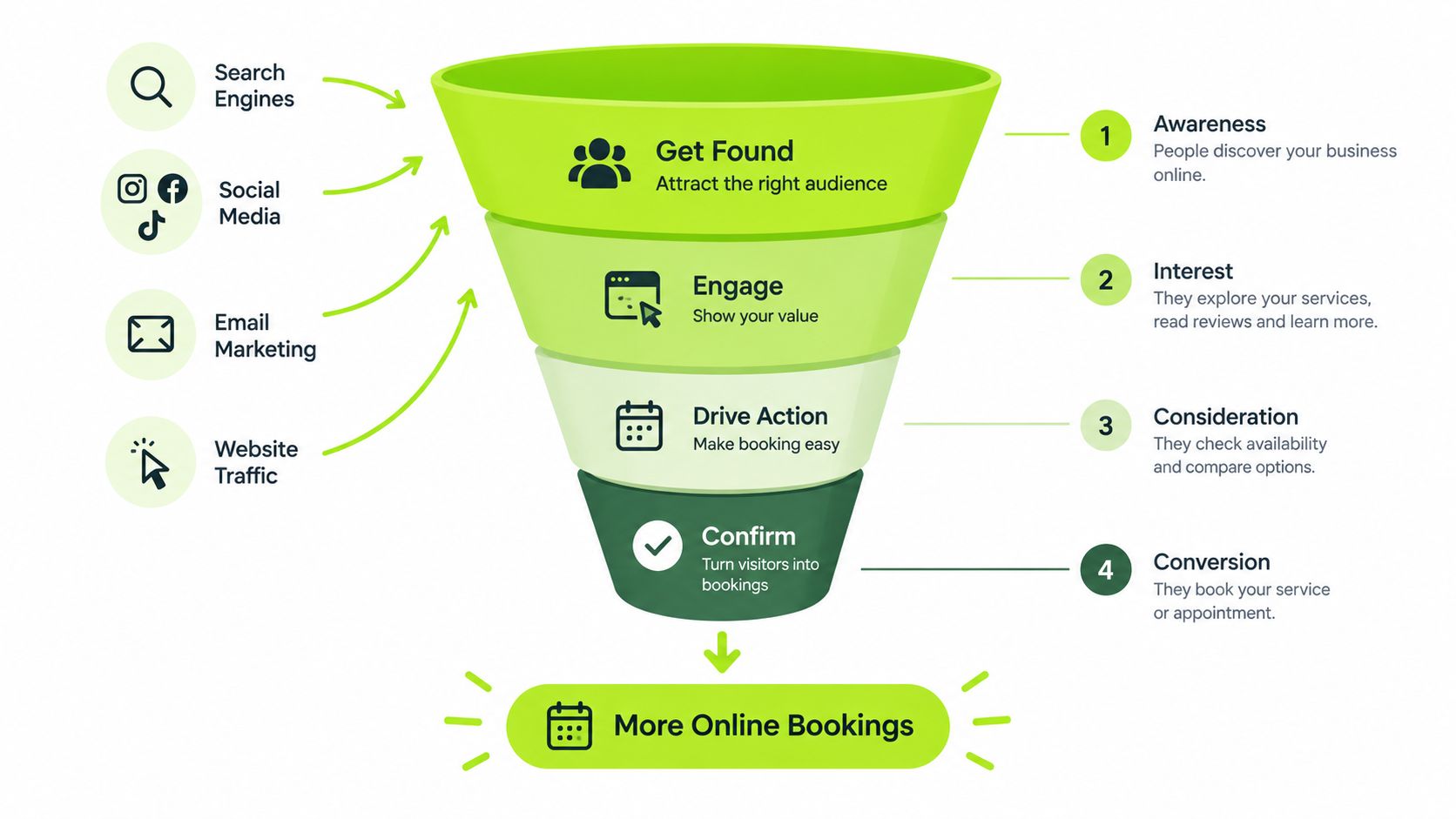
Remove the obvious leaks
- Discover: A golfer finds an outdated Google listing or a page with no clear visitor route. Fix the profile, link directly to booking and show current visitor information.
- Land: The mobile page loads slowly or hides the price. Put the rate, course proposition, location and booking button near the top.
- Browse availability: The golfer can't see real-time tee times. Use one primary booking platform and show availability without requiring a phone call.
- Choose a slot: The golfer sees confusing restrictions or unexpected terms. Explain member protection, group size, cancellation rules and what the rate includes.
- Pay: Hidden fees, a failed payment or a vague confirmation breaks trust. Display the full cost before payment and send a confirmation with arrival time, parking, dress guidance and contact details.
A simple calculation helps the committee understand the value of small improvements. If 1,000 monthly visitors currently produce a 2% conversion rate, a two-percentage-point lift creates 20 additional rounds. The revenue value is 20 multiplied by the club's average green fee, so use the club's actual rate rather than inventing a headline figure.
Peak slots should normally require a deposit or full payment. The rule reduces no-shows and makes demand more reliable. After payment, offer a buggy, lunch, club hire or lesson enquiry based on the booking details. Keep the offer relevant and easy to accept.
The GolfRep guide to booking a visit online is useful for reviewing the route from initial interest to confirmed attendance. The target isn't a prettier page. It's more completed bookings from the inventory the club has chosen to sell.
Getting More From Each Visitor Once On Site
A visitor round doesn't end at the green fee. A fourball on a midweek rate can also create a buggy-hire purchase, drinks after the round and a lesson conversation that converts later. None of those outcomes should depend on luck or a staff member remembering to ask.
Build the ancillary stack around the visit
Pre-arrival offers work because the golfer has already committed. Present buggy hire, club hire and lunch during checkout or in the confirmation email. On site, make halfway-house and drinks purchases visible without disrupting play. After the round, offer a lesson voucher, loyalty sign-up or event enquiry route while the experience is still fresh.
Use targets as operating hypotheses, then replace them with club data. A starting point might include 35% buggy uptake and 60% food-and-beverage attachment, but those are management targets, not verified industry benchmarks. Track them through POS tags linked to the booking reference.
| Ancillary Category | Target Attachment Rate | Avg Spend per User | Revenue per Visitor |
|---|---|---|---|
| Buggy hire | 35% working target | Club-specific | Attachment rate × average spend |
| Food and drink | 60% working target | Club-specific | Attachment rate × average spend |
| Club hire | Set from local demand | Club-specific | Attachment rate × average spend |
| Lessons | Track enquiries and conversions | Club-specific | Conversion value per visitor |
| Loyalty or event sign-up | Track registrations | Club-specific | Future value, not immediate till value |
The table should feed one per-visitor view, not five disconnected departmental reports. If the clubhouse manager reports food revenue separately and the PGA professional reports lesson enquiries separately, the GM still can't see the value of the visitor relationship.
For clubs that want a more structured approach to guest records, restaurant guest CRM software offers a useful reference point for capturing preferences, visit history and follow-up tasks in a hospitality setting. The specific system matters less than the operating rule: every visitor should have a traceable commercial record, with consent handled properly and purchases attached where possible.
Operational test: If you can't explain the average total value of a visitor round, your green-fee report is incomplete.
KPIs, Reporting and a 90-Day Implementation Plan
A weekly report should fit on one page. The GM needs enough information to make a decision before the month closes, not a collection of figures that only explains last month's result.
Track these eight visitor-revenue KPIs:
- Visitor rounds booked, split by weekday, weekend, twilight and group size.
- Visitor revenue per available slot, the club's RevPAR equivalent.
- Midweek fill rate, with Tuesday to Thursday visible separately.
- Online conversion rate, from eligible booking sessions to completed payments.
- Average ancillary spend per visitor, combining relevant POS categories.
- Visitor return rate within 90 days, based on identified first-time visitors.
- Blended customer acquisition cost, including platform charges and campaign cost.
- Member-versus-visitor revenue mix, interpreted alongside member access and satisfaction.
Use traffic lights with decision rules
Green means the KPI is at or above the club's agreed target. Amber means it has weakened for two consecutive reporting periods or is close enough to require action. Red means the result is materially below target, the trend is worsening or the issue threatens member experience.
Don't use generic thresholds copied from another club. Set the baseline from your own data, then agree the trigger before the report is presented. For example, a red midweek fill rate should automatically prompt a review of price, availability, channel allocation and member-protected blocks. A red return rate should prompt a CRM and post-visit review, not another round of prospecting.
Sequence the work over 90 days
| Weeks | Focus | Key Actions | KPI to Move | Pivot Trigger |
|---|---|---|---|---|
| 1-2 | Baseline and pricing reset | Audit inventory, member protection, realised rate and booking flow | Revenue per available slot | No reliable slot-level data |
| 3-6 | Channel and checkout activation | Match channels to gaps, simplify booking, remove payment friction | Online conversion and midweek fill | Paid demand enters already-strong slots |
| 7-10 | Ancillary and CRM execution | Train staff, tag POS sales, launch post-visit sequences | Ancillary spend and return rate | Offers aren't attached to visitor records |
| 11-12 | Review and cadence | Reprice, review member feedback, confirm ownership and weekly reporting | Revenue mix and overall contribution | Revenue rises while access or satisfaction deteriorates |
During weeks one and two, don't launch new campaigns. Establish a trustworthy baseline and identify where the tee sheet is genuinely available. If the club can't distinguish member-protected time from visitor inventory, every later calculation will be unreliable.
Weeks three to six should focus on distribution and booking friction. Activate OTAs or Meta only where the club needs incremental demand. Direct high-intent traffic to a clean booking path, and make sure the confirmation process captures the information needed for future contact.
Weeks seven to ten are about value after booking. Train the pro shop and clubhouse team on relevant offers, connect POS categories to booking references and create a post-round follow-up sequence. The sequence might ask for feedback, present a suitable return offer and record a lesson or event enquiry.
By weeks eleven and twelve, the committee should see what changed, where it changed and what didn't work. Reprice slots using the rolling seven-day view, protect member periods that need protection and stop channels that produce low net contribution. Then lock in the weekly meeting, named owners and pivot rules.
GolfRep helps golf businesses connect visitor acquisition with booking, CRM follow-up, conversion tracking and revenue reporting across the visitor journey. To identify where your tee-sheet yield is being lost and build a practical improvement plan, visit GolfRep and start with a commercial review of your visitor revenue system.
Ready to tap into our proven growth system?