Golf Club Revenue Strategy: A Complete 2026 Playbook

A club can be busy on Saturday and still face a cash-flow problem by winter. Members may be renewing, visitor bookings may look healthy, and the bar may be active after competitions, yet no one can say precisely which channels are carrying the operation, which have room to grow, or where the next pound of revenue should come from.
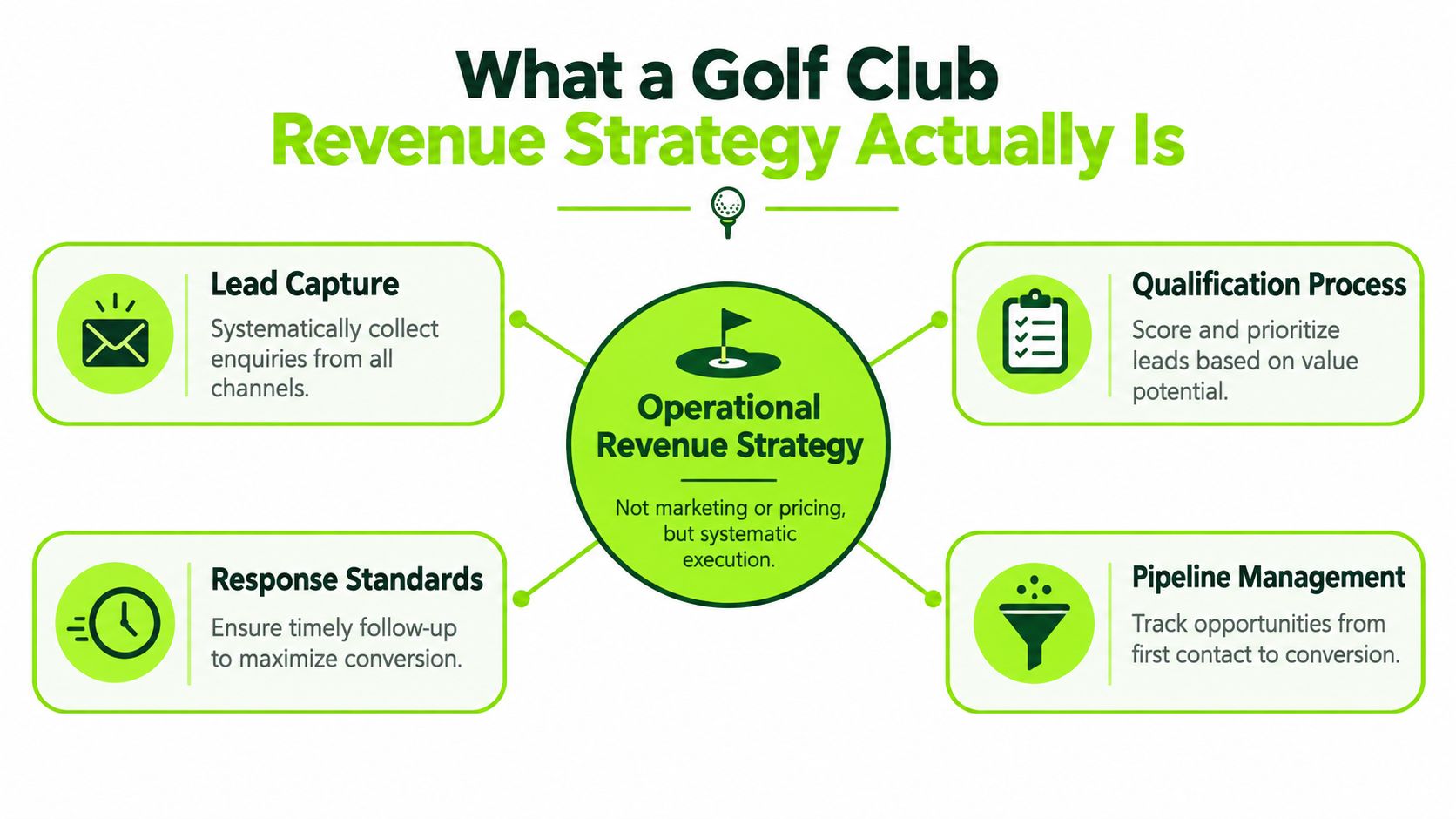
That's the practical question behind a golf club revenue strategy. It isn't a campaign calendar and it isn't a decision to discount green fees. It's an operating system for deciding how the club earns money, how much each stream should contribute, who owns the activity, and how performance is reviewed throughout the year.
What a Golf Club Revenue Strategy Actually Is
A golf club revenue strategy is a structured plan for turning the club's available assets, relationships and capacity into reliable income. It identifies every controllable revenue source, sets a contribution target for each, and connects those targets to actions such as renewal conversations, tee-sheet pricing, society rebooking, event sales, coaching utilisation and food and beverage offers.
That definition matters because marketing is only one part of the system. Lowering prices can increase activity while reducing yield. Generating more enquiries can create workload without creating bookings. A revenue strategy asks a harder question: what combination of customers, products, prices and processes produces healthy income for this particular club?
Build the system around four decisions
Start by mapping the club's commercial engine.
- Inventory: What can the club sell? This includes memberships, tee times, society packages, function space, coaching, simulator bays and hospitality.
- Demand: Which audiences can buy each product, and when are they most likely to do so?
- Conversion: What must happen between interest and payment? A visitor needs a clear booking route. A prospective member may need a visit, playing opportunity or joining conversation.
- Retention: How does the club encourage renewal, repeat play, repeat society bookings and ongoing clubhouse spend?
The system should also distinguish between recurring and seasonal income. Subscriptions provide useful visibility, but they're not automatically sufficient to fund the operation. The GCMA's guidance on golf club revenue notes that subscriptions may provide only around half of the revenue a golf club needs to keep running each year. That makes visitor play, societies, catering and events commercial necessities, not optional extras.
Practical rule: Every revenue stream needs an owner, a target, a process and a weekly measure.
A good strategy excludes vague activity targets such as “do more social media” or “increase awareness”. It replaces them with operational commitments, for example, filling selected off-peak tee times, rebooking society organisers before they leave, or moving suitable visitors into a membership pathway.
The Main Revenue Streams in a Typical UK Members Club
A wet Tuesday exposes a club's revenue structure quickly. Member subscriptions may keep the accounts steady, while unused visitor tee times, empty function space and a quiet bar leave capacity producing nothing. Each income stream has its own demand pattern, cost base and conversion process, so the commercial question is not how much the club sells. It is how profitably each available asset is used.
Start with the current mix before changing it. Reconcile management accounts, till reports, tee-sheet data and membership records. Separate revenue from contribution margin where possible. A busy society, event or coaching programme may look successful while consuming catering capacity, staff hours or playing time that could produce a better return elsewhere.
The Hillier Hopkins 2025/26 survey benchmarks median member income at 73% of revenue, with a middle-50% range of 57% to 85%, average green fees of £172,000, society revenue of £66,000 and total turnover of £1.5 million. These figures provide context, not a budget for every club.
Map the income streams
- Membership subscriptions and joining fees: The recurring base, with exposure to renewals, pricing decisions and concentration in particular membership categories.
- Green fees: Visitor income that depends on course quality, available tee times, pricing, online booking and the club's ability to turn a first round into another booking or a membership enquiry.
- Societies and group golf: Bookings that can combine golf, food, drinks, buggy hire and deposits. The organiser's experience determines whether the group returns.
- Functions and weddings: Space-led income shaped by staffing, kitchen output, lead times and the quality of enquiry handling.
- Food and beverage: Spend generated by members, visitors, societies and events. It often rises or falls with golf volume and the standard of service.
- Coaching and indoor golf: Activities that can introduce new customers, fill quieter periods and create income when outdoor capacity is restricted.
The GolfRep guide to how golf clubs make money offers a wider view of subscriptions, visitor play, societies, events, coaching and hospitality. Use that category map, then test each stream against the club's own constraints. A compact members' club, proprietary course and resort will not have the same space, staffing or demand.
Measure diversification by contribution
A membership-heavy club is not automatically secure. If renewals weaken, the gap in fixed-cost funding can be large. Visitor rounds, societies, catering and events provide protection only when the club has already built the routes to market, booking process and follow-up discipline.
Review every stream through five measures: revenue, direct cost, contribution margin, capacity used and forward bookings. Then calculate revenue per member and revenue per available tee time where the data supports it. That dashboard shows whether the club is growing income, filling spare capacity or merely shifting staff effort between departments. Each stream should have an owner, a target and a weekly commercial measure.
Diagnosing Your Club's Current Revenue Position
Before changing prices or launching a membership offer, establish where the club is commercially strong and where it is leaking value. A useful diagnosis combines three years of channel income with the operational facts behind it, including capacity, staffing, seasonality and customer behaviour.
Start with a clean revenue file. Pull monthly figures for subscriptions, joining fees, green fees, societies, functions, food and beverage, coaching and any indoor activity. Then add member numbers, renewals, visitor rounds, society bookings, event enquiries and available capacity for the relevant area.
Use a five-part diagnostic
- Revenue per member: Divide member-related income by the relevant membership base, then separate subscription income from additional spend where the data allows.
- Seasonality: Mark peak and trough months for each stream. A weak month may reflect normal golf conditions, while a weak period against the same period last year needs investigation.
- Channel direction: Classify each stream as growing, flat or declining, then record the operational reason rather than relying on the label.
- Capacity pressure: Identify whether the constraint is tee-time availability, catering space, staff time, kitchen output or sales attention.
- Customer movement: Track joiners, leavers, waiting-list movement, visitor repeat bookings and society rebookings.
Hillier Hopkins' earlier members' and proprietary clubs report found that the proportion of clubs reporting more leavers than joiners improved to 24% in 2023 and improved again in 2024. Average joiners stood at 53, compared with 51 in 2023, while 59% of clubs kept waiting-list members informed and an average of 21 members per club moved from the waiting list into membership at renewal (Hillier Hopkins 2024/25 report).
Find the binding constraint
Score each area from weak to strong against demand, conversion, capacity and margin. The lowest combined area is the likely first constraint.
If renewals are uncertain and member usage is falling, retention deserves attention before acquisition. If the tee sheet has valuable empty periods, visitor yield may be the priority. If societies arrive once but don't rebook, organiser management is the constraint. If the clubhouse has available space and a weak events pipeline, event fill rates may offer the clearest route.
The GolfRep revenue structure guide is useful when turning that diagnosis into a channel map. Don't copy an industry average. Use it to ask whether your club's concentration and capacity profile are deliberate or accidental.
Setting Revenue Targets and Choosing the Priority Stream
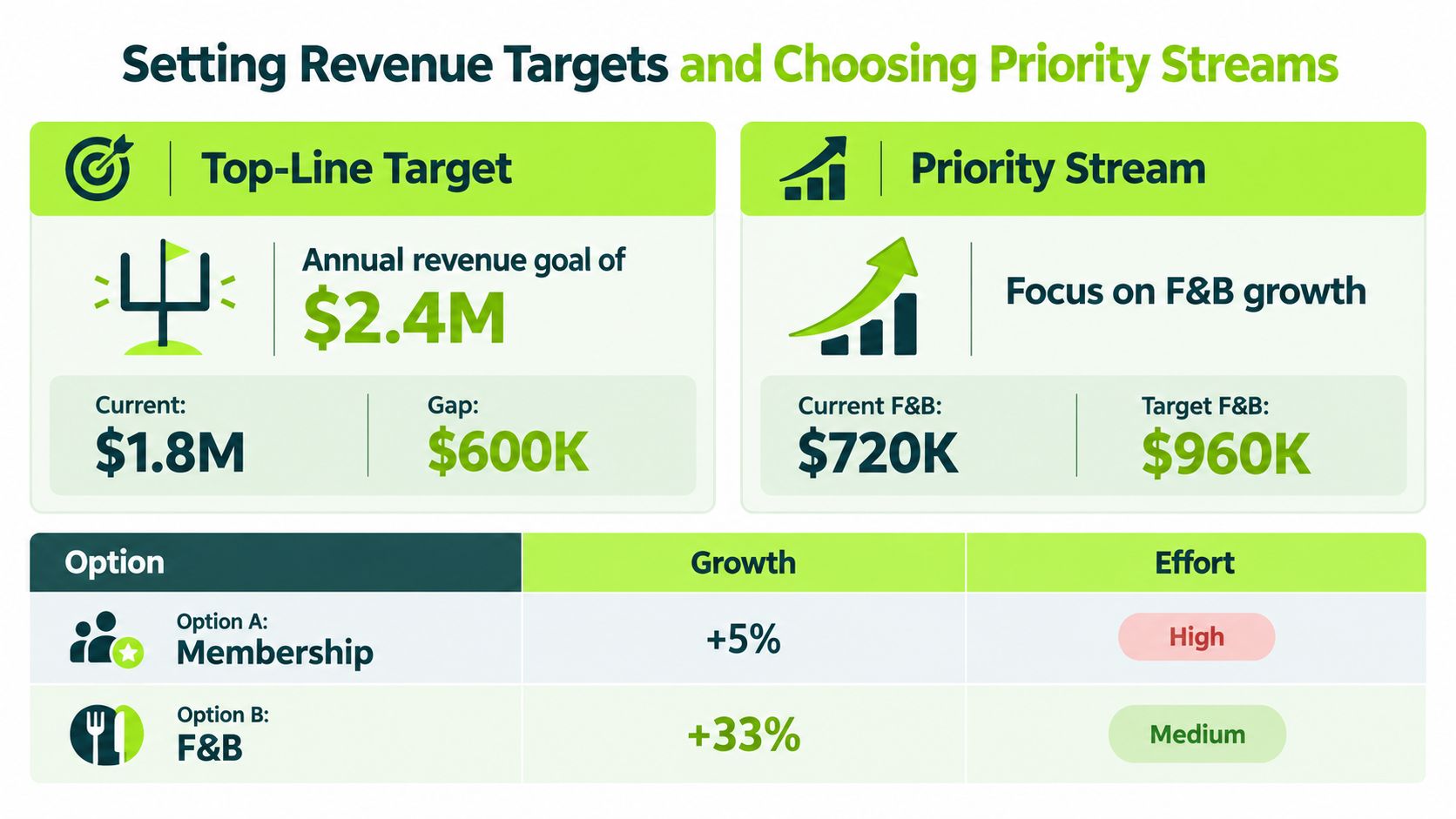
A top-line target only becomes useful when the club can explain where the money will come from. Begin with the turnover objective approved in the budget, then allocate contributions across membership, visitors, societies, events, catering and other relevant streams. The allocation must reflect what the club can physically deliver.
A target based on unused tee times is different from one based on additional members. Tee-sheet revenue depends on available slots, booking behaviour, weather and price bands. Membership growth depends on proposition, capacity, onboarding and retention. Events depend on room availability, kitchen capability and lead time.
Compare the two common strategic choices
Membership growth should lead when the club has room for more members, an attractive proposition, sound onboarding and evidence that current members renew. It creates recurring income and can support secondary spend, but it also adds service expectations and may increase pressure on tee times and competitions.
Non-dues revenue should lead when membership is near capacity, visitor demand is present, the tee sheet has underused periods, or the clubhouse can support more profitable events and catering. This route can improve cash flow without changing the core membership proposition, but it requires sharper pricing and operational coordination.
A club shouldn't pursue both with equal force because both sound positive. Choose one primary objective and make the other streams supporting measures.
Apply an impact and effort test
For each proposed initiative, score:
- Commercial impact: How much income could the activity reasonably contribute within the available capacity?
- Speed to revenue: How quickly can the club move from decision to paid booking or renewal?
- Operational effort: Which teams, systems and suppliers must change?
- Strategic fit: Does the activity strengthen the club's customer base or create avoidable pressure?
- Margin quality: What remains after staffing, catering, discounts and delivery costs?
A visitor yield project may have high impact and moderate effort where the tee sheet already receives demand. A full membership restructure may have significant long-term value but require committee approval, communications and careful capacity management. The right priority is the one that addresses the current constraint, not the one with the most attractive headline.
Designing Membership and Non-Dues Revenue Initiatives
Revenue initiatives work when they connect a defined customer need to a product, price and next action. “Increase membership” isn't an initiative. A suitable initiative might be a structured visitor-to-member pathway, with a clear point at which a repeat visitor receives a relevant membership conversation, course visit or category recommendation.
Build the membership route around fit
Start with the club's profitable member types and the capacity they use. A flexible category may suit a golfer with limited weekday availability. A trial pathway may help someone who hasn't yet experienced the club environment. A waiting-list process should keep suitable prospects informed and make the next available membership step clear.
The commercial test is simple. For every pathway, record:
- the source of the prospect;
- the membership category considered;
- the visit or playing experience completed;
- the joining decision;
- the recurring value and expected retention;
- the reason for non-conversion.
That prevents the club from treating every enquiry as interchangeable.
Price the tee sheet, don't just fill it
The PGA's UK-referenced guidance reports average annual green-fee revenue of £163,952, with 65% sold online. The same guidance later states that UK golf clubs generated average green-fee revenue of £190,000 in 2025, a 17% year-on-year increase, with 67% of casual green fees booked online (PGA guidance on dynamic pricing and tee-sheet optimisation).
That points to four practical actions:
- Optimise the tee sheet first. Identify which periods are genuinely constrained and which are repeatedly underused.
- Make digital booking the default. Phone and walk-up bookings shouldn't remain the only route for casual demand when online booking is already the majority channel.
- Compare like-for-like periods. Monthly spikes can mislead in a seasonal sport, so review each month and the year against the equivalent prior period.
- Test time-band pricing. Protect peak value, while using carefully controlled offers for weaker periods rather than discounting everything.
GCMA reports that online revenue increases by an average of 77% when dynamic pricing is implemented, as reported within the PGA's referenced guidance. Treat that as an industry benchmark, not a promise for an individual club. The test is whether the club's own revenue per available tee time improves without damaging member experience or future demand.
Package societies and events for total spend
A society offer should specify more than a green fee. Build options around arrival arrangements, competition administration, food, drinks, buggy hire, practice facilities and a clear deposit policy. Then capture the organiser's preferred month, group size and event type so the club can propose a suitable date before the next season's diary fills.
The same principle applies to weddings, corporate days and clubhouse functions. Price the whole occasion, protect margin and give the customer a reason to book again. Discounting the room while ignoring catering labour and service requirements usually creates activity without enough contribution.
Building Lead Generation, CRM and Sales Operations
A revenue plan becomes real when every opportunity has a source, an owner, a next action and a commercial outcome. That applies to a membership enquiry, a visitor booking request, a society organiser, a corporate event and a lapsed member.
Use a simple pipeline with stages that reflect how the club sells:
- New: enquiry captured with source and customer type.
- Qualified: budget, timing, playing needs or event requirements understood.
- Visit or proposal: the customer has a booked next step.
- Decision: joining, booking or rebooking is being considered.
- Won or lost: payment, membership or booking recorded with a reason.

Make ownership visible
Committee-led clubs often lack a dedicated sales department. That doesn't remove the need for ownership. The general manager may own commercial reporting, the secretary may manage membership administration, the PGA professional may handle playing visits, and the events manager may own functions. Each opportunity should still have one named person responsible for its next action.
Automated reminders can protect follow-up during holidays and busy competition periods. They shouldn't replace judgement. A prospect considering membership needs a relevant conversation, not a sequence of generic messages.
Clubs reviewing their acquisition mix can also learn from practical cross-channel lead gen strategies, particularly where paid activity, website forms, email and telephone handling need to work as one journey.
Keep the dashboard commercial
Report enquiries by channel, qualified opportunities, booked visits, proposals, won revenue, lost reasons and time to next action. Separate membership, visitors, societies and events so one healthy channel doesn't hide another channel's decline.
A club's approach to golf club CRM should support this visibility without forcing staff to maintain an elaborate system they won't use. GolfRep can provide demand generation, CRM visibility, automated nurture and revenue tracking as part of its work with golf businesses, but the same operating principles can be applied with a suitable CRM and disciplined ownership.
Measuring Progress and Optimising Revenue Performance
A revenue strategy needs a review rhythm that matches the way golf demand behaves. Weekly reporting should focus on leading indicators and immediate action. Monthly reporting should examine yield, margin and progress against the equivalent period in the previous year.
The core dashboard should include:
- Revenue per member, separated into subscription and additional spend where practical.
- Renewal rate, with undecided and at-risk members visible before the deadline.
- Visitor yield, including revenue per booked tee time and the share booked digitally.
- Society repeat bookings, not only first-time society revenue.
- Event fill rate, measured against available function capacity.
- Conversion by channel, from enquiry to visit, booking, joining or rebooking.
Year-on-year comparison matters because a strong month can reflect weather, fixtures or a local event rather than a durable improvement. Review the same period against the prior year, then add booking pace and forward demand to decide whether pricing, staffing or promotion should change.
The market context supports a conversion-led operating question. England recorded 11.83 million WHS scores in 2025, up 16% on 2024, while clubs in the UK and Ireland averaged 17% more green-fee income in 2025 than in 2024, with average green-fee income of £189,240 (The Golf Business report on the UK golf industry). The same reporting notes that 30% of surveyed golfers said their club had a waiting list, compared with 27% in 2024, and that overall membership growth rose by nearly 10 percentage points year on year.
Those figures don't tell a club whether to monetise its waiting list, convert visitors or upgrade existing categories. The dashboard must answer that. Golfshake found that 86% of respondents were club members in 2025, up from 84% in 2024, while 77% planned to renew, 4% said they wouldn't renew and 19% were undecided (Golfshake membership health survey).
A waiting list is not automatically revenue. It becomes revenue when the club manages communication, eligibility, timing, capacity and the joining route.
Set a weekly meeting around exceptions. Which tee periods are under yield target? Which societies haven't rebooked? Which prospective members have no next action? Which events are approaching without a firm proposal? Resolve those points, measure the result next month and then move to the next constraint.
GolfRep helps golf businesses structure acquisition, CRM, follow-up, conversion and retention across membership, visitor, society and event revenue. If you want to identify the main commercial constraint in your club and turn it into a measured operating plan, visit GolfRep.
Ready to tap into our proven growth system?