Golf Club Unpredictable Revenue: Predictable Growth in 2026
Most advice on golf club unpredictable revenue starts in the wrong place. It tells clubs to push harder on marketing, buy more clicks, run more offers, and fill the top of the funnel.
That sounds sensible, but it often misses the underlying issue.
Many clubs already have interest. They get membership enquiries, visitor bookings, society requests, event questions, and website traffic. Revenue still feels erratic because that interest isn't handled in a joined-up way. An enquiry sits in an inbox. A visitor starts a booking and drops out. An event lead comes in without budget detail, then nobody follows up properly. The issue isn't always demand. It's what happens after demand appears.
At GolfRep, that's the pattern we see most often. Clubs think they need more leads when what they actually need is a better system for converting the leads they already have into rounds, visits, memberships, and repeat spend.
The Real Reason Your Golf Club Revenue is Unpredictable
The popular advice says revenue swings happen because the club isn't generating enough interest. In practice, that's only part of the picture, and often not the decisive part.
GolfRep's analysis of club revenue generation points to a different cause. Revenue volatility is often driven by fragmented processes that stop clubs monetising existing demand, including slow response times to membership enquiries, abandonment in booking funnels, poor capture of event details, and weak follow-up because there isn't a proper CRM and automation system in place, as outlined in GolfRep's revenue generation analysis.
A lot of clubs recognise the symptoms immediately. The website is producing enquiries. The phone rings. Visitors ask about availability. Prospective members ask for prices or a tour. But nobody can clearly say:
- How fast staff reply to a serious membership enquiry
- How many booking attempts are abandoned before payment
- How many event leads are followed up more than once
- How many prospects move from first interest to visit, then to sign-up
When that visibility is missing, revenue feels random even when it isn't. It's leaking.
More leads won't fix a broken handover
If a club adds more advertising on top of weak lead handling, it usually just creates a larger admin problem. More enquiries land, but they still get processed inconsistently. One staff member replies quickly. Another waits until the next day. A third sends a generic email with no follow-up task attached.
Practical rule: If your club can't track who replied, when they replied, and what happened next, the problem isn't marketing volume. It's operational control.
This is why broad advice about "doing more marketing" often disappoints. It treats demand generation as the only lever. Clubs need demand, of course, but they also need a reliable process that turns interest into action.
That's also why so much club marketing underperforms, as discussed in why most golf club marketing fails. The handoff between enquiry and sale is where a lot of value disappears.
Unpredictability usually starts inside the process
Managers often describe golf club unpredictable revenue as a weather issue, a seasonality issue, or a market issue. Those things matter. But they don't explain why two clubs in similar conditions can get very different outcomes from similar demand.
The practical difference is usually operational discipline. One club has a clear process for enquiries, pricing, booking, follow-up, and upsell. The other relies on inboxes, memory, spreadsheets, and whoever happens to be free.
That second model creates volatility even in busy periods. You can have demand and still fail to convert it consistently.
The clubs that stabilise revenue don't just ask, "How do we get more interest?" They ask, "Where are we losing the interest we already have?"
Diagnosing Your Revenue Volatility
Before a club can stabilise revenue, it needs a clear picture of what is fixed, what is recurring, and what rises and falls with the month.
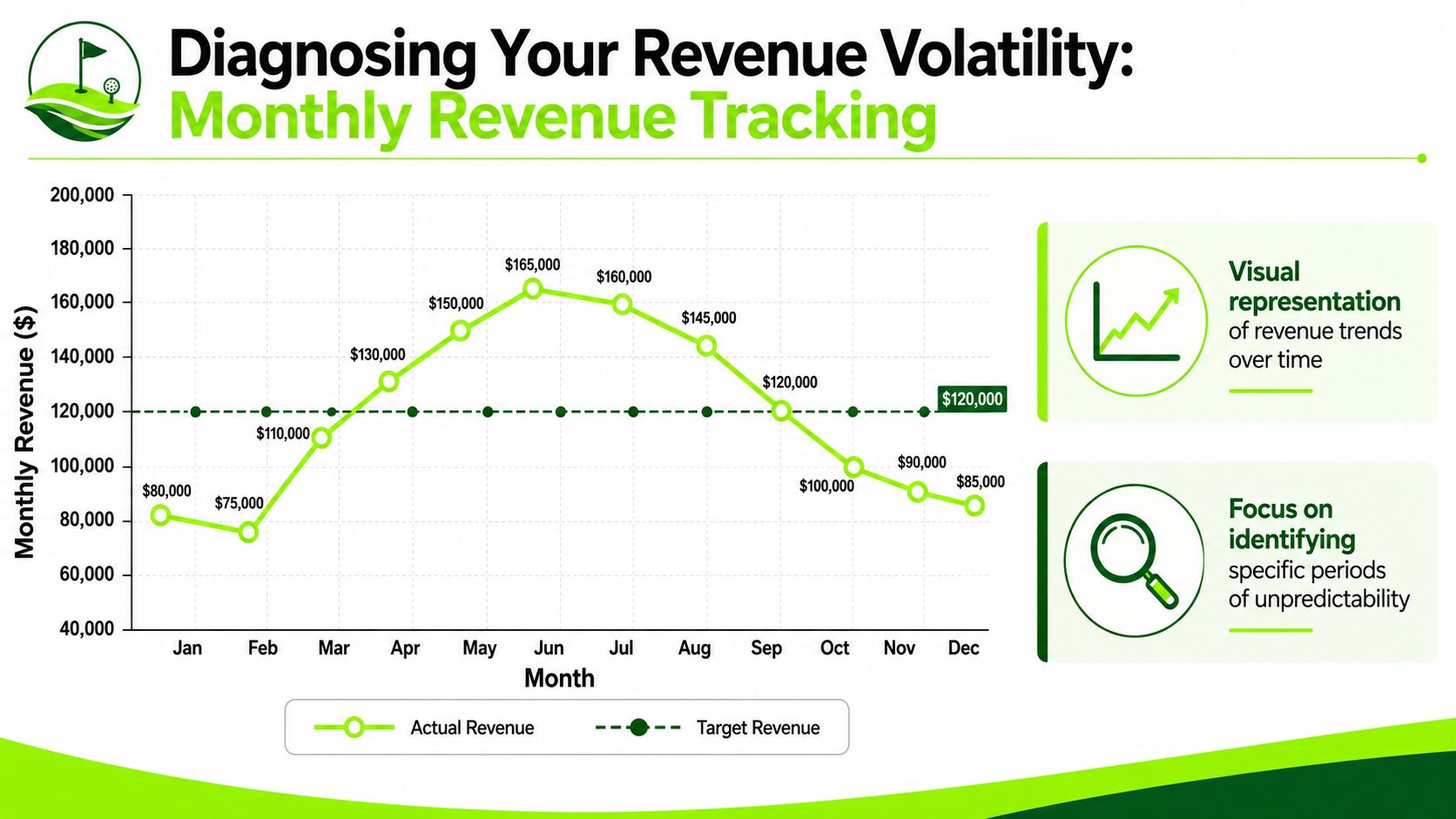
The first diagnostic question is simple. How much of total revenue comes from recurring income, and how much depends on variable activity? Industry guidance for private clubs says healthy clubs typically generate 50 to 60% of total revenue from dues, and when dues fall below 40%, the club becomes too reliant on variable income streams such as green fees and events, which makes monthly cash flow less predictable according to private club KPI guidance from Bobby Jones Links.
That doesn't mean every club should force the same model. It means you need to know your exposure. If your club depends heavily on visitor golf, societies, functions, and food and beverage spikes, then volatility isn't surprising. It's built into the model unless you manage it tightly.
Split revenue by behaviour, not just by department
Most management reports split revenue into neat accounting lines. That's useful for bookkeeping, but it doesn't always help with diagnosis. A better view is this:
| Revenue type | How it behaves | What usually affects it |
|---|---|---|
| Membership dues | More stable and recurring | Retention, renewals, joining pipeline |
| Visitor green fees | More variable | Weather, pricing, tee-sheet control, booking conversion |
| Events and societies | Lumpy and sales-led | Lead handling, follow-up, date availability |
| Food and beverage | Dependent on traffic and attach rate | Booking journey, onsite spend prompts, event packaging |
That exercise quickly shows where instability comes from. A club may think the issue is "marketing" when the underlying weakness is overdependence on one variable line without the systems to support it.
Audit the forecast, not just the past
Most clubs look backward. They compare this month to last month and try to explain the gap. That helps, but it doesn't create control.
A better habit is to maintain a rolling pipeline view. How many qualified membership enquiries are live? How many visits are booked? How many event conversations are active? How many unfilled tee times sit inside the next booking window? If your forecasting process is weak, a simple sales discipline framework like MakeAutomation's guide to sales forecasting can help shape how demand is tracked before it becomes revenue.
The aim isn't perfect prediction. It's earlier visibility, so you can act before a weak month shows up in the bank account.
Questions that reveal the real issue
Use this checklist with your management team:
- Recurring base: What proportion of club revenue is recurring?
- Variable exposure: Which lines drop fastest when weather, seasonality, or booking behaviour changes?
- Pipeline visibility: Can you see future membership, visitor, and event revenue before it lands?
- Conversion discipline: Do you know where prospects stall, or are you guessing?
Clubs often say revenue is unpredictable when what they really mean is that they don't have enough visibility into the process that creates it.
Securing Quick Wins for Immediate Stability
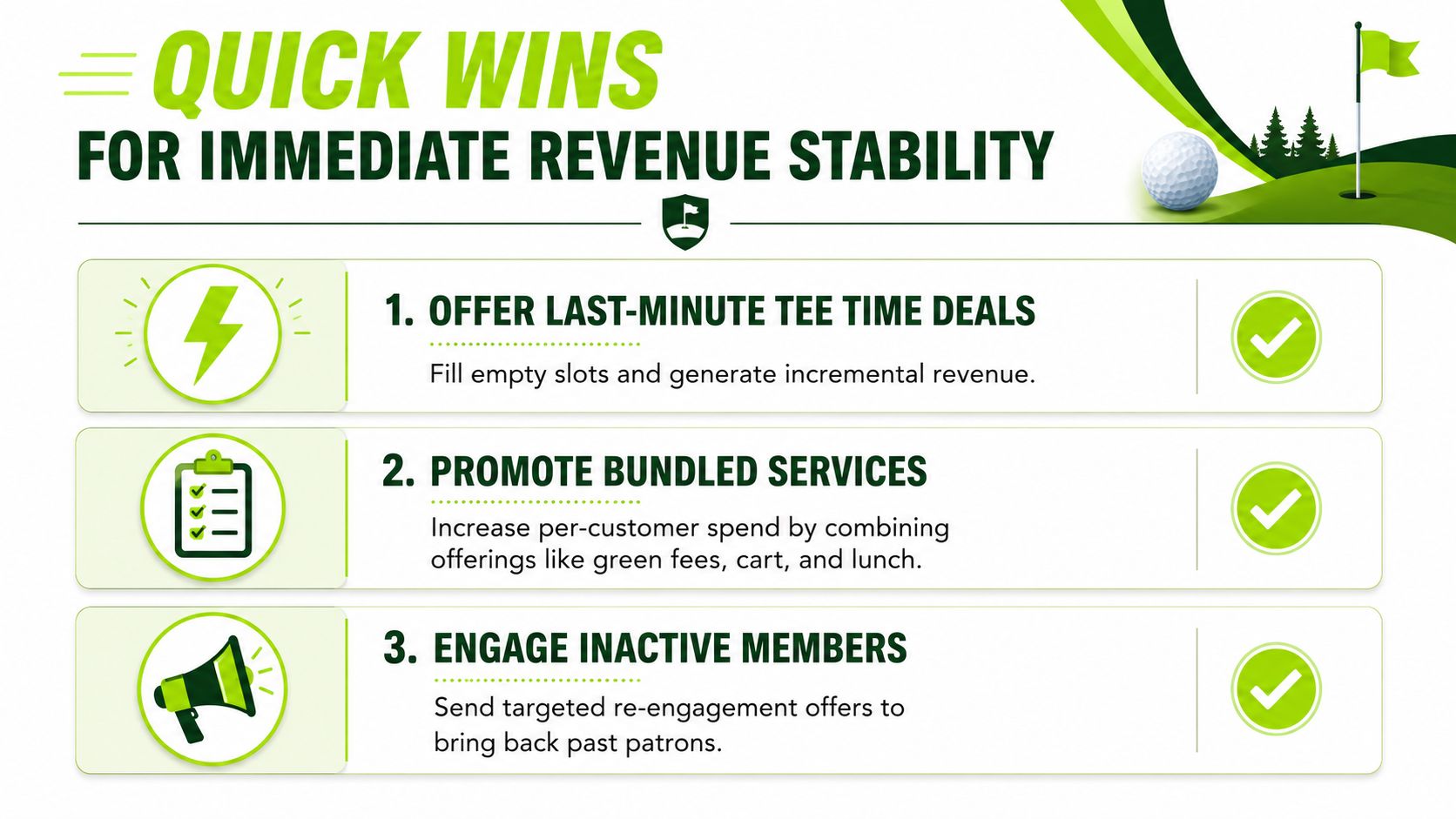
You don't need to rebuild the whole operation before you improve cash flow. A few practical changes can stop obvious leaks quickly.
One of the clearest examples comes from a UK case study. The Club Company reported 32% growth in green-fee sales in six months during a wet winter after implementing dynamic pricing and focused digital marketing, and the programme also lifted the average green fee by £4, showing the gain came from better yield management rather than volume alone in The Revenue Club's golf revenue management case study.
That matters because it shows two things. First, clubs can improve revenue even in difficult trading conditions. Second, quick wins usually come from tighter operations around pricing, demand capture, and follow-up, not from random promotions.
Start with the fastest leaks
The quickest gains usually come from three areas.
- Reply faster to membership enquiries: A delayed response doesn't just reduce your chance of conversion. It signals disorganisation. If an enquiry arrives and nobody owns it, the club loses momentum immediately.
- Review pricing on the tee sheet: Static pricing leaves money on the table in strong periods and fails to stimulate demand in softer periods. Basic demand-based adjustments are often more effective than blanket discounts.
- Package spend instead of selling in silos: Visitor golf, food, buggy hire, and event options should be presented together where relevant. If each category is handled as a separate transaction, the club misses straightforward revenue.
One-week actions that are actually realistic
Most clubs don't need a strategy document first. They need a short list that staff can execute this week.
Set an enquiry owner
Every membership and event lead should have a named person responsible for first response and follow-up.Check the booking journey
Go through your own visitor booking flow on mobile and desktop. Look for unclear pricing, extra steps, and dead ends.Identify underused tee times
Don't guess. Look at the live pattern and decide where demand-based pricing or better promotion is needed.Create one simple follow-up sequence
If a prospect asks about membership and doesn't book a visit, there should be a standard next step instead of silence.
A quick win isn't a gimmick. It's a change that removes friction from a live revenue path.
Don't confuse activity with progress
Many clubs respond to weak months by posting more on social media, sending a generic email, or running a discount. Sometimes that helps at the margin. It rarely fixes the core issue.
What's more useful is practical control over known points of leakage. If the club already gets attention, then the fastest route to stability is to convert more of that attention into booked rounds, club visits, and signed members.
For clubs looking at practical demand-generation ideas alongside operational fixes, these golf club marketing ideas are useful when they support a clearer conversion process rather than replace one.
Building Your Predictable Revenue Engine
A club doesn't create stable growth by chasing one revenue line at a time. It needs a joined-up system that moves people from interest to action in a consistent way.
Cornell research on golf course revenue management identifies tee-time control and demand-based pricing as two core strategic tools for protecting income from volatility, and the wider lesson is that clubs are managing a finite, time-based asset. A structured revenue engine gives the club a practical way to manage that asset more predictably, as outlined in Cornell's golf course revenue management research.
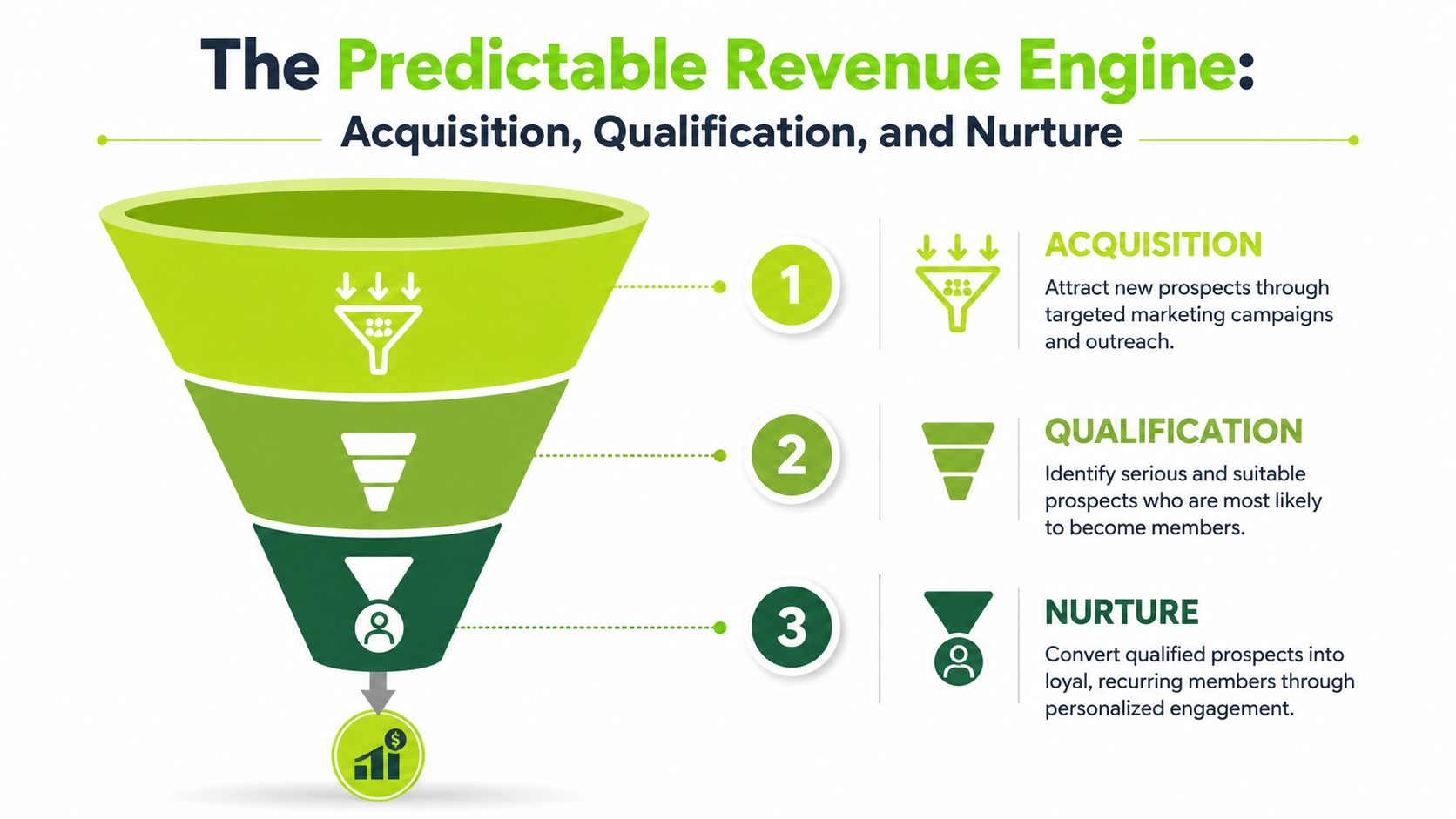
That engine has three working parts: acquisition, qualification, and nurture. Most clubs focus heavily on the first and leave the other two underdeveloped.
Acquisition
Acquisition is how the club creates and captures interest. That includes paid campaigns, local search visibility, website forms, visitor offers, membership pages, and referral sources.
This stage matters, but it isn't enough on its own. A club can generate enquiries and still struggle if every lead arrives in the same inbox with no triage.
For clubs reviewing their longer-term recurring income model, broader thinking around paid membership strategies can be useful because it pushes the conversation beyond one-off sales and toward structured subscription value.
Qualification
Qualification decides who needs immediate attention, who needs more information, and who isn't ready yet.
Without this step, staff treat every lead the same. That's inefficient and expensive. A person asking for a membership tour, a visitor checking a tee time, and a company considering a golf day all require different handling.
A working qualification process usually answers questions like:
- What type of enquiry is this?
- How serious is the intent?
- What timeframe does the prospect have?
- What next action should happen now?
The clubs that convert well don't just collect leads. They sort them quickly and route them properly.
Nurture
Nurture is where predictability starts to appear. A large share of prospects won't buy on the first interaction. That doesn't make them poor leads. It just means they need structured follow-up.
This is especially true for membership. A prospective member may need to visit, speak with family, compare options, or wait for timing to suit. If the club doesn't stay in touch helpfully and consistently, that prospect goes cold.
A proper nurture process can include:
- Visit follow-up: After a tour or trial round, the prospect should receive timely next steps.
- Content by interest: A golfer interested in competitive golf needs different messaging from someone interested in lifestyle and social use.
- Reactivation: Old enquiries, lapsed visitors, and dormant event leads shouldn't disappear into archives.
Why the engine matters
Clubs often treat memberships, visitor golf, functions, and food and beverage as separate businesses. That creates gaps. The customer doesn't experience the club that way. They experience one place, one brand, one decision.
A predictable revenue engine reflects that reality. It connects demand capture, qualification, follow-up, and spend opportunities across the whole club instead of leaving each team to operate in isolation.
Implementing the Right Technology and Systems
Spreadsheets, shared inboxes, and staff memory can work for a while. They don't create predictable growth.
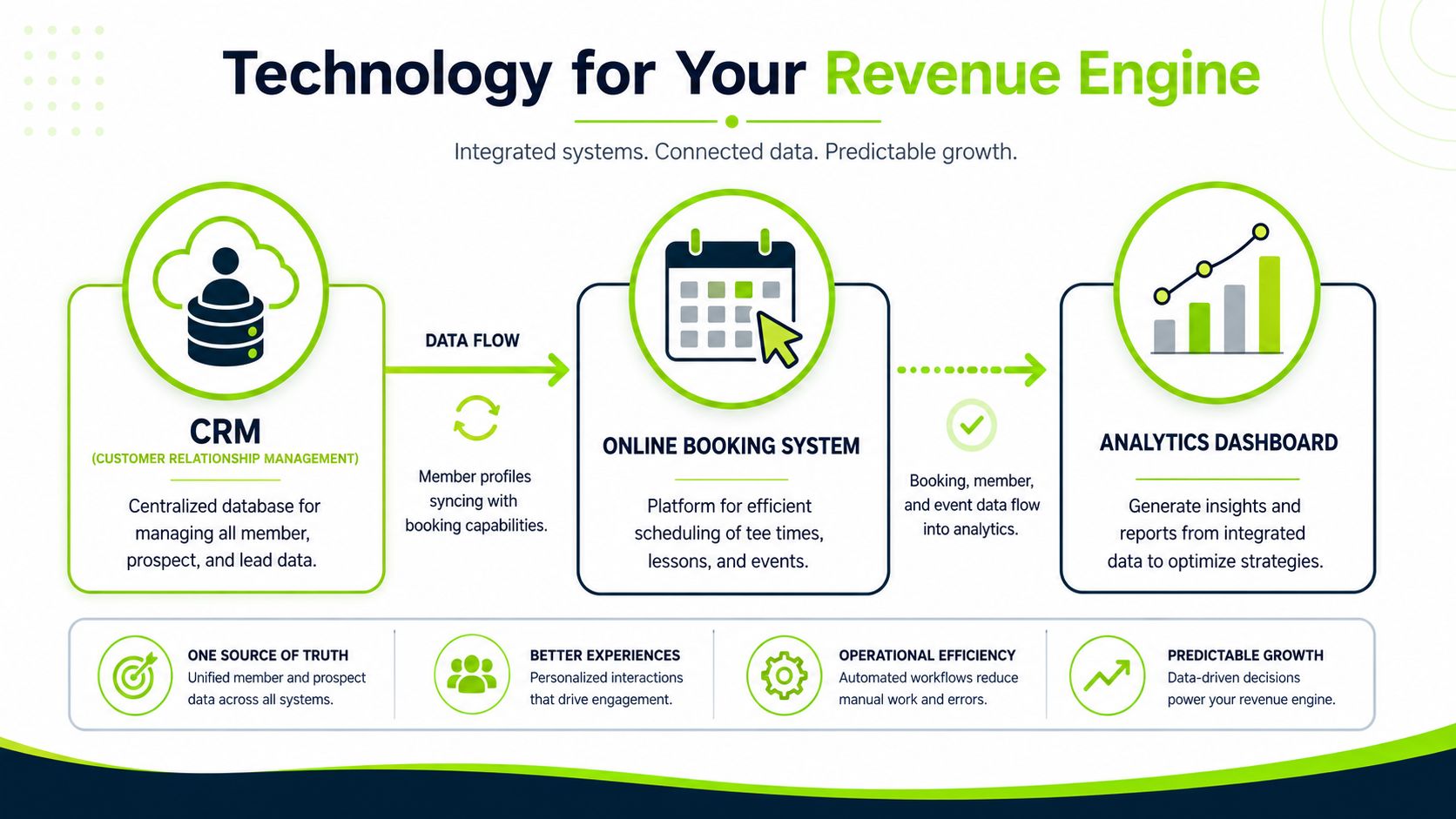
If a club wants to reduce golf club unpredictable revenue, it needs two foundations: a CRM and automation. Not because the technology is fashionable, but because staff cannot reliably manage every enquiry, reminder, and follow-up by hand once volume increases.
A CRM is the central record of who enquired, what they asked for, what happened next, and what should happen now. Without that, clubs lose context constantly. Notes sit in email threads. One team member knows the story, another doesn't. Prospects repeat themselves. Follow-up slips.
What good systems actually do
A useful setup doesn't have to be complicated. It should do a few things well:
| System need | What it solves |
|---|---|
| Central lead record | Stops enquiries being lost across inboxes and staff handovers |
| Task and follow-up tracking | Makes the next action visible and owned |
| Booking integration | Connects enquiries to real revenue activity |
| Reporting | Shows where the process is working and where it isn't |
Pricing control also matters here. If the club is reviewing software that helps with dynamic rate logic and yield decisions, this roundup of top price optimisation tools is a useful starting point for understanding the options.
An example workflow that removes guesswork
A prospect submits a membership enquiry on the website.
The CRM creates a record instantly, tags the enquiry as membership, assigns it to the right staff member, and triggers an acknowledgement. If the prospect books a visit, the system updates their status. If they don't, an automated follow-up sequence reminds staff and keeps contact moving.
That workflow sounds basic. In practice, it's where a lot of clubs break down because every step depends on someone remembering.
If your process only works when a specific staff member is on duty, you don't have a system. You have a dependency.
The technology should support staff, not bury them
Committees and managers sometimes worry that CRM and automation will feel impersonal. Usually the opposite happens when they are set up properly.
The system handles the repeatable parts. Staff spend more time on real conversations, tours, relationship building, and closing. The club becomes more responsive because the admin burden drops.
For clubs comparing setups, GolfRep's guide to golf club CRM software gives a practical view of what these systems need to do in a club environment. GolfRep itself is one option in this category, combining lead generation, CRM tracking, and automated follow-up so clubs can see what happens from first enquiry to conversion.
The important point isn't the brand. It's the operating model. If enquiries, bookings, and follow-up aren't connected, revenue will stay harder to predict than it needs to be.
Measuring Iterating and Scaling Your Growth
The final difference between a club that feels reactive and a club that feels in control is measurement.
Most clubs track revenue after it happens. Fewer track the inputs that create it. That leaves management looking at outcomes without knowing which part of the process needs attention.
Industry benchmarking guidance shows that healthy golf courses typically run at 50% to 65% utilisation of available tee times, while conversion from qualified membership enquiries generally averages 8% to 12% according to golf benchmarking standards from GGA Partners. Those numbers matter because they turn vague concerns into operating questions.
The metrics that deserve management attention
A useful growth dashboard should focus on a small set of metrics that connect activity to revenue.
- Tee-time utilisation: Are available slots being used effectively, or are valuable periods going unsold?
- Average revenue per round: Are pricing and packaging decisions improving yield, or is the club filling times without enough value?
- Qualified enquiry conversion: Are serious prospects moving to visit and sign-up, or stalling in the middle?
- Membership attrition pattern: Which members are at risk, and where does retention need attention?
What a dashboard changes
Once those measures are visible, the management conversation improves quickly.
Instead of saying "marketing isn't working", the team can say:
- enquiry volume is healthy but follow-up is slow
- visits are being booked but not converted
- off-peak tee times need a different pricing approach
- event leads are coming in without enough detail to quote properly
That shift matters because it makes action specific.
Good reporting doesn't just tell you what happened. It tells you where a manager should intervene this week.
Iteration is where stability is built
No club gets this perfect on the first pass. The point is to improve steadily.
If enquiry-to-visit conversion is weak, review the first contact and booking process. If tee-sheet utilisation is soft in particular periods, review availability, pricing, and how those slots are marketed. If membership visits are happening but sign-ups stall, examine what prospects receive after the visit and whether the proposition is being presented clearly.
Clubs that scale well don't run one campaign and hope. They operate a loop:
- Measure the live pipeline
- Spot the friction
- Adjust the process
- Review the result
- Repeat with discipline
That is how unpredictable revenue becomes more manageable. Not because volatility disappears, but because the club can see problems earlier and act on them faster.
The practical takeaway is simple. If revenue still feels chaotic, stop asking only how to generate more interest. Ask whether your club can track, respond to, convert, and retain the demand it already has.
If your club wants a clearer view of where revenue is leaking and what to fix first, GolfRep helps golf clubs build predictable pipelines through lead generation, CRM structure, and automated follow-up systems that turn enquiries into trackable revenue.
Ready to tap into our proven growth system?