Golf Club Tee Time Marketing: Boost Bookings for 2026

The most common advice in golf club tee time marketing is also the most expensive mistake. Clubs are told to run more ads, post more often, and push harder on visitor demand. That sounds sensible until the enquiries start coming in and nobody owns the follow-up, the booking journey is clunky, and the best slots remain protected while weaker inventory sits untouched.
Most clubs don't have a traffic problem first. They have a conversion problem.
At GolfRep, we see the same pattern repeatedly. A club spends money to generate interest, then handles responses manually through a mix of inboxes, phone calls, paper notes, and staff memory. Some enquiries get answered quickly. Others wait until the office is quieter. Some golfers book. Some disappear. Nobody can say with confidence where the drop-off happened.
That's the leaky bucket. More marketing poured into a weak system just means more waste.
Stop Chasing Enquiries You Cannot Convert
The reason this matters so much in UK golf is simple. Tee time stock expires every day. Once a slot has passed, you can't sell it tomorrow. The PGA's guidance on digital booking systems and tee time revenue notes that England had roughly 1.1 million adult golfers and around 1,900 affiliated clubs, with demand that is strongly seasonal and weather-sensitive. In that environment, quick conversion matters because every unfilled tee time is lost revenue.

That should change how club managers think about marketing spend. If your booking path is awkward, your pricing is unclear, or your follow-up relies on whoever happens to be in the office, buying more traffic won't fix the core issue. It usually hides it for a while.
What the leaky bucket looks like in practice
A club may already be generating demand from members, visitor play, societies, local search, and word of mouth. The losses usually happen later:
- Slow first response: An online enquiry arrives in the evening and waits until the next day, even though the golfer wanted to book there and then.
- Poor lead visibility: One staff member saw the enquiry, another thought it had been handled, and nobody had a clear next action.
- Manual follow-up: A promising visitor asked about availability, but no reminder or chase went out when they didn't complete the booking.
- Friction at checkout: The golfer clicks through and meets confusing tee time options, hidden restrictions, or a mobile booking flow that feels harder than calling another club.
Practical rule: Don't increase ad spend until you can see, in plain terms, how an enquiry becomes a confirmed booking.
What works better
The stronger approach is operational before promotional. Tighten the path from interest to booking. Make sure every enquiry is visible, assigned, and followed up. Remove avoidable booking friction. Then push harder on acquisition.
This is why good golf club tee time marketing is closer to revenue management than traditional advertising. It depends on speed, clarity, and process discipline. Clubs that respond quickly, keep booking available outside office hours, and direct demand into the right windows are in a much better position than clubs trying to solve everything with another campaign.
A club manager doesn't need more dashboards or more noise. They need a system that answers three straightforward questions:
- Where are enquiries coming from?
- Who is handling them?
- How many turn into booked rounds?
If those answers aren't clear, the first job isn't scaling promotion. It's fixing the bucket.
Build Your Audience and Channel Plan
The next mistake clubs make is treating all golfers as one audience. They aren't. A member who might add an extra midweek round behaves differently from a casual local visitor, and both are different again from a society organiser trying to book a group.

When clubs say their marketing isn't working, the problem is often that the message, offer, and channel are all slightly mismatched. They advertise a general tee time offer to everyone, in every week, across every available slot. That tends to drag down pricing discipline without solving utilisation.
Start with four audience groups
For most UK clubs, a practical audience plan starts with four segments.
- Members with low playing frequency: They already know the club, so they don't need broad persuasion. They need reminders, availability visibility, and reasons to use quieter slots.
- Local pay-and-play golfers: These players are often comparing convenience, price, and booking ease. They respond well to clear offers and frictionless online booking.
- Societies and group organisers: They need certainty, communication, and packages that are easy to understand.
- Corporate and hospitality buyers: They're less interested in a cheap green fee than a polished experience that is easy to arrange.
Match the channel to the intent
Paid search is usually the strongest channel when someone already wants to play. If a golfer is actively searching for a tee time near your club, that's high-intent traffic. Your job is to send them to a page that makes availability and booking obvious.
Paid social does a different job. It's stronger for local awareness, off-peak promotions, events, and nudging occasional players who weren't planning to search that day. It works well when the creative is timely and specific, not generic.
Email and SMS are often underused. They are particularly effective for known audiences such as members, past visitors, and people who have already enquired. These channels are where clubs can fill weaker inventory without publicly discounting peak demand.
A channel plan should protect your best stock and promote your weakest stock. If it does the opposite, it isn't a marketing plan. It's a pricing leak.
Keep your content tied to real availability
Many clubs often drift into noise at this stage. They post nice course photos and broad messages about booking now, but they don't align content with the tee sheet. Better content is tied to a real operational need. Push twilight windows that need support. Promote a weather break when the next day looks playable. Nudge members around known quiet days.
If your team needs help producing that content faster, this guide on how to boost social media with AI tools is useful because it focuses on workflow rather than hype.
For a practical look at connecting demand generation with actual slot filling, see GolfRep's guide on using digital marketing to fill tee times at your golf club.
Budget by demand window, not by habit
Many clubs still allocate spend by channel first. A better method is to allocate by inventory problem.
| Inventory need | Better channel choice | Why it fits |
|---|---|---|
| Quiet midweek periods | Email, SMS, paid social | Good for nudging known or local audiences |
| Last-minute gaps | SMS, email, retargeting | Speed matters more than reach |
| High-intent visitor demand | Paid search | Captures active booking intent |
| Society and group enquiries | Search, direct outreach, landing pages | Requires clarity and stronger follow-up |
The point isn't to be everywhere. It's to be present where the right golfer is most likely to act.
Design Irresistible Offers and Smart Pricing
Discounting is the lazy version of golf club tee time marketing. It can fill a gap, but it often trains golfers to wait for a deal and creates tension with members who don't want to see prime inventory cheapened.
A stronger offer gives the golfer a reason to book without teaching them that your standard rate has no meaning.

Value beats blanket discounting
Good offers usually do one of three things. They add value, they reduce uncertainty, or they direct demand to a time you want to fill.
Examples include:
- Bundled off-peak play: A twilight round paired with food, range balls, or a small clubhouse incentive.
- Convenience-led offers: Clear, easy-to-book packages for pairs or fourballs in lower-demand windows.
- Behaviour-led offers: Repeat play rewards for visitors who book again within a defined period, handled privately through follow-up rather than broad public discounting.
Each approach protects the perceived value of your course better than a blanket rate cut.
Pricing only works if the tee sheet supports it
There's an operational side to this that many marketing articles ignore. If you create demand but your tee sheet structure can't absorb it sensibly, you create congestion, poor pace, and unhappy customers.
The Cornell study on tee time intervals found that reducing the interval from 10 minutes to 8 minutes increased course capacity by 25%, while the revenue-maximising interval at the course examined was around 11 minutes, where party volume was about the same as at 10 minutes but wait times were shorter and satisfaction improved. For club managers, that's what matters. Promotion works best when paired with a tee-sheet design that protects the playing experience while expanding sellable inventory where appropriate.
Don't ask marketing to solve a tee-sheet problem. Fix the tee sheet, then market the inventory it creates.
Where smart pricing usually starts
If a club wants to use dynamic pricing, start carefully. Don't reset every rate at once. Segment the tee sheet by demand level, protect your strongest periods, and test pricing changes where the club has room to move.
A practical sequence looks like this:
- Identify premium windows such as weekend mornings and holiday periods.
- Separate soft periods where demand regularly underperforms.
- Apply targeted pricing changes only where there is clear need.
- Display rates transparently so golfers understand what they are booking and why.
- Review booking behaviour weekly and adjust with discipline, not instinct.
Industry guidance also points clubs towards measuring peak versus off-peak fill rates and warns that confusing pricing can erode trust. That matters because a clever pricing model still fails if the golfer thinks the system is opaque.
If you want a practical view of how booking technology, stock control, and promotion fit together, GolfRep's article on tee time books is a useful reference point.
What doesn't work
Some common mistakes are easy to spot:
- Public discounts on premium times: This annoys members and rarely improves long-term value.
- Offers with too many conditions: If staff have to explain it three times, golfers won't complete it online.
- Pricing changes without message control: A lower off-peak rate needs context. Position it as a flexible or quieter play option, not a desperate reduction.
- Ignoring fulfilment: If a promotion lands but food service, staffing, or pace of play can't support the visitor experience, the short-term booking isn't worth much.
The best offers are simple to understand, easy to redeem, and attached to inventory the club aims to move.
Optimise Your Booking Funnel for Conversion
A lot of clubs make tee times visible, but not legible. That distinction matters. Visibility gets the click. Legibility gets the booking.
The UK POS guidance on golf course marketing and promotions makes a useful point here. Clubs need to show what's happening on the course daily, including available times, busy days, and member competitions. That clarity reduces the friction behind a common response from golfers: “I didn't know there was space.”
Audit the booking journey like a customer
Start with the basics. Open your own site on a mobile phone and try to book a round as if you've never visited before. Most clubs find the issues quickly once they do this.
Look for these friction points:
- Can the golfer find the booking button immediately?
- Does the booking page load cleanly on mobile?
- Are available times obvious, or buried behind too many clicks?
- Can a visitor understand restrictions without phoning the office?
- Is the pricing clear before they commit?
If any step feels ambiguous, you are asking the golfer to do extra work. Many won't.
Make availability understandable
A booking engine should answer straightforward questions fast. Is there space? When is it quieter? Are there competitions on? What can a visitor book today?
Clubs often assume golfers will click around until they figure it out. That assumption costs bookings.
A stronger setup includes:
- Clear day-by-day visibility: Let users see what is available without guesswork.
- Simple labels for peak and quieter periods: Don't make the golfer decode your diary.
- Competition awareness: If members have blocked parts of the day, show it plainly.
- Direct paths to action: Once someone sees a suitable slot, there should be no confusion about what to do next.
If staff frequently answer “yes, there is space later in the day” on the phone, your website should already be doing that job.
Reduce abandonment at the final step
Most drop-off happens near commitment. At this stage, hidden costs, login friction, or awkward forms kill intent.
A cleaner booking funnel usually means:
- Fewer fields.
- Better mobile usability.
- Transparent price display.
- Confirmation that feels immediate and trustworthy.
This also applies to enquiry forms. If a golfer isn't ready to book but wants information, make that path simple too. The form should capture enough detail to follow up properly, but not so much that it becomes admin for the customer.
Give the office team fewer rescue jobs
The goal isn't to push more work onto staff after the click. It's the opposite. A better booking funnel reduces inbound confusion, fewer “just checking” calls, and less manual patching of avoidable problems.
When clubs improve this part of the process, they usually notice something important. Conversion improves before traffic does. That's why the booking funnel deserves attention before another round of promotion.
Automate Follow-Up to Maximise Revenue
Most clubs already have demand signals coming in. Booking attempts. Enquiry forms. Event interest. Visitor rounds that could become repeat play. The issue isn't a lack of opportunity. The issue is that too much of it depends on manual memory.
That's where automation stops being a nice extra and becomes revenue protection.
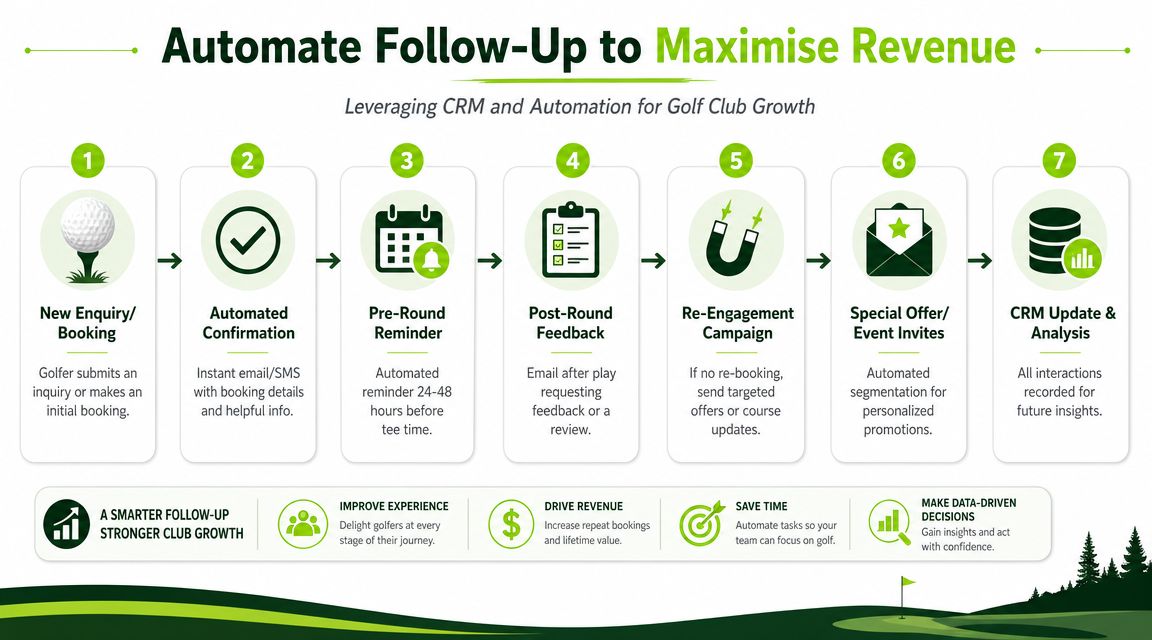
The follow-up most clubs still leave to chance
A golfer enquires after office hours. Another starts booking and drops out. A visitor plays once and then disappears. None of these moments are unusual, but they are valuable. If there is no structured response, the club is relying on staff noticing, remembering, and acting at the right time.
That's unreliable even in a well-run operation.
A proper CRM with automated workflows gives you three things manual handling usually can't:
- Immediate acknowledgement
- Consistent follow-up
- Full lead visibility
This is the heart of a predictable pipeline. Every enquiry is recorded. Every next step is assigned or automated. Every outcome can be tracked.
High-value automation flows for tee time revenue
The useful automations are not complicated. They are practical and tied to common revenue moments.
Consider these flows:
- New enquiry response: The golfer gets an instant confirmation by email or SMS with the right next step, rather than waiting for the office to reopen.
- Booking reminder sequence: Before the round, send a reminder with booking details and any useful course information.
- Abandoned booking follow-up: If someone starts the process and does not finish, prompt them to return while intent is still fresh.
- Post-round review request: Ask for feedback while the experience is current, then route positive sentiment towards reviews and repeat-play prompts.
- Lapsed visitor reactivation: If someone has not returned for a period, send a relevant update or offer tied to likely playing windows.
Automation does not replace staff judgment. It protects the moments staff are most likely to miss when the day gets busy.
Systems beat good intentions
Many committee-led clubs frequently struggle with follow-up procedures. They know follow-up matters, but they still handle it informally. One person answers quickly. Another prefers to batch responses. Notes sit in inboxes. Good prospects disappear because there was no structured next action.
A system removes that inconsistency.
For example, GolfRep uses CRM-led follow-up and automation as part of a wider club growth process, but the same principle applies whether a club uses a specialist partner or builds internally. The requirement is the same. Enquiries need visibility, response rules, and measurable outcomes.
If you want a closer look at what that kind of structure can include, this guide on golf club automated follow-up sets out the practical mechanics.
What to automate first
Don't try to automate everything at once. Start where revenue is already leaking.
A sensible order is:
- Instant responses to new enquiries
- Booking confirmations and reminders
- Post-round feedback collection
- Re-engagement for past visitors
- Segmented offers based on behaviour
Each one reduces reliance on manual chasing and gives staff clearer oversight.
What clubs gain from this
The obvious benefit is more recovered bookings. The less obvious benefit is operational calm.
Staff stop firefighting missed messages. Managers get clearer reporting on what came in, what converted, and what stalled. Committee members get a more realistic view of where marketing spend is going and whether demand is being monetised.
That's why automation matters in golf club tee time marketing. It doesn't exist to sound modern. It exists because a club cannot build reliable revenue on inboxes, memory, and good intentions alone.
Track What Matters and Plan Your Campaigns
Many clubs still review marketing by looking at clicks, reach, and general noise. Those numbers may tell you something about activity, but they don't tell you enough about revenue.
The more useful view starts with the tee sheet.
The guidance in Sagacity's 2026 tee time marketing plan is practical on this point. Effective tee-sheet management depends on tracking the right KPIs, particularly peak versus off-peak fill rates, then using that data to trigger promotions for weak inventory because unsold tee time revenue cannot be recovered once the slot passes.
The KPIs worth watching
You don't need a huge dashboard. You need a small set of measures that support decisions.
- Peak versus off-peak fill rates: This tells you where the core inventory problem lies.
- Enquiry-to-booking conversion: If interest is healthy but bookings are weak, the leak is downstream.
- Booking source by channel: Useful for deciding where to keep spending and where to cut.
- No-show and cancellation patterns: These often reveal communication problems, not just customer behaviour.
- Repeat visitor rate: A first booking is useful. A returning visitor is far more valuable.
A simple campaign rhythm
Most clubs benefit from working in short cycles. Review demand patterns, choose the weak windows, run targeted activity, then assess what moved.
| Month | Primary Focus | Key Channels | Sample Offer | Primary KPI |
|---|---|---|---|---|
| Month 1 | Audit weak inventory and booking friction | Website, booking engine, CRM review, email | Midweek visitor push with clear online availability | Off-peak fill rate |
| Month 2 | Promote low-demand windows to segmented audiences | Paid search, paid social, email, SMS | Twilight or quieter-day package with value add | Enquiry-to-booking conversion |
| Month 3 | Improve repeat play and recover missed demand | CRM automation, post-round email, reactivation campaigns | Return-visit prompt for recent players | Repeat visitor bookings |
Measure the part of the system you are trying to improve. If the issue is poor conversion, don't judge success by reach.
Keep planning tied to operations
For the whole system to come together, campaigns should reflect real availability, pricing should reflect demand conditions, and follow-up should be automatic wherever possible. If those parts are disconnected, marketing becomes theatre.
Good golf club tee time marketing is disciplined. It fills the right times, protects the right times, and gives the manager visibility over what is working.
GolfRep helps golf clubs build that structure with advertising, CRM, and follow-up systems designed around conversion rather than just lead volume. If your club is generating interest but still losing bookings through slow response, poor visibility, or manual handling, you can see how the team approaches it at GolfRep.
Ready to tap into our proven growth system?