How to Increase Tee Sheet Occupancy at Your Club

Most clubs are chasing the wrong problem. They keep asking how to generate more enquiries, more clicks, more calls, more interest, while the tee sheet still has dead space because nobody has fixed the process that turns interest into a booked round. How to increase tee sheet occupancy starts with admitting that demand is usually there already; the leak sits in response time, inventory design, and the way your club releases and protects tee times.
In England and Wales, the playing base has not disappeared, but the supply of courses has tightened. The number of 18-hole courses fell from 1,890 in 2002 to 1,468 in 2023, and 9-hole courses fell from 675 to 568 over the same period, while the review also recorded 5.17 million adult golfers across England, Scotland and Wales in 2023 (R&A ecosystem participation review summary). That is the context for operators. The priority is not bringing more people to the door, it is converting existing demand into booked tee times with less friction and better control.

Practical rule: if your enquiry flow is messy, your occupancy problem is partly self-inflicted.
If you want a blunt example of where clubs lose occupancy without noticing, read how most golf clubs lose 30% of enquiries without realising. The pattern is usually the same, slow acknowledgement, no consistent follow-up, and no clear owner for the lead once it arrives.
Why More Enquiries Rarely Fill More Tee Sheets
The usual club reaction to a soft tee sheet is to push harder on demand. More ads. More social posts. More enquiries. That instinct feels sensible, but it misses the core failure point. If your club already attracts interest, the gap is usually not at the top of the funnel, it is between enquiry and confirmed booking.
Occupancy is a conversion metric, not a vanity metric
Tee sheet occupancy measures what you book against what the course could have sold. The cleanest way to read it is utilisation, which is rounds booked divided by theoretical capacity. A simple example makes the point. If a course can take 200 rounds in a day and books 160, utilisation is 80% (tee sheet utilisation definition).
That is why a busy marketing calendar does not guarantee a full diary. Poor handling of enquiries leaves tee times empty even when demand is there. The leak often shows up after the booking as well, because show rate tracks how many booked rounds are played.
The weak point is rarely awareness. It is the handoff from interest to commitment.
A club can spend to generate demand and still underfill the sheet if the response process is slow, the inventory is poorly shaped, and the pricing rules work against conversion. Read how most golf clubs lose 30% of enquiries without realising and the pattern is obvious, slow acknowledgement, inconsistent follow-up, and no clear owner for the lead once it lands.
Treat occupancy as a conversion problem first. Then treat CRM response time, inventory design, and dynamic pricing as one operating system. That sequence is what fills tee times.
Audit Your Tee Sheet Like an Inventory Manager
Stop guessing about demand and audit the sheet you already have. A proper tee sheet review starts with 12 months of historical bookings so you can see recurring demand patterns, weak windows, and where no-shows are hitting you before you change anything meaningful. Without that baseline, every pricing or marketing move is a shot in the dark. 12-month data and pricing guardrails
Build a slot-by-slot heatmap
Export the booking history and break it down by time band, day of week, and season. A heatmap shows where the course is chronically underfilled and where it sells through on its own. That distinction matters, because a quiet Tuesday morning is a different problem from a quiet Saturday twilight.
Use your internal booking history with a simple daypart review. Start by comparing Mon-Thu, Friday, and weekend occupancy in each time band. Then isolate the slots where idle capacity repeats week after week. Those are the first places to fix, not the whole sheet.
The core job is separating low demand from low conversion. A weak window may need a different booking rule, a different start pattern, or a different release window. A strong window needs protection, not discounting.
The internal guide on tee time books is useful here because it treats the tee sheet as a set of sellable slots, not one flat product. That is the mindset most clubs still miss.
Sample slot-level heatmap output
| Time band | Mon-Thu occupancy | Fri occupancy | Weekend occupancy | Action |
|---|---|---|---|---|
| Early morning | Low | Medium | High | Protect at weekends, test weekday pairing |
| Mid-morning | Medium | High | High | Hold pricing, preserve yield |
| Midday | Low | Medium | Medium | Trial short-window offers |
| Afternoon | Low | Low | Medium | Consider squeeze times or 9-hole starts |
| Twilight | Low | Low | Low | Release later and monitor weekly |
Simple test: if a slot keeps underfilling, treat it as an inventory problem first and a price problem second.
You do not need new software to do this well. You need a clean export, a spreadsheet, and a manager who will look at the sheet carefully.
Reshape Inventory Before You Change Price
Most clubs reach for discounts too quickly. That's lazy revenue management. If a time band is weak, the first question should be whether the inventory is designed badly, not whether the price tag is too high.

The redesign levers that actually move occupancy
Pair twosomes when the time band is fragmented. Use double-tee starts where the course layout and pace allow it. Open earlier only when demand justifies the extra capacity. Add 9-hole back-nine starts if your weak demand sits in times that can't support full 18-hole play. And use squeeze tee times to fill small gaps instead of leaving them stranded.
Those tactics matter because they increase sellable unit density without trashing peak yield. A busy weekend morning should not be treated the same as a thin weekday afternoon. If your course can preserve strong prices where demand is already healthy, you have more room to shape the weaker parts of the sheet without giving away revenue.
The operating guide at premium tee time strategy fits this logic because premium inventory should be protected, not flattened. Once a time band shows real demand, spacing and start patterns should be adjusted locally, not across the whole day.
Match the lever to the weakness
Weekday mornings usually need different treatment from weekend twilight. A morning gap might respond to pairing and shorter release windows. A thin late-afternoon band may need a squeeze time or a 9-hole start. Don't spray the same fix everywhere.
Operational rule: make local changes, not blanket changes. Then review them weekly.
If you change tee spacing, start patterns, or opening hours, do it in a narrow band first. Measure what happens. Keep the gain if it works. Reverse it quickly if it doesn't. Clubs that tinker weekly tend to learn faster than clubs that wait for the next committee meeting.
Dynamic Pricing With Guardrails, Not Gimmicks
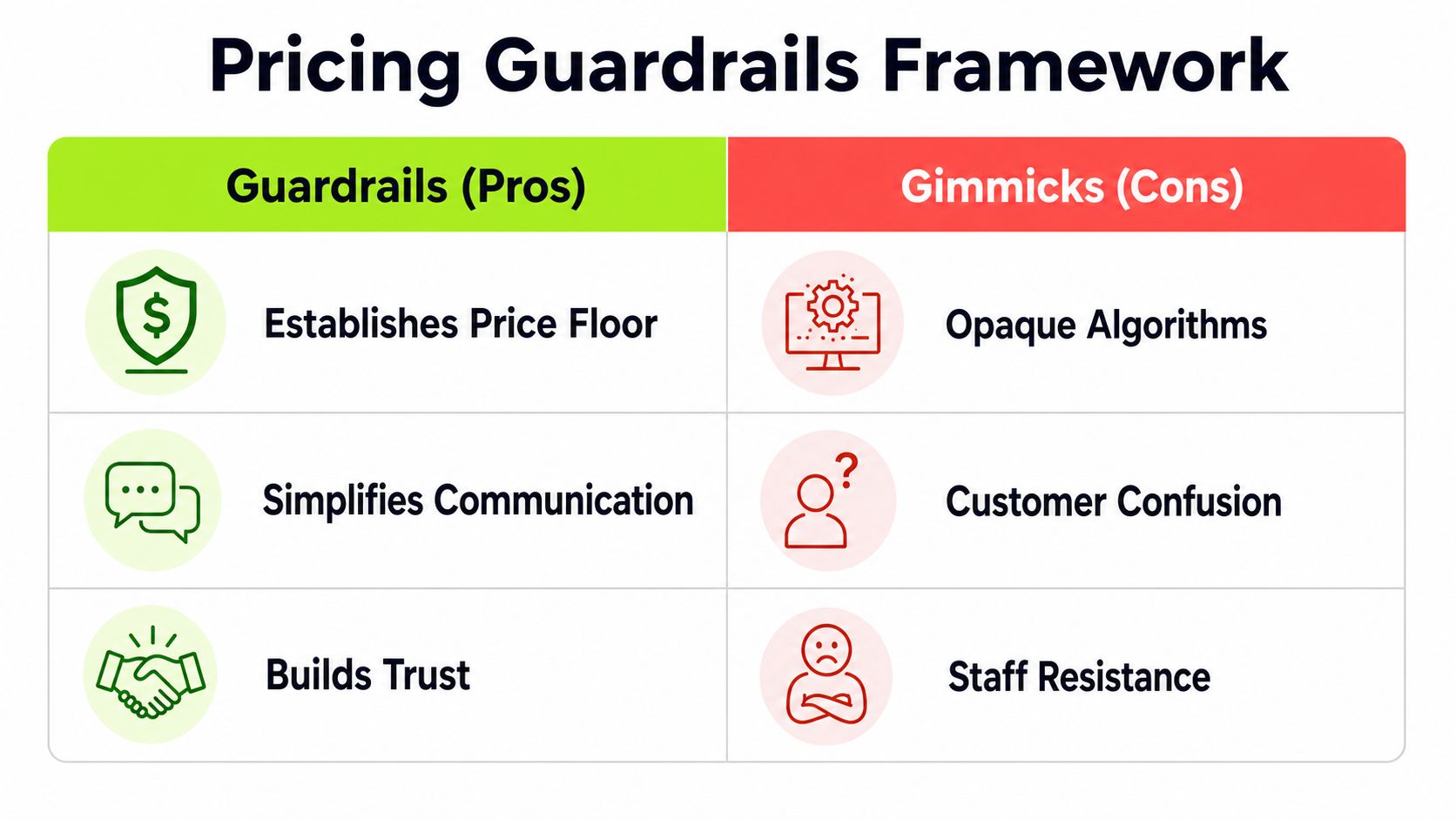
Dynamic pricing only works when the club controls it. The moment staff treat price as a knob to twist for every booking gap, members, regulars, and visitors lose trust fast. Set a floor rate and a ceiling rate, then use them to protect the sheet while you shape the soft spots. That is the discipline that keeps pricing useful instead of noisy.
Test the weak slots only
Pull the underfilled windows from your heatmap and run offers there first. Keep the test narrow and read the result over a clean operating window, rather than flooding the whole sheet with discounts. That is how you learn whether price is the primary issue or just a distraction. Use phased slot testing guidance to structure the rollout and judge one slot band at a time.
A sensible test should sit inside firm guardrails. Change only the targeted windows, hold the rest of the day steady, and compare like for like against the same booking pattern. Do not slash prices across the board because one segment is soft. That trains golfers to wait for the next discount and weakens the rest of the inventory.
For clubs that need a useful reference point, how to use personalised pricing shows the same control logic without turning the booking journey into a mess. The useful lesson is simple. Structure the offer, keep the rules clear, and avoid improvising slot by slot.
Join pricing to real demand signals
Pricing should respond to actual booking conditions, not gut feel. Booking history, weather, holidays, and local events all shape demand, and the club should fold those signals into its pricing decisions. Ignore them and you end up misreading peak demand while leaving weak inventory underused.
The cleanest setup is a connected one. Use the booking record to identify the soft windows, use response speed and enquiry flow to protect conversion, and use pricing only where the inventory design still needs help. A club that separates those jobs ends up with three weak systems. A club that runs them together gets a sheet that behaves predictably.
Keep the first tests tight. Keep the guardrails visible. Measure the result on the targeted slots only, then adjust if the numbers justify it. pricing guardrails guidance is useful here because it keeps the club focused on control, not gimmicks.
Turn Enquiries Into Bookings With a Real CRM Flow
Most clubs leak occupancy at the point of first contact. The enquiry arrives, someone sees it, someone means to reply, and then the lead goes cold. On busy days, volunteer-run and committee-led clubs are especially vulnerable because there's no consistent owner for the follow-up process.
The minimum flow every club should run
Start with an instant acknowledgement for every enquiry. That message should confirm receipt, set expectations, and make it obvious that the enquiry hasn't vanished into a shared inbox. Then get a human to follow up quickly, because speed still matters when the golfer is actively considering where to book.
After that, log every enquiry in one central CRM view. Without that single record, you can't see who followed up, who replied, and where the lead stalled. You end up with fragments in inboxes, not a pipeline.
A sensible nurture sequence is simple:
- Instant acknowledgement, so the golfer knows the message landed.
- Same-day personal follow-up, so the lead doesn't cool off.
- A value-led reminder, if they haven't replied.
- One final follow-up, before the enquiry goes cold.
That sequence sounds basic because it is basic. Basic is what works when the club is busy.
GolfRep builds that kind of structure with enquiry tracking and automated follow-up, but the same operating logic applies whether you use a CRM, a booking platform, or a mix of both. The point is not software for its own sake. The point is making sure no genuine booking intent disappears.
If you want a useful reference on the automation side, this practical guide to AI outreach is a decent read because it shows how follow-up can be structured without relying on memory or goodwill alone.
The real cost of slow response
A golfer who enquires on Tuesday and hears back on Thursday has usually moved on. That's not because they weren't interested. It's because the club made the decision easy for someone else.
If the enquiry exists, the demand exists. Your job is to stop it leaking before the booking is confirmed.
That is why systems beat heroics. A single secretary or pro can't save every lead manually, especially when the clubhouse is busy. A CRM flow can.
KPIs and a Phased Rollout That Sticks
If the club measures the wrong things, old habits return fast. Raw rounds do not show where occupancy is leaking. Weekly review should focus on utilisation, show rate, revenue per available tee time (RevPATT), and enquiry response time. Those four figures show whether the sheet is filling, whether booked golfers are turning up, whether revenue is being protected, and whether the club is replying fast enough.
What to review each week
Keep the review short and specific. Look at utilisation by daypart, show rate by source if you can, RevPATT on the weak slots you are testing, and response time for every enquiry channel. If those figures improve, the process is working. If they do not, there is still a leak in the system.
Revenue-linked metrics matter because a club can book more rounds and still use the sheet badly if those rounds sit in the wrong time band or fail to show. Weekly review forces the team to see the operating problem before it hardens into a seasonal pattern. A simple dashboard is enough if it is used every week and someone is accountable for the actions that follow.
Roll out in phases
Move in phases and keep the sequence disciplined. Start with response time and enquiry handling, then reshape inventory, then apply guarded pricing to weak slots, and only then automate repeat tasks. That ordering fits the way clubs operate, and it stops teams from using pricing as a substitute for basic process.
For service standards, Heyline's customer service playbook is useful because it reinforces consistent response discipline. Golf clubs need that same discipline applied to enquiries, tee times, and callbacks. The detail matters, because slow handling turns interest into lost rounds long before pricing enters the picture.
Do not make the rollout complicated. Fix response time first. Then inventory. Then pricing. Then automate the parts that keep repeating. Treat it as one operating system, not three separate projects.
Putting It Together as One Operating System
Clubs that raise occupancy reliably do one thing well, they run the tee sheet as a connected conversion system. They audit the numbers, reshape inventory where the gaps sit, apply guarded pricing only to weak slots, and move enquiries through a tracked CRM flow. That is the operating rhythm. Everything else is noise.
The main lift comes from converting existing demand into booked tee times, not from chasing more enquiries. That only works when inventory is controlled properly and low-demand slots are handled with shorter booking windows and clearer rules (UK tee-sheet management guidance). Put that on the wall and keep the standard simple. Know your weak slots. Protect your strong slots. Reply fast. Track every enquiry. Review weekly.
The clubs that miss this are usually treating separate problems as if they were separate businesses. They are not. If response time is poor, the CRM flow leaks. If inventory is badly shaped, pricing just discounts the wrong part of the day. If pricing is not tied to weak inventory, the club trains golfers to wait for deals instead of booking the times you want to fill.
The next empty tee time is usually a process problem, not a demand problem. Clubs that accept that move faster, make cleaner decisions, and stop confusing activity with occupancy.
If you want a club-level view of how to tighten enquiry handling, tee sheet management, and CRM follow-up into one predictable operating system, talk to GolfRep. We work with UK clubs that want clearer lead visibility and more booked rounds without relying on blanket discounts. Visit GolfRep to see how that system is put together.
Ready to tap into our proven growth system?