Golf Club Social Media Marketing That Fills Tee Sheets

A committee meeting can leave a general manager with a familiar problem. The club's Facebook page is active, Instagram looks attractive, and someone has posted a short video from the first tee. Yet the membership enquiries are vague, visitor bookings remain uneven, and nobody can say which post produced a commercial result.
That isn't a failure of effort. It's a failure to connect golf club social media marketing with the way the club makes money. A post should create awareness, support a decision, generate an enquiry, encourage a booking, or strengthen an existing relationship. If it does none of those things, it may still be pleasant content, but it shouldn't consume scarce management time.
Why Golf Club Social Media Marketing Must Start With Commercial Goals

A private members' club might have a strong following among existing members but too few membership visits. A resort may generate plenty of interest in its course and hotel, yet fail to fill weaker weekday tee times. A volunteer-run club may publish regularly, but nobody owns the move from a Facebook question to a booked visit.
Those are different commercial constraints, so they need different social objectives.
The UK market has already moved beyond the question of whether golf clubs should use social media. An England Golf membership questionnaire covering 602 clubs found that 75% of clubs used channels such as Facebook, Twitter and Instagram in 2016, while 25% didn't use them effectively. Website marketing was more established, with 89% using a website regularly, and social adoption had risen by 15 percentage points compared with 2014. The useful lesson isn't the age of the survey. It's that adoption alone never guaranteed commercial discipline.
Find the constraint before choosing the content
Use GolfRep's ATTRACT → NURTURE → CONVERT → RETAIN lens to diagnose the club's current position.
- Attract: local golfers don't know enough about the club, its course, facilities or proposition.
- Nurture: people show interest but need proof, answers, reminders or a clearer reason to act.
- Convert: enquiries arrive, but visits, tee-time bookings or applications don't progress.
- Retain: members, visitors or society organisers don't receive enough value to return or recommend the club.
Choose one primary objective for a campaign. “Improve social media” isn't an objective. “Generate membership open-day registrations from golfers within the club's local catchment” is. “Fill quieter visitor tee times with local golfers” is better still because it identifies the commercial outcome.
Commercial rule: judge a social post by the next useful action it creates, not by how busy the page looks.
A practical golf club commercial strategy should connect the audience, offer, platform, booking route and follow-up owner. That alignment stops a membership post being measured against likes, or a visitor campaign being judged by member comments. Social is one part of the revenue system, not a separate publishing task.
Mapping Your Audience and Setting Objectives That Drive Revenue
Start with the people you want to attract, not the platform you happen to use. A club can't write useful content for “everyone who likes golf”. It can speak more clearly to a prospective member living locally, a visiting golfer looking for a convenient weekday round, or a society organiser comparing packages for a group.
Build a useful segment profile
Run a short workshop with the general manager, club secretary, PGA professional and whoever manages visitor or membership sales. For each audience, record:
- Location: How far is the person likely to travel for a round, membership visit or society day?
- Playing pattern: Do they want regular member golf, occasional visitor rounds, coaching, indoor practice or corporate hospitality?
- Decision trigger: Are they responding to a trial, an open day, course conditions, availability, value, convenience or the club atmosphere?
- Commercial value: Could the relationship produce membership income, repeat tee-time bookings, food and beverage spend, society revenue or referrals?
- Barrier: What stops action today? It may be uncertainty about joining, a lack of playing partners, difficulty booking, price sensitivity or not knowing the club exists.
Write this in plain language. “Local golfer” is too broad. “A lapsed member who still lives nearby and has stopped playing regularly” gives the team something to work with.
The golfer platform data supports this segmented approach. A UK golfer survey found Facebook was used by 62% of respondents, compared with 25% for LinkedIn and 24% for Twitter. Among under-35 golfers, Facebook usage rose to 80%, Twitter to 64%, while LinkedIn stood at 16%. Those figures don't tell a club what to post, but they do show why age and audience profile should influence channel selection.
Turn each segment into an offer
Give every priority audience a clear next step.
- Prospective member: invite them to a membership open day, guided course visit or trial experience.
- Lapsed member: show what has changed, offer a personal conversation and make re-engagement simple.
- Visitor golfer: promote a specific tee-time opportunity with a direct booking route.
- Society organiser: present a concise package, availability prompt and contact method.
- Corporate buyer: show meeting, hospitality and golf options through a professional enquiry path.
Set one primary objective and one secondary objective. A members' club might prioritise booked membership visits, with lapsed-member reactivation as the secondary objective. A resort might prioritise weekday visitor bookings, with repeat visitor capture as the secondary objective.
Assign ownership before publishing. The manager can own the objective and reporting, the PGA professional can supply course and coaching content, the secretary can confirm club information, and one named person should own every commercial response. If resource is limited, prioritise the segment with the clearest combination of available capacity, commercial value and a credible offer. Don't split a small team across every audience to appear active.
Choosing Platforms and Content Pillars for Your Club Type
The right platform depends on club model, audience and funnel stage. There's no prize for maintaining every network badly. UK-facing golf guidance recommends focusing on two or three platforms rather than trying to keep all six major platforms active, because concentration usually produces a more consistent presence.
Facebook remains useful for member communication, events, local groups and older golfer audiences. Instagram suits course imagery, short videos, staff profiles and visual evidence of conditions. LinkedIn deserves deliberate attention from resorts, clubs pursuing society business and operators building local corporate relationships. X, TikTok and YouTube should be secondary unless the club has a clear audience and someone who can produce suitable content consistently. Clubs wanting a more detailed route into short-form video can use this guide to develop a winning TikTok system, but TikTok shouldn't become another abandoned account.
| Club Type | Primary Platforms | Core Content Pillar | Funnel Role |
|---|---|---|---|
| Private members' club | Facebook and Instagram | Membership value, people and culture | Attract local golfers, nurture interest and secure a visit |
| Resort or hotel group | Instagram, Facebook and LinkedIn | Course experience, packages and proof | Attract visitors, support booking decisions and generate repeat demand |
| Volunteer-run club | Facebook and one visual channel | Course conditions, community and events | Maintain local awareness and direct people to simple enquiries |
| Indoor golf facility | Instagram, Facebook and possibly TikTok | Leagues, coaching and off-peak experiences | Turn discovery into a first booking and then repeat visits |
Use durable content pillars
Your calendar should revolve around repeatable themes, not random ideas.
- Course and conditions: Monday morning updates, greenkeeping work, weather-led information and honest views of the course. This helps visitors judge whether to book and gives members a useful reason to return to the page.
- People and culture: staff introductions, competition results, coaching advice, volunteers and member achievements. A club's atmosphere is often easier to demonstrate through people than through a facilities list.
- Membership value: explain playing access, competitions, coaching, social activity and the practical experience of belonging. Avoid vague claims about “community”. Show what a new member can do.
- Visitor, society and corporate offers: present the audience, availability and next action clearly. A society organiser needs a package and a conversation, not a scenic photograph without context.
- Proof and social validation: share genuine reviews, tagged photographs, event coverage and member stories, with permission and appropriate moderation.
Every post needs a funnel role. A course video can attract a local visitor, a follow-up post can answer practical questions, and a booking link can convert intent. A member story can nurture a prospective joiner, while an event recap can reinforce retention and referrals. Keep the commercial destination visible through a clear website to promote, whether that destination is a membership page, visitor booking route or society enquiry form.
Building an Organic Content Calendar and Engagement System
A sustainable calendar is better than an ambitious one that collapses when the PGA professional takes annual leave. The club needs a rhythm that reflects how golfers make decisions during the week.
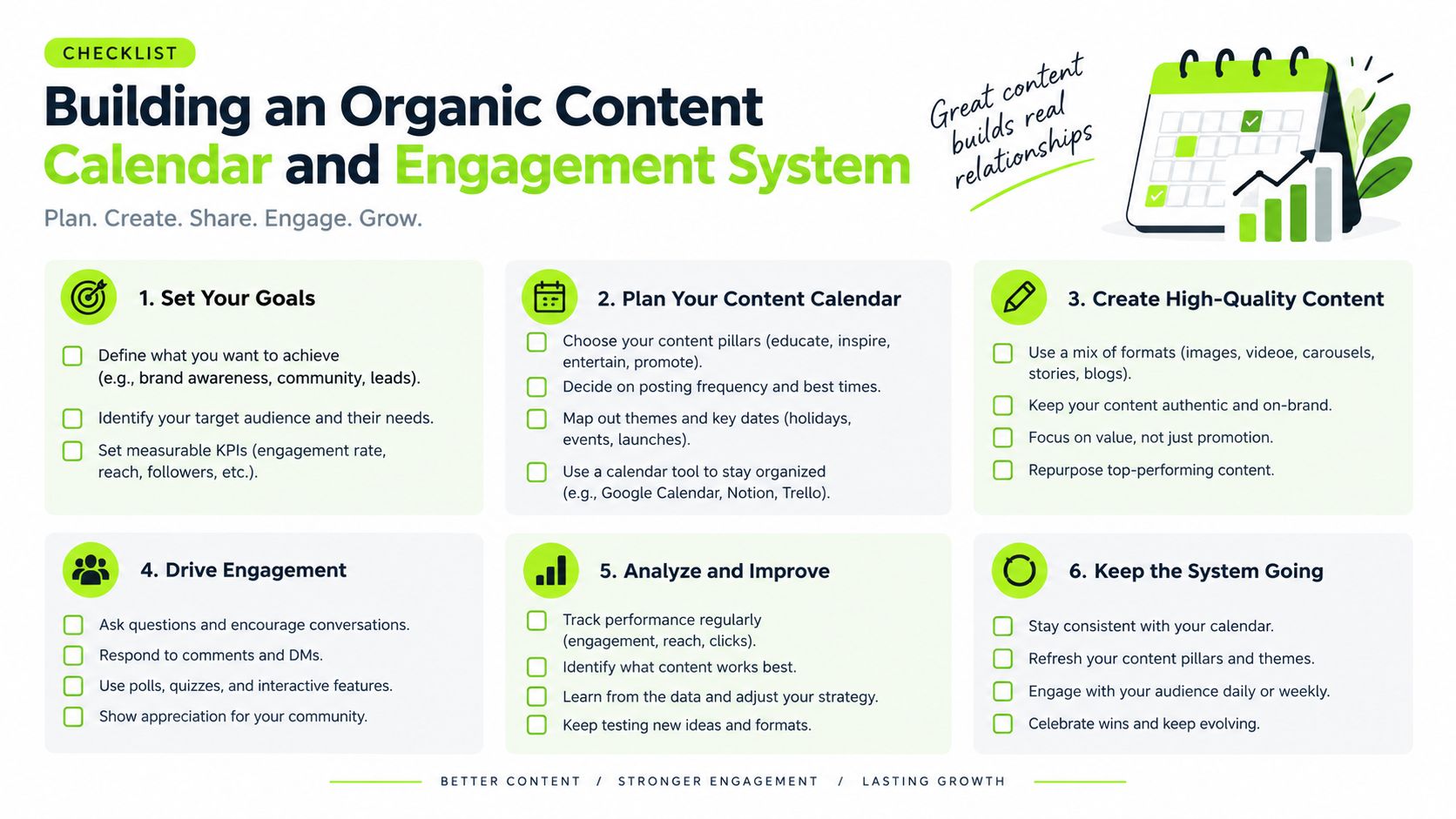
Use a simple weekly pattern:
- Monday: publish course conditions, maintenance information and the best available visitor or practice opportunity.
- Tuesday or Wednesday: feature a member, coach, volunteer, competition or club activity.
- Thursday: answer a common question about membership, societies, coaching, dress code, facilities or booking.
- Friday: promote weekend availability, an event, food and beverage activity or a specific experience.
- After the weekend: share results, photographs, reviews and a clear route for future enquiries.
Batch the work. The marketing owner can collect course footage, interview staff and photograph activity during one planned session, then prepare several pieces of content. Use short-form video when it demonstrates something useful, such as a hole, a coaching point, a clubhouse experience or current conditions. It doesn't need elaborate production. It needs to be recent, understandable and connected to a next action.
Write captions that move people
A useful caption normally contains three elements:
- Context: what the golfer is seeing or why it matters.
- Commercial relevance: who should care and what problem the club solves.
- Action: book, enquire, register, visit, reply or send a direct message.
“Beautiful morning at the club” creates atmosphere but gives a prospective visitor no decision-making information. “The course is open for weekday visitor bookings, with the latest conditions shown in today's video. Check availability through the booking page” gives the audience a route forward.
Give engagement an owner
Comments and messages need a named owner for each working day. The person should use approved saved replies for routine questions, escalate pricing or membership exceptions to the right manager, and move genuine buying interest into the club's enquiry process. Publicly answer useful questions where the response may help other golfers, then move personal details into a private channel.
Keep a simple responsibility structure:
- Responsible: the person publishing or responding.
- Accountable: the manager who owns the commercial objective.
- Consulted: the PGA professional, secretary or event lead.
- Informed: committee members or senior operators through a regular report.
Set a response standard the team can meet, then review whether it is being met. An enthusiastic volunteer can start the system, but the club shouldn't make revenue dependent on one person's availability.
Running Paid Social Campaigns and Turning Enquiries Into Bookings
Paid social works best when the club gives each campaign one job. Don't combine membership, visitor golf, societies and events in one advert set, because the audience, message, landing page and sales process are different.
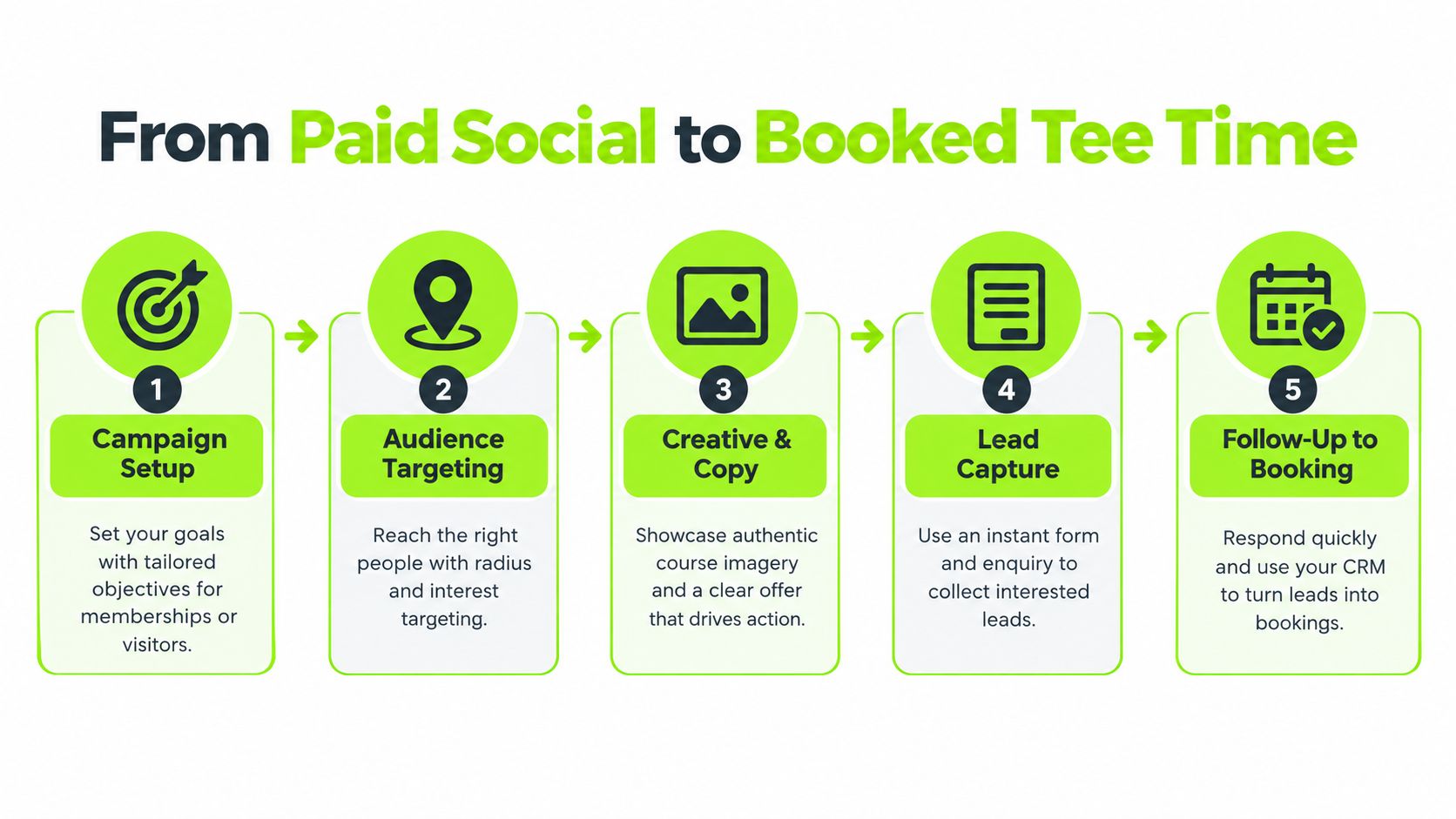
Build the campaign around the commercial outcome
For a membership campaign, choose a local audience and offer a visit, open day or conversation. For visitor golf, target golfers who can realistically travel to the course and send them to current availability or a relevant package. For societies, use a form that asks for the group size, preferred date range and organiser contact details. A corporate campaign needs a more professional creative treatment and a route to someone who can discuss hospitality and requirements.
Use genuine course imagery, recognisable staff and clear language about the experience. Don't hide important conditions behind clever copy. If pricing, dates, availability or eligibility matters, make it easy to understand before someone submits a form.
Campaigns should contain:
- A defined audience: location, golfer type and relevant interest signals.
- One offer: a membership visit, visitor opportunity, society discussion or event enquiry.
- One conversion route: an instant form, booking page or structured enquiry form.
- A tracking method: record campaign, audience, offer and outcome.
- A budget owner: agree how spend will be reviewed and when it can be moved.
- A follow-up owner: identify the person responsible before launch.
The guide to GolfRep's golf club Meta Ads can help managers think through campaign structure, but the operational handover still belongs to the club.
Treat the form as the start of the sale
A social lead form should collect enough information to qualify the opportunity without creating unnecessary friction. Ask what the person wants, their preferred timing and the best contact route. A visitor enquiry might require a preferred date and number of golfers. A membership enquiry might ask about current playing habits and interest in visiting the club.
Send submissions into one pipeline rather than leaving them scattered across Facebook, Instagram and personal inboxes. The pipeline should show:
New enquiry → contacted → conversation held → visit or tee time booked → attended → joined or played → follow-up required
Use automated confirmation to acknowledge the enquiry and explain what happens next. Automation can provide useful information, but it shouldn't replace a human conversation where the value or complexity of the purchase demands one.
Response speed is a commercial control, not merely a customer-service preference. A UK lead-response study covering golf-club membership enquiries reported an average response time of 47 hours and 32 minutes, while stating that a lead answered within one hour was five times more likely to convert than one left for 24 hours. The same material reported that nearly 10% of firms replied within five minutes and more than 46% within an hour. Set an internal target that the team can monitor, route every lead to a named owner and record the outcome.
GolfRep can sit within this type of operating model as a UK golf growth partner, combining paid acquisition with lead capture, CRM-enabled nurture and conversion tracking. The important point is the joined-up process, not the software label.
Measuring What Matters and Optimising for Predictable Growth
A committee report should show whether social activity is creating commercial movement. Reach and engagement help explain awareness, but they don't prove that the club has filled a tee time or progressed a membership opportunity.
Track a compact set of measures:
- Reach: whether the intended local audience is seeing the content.
- Engagement quality: saves, shares, meaningful comments and direct messages, rather than likes alone.
- Enquiry rate: how often a relevant audience takes the chosen action.
- Cost per lead: paid spend divided by valid enquiries.
- Booking rate: the proportion of enquiries that become booked visits, tee times or conversations.
- Conversion rate: the proportion that becomes a member, visitor booking, society booking or event sale.
- Retention signal: repeat bookings, re-engagement or continued participation where the campaign supports an existing audience.
Define each measure before launch. A “lead” should mean a valid enquiry that the club can contact, not every form submission. A “booking” should mean a confirmed appointment or tee time, not a click on a booking button.
Report by funnel stage
Use a monthly management report for operational decisions and a shorter committee summary for commercial visibility. Show the campaign, audience, offer, spend, valid enquiries, booked outcomes and revenue category. Where a campaign supports membership, separate open-day registrations from actual visits and joining decisions. Where it supports visitor golf, separate booking enquiries from completed rounds.
The 2023 UK golf-club survey from Hillier Hopkins found that 42% of clubs used social media in their marketing activity, down from 63% in 2022, while 21% of members' clubs named it their most successful marketing activity. Proprietary clubs relied on it more heavily, with 79% using social media as their most popular marketing activity. The same report recorded an average of 94 new members in 2023. Separately, England had 750,071 club members in 2025, up from 730,602 in 2024, a 2.66% year-on-year increase, according to the same source. Social therefore deserves a place in the commercial plan, but its contribution still needs to be visible at club level.
Test one variable at a time
Change the creative, audience or offer, but don't alter everything in one launch. A course-conditions video and a member-story video may attract different people. A weekday tee-time message may produce a different quality of enquiry from a general awareness advert. Record the result by booked outcome, not by the cheapest lead.
For a broader framework on assigning value to social activity, the Sup Growth ROI measurement guide offers useful measurement context. Your own reporting should remain grounded in the club's economics and capacity.
The optimisation loop is straightforward: identify the weakest funnel stage, improve the offer or process, measure booked outcomes, then move attention to the next constraint. Don't increase content volume when the primary issue is an unclear membership proposition. Don't increase ad spend when the club can't respond or book efficiently. Build the system in the order the golfer experiences it, from awareness through to a round, a visit, a joining decision or a return booking.
GolfRep helps golf clubs connect social campaigns with audience strategy, lead capture, CRM, follow-up and measurable booking outcomes across membership, visitors, societies and events. If you want to identify the biggest commercial constraint in your current social pipeline and build a practical improvement plan, visit GolfRep.
Ready to tap into our proven growth system?