Golf Club Meta Ads That Convert: A Practical Playbook

If you're running golf club Meta ads and the enquiries feel inconsistent, the issue often isn't the ad account. It's what happens after someone taps submit.
Most clubs can generate interest on Facebook and Instagram. The UK audience is there. Meta advertising has an estimated 55.9 million users in the UK, equal to 80.1% of the population, with the 25 to 34 audience the largest segment at 13.8 million users, according to White Hat SEO's UK Meta advertising overview. People also spend an average of 42 minutes per day on Facebook, and Facebook accounts for 66.54% of social network visits in the UK from the same source. For golf clubs, that means reach is rarely the constraint.
The harder part is turning an enquiry into a booked visit, a conversation, and then a member. At GolfRep, that's the gap we see most often. Clubs chase cheaper leads, then lose them to slow replies, weak routing, poor tracking, and manual follow-up that depends on who is in the office that day.
Why Most Golf Club Meta Ads Underperform
The common assumption is simple. More spend should create more leads, and more leads should create more members.
That logic breaks down inside the club office.
A club can double ad spend, see more form submissions, and still keep membership joins flat if response time slips, if the wrong person receives the enquiry, or if every lead gets the same generic welcome email. The leak isn't always in the ad. It's often in the handover.
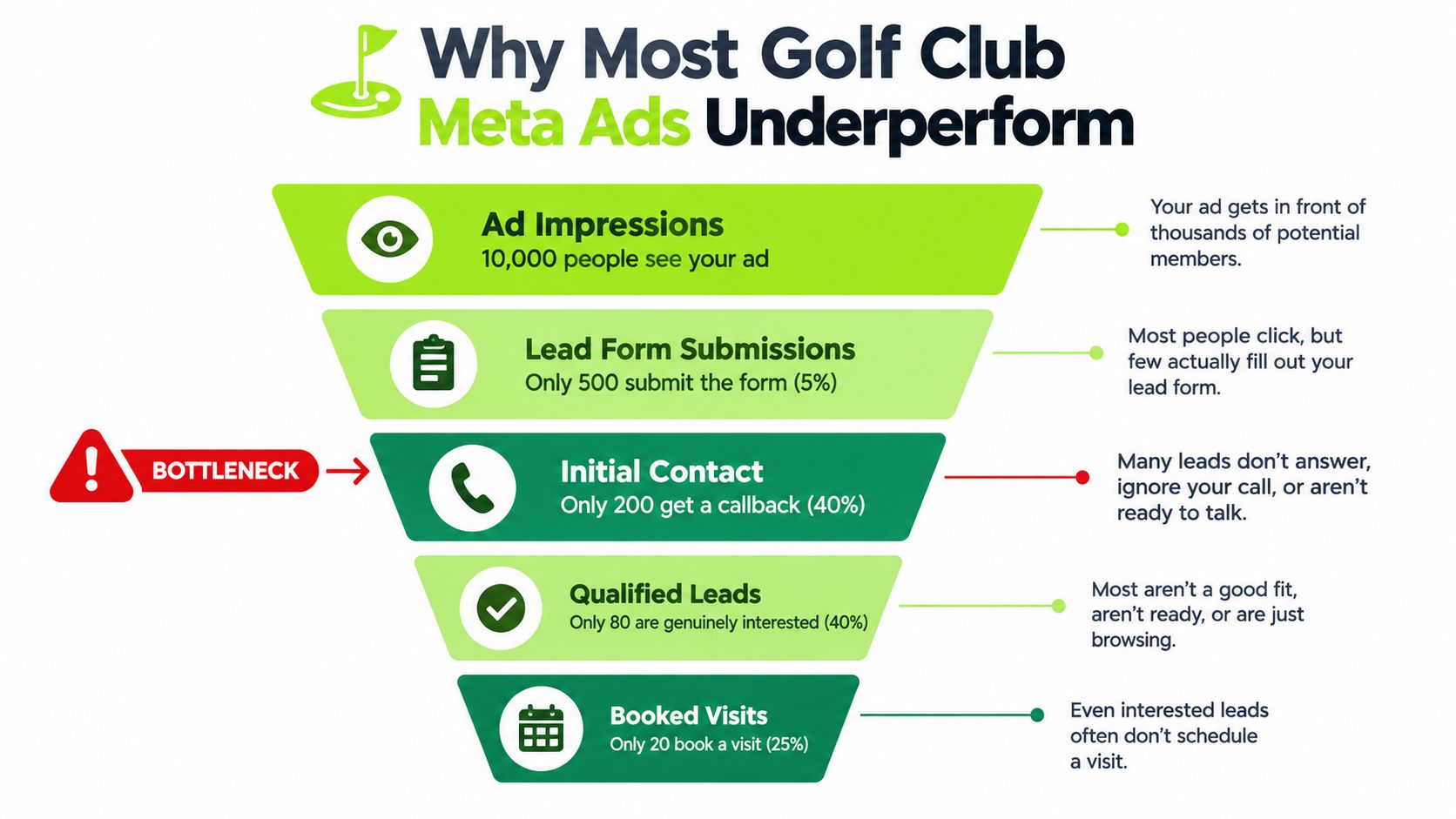
The real bottleneck sits after the form
A familiar pattern looks like this. The ads work well enough to generate evening enquiries. The form arrives at 9pm. Nobody sees it until the next morning. The secretary is busy. A callback happens late, or not at all. By then, the person has forgotten the ad, spoken to another club, or lost momentum.
That isn't a traffic problem. It's an operations problem.
Practical rule: If your lead handling depends on one person checking an inbox, your Meta campaign is fragile before it even launches.
This matters even more because clubs already rely heavily on trust-led acquisition. Hillier Hopkins' 2024/25 survey found 71% of members' clubs used member referrals, up from 64% in 2023, as shown in the Hillier Hopkins Golf Clubs Report 2024/25. Paid social rarely converts like a warm recommendation on first contact, so clubs need a proper nurture path, not just a lead form.
The market isn't short of reach
Many clubs still treat social as optional. That creates an odd split. Attention is available, but execution is patchy.
In a survey of 602 golf clubs in England, only 75% said they used social media such as Facebook, Twitter, and Instagram to promote their business, while 89% used a club website regularly. The same report said social usage had risen by 15 percentage points since 2014, according to this UK golf club marketing summary. Clubs that still rely on website traffic and referrals alone leave demand uncaptured.
For a fuller view of why enquiry handling matters more than promotion volume, GolfRep has also written about why most golf club marketing fails.
What works better than the spend-more loop
The better model is a pipeline model.
Instead of asking, "How do we get more leads?", ask:
- Who qualifies this lead first
- How quickly the first response goes out
- What happens if they don't reply
- How booked visits are tracked
- Which campaigns create members
A golf club Meta ads programme performs properly when every lead is acknowledged fast, qualified, routed clearly, and followed through to a visit or a no-fit outcome. That's where conversion gains usually come from. Not from endlessly tweaking headlines in Ads Manager.
Building the Right Meta Audience for Membership Enquiries
Audience build is where many membership campaigns go off course. Clubs either target too broadly and pay for weak intent, or they target too narrowly and starve delivery.
For most UK clubs, the cleanest starting point is local geography first, then intent signals second.
Start with local relevance
A membership campaign should usually begin with a tight radius around the course. In practice, that often means 15 to 25 miles depending on road access, pricing, competition, and whether the club is private, proprietary, or part of a resort.
Then split that local market into distinct audience layers rather than pushing everything into one audience.
| Audience Layer | Example Inputs | Expected Scale | Best Use Case |
|---|---|---|---|
| Cold radius | People living within a realistic drive-time catchment around the club | Broad local pool | Core membership awareness |
| Interest stack | Golf, country clubs, competitive golf, premium sport, lifestyle signals relevant to the area | Medium | Finding non-members with visible golf intent |
| Member-based lookalike | Existing member email list, high-value segments, recent visitors | Controlled | Prospecting with stronger quality signals |
| Website retargeting | Membership page visitors, pricing page visitors, lead form openers | Smaller | Bringing back warm traffic |
| Enquiry exclusion layer | Past recent enquirers and current members | N/A | Preventing wasted spend |
Build layers that reflect quality, not just volume
Interest targeting still has a place for golf club Meta ads, especially when a club has thin first-party data. Useful stacks often include golf, country clubs, competitive golf, premium sport, and local lifestyle cues that fit the club's pricing and positioning.
Lookalikes should be built from current members, recent visitors, or higher-value membership segments where possible. Raw lead lists are usually noisy. If your seed audience is full of weak enquiries, Meta will find more weak enquiries.
A sensible build is:
- Cold radius ad set for broad local coverage
- Interest ad set for behaviour and affinity signals
- Lookalike ad set based on stronger first-party lists
- Retargeting ad set for site visitors and engaged users
Exclude recent enquirers and existing members where data quality allows. If someone has already enquired in the recent window, they need follow-up, not more acquisition ads.
Tie audience design to later scoring
Audience choices shouldn't sit in isolation. They should feed later CRM scoring and reporting.
If one ad set pulls broad local curiosity and another pulls serious players who view pricing pages, those leads shouldn't be treated the same way once they hit the pipeline. Segmentation matters commercially, not just inside Meta. GolfRep's own thinking on what market segmentation looks like in practice lines up closely with this. Better audience inputs make later qualification and conversion analysis far more useful.
One final caution. Don't let detailed targeting expansion or Advantage+ audience settings flatten your structure too early. They can work well, but only after you've established which base audiences produce qualified conversations, not just cheap submissions.
Creative Briefs That Mirror Referral-Led Trust
The strongest golf club Meta ads rarely look like ads. They feel more like a quiet recommendation from someone the prospect could imagine playing with.
That matters because referral still shapes how people judge clubs. If your creative feels salesy, polished, and generic, it clashes with how membership decisions are made.

Three trust signals worth briefing into every ad
The brief should usually include three things.
- A known face. A member, PGA professional, membership manager, or familiar club representative gives the ad social credibility.
- A recognisable course moment. First tee, practice ground, clubhouse coffee after a round, junior coaching, or a quiet early-morning fairway.
- A plain-language perk. Not vague prestige. Something tangible such as flexible membership, coaching access, competition calendar, family use, or weekday playing value.
Stock imagery usually weakens all three. It says nothing about your club and often signals "advert" before the message has a chance to land.
A good membership ad should feel like someone saying, "You'd probably like it here," not "Limited spaces, enquire now."
Format briefs that work in practice
Short-form video tends to work well when it's simple. A member walking to the first tee and speaking naturally can outperform a glossy promo because it feels believable. Keep the script grounded. Why they joined. What surprised them. What sort of golfer fits.
Carousel ads are useful when the club has several strong visual proof points. A clean sequence is course, clubhouse, lesson time, member social moment. Each card should answer one quiet objection.
Lead form copy should stay short and ask one qualifying question instead of five. If you ask too much upfront, completion drops. If you ask nothing useful, the club ends up chasing curiosity rather than intent.
If you want a solid framework for building better creative briefs before production starts, this editorial planning tool guide is a useful reference. The principle carries over neatly to paid social. Better briefs produce more usable first drafts, whether you're briefing content or membership ads.
Match the message to the audience layer
Creative should change by audience, not just by format.
A cold local audience may respond best to broad trust and atmosphere. A warm retargeting group that has already looked at pricing may need reassurance about fit, value, or the joining process. A lookalike audience based on active members may respond to competitive play, community, or practice access.
That alignment is what makes golf club Meta ads feel relevant instead of repetitive.
Campaign Structure, Budget Split and Bidding Choices
Most clubs cram everything into one campaign and then wonder why the results are messy. Prospecting, retargeting, and conversion intent are different jobs. They should be structured that way.
The simplest useful setup separates cold discovery from warm consideration and hot decision traffic.
Keep each campaign honest
A practical structure for a membership programme usually looks like this:
| Campaign | Audience Stage | Objective | Suggested % of Budget | Key KPI |
|---|---|---|---|---|
| Prospecting campaign | Cold | Lead generation or lead form open intent | 70% | Qualified enquiries |
| Retargeting campaign | Warm | Re-engagement with taster visit or membership interest action | 20% | Booked visit intent |
| Membership conversion campaign | Hot | Bottom-funnel conversion action | 10% | Confirmed sales conversations or booked tours |
The 70/20/10 split is a good operating model for many clubs because it protects prospecting while still reserving budget for people who already know the club.
Within that structure, separate cold radius, interest, and lookalike ad sets if the account has enough volume. If budget is tight, merge carefully, but don't let Meta collapse everything into retargeting. Clubs often think retargeting is winning when it is harvesting people warmed up elsewhere.
Bidding and optimisation choices
For lead volume campaigns, lowest cost is usually the cleanest place to start. If the club has enough stable conversion data, cost controls can help stop delivery drifting into weaker inventory.
Once a campaign has a meaningful baseline of 30+ conversions, target cost becomes more realistic as a control mechanism. Before that point, it often adds restriction before the system has enough learning.
There is also a point where lead forms stop being the best optimisation event. Native forms reduce friction, which is useful early on. But when quality becomes the issue, landing page optimisation can improve intent because the prospect has to take an extra action and absorb more context before enquiring.
Budget decisions should follow evidence
A lot of clubs still make budget choices by feel. That's usually where waste enters.
One of the more useful habits is to move from guesswork to real decisions by treating audience and creative testing as a discipline rather than a hunch. That means clear comparisons, enough runway to read outcomes, and judging results on downstream pipeline movement, not just ad-level CPL.
Decision test: If a campaign generates cheap leads but almost none book a visit, it isn't a cheap campaign. It's an expensive distraction.
For clubs aiming to generate 20 to 40 qualified enquiries per month, structure matters more than complexity. Keep the campaigns distinct. Protect warm audiences. Don't let one good CPL hide a poor enquiry-to-visit rate.
Tracking, CRM and Automated Lead Qualification
Most membership growth is won or lost.
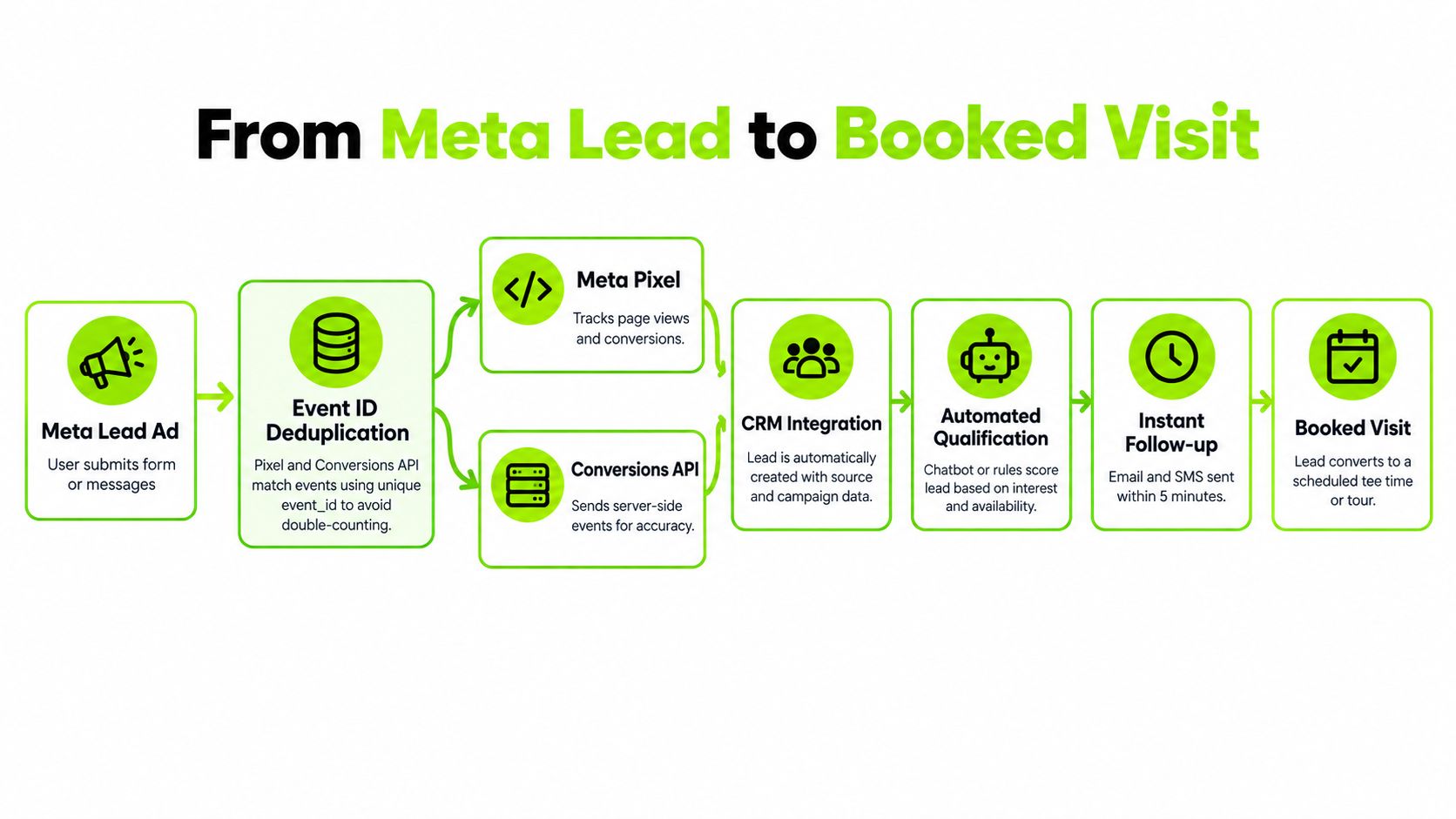
A Meta lead that lands in an inbox is not a system. It's an interruption. A club needs the data flow, the routing logic, and the response sequence already in place before the campaign goes live.
Track the lead properly from the start
At minimum, a club should capture:
- Source data such as Meta, campaign, ad set, and creative
- UTM values for reporting consistency across forms and pages
- Contact details with one or two qualifying fields
- Lifecycle stage from new enquiry to booked visit to joined member
- Outcome tags such as no answer, not local, price mismatch, or revisit later
If you're using a landing page rather than native lead forms, Meta Pixel and Conversions API need to work together cleanly. Deduplication via event_id matters because it avoids double-counting the same conversion when browser and server events both fire.
Server-side tracking is particularly important for today's environment because browser-only tracking is less reliable. Clubs that skip this often end up optimising to incomplete data and then wonder why Ads Manager doesn't match CRM reality.
A proper setup can feed systems like HubSpot, Salesforce, ClubWise, or a specialist golf workflow. GolfRep is one option clubs use when they want the ad source, routing, and nurture process tied into a single golf-specific growth system rather than handled manually in separate tools. The important point isn't the brand name. It's that the lead arrives with enough context to act on immediately.
For a deeper implementation view, GolfRep also covers the mechanics in its guide to conversion tracking setup.
Response speed changes the outcome
The first few minutes matter more than most clubs realise.
UK service-business research published by Automation Clarity Hub on lead response timing says an automated response should be sent within seconds, with human follow-up within 5 minutes during working hours, and that follow-up over the next 48 to 72 hours can recover leads that don't respond immediately.
Made Smarter's UK lead-response report found businesses replying within 5 minutes are 100 times more likely to connect with prospects than those waiting 30 minutes, with estimated conversion potential of 70 to 85 percent within 5 minutes versus 50 to 60 percent at 30 minutes, according to The Lead Response Crisis report.
The problem is that many firms still don't respond this quickly. A UK study found only 9.7 percent of firms responded within 5 minutes, while 46.4 percent replied within an hour, as reported in the Survey Booker lead response study.
Automate qualification before the club falls behind
The practical fix is straightforward:
- Send an instant acknowledgement by SMS, WhatsApp, or email.
- Ask two short qualifying questions such as postcode and playing frequency.
- Route high-intent leads straight to the membership manager's calendar or call queue.
- Tag lower-intent leads into a nurture sequence rather than leaving them untouched.
Disqualifiers shouldn't delete a lead. They should organise it. Common examples include being outside the catchment area, wanting only casual pay-and-play, not being ready this season, or looking for a category the club doesn't currently offer.
Clubs don't usually need more leads first. They need one place where every enquiry arrives, a clear owner, and visible follow-up.
That aligns with broader UK guidance. Visionary Marketing's lead response guidance recommends a centralised system, clear process ownership, and tracking of what has and hasn't been answered. That's the difference between manual chasing and a predictable pipeline.
Measuring Success Beyond Cost Per Lead
Cost per lead is useful, but it is not the score that matters.
A golf club can produce an attractive CPL and still lose money on the campaign if too few enquiries turn into visits, or if the wrong prospects keep entering the system. The more useful numbers sit further down the journey.
Use a pipeline view, not a platform view
A better measurement stack looks at:
- Cost per qualified enquiry
- Cost per booked taster or visit
- Cost per converted member
- Lead-to-contact rate
- Contact-to-visit rate
- Visit-to-member rate
That last group matters because each stage diagnoses a different failure. If contact rate is low, lead handling is weak. If visits are low, qualification or follow-up is weak. If visits happen but joins don't, offer fit, pricing, experience, or sales conversations need work.
The best example in the available golf data makes the point clearly. A UK golf membership case study reported 71 qualified leads from £225 spend at £3.20 per lead, with 21 converting to 7-day members, described as roughly a 30% enquiry-to-member conversion rate. The same source also reported campaigns with 644 leads from £1,275 spend at £1.97 per lead and 410 leads from £1,884 at £4.59 per lead, as shown in The Revenue Club golf Meta ads case study. The lesson isn't that cheap leads always win. It's that qualified conversion is the benchmark worth caring about.
A practical KPI table
| Metric | What It Measures | Typical Range for UK Golf Club | Action Trigger |
|---|---|---|---|
| Cost per lead | Top-of-funnel form efficiency | Varies widely by audience and offer | Ignore in isolation if booked visits are weak |
| Cost per qualified enquiry | Lead quality after basic screening | Should improve as targeting and creative mature | Rising sharply without better visit rate |
| Lead-to-contact rate | Whether the club reaches enquirers promptly | Depends heavily on response systems | Low rate signals handover or speed failure |
| Contact-to-booked-visit rate | Strength of qualification and call handling | Varies by club proposition and process | Low rate signals script, timing, or fit issue |
| Visit-to-member rate | Sales effectiveness and offer alignment | Strongest marker of true campaign value | Low rate signals club experience or audience mismatch |
| Cost per converted member | Full commercial outcome | The main number to manage | Rising trend over time requires structural review |
Review on three cadences
Weekly review should focus on speed, lead volume quality, and obvious campaign issues.
Monthly review should compare audiences, creatives, and booked-visit outcomes.
Quarterly review should connect ad spend to joined members and ask a simple question. Which audience-creative combinations produce real membership movement, and which only produce admin?
England Golf membership rose from 730,602 in 2024 to 750,071 in 2025, a 2.66% increase, with junior membership up 34% from 46,028 to 61,483, according to Golfshake's report on golf club membership in 2025. Demand exists. The clubs that benefit most won't just generate enquiries. They'll track which ones become members.
Your 90-Day Golf Club Meta Ads Plan
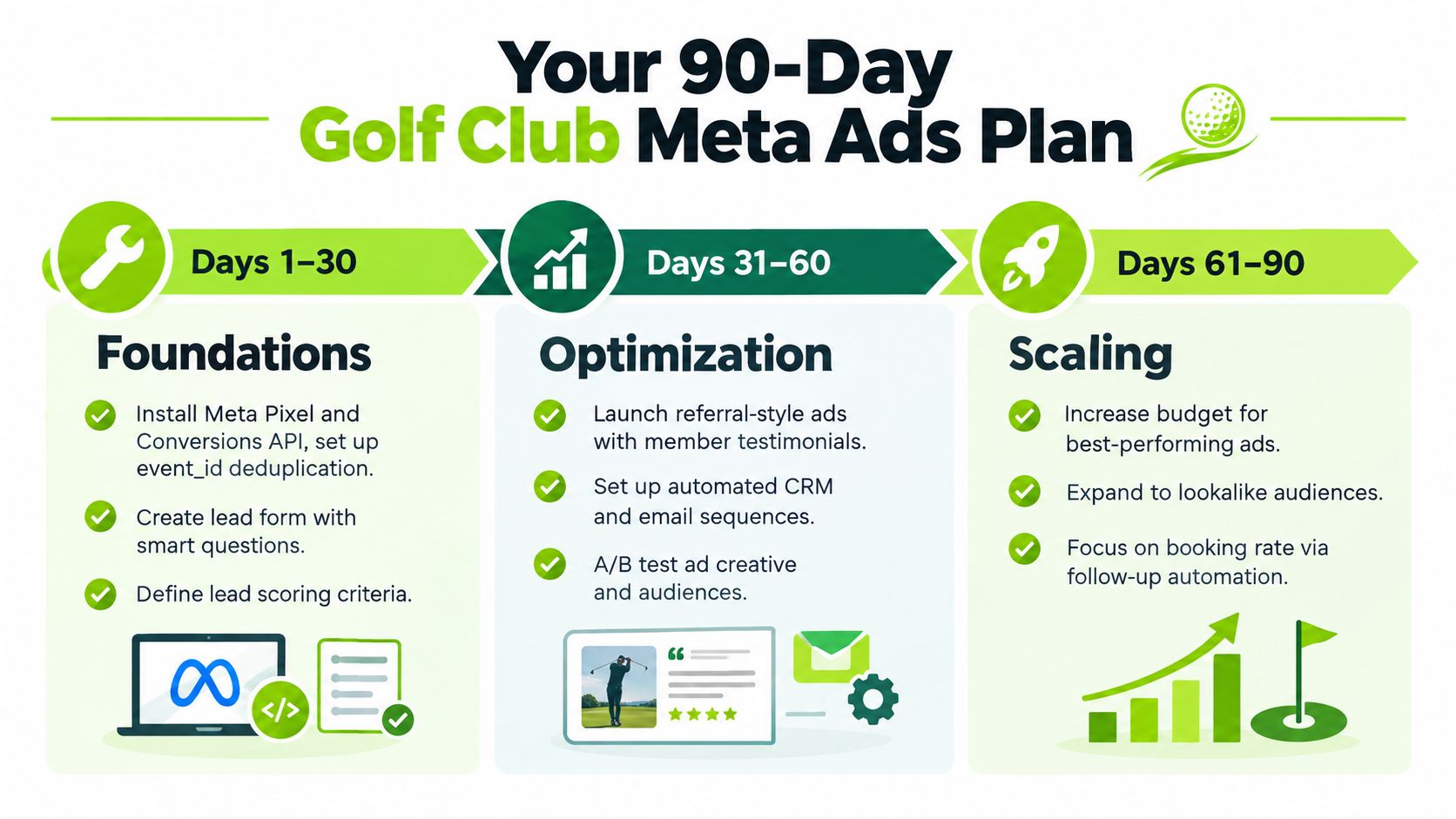
A good Meta programme for a golf club isn't a one-off burst. It's a repeatable operating rhythm.
The first ninety days should build the system before chasing scale.
Days 1 to 30
Install Meta Pixel and Conversions API. Make sure event deduplication is working. Connect lead capture into the CRM and define the stages from new enquiry to booked visit to joined member.
Build the first audience layers and produce a small batch of referral-style creative. Keep the forms short. Add one useful qualifier. Make sure every enquiry has a clear destination and owner.
Days 31 to 60
Launch with a controlled split between prospecting and warmer traffic. Turn on automated SMS or email acknowledgement immediately after form submit.
Review the first signs of quality, not just lead count. Which audience sends reachable people. Which ads create replies. Which leads book visits.
Days 61 to 90
Read the data through the CRM, not just Meta. Shift spend towards the audience and creative pairings that produce qualified visits and joined members.
Prune weak ad sets, refresh tired creative, and lock in a weekly reporting rhythm tied to cost per converted member. Then repeat the cycle next season with better inputs, cleaner data, and less manual chasing.
GolfRep helps UK golf clubs build this properly, with Meta lead generation connected to CRM tracking, automated follow-up, and clear visibility from enquiry to membership outcome. If you want your golf club Meta ads to produce booked visits and members rather than a pile of unworked leads, visit GolfRep.
Ready to tap into our proven growth system?