Boost Golf Club Advertising: Get More Members

Most advice on golf club advertising starts in the wrong place. It tells clubs to chase more clicks, broaden reach, post more often, or increase ad spend. That sounds sensible until you look at what happens after an enquiry comes in.
At GolfRep, we see the same pattern again and again across UK clubs. Interest exists. People visit the site, ask about membership, request a society package, or reply to an offer. Then the process breaks. Emails sit unread. Calls aren't logged. Nobody knows who followed up. A promising lead goes cold, not because the advert failed, but because the club had no reliable system to carry that lead through to a booked visit and a signed member.
That changes how golf club advertising should be judged. The question isn't just whether an advert can generate attention. The question is whether your club can turn that attention into revenue in a repeatable, visible, organised way.
The Real Problem with Golf Club Advertising
Most clubs don't have a lead generation problem first. They have a lead handling problem.
A committee member might believe the answer is more Facebook ads. A manager might want Google Ads switched on next week. A membership secretary might already be juggling form fills, voicemail messages, website emails, and handwritten notes from front-of-house. Adding more volume into that setup doesn't fix the issue. It usually makes it worse.

Club managers and committees often suffer from a severe lack of lead visibility, meaning they can't clearly see how many genuine prospects are in the pipeline, what stage each person is at, who followed up last, or why a lead went cold, as outlined in GolfRep's view on why most golf club marketing fails.
What the leaky bucket looks like
In practical terms, it usually looks like this:
- Enquiries arrive in different places. The website sends one email, Facebook sends another, and phone calls stay with whoever answered.
- Nobody owns the next step. A prospect asks about membership on Friday evening and waits until Monday for a reply.
- Follow-up depends on memory. If the person handling it gets busy, the lead disappears from view.
A club can be busy with enquiries and still lose revenue every week.
The core opportunity isn't just generating more leads. It's building a predictable system that ensures every enquiry is nurtured efficiently, a point GolfRep has made clearly in its work on club marketing systems and lead visibility.
What works instead
Good golf club advertising starts with operational honesty. Before adding spend, a club needs to know:
| Question | Why it matters |
|---|---|
| Where do all enquiries land? | If leads enter different inboxes, they get missed |
| Who replies first? | Ownership improves speed |
| What happens after the first reply? | Most conversions happen in follow-up, not the first touch |
| Can anyone see pipeline status? | Visibility stops good leads from going cold |
When clubs fix those basics, advertising becomes far more effective. Without that, paid traffic is just pouring water into a bucket with holes in the bottom.
Defining Your Ideal Member and Crafting Your Message
Weak golf club advertising often starts with vague targeting. "Local golfers" isn't a target. It's a catch-all phrase that usually produces bland campaigns and generic copy.
A better starting point is clarity. Who does the club want more of, and why are those people a fit?
Build one clear member picture at a time
The easiest way to sharpen your message is to define one ideal member profile before writing a single advert. That means more than age and postcode. It means understanding what that person is trying to solve.
A useful framework is to ask:
- Life stage. Are they a young professional, a retired golfer, a family decision-maker, or a society organiser?
- Playing pattern. Do they want weekend competition golf, flexible access, casual midweek rounds, or a regular social group?
- Decision trigger. Are they leaving another club, returning to golf, starting as a beginner, or looking for better value in a local area?
- Club fit. Do they care most about community, course quality, practice facilities, convenience, or a welcoming environment?
If your team needs a simple refresher on persona thinking, Clepher on understanding customers is a useful reference because it pushes clubs beyond broad demographics and into buying motives.
Match the message to the person
Once the profile is clear, the advert should speak to that specific person. Not everyone wants the same club for the same reason.
A younger working golfer may respond to convenience and flexibility. They want to know if joining fits around work, family life, and limited time. Messaging for them should be practical. Show easy access, straightforward membership routes, and a clear first step such as a visit or trial conversation.
A retired golfer may care more about routine, community, and belonging. They often want confidence that the club feels friendly, active, and socially rewarding. In that case, the message should emphasise atmosphere, regular golf, and the experience of becoming part of the club rather than purchasing mere access to a course.
Practical rule: If the same advert could describe ten different clubs, it won't persuade the right prospect to choose yours.
Questions that improve ad copy fast
Before approving creative, ask these questions internally:
- Why would this person enquire now?
- What concern might stop them?
- What proof or reassurance does the advert give?
- What single action do we want next?
That last point matters. Too many adverts ask people to do too much. View memberships, browse the course, read the history, check the diary, call the office. Strong campaigns usually ask for one clear next action.
Examples of sharper positioning
Here are the kinds of differences clubs should make in their messaging:
- For a flexible younger member. Focus on access, ease, and a straightforward path to explore membership.
- For a community-led older member. Focus on club life, regular golf, and the social side of belonging.
- For a family-minded prospect. Focus on atmosphere, welcome, and how the club fits wider lifestyle needs.
- For society and group buyers. Focus on organisation, reliability, and a package that feels easy to book.
The goal isn't clever wording. It's relevance. Good golf club advertising feels like it understands the person reading it. That's what earns the enquiry in the first place.
Building Your Channel Mix for Local Dominance
Most clubs don't need to be everywhere. They need to be visible in the right places, inside the right radius, with a role for each channel.
That matters because each channel solves a different problem. Search captures intent. Social creates familiarity. Local SEO builds ongoing visibility. Email helps convert and re-engage people who already know you.

In the UK golf sector, over 60% of all golf-related searches occur on mobile devices, which makes mobile-friendly advertising a foundational requirement for golf club advertising. Campaigns that neglect mobile responsiveness risk missing the main way golfers discover clubs, and local search is typically the first channel clubs need to fix, according to Digital Caddie's digital marketing guide for golf clubs.
What each channel is actually for
A common mistake is expecting every channel to produce the same outcome. That's not how the mix works.
| Channel | Primary role | Best use case | Common mistake |
|---|---|---|---|
| Google Ads | Capture high intent demand | Membership, visitor golf, society enquiries | Sending traffic to a weak page |
| Facebook and Instagram Ads | Build awareness and generate local interest | Promoting open days, trial routes, seasonal campaigns | Targeting too broadly |
| Local SEO | Show up consistently in local discovery | Membership and visitor searches in your area | Treating it as a one-off task |
| Email marketing | Nurture and reactivate leads | Following up enquiries and re-engaging lapsed prospects | Only sending generic newsletters |
Search first, then support it
If someone is actively searching for a golf club nearby, that's high-value intent. Those people don't need to be convinced golf exists. They need to be shown the right club and given a clear route to enquire.
That's why search-led activity usually deserves priority in local golf club advertising. Social can support that effort well, but it shouldn't replace it when the club hasn't yet locked down local search visibility.
Social works best with local specificity
Paid social tends to perform best when clubs stop trying to look polished and start looking relevant. Course updates, real club atmosphere, beginner-friendly offers, event promotion, and membership messaging designed for a local audience usually outperform generic branding.
For clubs that also attract groups, visitors, or tour-related traffic, it helps to understand how local organisers assess destinations and experiences. Live Tourney's insights for golf tour organisers are useful here because they highlight the local planning mindset behind group golf decisions.
The strongest channel mix isn't the loudest one. It's the one where each channel has a job and every enquiry lands in a process that can convert it.
The non-negotiable mobile check
Before spending more, test your own journey on a phone. Search your club name, click your advert, load the page, and try to enquire. If that process feels awkward, slow, or unclear, the problem isn't channel choice. It's conversion friction.
Local dominance doesn't come from being everywhere. It comes from being easy to find, easy to trust, and easy to contact.
Budgeting Smarter for Predictable Growth
Most clubs underinvest, misallocate, or spread budget too thinly across the year. All three hurt results.
The bigger issue isn't just how much is spent. It's whether the budget reflects how golfers discover clubs and when they are most likely to enquire.

A practical benchmark for UK golf club advertising is to weight 50% to 60% of total spend toward SEO and search advertising. For clubs with a £10,000 annual budget, around £500 per month should go to ad spend, with 70% of that concentrated in the first half of the year, as outlined in GolfRep's guide on golf club marketing costs.
Why flat monthly budgets don't help
Many clubs default to an even monthly spend because it feels tidy. It also ignores seasonality.
In practice, membership demand isn't evenly distributed. Interest tends to build when golfers are planning the season, comparing options, and deciding where to commit their time and money. If your budget is diluted across the full year, your strongest window gets underfunded and weaker periods get too much support.
That doesn't mean spending recklessly in spring. It means recognising that timing affects return. The same budget can perform very differently depending on when it is deployed.
A better way to think about allocation
There are two budget decisions that matter most.
First, decide how much of the total budget is building visibility through search. If search and local visibility are underfunded, the club often misses people already looking for exactly what it offers.
Second, decide how much of the active ad budget should be front-loaded. For many clubs, that early-year weighting is the difference between building a healthy pipeline and trying to force results later.
A simple planning model looks like this:
- Foundation spend. Local SEO, website conversion improvements, and core search visibility.
- Active campaign spend. Paid search and paid social around membership pushes, open days, and society demand.
- Nurture spend. Email and CRM setup so leads don't disappear after first contact.
The trade-off clubs need to accept
There is always a temptation to push more budget into awareness because it looks active. But awareness without capture and follow-up often creates noise rather than revenue.
Clubs don't need a bigger budget nearly as often as they need a better sequence for spending the budget they already have.
That also means some common internal debates need reframing. The question isn't "should we spend on ads or SEO?" The practical answer is that the club needs both, but in the right order and proportion.
Budgeting around a pipeline, not a calendar
A sensible budget should follow pipeline logic. Spend more when the club can turn demand into conversations, visits, and decisions. Spend less when operational capacity is lower or the market is quieter.
If a club is still relying on a flat plan because "that's how we've always done it", the budget isn't strategic. It's administrative.
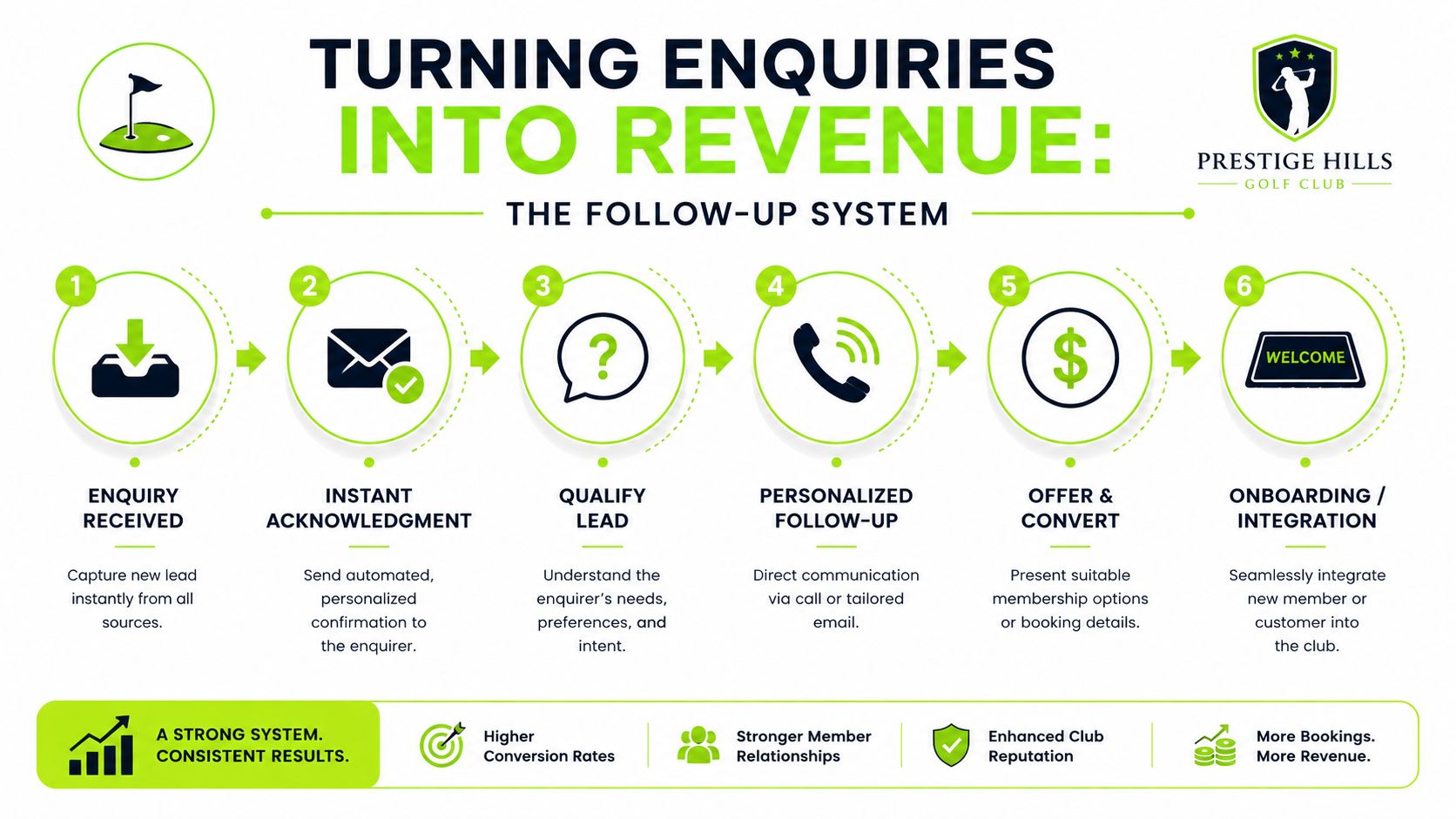
Turning Enquiries Into Revenue with a Follow-Up System
At this point, most golf club advertising wins or loses.
If a club responds slowly, has no follow-up sequence, and can't see where a lead sits in the pipeline, advertising performance will always look worse than it should. Not because demand isn't there. Because the handover from marketing to conversion is broken.
For UK golf clubs, the average response time to membership enquiries is 47 hours and 32 minutes, and a membership lead that receives a response within one hour is five times more likely to convert than one that waits 24 hours. By 48 hours, the odds of conversion drop significantly, according to GolfRep's guide to building a golf club follow-up system.
The manual process that keeps failing
Most clubs know they should follow up better. The issue is that "should" isn't a system.
A typical broken process looks like this:
| Stage | Manual reality | What goes wrong |
|---|---|---|
| Enquiry arrives | Email lands in a shared inbox | Nobody owns it |
| First response | Sent when someone notices | Response is delayed |
| Next step | Staff member intends to call later | No reminder, no structure |
| Ongoing follow-up | Notes kept in inbox or on paper | Lead goes cold without visibility |
| Outcome tracking | Handled informally | The club can't see conversion gaps |
That process relies on good intentions and spare time. Most clubs don't have enough of either.
The system that actually converts
A working follow-up system is simple, but it has to be consistent.
Capture every enquiry centrally
Website forms, social leads, email replies, and phone enquiries should all feed into one place. If the club can't see all leads in one view, it can't manage them properly.Acknowledge immediately
An instant response doesn't need to be long. It needs to confirm receipt, reassure the prospect, and explain what happens next.Assign clear ownership
One named person should own the lead until it moves stage. Shared responsibility usually means no responsibility.Use structured follow-up
If the prospect hasn't booked a visit or replied, the system should prompt the next action. That might be a call, a personal email, or a message tied to the original enquiry.Track stage movement
New enquiry, contacted, booked visit, attended, decision pending, joined, lost. If those stages aren't visible, the club can't improve the process.
Speed matters, but consistency matters more
Fast first response is critical. But a quick reply on its own doesn't solve the bigger problem. Many prospects don't convert on the first touch. They convert after a second or third interaction, often once they feel understood and see a path that fits them.
That's where a basic CRM becomes so valuable. Not because it's glamorous, but because it removes guesswork. It tells the team who needs a call, who was invited to visit, who attended, and who drifted away.
At GolfRep, that combination of lead generation, structured follow-up, and CRM visibility is usually what turns inconsistent campaigns into a predictable pipeline.
Field note: Clubs often ask for more leads when the real fix is faster replies, visible stages, and follow-up that doesn't rely on memory.
Don't ignore lapsed prospects
One of the most overlooked areas in golf club advertising is what happens to people who enquired but didn't join.
Some weren't ready. Some got distracted. Some liked the club but needed another prompt. Those leads often sit untouched because the club is focused on the newest enquiry rather than the warm list it already owns.
That is costly. Segmented email campaigns targeting lapsed members or infrequent visitors generate 760% more revenue than generic broadcasts, according to ProfileTree's analysis of digital marketing strategies for UK golf clubs.
What reactivation should look like
A strong reactivation process doesn't need to be complicated.
- Segment by context. Separate former members, trial visitors, society prospects, and cold membership enquiries.
- Send relevant follow-up. The message should reflect what they originally showed interest in.
- Give a low-friction next step. Invite them to revisit, ask a question, or discuss current options.
- Keep records updated. If someone re-engages, they move back into the active pipeline immediately.
Many clubs leave revenue behind. They keep paying for new attention while old interest sits dormant in an inbox.
The real purpose of the system
A follow-up system isn't admin for the sake of admin. It's the mechanism that turns golf club advertising into something reliable.
Without it, the club doesn't know what happened to its leads. With it, the club can see where prospects stall, where staff need support, and which campaigns are feeding real revenue.
That's the shift that matters. Better advertising doesn't start with louder campaigns. It starts with a process that makes every valid enquiry count.
Measuring Success and Optimising Your Pipeline
A lot of clubs still judge golf club advertising by the easiest numbers to find. Clicks. Impressions. Reach. Likes. Those numbers can tell you whether people noticed something, but they don't tell you whether the club made money from it.
That distinction matters because vanity metrics create false confidence. A campaign can look busy and still fail commercially.
Track the numbers tied to revenue
High-performing clubs measure outcomes, not surface activity. Real success is measured in revenue, not traffic or likes, and revenue-centric KPIs like cost per acquisition and enquiry response time drive growth more effectively than vanity metrics, as noted in this discussion on tracking outcomes in golf club marketing.
The most useful questions are straightforward:
- How many enquiries did the campaign generate?
- How quickly did the club respond?
- How many enquiries turned into booked visits or meaningful sales conversations?
- How many of those became paying members or confirmed revenue?
A simple pipeline dashboard
Clubs don't need an elaborate reporting setup to improve. They need a visible one.
A useful dashboard should show:
| KPI | Why it matters |
|---|---|
| Enquiry volume | Tells you whether campaigns are creating real interest |
| Response time | Exposes the operational bottleneck quickly |
| Booked visit rate | Shows whether follow-up is working |
| New member conversion | Connects activity to commercial outcome |
| Cost per acquisition | Reveals whether spend is efficient |
If a club can't see where leads are lost, it can't improve the pipeline. It can only guess.
Optimisation starts with diagnosis
When results dip, many advertisers blame the advert first. Sometimes that's right. Often it isn't.
If click volume is healthy but booked visits are low, the issue may be the landing page or response handling. If visits happen but joins stay weak, the issue may be the sales conversation, the offer, or the club's onboarding process. Measurement helps the team improve the right part of the pipeline instead of changing everything at once.
The goal isn't more reporting. It's clearer decisions.
GolfRep helps UK clubs build that kind of visibility and control by combining lead generation with structured follow-up and CRM-led pipeline management. If your advertising is producing interest but not enough signed members, GolfRep is worth exploring.
Ready to tap into our proven growth system?