Golf Club SEO: A UK Guide to Local Search Visibility

Google Search reached 83% of UK online adults in May 2024, roughly 41.3 million people, and nine in ten UK online adults used at least one of the ten highest-reaching search engines that month, according to Ofcom's Online Nation 2024 report. Search is not a niche channel for golf clubs. It is the default way a stranger finds out a club exists.
That reach explains why search belongs in the commercial plan. It doesn't tell anyone what to do on Monday morning. A club in Shropshire isn't competing for 41.3 million people. It's competing for the few thousand households within a 25-minute drive who might take a trial membership, book a society day, or put a child into a Saturday junior session.
So the useful unit of golf club SEO is the page, not the keyword. Each page is a route: one search, one answer, one conversion action, and one revenue line behind it. The membership page either produces tour bookings or it doesn't. The society page either produces quote requests or it doesn't. Rising national participation will never tell you which of those is true for your club.
What Golf Club SEO Covers and Where to Start
Golf club SEO is the work that puts a club in front of a golfer, a visitor or a society organiser at the moment they search for what the club sells, and turns that visit into an enquiry the office can act on. That definition is deliberately narrow. It rules out rankings with no page behind them and content written for other marketers rather than for someone deciding where to play on Saturday.
The competitive set is larger than most committees assume. England had 1,735 affiliated golf clubs and more than 730,000 golf-club members in 2025, according to England Golf data reported by The Golf Business. Several of those clubs sit within half an hour of yours, and a strong reputation in the clubhouse doesn't appear automatically in a search result.
The five areas worth auditing
Each row below is a separate piece of work with its own measure. Treat them as five routes to revenue rather than five technical jobs.
| SEO area | What it covers | Club example | How to measure it |
|---|---|---|---|
| Local search visibility | Google Business Profile and consistent name, address and phone details | Listing shows correct opening hours and visitor access | Calls and direction requests from the profile |
| Website structure | Separate pages for membership, visitor golf, lessons and societies | Membership page links to joining details and waiting list information | Enquiries and bookings per page |
| On-page content | Titles, headings and answers to practical questions | Title names the town and the membership type | Organic visits to each page and their conversion rate |
| Technical health | Mobile speed, crawlable pages and working booking links | Booking button works on a phone | Errors reported in search console |
| Off-site signals | Local directories, society organiser listings and reviews | Review request sent after a visit | Referrals and review count over time |
Where most clubs should start
Start with the weakest row, not the most interesting one. A club that has just rebuilt its website but leaves an unclaimed, half-finished Google Business Profile should correct the listing before rewriting a word of page copy.
The gaps clubs find most often, roughly in the order they cost money:
- Booking links that fail on a phone. A visitor trying to book a tee time at 8pm on a mobile gives up quickly and books elsewhere.
- One contact form serving every enquiry type. Membership, society and lesson enquiries land in the same inbox and get triaged by whoever is free.
- No page for the town the club draws from. The club ranks for its own name and nothing else, which only helps people who already know it exists.
- Titles that name the club but not the product or the place. Nobody searches for a club they haven't heard of.
- Directory listings showing an old email address. The golfer who does enquire gets no reply, and the club never learns why.
Rank your own club against that list before anyone commits budget. The output should be a work order with an owner and a date, not a wish list.
Local Search Checks That Put Your Club on the Map
Most local search work at a club is administrative rather than technical. One person, one afternoon, no developer and no new website.
The reason it pays is that the market is close to home. Welsh Government research reported in ProfileTree's guide to digital marketing for UK golf clubs found that more than 95% of visitors to most golf clubs come from the UK, primarily England. A club chasing national keywords is fishing in the wrong pond. A club that owns its own town and the three towns within half an hour is fishing where the fish are.
Here's the checklist I'd hand to a club secretary who has never opened a search console.
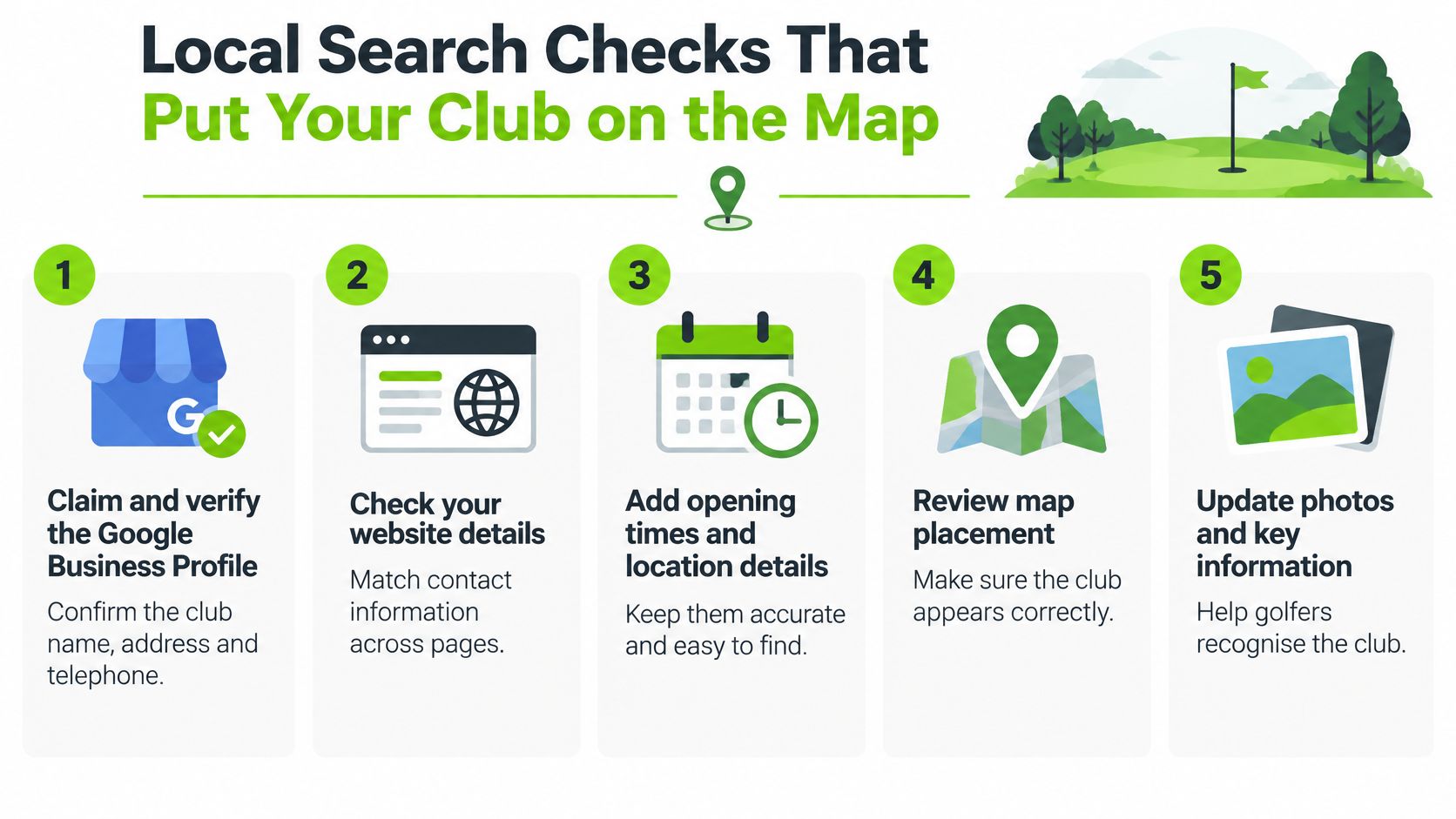
Claim and verify the Google Business Profile, then match the details. Name, address and telephone number on the profile should read exactly as they do on the website, postcode format included. Search engines read disagreement between sources as uncertainty, and golfers read it the same way. This is the highest-return fix at most clubs, and the guide to a golf course Google Business Profile covers the fields that matter most.
Fill in the attributes golfers check. Categories, opening hours (including winter hours and bank holidays), visitor access, parking, dress code, and whether societies can book midweek. Someone choosing between two clubs at 9pm on a Sunday will use these, not the history page.
Refresh the photographs each season. Twelve recent images of the course, clubhouse, practice ground and first tee do more than forty old ones. Photograph what a first-time visitor needs to recognise from the car park. If buggy hire is part of the visitor offer and the fleet is being renewed, Solana EV's guide to selecting a golf car dealer sets out what to compare between suppliers.
Build town or county pages only where you have something useful to say. Drive times from neighbouring towns, the nearest station, which visitor groups are welcome on which days. Two honest pages with real local detail beat six that swap the town name in the title.
Test the catchment from a phone, not a desktop. Search your own town and two nearby towns in a private browser window and record where the club appears in the map pack and in the main results. Repeat on the first of each month. That record is the baseline for everything that follows.
Answer every review in the same voice. Positive and negative, within a week, signed by a named person. The next golfer reads those replies to work out whether the club is friendly, which is the question the review was really asking.
Consistency runs through all six. When one page shows a different address from another, the search engine loses confidence and so does the golfer, and the club pays for it twice.
Website Pages That Match Each Golfer Search
England Golf data cited in GolfRep's analysis of golf club open day marketing indicates that 12.6 million adults in England played some form of golf during the previous 12 months, including 7.3 million on traditional nine- or 18-hole courses and 5.3 million using ranges, simulators or adventure golf. Those groups search differently, arrive with different budgets, and want different things from a website.
Seven page types and the action each one owes you
| Page type | Example query | Conversion action |
|---|---|---|
| Membership | golf club membership near [town] | Joining enquiry or tour booking |
| Visitor green fees | pay and play golf near [town] | Online tee-time booking |
| Lessons | golf lessons [town] | Lesson booking form |
| Societies | golf day venue [county] | Society quote request |
| Junior golf | junior golf [town] | Trial session booking |
| Corporate days | corporate golf day [county] | Event enquiry |
| Facilities and functions | golf club wedding venue [town] | Function enquiry |
Membership is the anchor page. England Golf notes that more than half a million golfers in England play through membership, which means the person comparing clubs has probably belonged somewhere before. They will read for specifics: categories, joining fee, waiting list position, what the subscription includes, how to arrange a visit. Brand language answers none of that.
Visitor green fees and pay and play need the booking link above the fold, because the searcher wants a tee time rather than a tour. The demand is real and moving: GCMA-reported data summarised by Glenmuir recorded more than 10.2 million scores submitted in 2024 and general play rising from 3.9 million to 4.4 million rounds. A pay-and-play page is a revenue page, not an afterthought.
Lessons, junior golf and societies should each have their own form and their own response promise. A single generic form means the junior parent, the society organiser and the prospective member all wait in the same queue. Corporate and function pages need capacity, minimum numbers and typical lead times, because the organiser is working to a date.
Linking is the part clubs skip
Each row is measured on its own conversion action. A page that ranks and never produces a booking or an enquiry is flagged for revision, not celebrated in the monthly report.
Internal links then connect the routes. Membership should link to lessons and junior golf, since those visitors often convert later. The facilities page should link to both. Every page should link back to the booking or enquiry route, and none should dead-end in a paragraph about the club's history. A club with few facilities can combine two rows onto one page, as long as the separate conversion action survives. If the site is being rebuilt rather than edited, the principles in golf club website design apply before anyone writes copy.
Answering the Questions Golfers Ask Before They Enquire
Pages that earn enquiries answer operational questions. They don't describe the course.
The demand behind those questions is shifting faster than most club websites. Golf News reporting on England Golf's 2025 figures records nine-hole submissions up 28%, and female golfers submitting more than 151,000 additional scores, a 14% increase. The same coverage cites a 2025 Golfshake survey in which 30% of golfers said their club had a waiting list and 39% said their club charged a joining fee.
The answers belong on the page, in the golfer's words, before the enquiry form gets in the way.

- Can beginners join this golf club? Answer yes or no in the first line, then explain the first month: group induction, a playing lesson, a nine-hole roll-up on a Tuesday evening. A beginner is checking whether they'll be the only one.
- How long is the waiting list, and what does the joining fee cover? Give the current position and the date it was last reviewed. A fee explained as covering something specific reads very differently from an unexplained number.
- What does membership include? Tee-time access, booking windows, reciprocal arrangements, locker and trolley storage, social membership for a partner. Say what's excluded, because the golfer will find out anyway.
- Can I play nine holes after work? Name the evenings, say whether booking is needed after 5pm, and confirm the kitchen is open. Nine-hole play is how casual golfers test a club.
- Is the club welcoming to women and juniors? Answer with specifics: junior coaching times, women's roll-ups, mixed competitions, the safeguarding contact. Warm adjectives aren't evidence.
- What happens after I enquire? A named person, a stated next step, a time frame.
On response promises: publish a response time only after the club has measured its own for a month. A stated 24-hour reply that takes four days is remembered longer than no promise at all.
The page for golfers who already hold a handicap
The GCMA's analysis of how golf participation is changing recorded 5.75 million WHS scores in the first half of 2025, a 29% year-on-year increase, with more than 55,000 golfers using iGolf without conventional club membership. Those golfers already understand handicaps, competitions and etiquette.
What they don't know is how to move from independent play into a club: what it costs, what they gain, what's expected of them. One page answering that, linked from the membership page, does more than a discount. Give the short answer first, then the operational detail, then a single clear next step.
Off-Site Signals That Bring Golfers and Societies Back
Off-site signals are the places outside the club's website where a golfer or a society organiser checks whether the club is real, current and worth a call. County and regional directories, tourism listings, affiliation details, society organiser sites and reviews all do part of that job.
Most clubs have more listings than they realise, and a third of them are out of date.
- List every directory where the club appears, and mark the stale ones. County union listings, regional golf guides, local tourism sites and any society organiser directory the club pays for. Name, address, telephone, membership categories and package details should agree with the website.
- Put the society package and lead time on every society listing. An organiser choosing between four clubs wants minimum numbers, price bands and how far ahead to book, without phoning four offices.
- Ask for one review after every visit or round. Put the direct link in the booking confirmation email rather than a poster in the changing room, and reply to each review within a week.
- Tag every enquiry with its source. A field on the form or a source value in the CRM shows which listing produced the booking.
Decision rule: if a directory produces no enquiries over two quarters, stop paying for it and move the time to the sources that do.
The review habit is worth more than most paid listings, and the guide to golf club Google reviews covers how to ask, how often, and how to answer a critical one without sounding defensive.
What to Expect and When Results Show
Committees ask when SEO will pay for itself. The honest answer is that search changes need time to be found, read and acted on, and the club's own calendar decides when that shows up.
Record a baseline in the month before work starts: enquiries by page, visits by town, membership sign-ups from organic leads. Review at three, six and twelve months. Judge any page change over a full season rather than a single month, because enquiry volumes follow the calendar.
Compare like with like
Take a club whose membership enquiries dip in January and rise in March. The useful comparison is March against last March, not March against January. Joining follows the club's own cycle too, so record the month each new member first made contact. That date is what shows whether the website contributed or the enquiry came from a member's introduction.
National figures won't settle the question either. England Golf data reported by The Golf Business puts 750,071 club members in England in 2025, a rise of 2.66% on 2024. That number describes the country, not your website. Only your own baseline answers the committee's question.
Clubs reviewing on-site data capture at the same time will find the K Club guest WiFi case study useful reading before choosing a provider.
Measuring Organic Enquiries and Running the Monthly Review
Set the baseline before any work starts, then read six measures each month. That is the whole reporting discipline. Everything else is detail.
Test the economics one page at a time. Say a club spends £1,200 a month on search work and the membership page produces four sign-ups from it. That is £300 per member, which the committee compares with the first-year value of a membership rather than with the cost of printing a leaflet. If the arithmetic doesn't work, the answer is a better page or a better follow-up, not a bigger budget.
| Measure | Where to find it | Decision rule |
|---|---|---|
| Organic enquiries | Enquiry form and phone log, tagged by source | Set a baseline before the work starts and compare monthly |
| Enquiry-to-visit rate | CRM stage data | If falling, review the follow-up step before changing the page |
| Membership sign-ups from organic leads | Membership system | Compare with other channels for the same period |
| Visitor bookings from organic search | Tee-sheet data | Track the weekday share separately from weekends |
| Cost per sign-up | Marketing spend divided by sign-ups | Compare with the first-year value of a membership |
| Retention at twelve months | Membership records | Confirm organic joiners renew at the same rate as other joiners |
Two of those measures need care. Organic enquiries include phone calls, so the office needs the habit of asking how each caller heard about the club and logging the answer. Retention at twelve months exposes whether search brought the right golfers or merely cheap ones.
The six-step monthly routine
- Pull organic enquiries by page and by town. From the enquiry form and the CRM. If the form doesn't capture a town, add the field this week.
- Compare with calls, tour bookings and visitor bookings from the same period. Form fills rising while tours stay flat usually points at the follow-up, not a ranking win.
- Check for breakage. Broken booking links, out-of-date opening hours, pages that fail on a phone. This protects traffic already earned.
- Choose one page change that addresses the largest gap. One, not five, so next month's result is readable.
- Assign a named owner and a completion date. Committees approve; somebody still has to do it.
- Review the result against the baseline the following month.
The one-page committee summary: three numbers (organic enquiries, enquiry-to-visit rate, sign-ups), one change for the month, and one named owner with a date.
For clubs that want position data by town without a manual check each month, a rank tracker API can feed positions into the same report.
Confirm the Next SEO Fix Before You Commit Budget
Three decision rules cover most of the conversations I have with club managers. They're worth applying in order before anyone signs a contract.
If the club has no verified Google Business Profile, or its name, address and telephone details differ across the website and the main directories, fix that first. Nothing else reaches golfers reliably until those agree.
If pages get visits and the phone rings, but enquiries are thin, look at the page's call to action and the follow-up step before commissioning more content. A well-written page with a generic contact form will lose to a plainer page with a working booking link.
If enquiries arrive and few become members, the constraint sits in the sales process. Who owns the enquiry, how fast they reply, what they send, when they follow up. Search is doing its job at that point, and extra traffic only creates more of the same waste.
Most clubs have one constraint at a time. Fix it, measure the result across the review period, then move to the next. GolfRep works with clubs as a system, strategy and partnership for membership growth, enquiry volume and retention, which is useful when the constraint isn't obvious from the inside.
The next action is small and specific: one owner, one page or listing, one measure and one date. Write those four things down before the next committee meeting and the work has somewhere to go.
GolfRep works with golf clubs across membership, visitor golf, societies and events, connecting each page on the site to the enquiry, follow-up and conversion route behind it. If you want to know which page in your own site is closest to producing a paying member, and what it would take to get it there, start with GolfRep.
Ready to tap into our proven growth system?