Golf Club Direct Mail Campaign: Build, Test and Measure
There is a print quote on your desk, a spring deadline in the diary, and a rough idea of the offer. What's less settled is the list. Someone in the office has exported every contact from the tee sheet system and the old booking software, and the file now holds former members, society organisers, people who asked about joining two summers ago and a few thousand addresses within ten miles of the club.
That file isn't a mailing list. It's five or six different audiences with different reasons to respond, and mailing all of them the same postcard is the most expensive way to discover that.
Direct mail works for golf clubs. The judgement sits in the split, in the offer that follows it, and in a test small enough to fail cheaply.
Who to Mail and What Each Group Should Receive
The first decision in a golf club direct mail campaign is the list, not the artwork. Settle who is being mailed and what each group is being asked to do, and the letter almost writes itself. Skip that step and you'll spend a committee meeting arguing about headline wording for an offer that suits one group out of five.
The market sitting outside your membership
England isn't short of golfers who don't belong to a club. England Golf data reported for 2024 recorded more than 730,000 club members across 1,735 affiliated clubs, while iGolfers, who hold a handicap without traditional membership, made up 7% of golfers with a Handicap Index and submitted nearly 494,000 scores that year. Separate reporting on the same data puts the wider adult golfing population in England at approximately 4.2 million, as summarised in the GCMA's breakdown of England Golf participation data.
That gap is the commercial case for local targeting rather than a broad leaflet drop. England's first-half 2025 figures recorded more than 5.75 million World Handicap System scores, up 29% year on year, with more than 55,000 golfers using iGolf, according to GCMA's reporting on golf participation trends. These are people already playing and already recording scores, often within a short drive of your entrance.
The practical split falls into two clusters. Warm covers former members, lapsed visitors and society golfers, and anyone who enquired about membership in the last twelve months. Cold covers engaged local golfers who hold a handicap but no club, plus households inside a defined catchment with no known relationship to the club. Existing members sit outside both and need a different job done entirely, which is a guest card for a friend rather than a sales letter.
One offer and one tracking route per group
| Segment | Suitable offer | Response mechanism | Measure |
|---|---|---|---|
| Former members | Return visit and rejoining conversation | Named phone extension | Rejoining applications |
| Existing members | Guest card for a friend's round | Named guest card code | Guests booked |
| Lapsed visitors and society golfers | Guided visit or society trial day | Unique landing page | Booked visits |
| Previous membership enquiries | Waiting-list place or joining evening | Unique landing page | Joining applications |
| Local iGolfers and handicap holders | Open day or 9-hole taster | QR code | Booked visits per 100 mailed |
| Cold catchment households | Open day invitation | Reply code | Enquiries per 1,000 mailed |
Put the table in front of whoever signs off the budget. If two rows share a response mechanism, one of them will be unattributable by the end of the campaign.
The test before anything else
Can your CRM tell these groups apart today? If the only way to identify former members is a trawl through old bank statements, fix that first, because every code and every measure below depends on it. The groundwork for splitting a database properly is covered in our guide to market segmentation.
Response Benchmarks and What They Mean for Your Budget
Start with arithmetic, because it settles the budget argument faster than opinion. Mailing 1,000 warm contacts at 6.3% produces roughly 63 responses. Mailing 1,000 cold contacts at 1.0% produces roughly 10. Those averages come from JICMAIL-based figures reported for 2023 to 2025 and set out in Glenmuir's summary of UK direct mail performance.
Six times the response, from the same print run, by choosing a different thousand people.
| Audience | Average response rate | Responses per 1,000 mailed | Average ROI per £1 |
|---|---|---|---|
| Warm (former members, lapsed visitors, previous enquirers) | 6.3% | about 63 | £8.80 |
| Cold (no known relationship to the club) | 1.0% | about 10 | £2.10 |
Where these numbers stop being useful
The same source reports average return of £8.80 per £1 on warm mail against £2.10 per £1 on cold mail. Treat both as directional. Your subscription level, print costs, list quality and member lifetime value will move them substantially, and a club charging £1,800 a year is working with different economics from one charging £600.
Planning rule: a blended response rate hides which list worked. Report warm and cold separately from the first campaign, or you'll never know which one to buy again.
Use the benchmark to set expectations with the committee, then replace it with your own pilot result as soon as you have one. A club that plans on 6.3% and gets 4% hasn't failed; it has a better number to plan the next run with.
How to record the result
Track responses by segment, offer, postcode and mailing version. That four-way split is what turns a mailing into a repeatable system rather than a one-off event. The four-way view also exposes the offers that only looked good because they went to the strongest list.
Tracking Codes and Measures That Prove Results
A campaign with no source field in the CRM can't be judged, only argued about. Every response needs a route back to the segment and version that produced it.
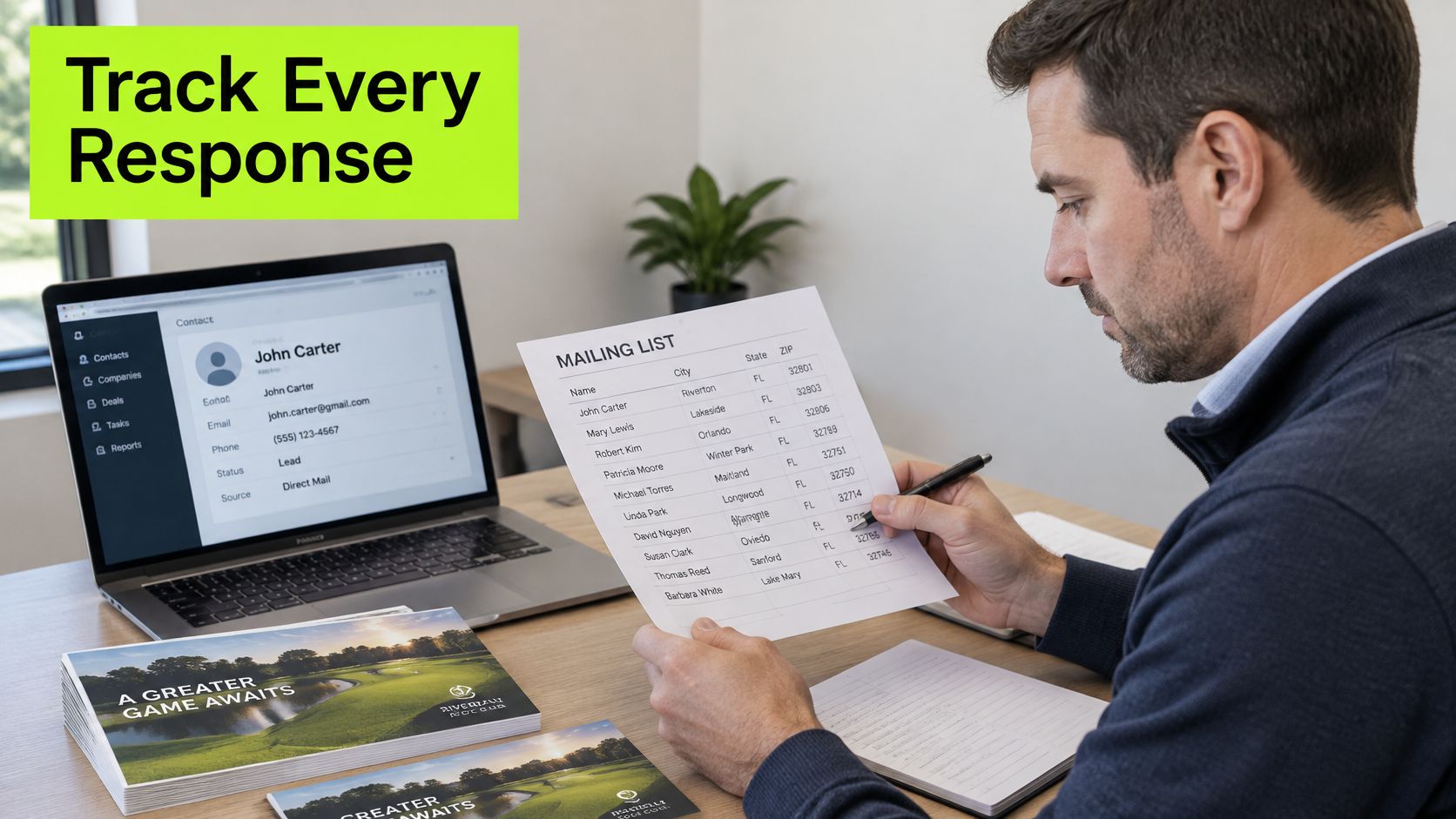
Assign a unique code to each segment and each creative version. For phone enquiries, the reception team records the extension the caller dialled or the postcode on the reply card. For landing pages, use a separate URL per segment, not one page with a dropdown, because the dropdown won't be filled in and you'll lose the attribution.
Five measures in a fixed order
Report them in this sequence every time, so comparisons hold across campaigns.
- Cost per booked visit: total print and postage for that segment divided by the visits it produced. This is the first measure to read, because it shows whether the offer created real intent or just polite interest.
- Enquiry to visit rate: the share of enquiries that turn into a booked visit. A low rate points at follow-up speed and clarity, not at the mailing.
- Cost per joining member: print and postage divided by joining applications, with any joining fee accounted for separately.
- 90-day retention share: the proportion of joiners still active three months in. Without this, a campaign can look successful while recruits leave within a season.
- Revenue per recruited member: the figure that closes the case with a board, because it ties the print run to subscription income rather than to goodwill.
A worked example
Say a pack costs £1.20 to print and post, and 1,000 packs produce 25 booked visits for a lapsed-visitor segment. That's £1,200 of spend against 25 visits, or £48 per booked visit. If ten of those visitors join at your standard fee, the arithmetic either holds up or it doesn't, and you'll know before the next print run rather than after it.
Keep a weekly one-page report during live activity. One row per segment, the codes in use, and a note on any suppression or list changes made that week.
These measures show association rather than proof of cause, so compare against a control postcode with no mailing where the list size allows it. The discipline of separating what moved the number from what happened at the same time is set out in our guide to attribution rules.
How to Build and Test the Campaign in Six Steps
The build follows the split. Once the segments and offers are agreed, the work is sequencing, not creativity.
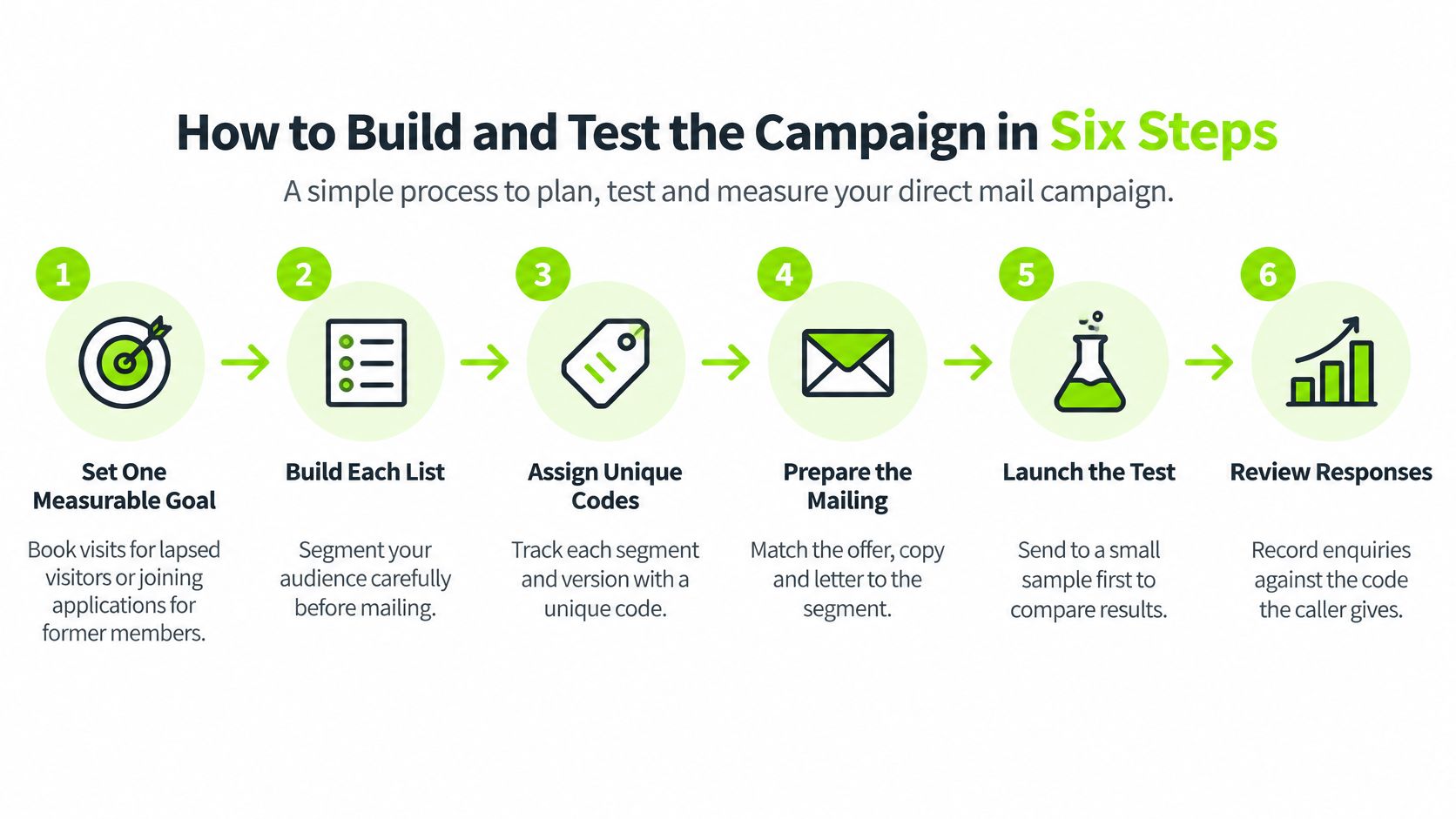
- Set one measurable goal per segment. Booked visits for lapsed visitors, rejoining applications for former members, guests booked for the member guest card. A goal you can't cost per unit is a goal you can't scale.
- Build each list from the CRM and check the basis for contact. Verify every source against UK GDPR and your club's privacy notice before use, then suppress recent enquirers, anyone who has opted out and anyone mailed in the last quarter. Mailing someone twice wastes print and irritates the person most likely to join.
- Write two propositions per segment. A guided visit against a member-introduction evening is a fair test. Where capacity is tight, include a waiting-list option, because it protects yield while still generating a response. Two versions, not five. You're trying to read a difference, not cover every angle.
- Give every version its own response route. A landing page URL, a phone extension, a QR code or a reply code, and only one of them per version. Shared routes make the test worthless.
- Send a pilot. Split it evenly between the two versions, randomised across postcode bands so the difference comes from the offer rather than the street, and post both versions on the same day. Timing and weather move response in this county more than most committees expect.
- Log everything against the code. Delivery, enquiry, booked visit, joining and 90-day retention, entered as it happens rather than reconstructed in a fortnight.
Getting the pilot size right
A few hundred packs per version reads a difference. Fifty doesn't; one strong household in a street of fifty will swing the result and give you a confident answer that happens to be wrong. If the budget won't stretch to a few hundred per version, test fewer segments rather than thinning the sample across all of them.
Preparing the pack for print
Production problems reduce response without notice. If artwork is being assembled in-house, a guide to leaflet printing advice for Chester shops covers bleed, safe margins and colour setup, and the same rules apply to a six-panel mailer with a reply card. Check the QR code on a phone that isn't yours before the print run is signed off.
The two propositions also need to be different. Writing two shades of the same appeal, then wondering why the results tie, is the most common way a pilot wastes its sample. Our notes on ad copy optimisation cover how to make versions meaningfully distinct.
Common Mistakes That Waste the Print Run
Judging the campaign on response rate. A mailing can produce a healthy pile of enquiries that never become visits, and it will look fine until you divide spend by booked visits. Set the visit and joining measures before the packs go out, not after the results arrive.
Mailing existing members as if they were prospects. Loyal members receiving an acquisition letter learn two things: that the club doesn't know them, and that it's spending money on people who already pay. Give them a guest card and track guests booked instead.
Discounting into a waiting list. This one is expensive because it looks generous. Golfshake's 2025 UK survey found 30% of respondents said their club had a waiting list, up from 27% in 2024, and 39% reported a joining fee, up from 37%, according to Golfshake's membership health survey. Where demand already exceeds capacity, the right mailer promotes a guided visit or a waiting-list place, not a reduced fee.
Not checking capacity before the send date. A strong campaign can put more visits into one fortnight than the pro shop and the membership office can host, and warm enquiries go cold while they wait. Book the visit slots and agree who answers the phone before the packs land.
Mailing without suppression. Recent enquirers receiving the same letter twice is the fastest way to look disorganised to the people closest to joining. A suppression list, run the week of the send rather than the week of the brief, prevents it.
Warning sign: enquiry counts rising while booked visits stay flat. That's an offer generating curiosity rather than intent, and it needs a tighter call to action, not more volume.
Confirm the Pilot Result Before You Scale the Print Run
The argument about which creative worked happens after every mailing, so settle the scoring before the pilot closes. Write the decision rule down while both versions are still being printed: compare them on cost per booked visit first, then on joining applications, then on 90-day retention. The version that wins on the first measure and holds on the third earns the bigger run.
A version can lead on cost per booked visit and still be the wrong choice. If its retention trails, the pilot has found an offer that fills visit slots without producing members, and one strong postcode can flatter it. Re-test on a fresh sample, ideally into a different warm segment, and scale only if the pattern repeats.
The widening order
Extend a confirmed winner into the warm segments first, because that is where the pilot's return was strongest. Cold catchment coverage comes after, once the warm groups have shown the offer travels.
Volume is the second check. A full print run lands more calls and visit requests than a pilot ever did, so confirm the membership office can host the larger fortnight and agree who handles calls, visits and waiting-list places on which days before the packs go out.
Decision rule: a version earns a bigger print run by producing booked visits and retained joiners. Response rate alone is not a reason to spend more.
The habit matters more than the template: one page, one row per segment, reviewed weekly while the campaign is live.
If your database holds several audiences that have been receiving the same letter, that is the problem to fix before the next mailing. GolfRep builds campaigns around a club's brand, pricing and goals, with CRM records tracking each coded route so the reporting shows which enquiries became booked visits and which became members, and nurture follow-ups keep warm prospects moving until the club's team is dealing with golfers ready to join. Visit GolfRep to talk through where your next mailing should start.
Ready to tap into our proven growth system?