Golf Club Revenue Growth: A Practical Playbook

The clearest recent signal on UK golf club revenue growth isn't membership alone. In 2025, average visitor green-fee revenue rose from £274,000 to £315,000 per club, a 15% increase, while average online sales reached £125,855, accounting for more than a third of overall revenue. The Revenue Club's 2025 market report shows where the commercial opportunity has moved: clubs that distribute tee times effectively can capture more value from existing demand.
Membership still matters enormously. Hillier Hopkins found that 77% of members' clubs reported growth in the last 12 months, with an average growth rate of 8%, while 81% generated more than £150,000 in annual bar revenue in 2024. The 2024/25 Hillier Hopkins golf clubs survey points to a broader lesson. The clubs with the strongest prospects aren't chasing one revenue source. They're managing a commercial system in which demand is attracted, qualified, converted and retained according to the constraint that matters most.
Where Golf Club Revenue Growth Actually Comes From
Revenue growth starts with a better question than “How do we get more members?” Ask instead: which part of our commercial system is restricting income today?
A membership-heavy private club may have adequate demand but lose value through weak retention, underused member benefits or poor food and beverage participation. A visitor-led course may have available tee times but fail to turn searches into bookings. A society-reliant venue may fill group slots while leaving catering, drinks and repeat bookings underdeveloped.
The four stages are straightforward:
- Attract: reach the right members, visitors, societies and event buyers.
- Qualify: establish fit, value, timing, group size and buying intent.
- Convert: turn interest into a joining payment, tee-time booking, society deposit or event contract.
- Retain: create repeat visits, renewals, referrals and ancillary spend.
A lead-handling fix won't solve a retention problem. More advertising won't help if peak-time capacity is already full and off-peak slots remain empty. Discounting may increase bookings while reducing yield, particularly when demand is already strong.
Commercial rule: Improve the stage with the greatest revenue exposure and the clearest performance gap. Don't spread budget evenly across all four stages.
Hillier Hopkins' 2025/26 survey reports average member income of £1.16 million, with the middle 50% of clubs between £650,000 and £1.575 million. It also found that 59% of members' clubs had more than 600 members and 75% reported growth. The 2025/26 survey report reinforces the importance of membership conversion and retention, but it doesn't make visitor or hospitality revenue secondary. It makes the case for managing both.
| Revenue stream | 2024/25 evidence | 2025/26 trend | Growth lever |
|---|---|---|---|
| Membership | Member income remains a major recurring source | Growth depends on conversion and retention | Better packaging, onboarding and renewal |
| Visitor green fees | 87% of members' clubs generated more than £60,000 in annual green-fee income | Digital booking is driving stronger visitor yield | Online distribution, pricing and repeat visits |
| Bar and catering | 81% generated more than £150,000 from bar revenue | Ancillary spend is structurally important | Bundles, guest spend, societies and events |
| Societies and groups | Valuable single transactions with repeat potential | Demand must be converted into annual rebooking | Packages, deposits and organiser relationships |
For a fuller breakdown of the different income lines, see GolfRep's guide to how golf clubs make money. The practical conclusion is clear: golf club revenue growth comes from matching the right commercial intervention to the right constraint, not from buying more activity in every channel.
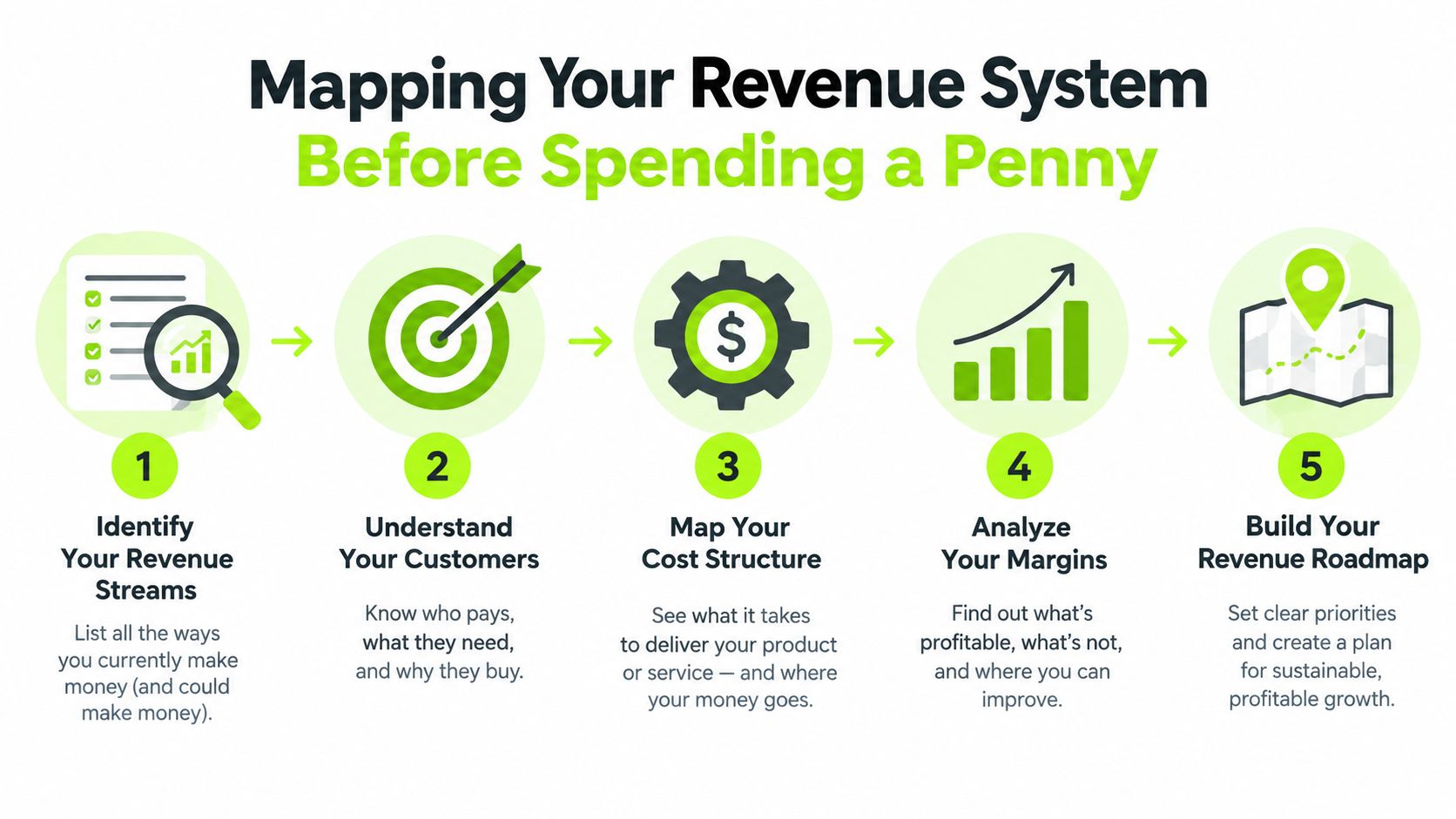
Mapping Your Revenue System Before Spending a Penny
Before approving a campaign, CRM platform or membership promotion, take one working afternoon to map the commercial system. Start with the management accounts, not the marketing dashboard.
Build the revenue picture
Pull the latest available figures for:
- Member income: subscriptions, joining fees and other recurring member charges.
- Visitor income: green fees, online bookings and guest rounds.
- Societies and events: deposits, final payments, food and beverage and room hire.
- Ancillary revenue: bar, catering, retail, buggies, coaching and other on-site spend.
- Capacity: available tee-time slots by weekday, weekend, morning, afternoon and season.
Then tag every new enquiry from the last 90 days by source, audience, stage and outcome. You need to know whether each enquiry became a visit, booking, joining payment, lost opportunity or no decision. If the team can't answer those questions, the club isn't ready to judge campaign performance.
Score the bottleneck
Use a simple score for each stage:
Bottleneck score = revenue exposure × performance gap
Rate revenue exposure as low, medium or high based on the size of the relevant income line. Rate the performance gap by comparing actual performance with the club's own acceptable standard, previous results or a carefully chosen operational benchmark. This isn't a pretend precision exercise. Its purpose is to force a commercial choice.
Consider a club with strong society demand but only 22% enquiry-to-visit conversion. That figure is an example for diagnosis, not an industry benchmark. If enquiries are arriving but organisers aren't visiting or confirming, the bottleneck sits in Convert, not Attract. The club should prioritise a faster booking route, clear package pricing, named ownership and CRM follow-up before buying more clicks.
Decision test: If additional demand would create more unworked enquiries, more empty follow-up tasks or more pressure on already full tee times, fix the constraint first.
Finally, compare the bottleneck with capacity. A membership campaign aimed at a club with limited playing capacity may produce avoidable dissatisfaction. A visitor campaign aimed at a course with empty weekday afternoons should focus on yield and occupancy by daypart, not blanket discounts. The map gives the GM a defensible reason to say yes, no or not yet to new spending.
Segmenting Audiences by Value and Behaviour
Generic personas rarely help a golf club make a better commercial decision. “Local golfer” is too broad. Segment customers by how they buy, what they spend, how often they return and how much capacity they consume.
Start with customer economics
A full member is primarily a recurring-revenue and lifetime-value proposition. Their value depends on tenure, renewal, guest activity, bar participation and use of services such as coaching or the practice ground. Protecting a good member from churn usually matters more than finding another low-value lead.
Flexible members need a different proposition. They're often more price-sensitive and may be at greater risk of leaving if the permitted playing times or benefits don't match their real behaviour. The club should track usage, identify unused entitlements and offer a clear upgrade path when their pattern changes.
Peak-time visitors are a yield opportunity. They should see availability, convenience and a premium experience rather than an unnecessary discount. Bundle a round with food, a buggy or a guest benefit where the economics support it, and use scarcity messaging only when the tee sheet has limited availability.
Off-peak visitors are a volume and utilisation play. Open Pass, twilight and weekday packages can fill weaker dayparts, but the club must avoid allowing low prices to become the reference point for every booking. Push these offers through local search, Meta campaigns and existing visitor databases.
| Segment | Offer shape | Channel | Priority |
|---|---|---|---|
| Full members | Annual value, guest privileges, F&B benefits and service consistency | Member communications, referrals and onboarding | Retain at all costs where contribution is strong |
| Flexible members | Clearly limited access with an upgrade route | Email, member calls and usage-triggered messages | Retain selectively and prevent cannibalisation |
| Peak-time visitors | Convenient tee times, premium bundles and limited availability | Google Search, booking platform and local SEO | Acquire when yield supports the slot |
| Off-peak visitors | Open Pass, twilight or weekday value offers | Meta, local landing pages and database reactivation | Use to improve capacity utilisation |
| Societies and corporate groups | Transparent package, food options, deposit and named organiser contact | Search, partnerships and outbound sales | Prioritise repeatability and ancillary spend |
| Lapsed members | Personal call, return conversation and tailored rejoin route | Manager-led phone contact | Win back where prior value justifies effort |
Choose the demand channel by intent
Google Ads and Meta serve different jobs. Google captures active intent around searches for tee times, societies, golf membership and local facilities. Meta is better for creating demand around flexible memberships, weekday offers, junior activity and visual experiences. Judge both on the value of converted business, not impressions.
Local SEO compounds when the club owns specific landing pages for membership, visitor golf, societies, weddings, leagues and local areas. The Google Business Profile should carry accurate opening times, booking routes, facilities and recent imagery. A page aimed at “golf societies in [local area]” should answer the organiser's real questions, including pricing structure, catering, parking, competition format and deposit terms.
Partnerships work when both parties have a defined commercial exchange. Suitable partners include local corporates, hotels, wedding venues, schools, county golf partnerships and tourism businesses. Reciprocal referrals are useful only when someone owns the relationship and both sides agree how leads will be recorded.
Require a partnership agreement to specify:
- Named audiences: who each partner will introduce.
- Commercial value: referral fee, reciprocal exposure, package inclusion or room-night relationship.
- Lead ownership: who contacts the prospect and within what timeframe.
- Tracking: source code, booking field or shared monthly report.
- Review point: what happens if referrals don't produce qualified business.
Compare acquisition cost with booking value
For each campaign or partnership, calculate:
Cost per enquiry = total channel cost ÷ qualified enquiries
Then calculate:
Expected revenue contribution = qualified enquiries × booking conversion rate × average transaction value
Use the club's actual management-account figures. If a campaign produces cheap enquiries that rarely book, it's not efficient. If a partnership produces fewer but larger society bookings with reliable catering spend, its higher apparent acquisition cost may be commercially sensible.
At a smaller budget, favour one tightly defined audience and one channel that can be measured quickly. A local society partnership may beat broad paid media when the club has a strong package and limited sales capacity. With a larger budget, combine paid search for immediate intent with local SEO for durable demand, then use the CRM to separate full members, flexible members, visitors and organisers.
Review the report monthly by source, segment, stage, revenue and margin. Stop celebrating traffic that doesn't become a booking, joining payment or repeat visit.
Converting Enquiries Into Booked Visits
The conversion process should feel personal to the golfer and disciplined to the club. Put web forms, WhatsApp, webchat and phone enquiries into one working queue, then give every enquiry an owner and a next action.
A sensible sequence is:
- Immediate reply: confirm receipt, answer the main question and offer a clear next step.
- Value message: send course video, relevant benefits, availability or a society package.
- Three-day follow-up: address objections and, where commercially appropriate, present a time-limited trial or booking option.
- Seven-day proof: share suitable member feedback, course experience or organiser reassurance.
- Fourteen-day close: invite a decision, offer a practical incentive and record the outcome.
Set a 30-minute response standard during club hours. That isn't a promise of conversion. It's an operational discipline that prevents a warm enquiry becoming a cold one.
Qualify without making the process robotic
Use structured questions for party size, postcode, preferred playing times, membership interest, group frequency and event date. AI can classify intent, summarise an enquiry and suggest the right route, but a human should handle exceptions, objections and high-value opportunities.
For a useful comparison, the principles behind funnel analysis for real estate teams also apply to golf. The industry differs, but the discipline is the same: define each stage, track movement and identify where prospects disappear.
A club should monitor enquiry-to-visit conversion separately from enquiry-to-sale conversion. A membership prospect may need a visit before joining. A visitor may need only a booking link. A society organiser may need a quote, menu and deposit process.
For a practical GolfRep perspective on the operational detail, see golf club enquiry conversion. The system should record source, response time, qualification, next action, booked date, value and final outcome. If those fields aren't complete, the dashboard will reward activity rather than revenue.
Membership, Pricing and Retention as a Revenue Engine
Bidston-style turnarounds show why recurring revenue rarely improves through acquisition alone. A club can attract interest, run trials and collect joining fees, but the commercial result depends on whether new members become regular users who renew.
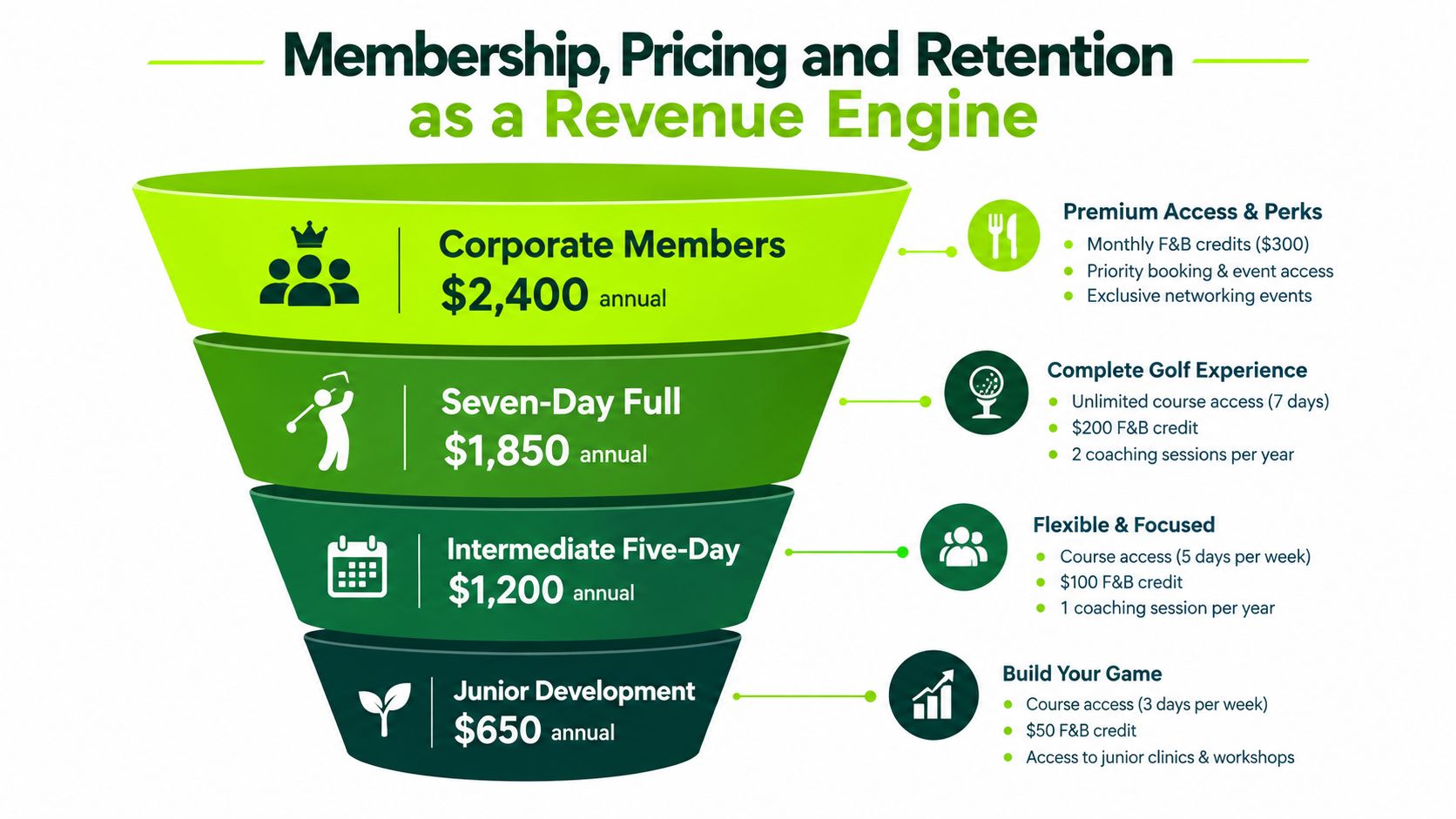
The pricing ladder should make the next step obvious. A club might offer seven-day, five-day, intermediate, junior, lifestyle and corporate options, but each tier needs a clear job. Seven-day membership sells access and status. Five-day membership monetises weekday capacity. Lifestyle membership captures lower-frequency demand. Corporate and junior products open different acquisition routes.
Add benefits that support usage rather than cutting price. Guest passes, reciprocal playing rights, coaching access and food and beverage credits can make annual value tangible. The club should calculate the cost of each benefit before including it, then describe the package as an annual experience rather than a monthly debit.
For pricing decisions, compare the annual offer with the value of the playing access and visitor alternative, not only with competitor fees. Hillier Hopkins' 2022 survey recorded average member green fees of £31, compared with £58 for non-members, which illustrates why membership value can be framed around access and usage as well as headline price. Golf Business News' summary of that survey also reported that 80% of clubs planned membership-fee increases, while 77% kept fees below £1,612. Pricing power exists, but clubs must protect affordability and retention.
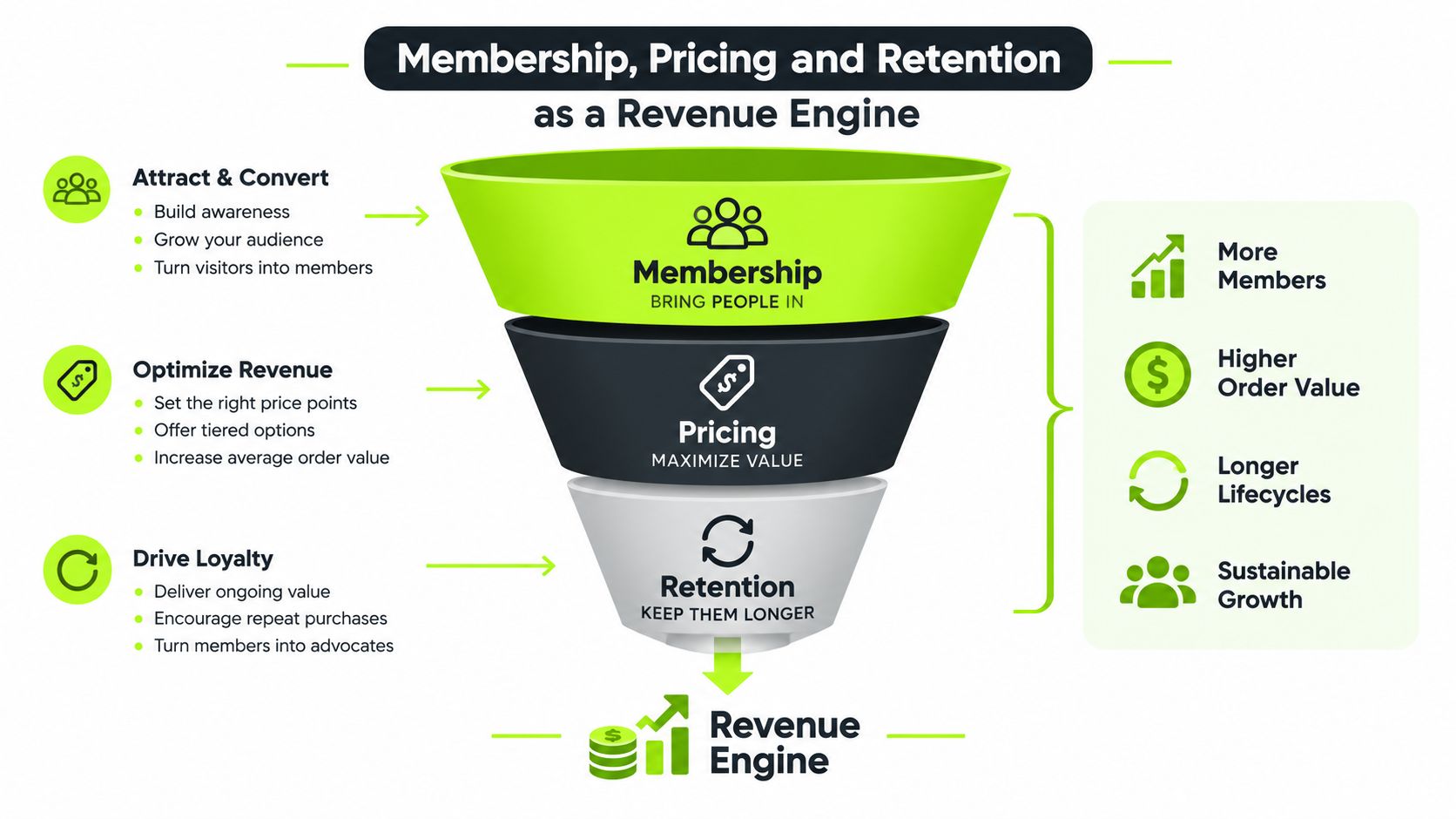
A strong retention system starts before the first renewal conversation:
- First 30 days: welcome the member, introduce people and confirm how to use the benefits.
- Days 31 to 60: check participation, invite a guest and identify barriers to playing.
- Days 61 to 90: review usage, promote relevant activities and ask for a referral.
- Renewal period: contact members before the deadline, with a specific response to any usage or service issue.
- After a missed renewal: trigger a manager-led win-back call and record the reason for leaving.
The trade-off is simple. Discounting may save a valuable member, but it can weaken perceived value and train members to wait for offers. Use a save-the-member offer only when the expected contribution from retaining the member exceeds the cost of the concession and service recovery. Exit surveys should feed pricing decisions, not sit in a folder.
For practical guidance on structuring the price ladder, see golf club membership fees. GolfRep can support this type of work through acquisition, CRM, follow-up, conversion and retention systems, but the club still needs to own the proposition and member experience.
KPIs, Dashboards and Reporting Cadence
A useful dashboard tells the team what to do next. It shouldn't become a monthly explanation of why last month's result was disappointing.
Review operational indicators weekly and financial outcomes monthly. Assign an owner to every figure. The GM may own the overall commercial result, while the membership manager, PGA professional, golf operations lead and food and beverage manager each own the actions within their area.
| KPI | Formula | Target | Cadence |
|---|---|---|---|
| Net member retention | (Opening members minus leavers) ÷ opening members | Set against the club's approved retention standard | Monthly |
| Joiners versus leavers | New members compared with cancellations | Joiners should exceed leavers where growth is required | Weekly and monthly |
| Average subscription per member | Subscription income ÷ paying members | Monitor movement by membership tier | Monthly |
| Enquiry-to-visit conversion | Booked visits ÷ qualified enquiries | Set by audience and channel | Weekly |
| Revenue per green-fee slot | Green-fee revenue ÷ available visitor slots | Improve by daypart, not just overall average | Weekly |
| Ancillary spend per visitor | Bar, catering and other visitor spend ÷ visitors | Increase through relevant bundles | Monthly |
| Society pipeline value | Weighted opportunities multiplied by expected value | Cover the required future booking need | Weekly |
| Conversion by month to event | Won events ÷ opportunities by lead-time band | Identify when follow-up and pricing fail | Monthly |
| Food and beverage attach rate | Transactions with F&B ÷ relevant bookings | Improve where package economics support it | Weekly |
| Buggy or service uptake | Relevant purchases ÷ eligible rounds | Track by visitor and member segment | Monthly |
Use a red, amber and green status for each KPI, but define the thresholds in advance. Green means the owner keeps the process running. Amber means the owner proposes a corrective action at the next operations huddle. Red means the GM assigns a specific intervention, deadline and expected result.
The weekly meeting should cover response queues, upcoming society and event dates, empty capacity, campaign leads and member issues. The monthly board pack should cover revenue by stream, yield, retention, acquisition cost, pipeline, cash received and forecast.
A practical way to think about the report is as a revenue-leak scorecard. The Starward Navigators leak analysis offers a useful general framework for examining where value escapes between opportunity and payment. For a golf club, that means checking lost enquiries, unfilled tee times, cancelled societies, unpaid deposits, unused member benefits and missed food and beverage opportunities.
Don't report a problem without naming the decision. “Visitor conversion is amber” is weak. “Visitor conversion is amber, so the golf operations lead will test a simpler booking route and review the result next week” is management.
A 90-Day Implementation Plan
Revenue work fails when clubs launch six initiatives at once. Sequence the work around the bottleneck, then make each phase produce an input for the next.
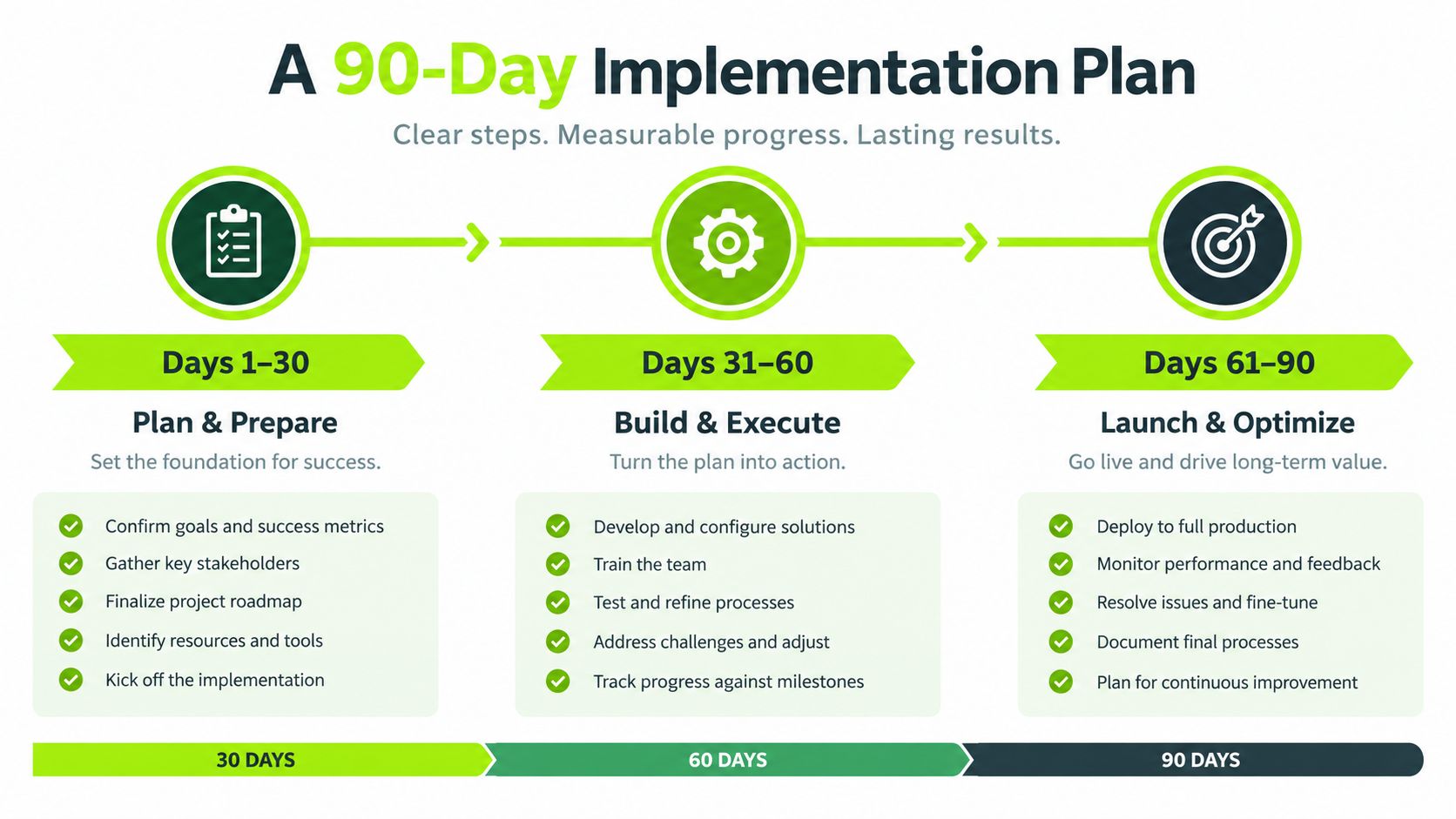
Days 1 to 30, establish the baseline
- Audit revenue: reconcile membership, green fees, societies, events, bar, catering and other income with management accounts.
- Map capacity: identify empty and constrained tee-time periods, plus service capacity in the clubhouse.
- Find the constraint: score Attract, Qualify, Convert and Retain by revenue exposure and performance gap.
- Create the dashboard: agree definitions, owners, reporting dates and red, amber and green thresholds.
- Fix data capture: make source, segment, next action, value and outcome mandatory fields for every enquiry.
- Choose one segment: start with the audience most closely connected to the priority bottleneck.
The minimum team is a commercial owner, an operational owner and a person responsible for data accuracy. On a smaller club, those roles may sit with the GM, secretary and PGA professional. Don't make the GM the sole operator.
Days 31 to 60, build the priority route
Launch the channel that matches the diagnosis. That may be local SEO for membership and visitor intent, paid social for an off-peak product, or direct society partnerships for a course with strong group capacity.
Build the relevant booking or joining route, then add qualification questions and nurture. Repackage membership tiers if the current structure confuses value or encourages discounting. For societies, publish clear packages, catering choices, deposit rules and a named contact. For visitors, make availability and booking friction visible.
The dependency is straightforward. You can't trust channel reporting until source data is captured. You shouldn't scale acquisition until the club can respond, qualify and record outcomes. You can't judge pricing until the team knows which segments use which benefits.
Days 61 to 90, improve retention and lock the next cycle
Launch onboarding and win-back actions, review the dashboard each week and run one controlled pricing or package test. Keep the test narrow enough to understand what changed. Review the commercial result by segment, not just total revenue.
At day 90, decide which constraint remains. If conversion improved but capacity is now tight, move attention to yield and retention. If demand is weak but the booking process works, invest in the right acquisition channel. If joiners are healthy but leavers remain high, stop adding pressure to the top of the funnel and fix the member experience.
The objective isn't to keep every initiative alive. It's to make the next commercial constraint visible and fund the intervention that addresses it.
GolfRep works with golf clubs to map revenue bottlenecks, connect acquisition with CRM and build measurable systems across membership, visitors, societies and events. If you want a practical assessment of where your club is losing revenue and what to prioritise next, visit GolfRep and start the conversation.
Ready to tap into our proven growth system?