Your Guide to the Golf Club Revenue Structure in 2026
A modern golf club is much more than a course and a clubhouse. To thrive, it must operate as a multifaceted business with a diverse, predictable, and year-round income plan. This means moving beyond the traditional reliance on memberships and embracing a complete financial strategy.
Beyond Green Fees: The Modern Golf Club Revenue Structure
For decades, many UK golf clubs worked on a simple premise: a full membership book meant financial security. While memberships are still the bedrock of any healthy club, clinging to this view alone is a dangerous game in today's market. The most resilient clubs have realised they are not just private courses; they are hospitality and events businesses.
A robust golf club revenue structure isn't about simply balancing subscriptions against visitor fees anymore. It’s about strategically blending your core golf operations with a whole host of other services. This means treating every part of your club, from the first tee and the pro shop to the bar and the function room, as a vital contributor to the bottom line.
This represents a critical shift in mindset. It's about moving away from a passive, reactive approach and building a proactive, systemised business. Having worked as a growth partner for UK clubs, we’ve seen first-hand that the main challenge is rarely a lack of interest or enquiries. The real bottleneck is nearly always the absence of a structured system to capture, manage, and convert that interest into reliable revenue.
This chart illustrates how a modern club’s total revenue is built from both core golf income and these crucial ancillary activities.
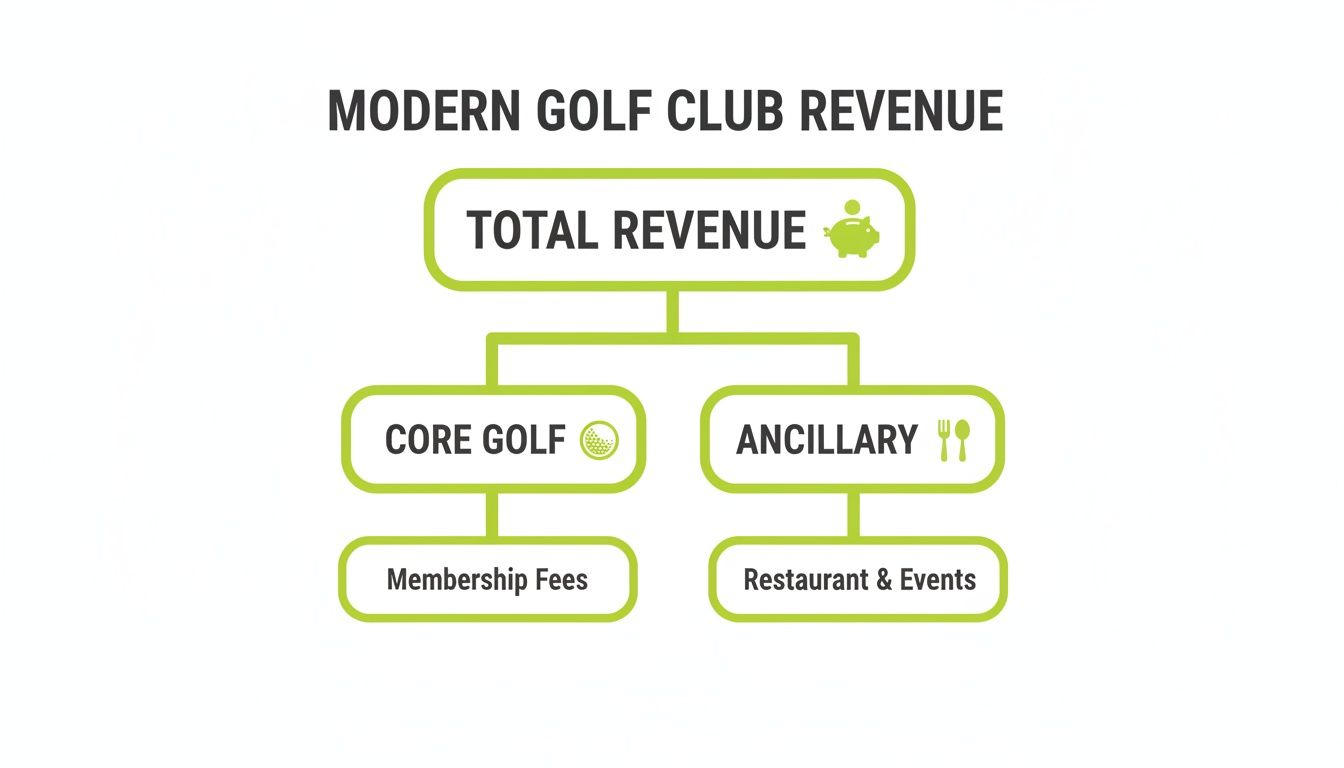
As you can see, the foundational golf income is supported by a range of other streams that provide financial stability throughout the year, smoothing out the seasonal peaks and troughs.
Why a Balanced Revenue Mix Matters
Relying too heavily on a single source of income leaves a club dangerously exposed. One wet, miserable summer can wipe out your green fee projections, while an economic downturn can put a serious dent in membership renewals. A diversified structure is your financial buffer against the unpredictable.
To give you a clearer picture, here is a general breakdown of how revenue streams typically stack up in a well-run UK golf club.
Typical UK Golf Club Revenue Mix
| Revenue Stream | Typical % of Total Revenue | Key Driver |
|---|---|---|
| Memberships | 40% – 50% | Retention and new member acquisition |
| Green Fees | 15% – 25% | Visitor numbers and dynamic pricing |
| Food & Beverage (F&B) | 20% – 30% | Member spend and external functions |
| Pro Shop & Retail | 5% – 10% | Member loyalty and visitor traffic |
| Lessons & Coaching | 2% – 5% | Academy programmes and pro reputation |
| Ancillary (Events, etc.) | 5% – 15% | Corporate bookings, weddings, room hire |
While these figures vary from club to club, they highlight the significant contribution of non-golf activities. The goal is to build a business where a quiet course doesn't automatically mean an empty bank account.
The Real Cost of a Broken Process
Building a resilient club isn’t just about creating different revenue streams; it’s about having a unified system to manage all the leads they generate. Every enquiry, big or small, needs to be visible, tracked, and handled with absolute professionalism.
Whether it’s a £1,000 membership, a £50 green fee, or a £5,000 wedding booking, every lead is valuable. Without a single, coherent system to manage them, you’re simply letting money walk out the door.
Think about these all-too-common scenarios. Do any of them sound familiar?
- The Lost Member: A prospective new member sends an email enquiry on a Friday afternoon. The club secretary is away for the weekend, so it sits unread until Tuesday. By then, the prospect has already booked a tour at a rival club down the road.
- The Ghosted Society: A society organiser fills out the enquiry form on your website. The notification gets lost in a general inbox, and nobody follows up. Frustrated by the silence, they book their 24-person event elsewhere.
- The Fumbled Function: A local business enquires about hiring your function room for a corporate day. The response they eventually get is slow and lacks the professional touch they expect. The poor first impression costs the club thousands in lost revenue.
Each of these examples is a failure of process, not a failure of demand. The real challenge for golf clubs is not generating enquiries, but handling, responding to, and converting them effectively. This guide will show you how to build the systems needed to manage and grow each revenue stream, turning scattered interest into a powerful, predictable pipeline for growth.
Analysing Your Core Revenue Streams
To build a financially healthy golf club, you first need a firm grip on where the money is actually coming from. Think of your club's finances not as separate pots of cash, but as an interconnected ecosystem. When one area thrives, it often lifts the others. Get it right, and you create a stable, profitable business that can weather any storm.
Let's walk through the primary income sources that form the financial backbone of nearly every golf club in the UK. Each one plays a different but vital role, from locking in predictable income to generating that all-important daily cash flow.
Memberships: The Bedrock of Predictable Income
For the vast majority of private and proprietary clubs, membership subscriptions are the engine room. They’re the reliable, recurring income that typically makes up 40% to 50% of your total revenue. This is the money that underpins your entire annual budget, giving you the confidence to plan ahead for big-ticket items like course maintenance, clubhouse improvements, and staffing.
However, the days of a single, "one-size-fits-all" membership category are long gone. Smart clubs are now diversifying their offerings to appeal to a much broader audience.
- Full Memberships: This is your traditional 7-day ticket. It remains the gold standard, attracting your most dedicated golfers and forming the loyal heart of your club's community.
- Flexible Memberships: Think points-based systems or off-peak access. These are perfect for younger professionals, busy families, or anyone who can't commit to playing every weekend. You’re capturing a slice of the market that would otherwise never join.
- Corporate Memberships: Offering packages for local businesses to entertain clients or reward staff opens up a lucrative B2B revenue stream that many clubs overlook.
Getting your pricing right here is crucial. By looking at real usage patterns and demand, you can set the right price for each tier. It's about finding that sweet spot where you maximise sign-ups without accidentally devaluing your core 7-day offer. This isn't just about plucking a number out of the air; it's about matching a product to a person.
Green Fees: Vital Cash Flow and Your Best New Member Funnel
While memberships provide stability, it’s the visitor green fees that inject immediate, essential cash into the business. This stream, often contributing 15% to 25% of revenue, is naturally more dependent on the season and the classic British weather, but it’s also highly responsive to dynamic management.
Never forget: green fees aren’t just a transaction. They are your single most powerful marketing tool.
Every visitor who pays a green fee is a potential member. Their entire experience, from the ease of booking online to the welcome they get in the pro shop, is a live audition for your club. A slick, professional, and friendly process can turn a one-off visitor into a regular, and maybe even a fully-fledged member. A poor experience? You can guarantee they won’t be back.
Food and Beverage: A Growing Profit Centre
The clubhouse is no longer just a place for a post-round pint and a packet of crisps. For the most successful clubs, the food and beverage (F&B) operation has become a major profit centre in its own right, often generating 20% to 30% of total turnover and sometimes even rivalling green fees.
You have two distinct audiences: the captive market of golfers already on-site, and the wider local community.
The key to a profitable F&B department is to see the clubhouse as a destination in its own right. It’s a hospitality venue that happens to have a golf course attached, not the other way around.
By actively marketing your clubhouse for Sunday lunches, private parties, christenings, and business meetings, you create a powerful revenue stream that doesn't care if it's raining outside. This kind of diversification is a hallmark of a modern, financially secure golf club.
Pro Shop and Retail: The Service Hub
Although it usually represents a smaller slice of the pie at 5% to 10% of total revenue, a well-run pro shop is the operational heart of the club. It’s the central hub for members and visitors, handling everything from tee time check-ins and competition entries to buggy and trolley hire. Strong retail performance is directly linked to member loyalty and visitor footfall, giving you a chance to increase the average spend of every person who walks through the door.
Across all these streams, the real challenge isn’t a lack of opportunity, it's often a failure of process. An enquiry for a flexible membership, a society booking, or a wedding reception all demand a quick, professional response. When these valuable leads are managed in a messy spreadsheet or a clogged email inbox, they inevitably fall through the cracks. That’s not just a missed opportunity; it's lost revenue, plain and simple. This is why having visible, trackable systems to manage every enquiry is absolutely essential to turning interest into income.
Unlocking Your Course's True Potential: Maximising Visitor and Green Fee Revenue
While memberships form the bedrock of a club's finances, it's the visitor revenue that provides the vital cash flow and flexibility for a truly healthy business. Getting the most from green fees, society days, and corporate bookings isn’t just about plugging a few gaps in the tee sheet. It’s about strategically turning a fluctuating income source into a reliable and powerful contributor to your bottom line.
To get this right, you have to think beyond a single, flat green fee. Your visitor income comes from a few different pots, and each needs its own approach. You've got your casual pay-and-play golfers, small groups, visiting parties, and of course, the big-ticket society and corporate golf days.
Today’s golfers live online. They expect to find your tee times, check availability, and book their round whenever it suits them, straight from their phone. A simple website with a contact number just doesn't cut it anymore. If you're serious about growing this side of the business, a powerful online booking system is non-negotiable.
The Power of Dynamic Pricing
One of the smartest moves a club can make is adopting dynamic pricing. This simply means your green fees change automatically based on real-world demand. Instead of one price for every slot, prices flex depending on the time of day, the day of the week, and even the weather.
It’s exactly how airlines price their seats. A flight on a Tuesday morning in February will always be cheaper than one on a Friday evening in August. Golf is the same. A 1:00 PM slot on a sunny Saturday is worth far more than a 3:00 PM tee time on a wet Wednesday afternoon.
By pricing your tee times based on their actual market value, you not only earn more during your busiest periods but you also drive more traffic during quieter spells. It’s about making sure every hour of daylight is working as hard as it possibly can for the club's finances.
Putting this into practice requires a system that can analyse booking data and intelligently adjust prices without you having to guess. You can dive deeper into setting rates for your most sought-after slots with our guide to building a premium tee time strategy.
Capturing Every Enquiry: Your Digital Front Door
The move to online booking is more than a trend; it's a huge commercial opportunity. The data speaks for itself. Figures from 2026 showed a phenomenal year for UK clubs, with average visitor income climbing to £315,000 per club. Tellingly, online bookings made up 67% of all visitor green fees, bringing in an average of £125,855 for each club. It's clear that your digital presence is now a cornerstone of a strong golf club revenue structure. You can see the full breakdown in the report on the record-breaking year for golf club revenue at TheRevenueClub.co.uk.
But here’s where so many clubs fall down. They do a great job of attracting interest, especially for high-value society and corporate bookings, but they don't have a solid process to handle the enquiries. Web forms drop into a general manager's inbox, get buried under other emails, and response times drag.
This is a massive own goal. In our experience here at GolfRep, the biggest challenge for most clubs isn't getting visitor enquiries, it's having the right setup to manage them effectively.
A potential corporate client looking to book a day for 40 people won't wait around. If they don't get a prompt, professional reply, they'll just move on to the next club on their list. This is where a few key metrics become make-or-break.
- Enquiry Response Time: How fast are you getting back to a new digital lead? Speed is everything. A quick response massively boosts your chances of turning that interest into a confirmed booking.
- Lead Visibility: Can you see every new enquiry from every channel in one central dashboard? If you can't, you are absolutely losing business.
- Conversion Tracking: Do you know what percentage of your website leads become paid-up bookings? You can't improve what you don't measure.
Trying to manage this manually with emails and spreadsheets is a recipe for failure. A systematic process, often powered by a CRM that captures and tracks every single enquiry, ensures no opportunity gets lost. It turns your website from a passive online brochure into an active, 24/7 revenue-generating engine.
Unlocking Hidden Ancillary Revenue Streams
The course and the clubhouse are the heart of any golf club, but true financial resilience comes from looking beyond them. Far too many clubs leave money on the table by neglecting ancillary income, which is the key to smoothing out the seasonal cash flow dips that can hit so hard, especially in the UK.
These are the income streams that turn underused assets like your function rooms, meeting spaces, and even your car park, into reliable revenue generators. Every square foot of your property has potential. The catch? It won't happen by accident. It demands a proactive, sales-driven approach that's a world away from managing the tee sheet.
Corporate and Private Functions
Your clubhouse isn't just a post-round retreat for members; it's a prime events venue in its own right. The same space that hosts the Captain’s Dinner on a Saturday can generate serious income from non-golf activities during the week.
- Corporate Events: Local businesses are crying out for unique, professional spaces for meetings, training days, and client hospitality. Your club offers a welcome change of scenery from the standard, soulless hotel conference room.
- Private Functions: Think weddings, anniversary parties, christenings, and milestone birthdays. Marketing your club as a go-to destination for these special occasions can build a hugely profitable revenue pipeline completely separate from the golf course.
The challenge, and where most clubs stumble, is in treating these enquiries with the commercial focus they deserve. A £5,000 wedding enquiry can't be handled with the same passive process as a £50 green fee booking, yet it often is. For more on getting this right, our practical guide on food and beverage management is a great starting point.
Strategic Sponsorships and Partnerships
Your membership and visitor footfall represent a captive audience that local and national brands would love to reach. Strategic sponsorships can add a significant layer of income with very little capital investment from the club.
You can start with the classics:
- Tee Sponsorships: A simple but effective way for local businesses to get their name out there.
- Scorecard Advertising: Putting a local solicitor or estate agent’s brand directly into the hands of every golfer.
- Event Sponsorship: Finding a headline partner for your club championship or a major open competition.
The real art is to move beyond just selling space for a logo. The best partnerships deliver genuine value to the sponsor and your members, which makes the relationship stickier and more sustainable for everyone.
Optimising On-Site Rentals
Never underestimate the small but mighty power of on-site rentals. Buggies, electric trolleys, and even pull trolleys aren’t just a convenience for golfers; they are a reliable, high-margin revenue stream when managed properly.
This is all about effective management. Are you tracking utilisation rates? Do you have enough buggies available to meet peak demand on a big society day? A simple system for bookings and maintenance is all it takes to maximise the return on these assets.
The core principle is this: a structured management system is just as crucial for converting a corporate booking as it is for signing up a new member. It allows your club to operate like a true multi-faceted hospitality business.
This is the shift in mindset we live and breathe at GolfRep. Generating enquiries for these ancillary services is only half the job. Real growth comes from having a robust pipeline to manage them properly. Without clear lead visibility and rapid enquiry response times, that potential wedding or corporate day revenue simply evaporates as the prospect moves on to a more responsive venue.
A centralised system ensures every single opportunity is captured, tracked, and professionally handled, turning those "hidden" assets into a predictable and powerful part of your club's financial future.
Creating a Reliable Revenue Engine with Systems
Knowing where your money could come from, such as memberships, green fees, and events, is one thing. But the real key to growing a club isn't just generating interest; it's about building a machine that can expertly handle that interest and turn it into predictable income.
So many clubs do the hard work of marketing to attract enquiries for memberships, society days, and functions, only to watch that potential revenue evaporate. The culprit, almost every time, is a broken process. Relying on a shared email inbox and a patchwork of spreadsheets simply can't keep up in a modern hospitality business.
Good leads get missed, follow-ups are forgotten, and promising customers are left hanging. This isn't just a bit inefficient; it’s actively costing your club money across every single department.
From Manual Chaos to Systemised Control
The old way of handling enquiries is fundamentally flawed. A potential member sends an email, someone jots their details on a notepad, and it hopefully finds its way to the manager's desk. A society booking form is submitted online but gets buried in a cluttered inbox. Sound familiar?
This manual chaos creates enormous, and entirely avoidable, problems:
- Slow Response Times: In this day and age, speed is everything. We all know it. Research consistently shows that the chance of converting a new lead plummets after just one hour. A slow reply doesn't just look unprofessional; it hands your competitors an easy win.
- No Clear Picture: When enquiries are scattered across inboxes, voicemails, and notebooks, nobody has a genuine overview of the sales pipeline. You can't manage what you can't see, making it impossible to forecast revenue or spot where things are going wrong.
- Patchy Follow-up: A single phone call or email is rarely enough. Without a proper system, busy staff inevitably forget to chase people up. All those valuable leads that just needed a gentle nudge go cold.
A systemised approach, built around a central Customer Relationship Management (CRM) platform, fixes these issues. It gives you one central hub for every income-generating activity, from a flexible membership enquiry to a major corporate golf day.
This isn't about adding complicated technology for its own sake. It’s about building an operational backbone that ensures every single opportunity is captured, tracked, and handled professionally from the first enquiry to the final payment. This discipline is what separates clubs that tread water from those that achieve reliable, predictable growth. If you want to see how this works in practice, you can learn more about how we implement practical golf club automation to build these systems.
The Power of a Single Hub
Imagine having one central dashboard where your team can see every new enquiry the moment it comes in, whether from your website, a phone call, or social media. That’s the power of a well-implemented CRM.
Instead of leads getting lost in the shuffle, they are automatically logged, assigned to the right person, and placed into a structured follow-up plan. The system can send out instant, personalised acknowledgements and pop reminders into your team's diaries for follow-up calls.
The impact on your club's performance is immediate and profound:
- Proper Conversion Tracking: At last, you can measure what's actually working. By tracking how many enquiries lead to a club tour, and how many tours convert into a new member, you get priceless data to fine-tune your sales process.
- Clear Accountability: When every lead and every action is tracked, it brings total clarity. Everyone on the team knows what they are responsible for, and management can see exactly how things are performing at a glance.
- A Professional Customer Experience: For the potential member or event organiser, the whole experience feels seamless. They receive prompt, professional communication at every step, which reinforces the quality of your club before they even set foot on the property.
At GolfRep, we've never seen ourselves as a generic marketing agency that just drops a list of leads on your desk. We’re a growth partner. We help clubs build these predictable pipelines by combining targeted lead generation with the robust follow-up systems needed to convert that interest into real, measurable revenue. It's that combination that creates a growth engine you can truly rely on.
The Key Performance Indicators That Actually Matter
If you want to build a truly robust financial future for your club, you have to look past the headline turnover and bottom-line profit figures. The most successful clubs we have worked with are run on sharp insights, not just gut instinct. That means tracking a handful of key performance indicators (KPIs) that paint a clear picture of your operational health.
Think of these metrics as the dashboard for your club. They show you precisely what’s working, what isn't, and where your biggest opportunities for growth are hiding. It’s about moving away from guesswork and towards making strategic decisions backed by real data. Ultimately, the goal is to understand the mechanics behind your revenue, not just count the cash at the end of the month.
Tracking Your Sales Funnel
Before you can even think about revenue, you need to know how efficiently you’re turning interest into income. These metrics are all about your sales pipeline, whether you’re chasing new members or a big society booking.
Cost Per Enquiry (CPE): How much does it actually cost you in marketing and sales time to get someone to enquire? By dividing your total spend by the number of enquiries, you get a hard number. This tells you instantly if your marketing budget is delivering real value or just noise.
Enquiry-to-Tour Conversion Rate: Of all the people who show initial interest, what percentage do you convince to come and see the club for themselves? This is a direct reflection of your front-of-house team’s effectiveness and how well your initial pitch lands. A low rate here points to a problem right at the start of your process.
Tour-to-Member Conversion Rate: This is the moment of truth. What percentage of prospects who take a tour actually sign on the dotted line? If this number is low, it’s a strong signal that something in your closing process, your pricing, or the final offer isn't hitting the mark.
Without a clear view of these conversion points, you’re essentially flying blind. A good CRM system gives you this visibility, tracking every prospect’s journey and showing you exactly where your pipeline is strong and where it’s leaking potential revenue.
Measuring Your On-Site Performance
Once a customer is on your books or on the premises, a different set of numbers comes into play. These KPIs reveal how well you’re running the day-to-day operation and how much each person is truly worth to the club over the long term.
Member Lifetime Value (LTV): This is a forecast of the total revenue one member will bring in over their entire relationship with your club. It includes everything from their annual subs to every coffee, golf shirt, and lesson they buy. Knowing this figure is critical for deciding how much you can justifiably spend to attract a new member in the first place.
Revenue Per Available Round (RevPAR): Borrowed from the hotel industry, this is a brilliant metric for golf. You take your total golf-related revenue and divide it by the number of tee times you had available. It’s the single best measure of how well you’re monetising your most precious asset: your tee sheet.
F&B Spend Per Head: Simple, but absolutely vital. Calculate this by dividing your total food and beverage takings by the number of customers served. It’s a powerful health check for your clubhouse and instantly flags opportunities to increase that secondary spend from golfers and visitors.
To help you get started, we've summarised the most important metrics you should be tracking. Think of this table as your financial health checklist.
Essential KPIs for Golf Club Revenue Management
| KPI | What It Measures | Why It Matters |
|---|---|---|
| Cost Per Enquiry (CPE) | The average cost to generate a single sales lead (e.g., a membership enquiry). | Helps you assess the efficiency and ROI of your marketing campaigns. |
| Conversion Rates | The percentage of leads that move from one stage to the next (e.g., Enquiry to Tour). | Pinpoints weaknesses in your sales process and shows where you're losing prospects. |
| Member Lifetime Value (LTV) | The total projected revenue a single member will generate over their entire tenure. | Informs your membership acquisition budget and retention strategies. |
| Revenue Per Available Round (RevPAR) | The revenue generated per available tee time, combining green fees and other golf income. | Measures your ability to maximise the yield from your primary asset, the golf course. |
| F&B Spend Per Head | The average amount spent on food and beverages by each visitor or member. | Tracks the profitability of your clubhouse and identifies upselling opportunities. |
| Member Attrition Rate | The percentage of members who do not renew their subscription each year. | A direct indicator of member satisfaction and the long-term stability of your revenue base. |
By regularly reviewing these indicators, you move from reactive management to proactive strategy, giving you the control to steer your club towards greater financial success.
Common Questions on Golf Club Revenue
We often get asked the same sharp questions by forward-thinking managers and committee members. Here are our thoughts on some of the most frequent ones, focusing on practical systems and smarter enquiry management.
What Is a Golf Club's Most Important Revenue Stream?
For years, the bedrock of any club's finances has been its membership base. That steady, predictable income is still vital. But a truly healthy club doesn't rely on it alone; it creates a balanced portfolio with visitor green fees and other ancillary income.
So, the 'most important' stream? It's the one you have the biggest opportunity to grow right now. More often than not, this means looking at the parts of your business where enquiry handling is weakest. Fixing those gaps with a proper system is where you'll find the quickest and most satisfying wins.
How Can We Boost Ancillary Revenue on a Shoestring Budget?
You don't need a huge marketing budget to make a difference. The secret is to start by marketing your existing facilities to a brand-new audience. Think about local businesses, community groups, or families who could use your clubhouse for meetings, private parties, or functions.
The real investment isn't in flashy advertising campaigns. It's in establishing a professional system to capture and follow up on every single enquiry. That discipline is what turns a casual phone call into a confirmed, profitable booking.
Why Is Tracking Enquiry Response Time So Important?
Because speed is everything. The chances of converting an online lead drop off a cliff after the first hour. A slow response isn't just a lost sale; it sends a powerful message about your club's service standards, and that can do lasting damage to your reputation.
This isn't just for membership either. It applies to everyone, from a potential new member to a corporate events organiser weighing you up against a hotel. A swift, tracked, and professional response is one of the greatest competitive advantages you can have. It directly translates into more business and a much healthier bottom line.
At GolfRep, we specialise in helping UK clubs put the right systems in place, turning scattered enquiries into a reliable and growing revenue pipeline.
Find out how we can help you build a robust growth engine for your club at https://www.golfrep.co.
Ready to tap into our proven growth system?