How to Increase Golf Club Revenue: The Playbook

A club can look busy and still be underperforming. Members are renewing, visitors are booking, the bar is open, societies are turning up, yet the year-end number still feels flatter than it should because each income stream is being managed separately.
That is the commercial challenge behind how to increase golf club revenue. The answer is rarely a single campaign or a bigger ad budget, it's a working revenue system that connects membership, visitor golf, societies, events, hospitality, and ancillary spend so each part supports the next. In UK clubs, that matters because membership remains the dominant income stream. Hillier Hopkins' 2025/26 survey reports that members' clubs average £1.5 million turnover, 72% generate more than £1 million annually, and the middle 50% derive 73% of total revenue from members' income, with a range of 57% to 85%. The average club's total income from members is £1,160,000 Hillier Hopkins 2025/26 survey.
A commercial director would look at that and ask one question first, not ten. What is the current constraint, demand, conversion, retention, pricing, or capacity?
Why golf clubs need a revenue system rather than a campaign
The committee room conversation often starts with a familiar line. “We need more revenue this season.” That sounds sensible until you ask where revenue comes from, because one-off campaigns rarely fix a club that is leaking value across several points at once.
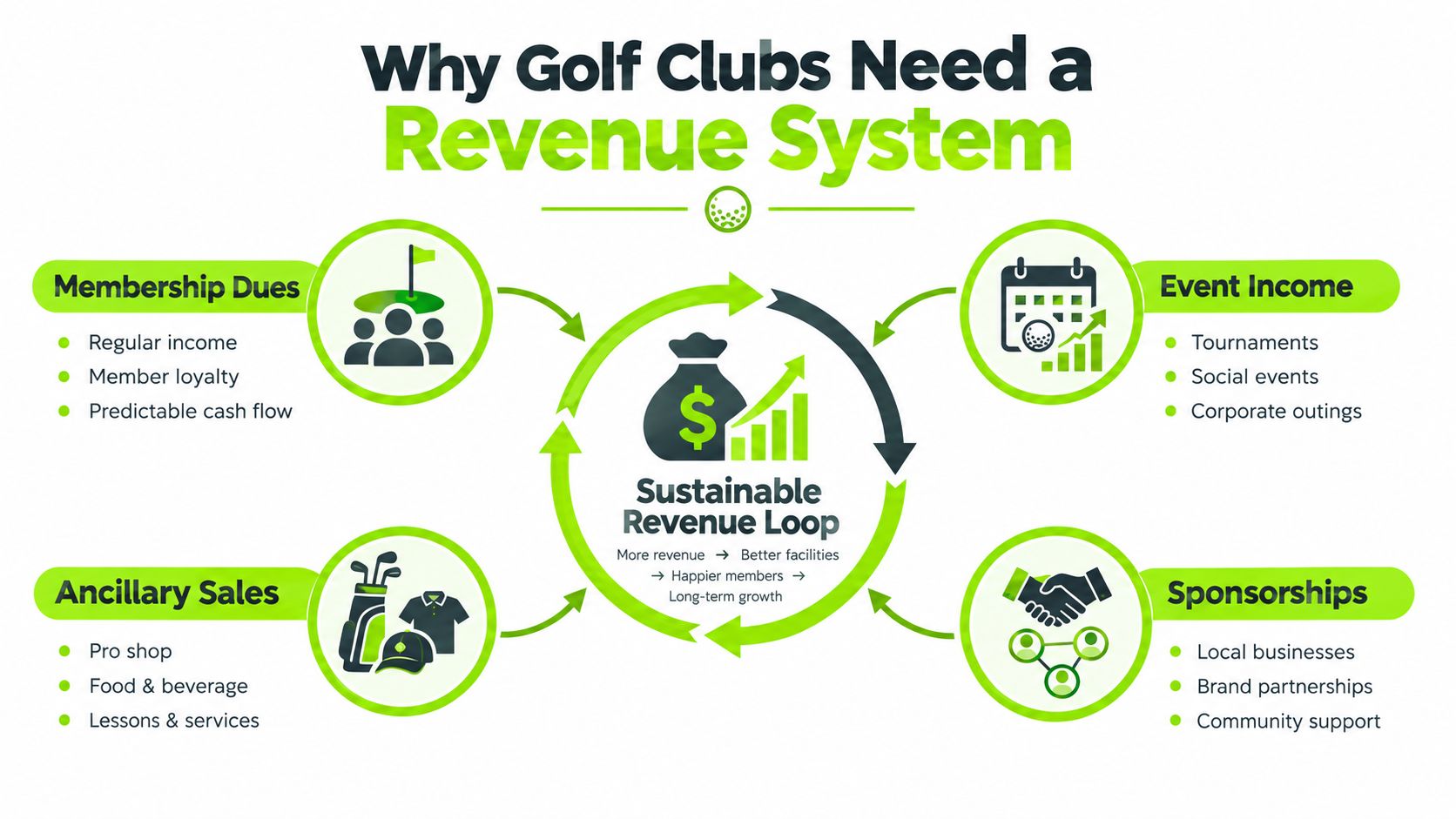
Revenue is a chain, not a channel
At club level, revenue is usually a connected loop. Membership brings predictable income, visitor golf fills spare capacity, societies and events use tee-sheet and clubhouse hours, and ancillary sales lift each visit's value. If one part grows while another is ignored, the club can still end up busier without being more profitable.
That is why the Attract, Nurture, Convert, Retain model matters. Attract brings the right traffic. Nurture keeps the prospect warm. Convert turns interest into bookings, joins or repeat spend. Retain keeps the value flowing after the first transaction.
Practical rule: if you can't name the bottleneck, don't start spending. More traffic won't help a club that already has demand but no follow-up discipline. Better follow-up won't help a club that has no clear offer.
The point is not to overcomplicate things. It's to stop treating every revenue issue as if it were a marketing issue. A committee may approve a campaign to drive joiners, then discover the club's real problem is weak onboarding, poor renewal timing, or a visitor offer that doesn't encourage repeat spend.
What this looks like in practice
A sensible revenue system starts with a simple map of where money comes from and where it gets lost. A club might discover that membership is strong but society bookings are inconsistent, or that visitors are converting but spending very little once on site. Those are different commercial problems and they need different fixes.
That is the value of the internal framework explained in Golf club revenue systems. It gives general managers and committee members a way to separate demand, conversion, retention and yield, instead of relying on instinct or hope.
If you run the club as a system, decisions become clearer. You stop asking whether you need “more marketing” and start asking whether you need better enquiry handling, better packages, or better per-member monetisation. That is the shift that protects recurring income while still leaving room to grow green-fee and visitor revenue.
Structuring predictable acquisition and conversion
A club can have healthy demand and still underperform if enquiries are handled loosely. That sounds obvious, but in practice the gap between interest and action is where a lot of revenue leaks away, especially when the work is spread across reception, the pro shop, operations and a general manager who is already overloaded.
Start with lead ownership and response standards
The first step is not a flashy campaign. It is ownership. Every enquiry needs a named owner, a response standard, and a clear next action. If nobody is responsible for moving the lead, the lead belongs to nobody.
A simple operating rule works better than an elaborate process that staff ignore. For example, one person owns membership enquiries, one owns society and event leads, and each lead has a visible status. That status should answer three questions, has the club replied, has the prospect been qualified, and what happens next?
A lead that sits unowned is not a lead. It's an open commercial liability.
The second step is qualification. Not every prospect is a good fit, and not every visitor should be treated the same way. Some clubs need more local members, some need higher-yield visitors, and some need societies that fill quiet times. The wrong offer to the wrong prospect wastes time and often lowers conversion.
Use a CRM to make follow-up visible
Structured CRM use starts to matter here. The job is not “having a CRM”. The job is logging communications against the right profile so the club can see what was said, when it was said, and who needs to act next. Without that, follow-up turns into memory, and memory is a weak commercial system.
A UK golf club CRM implementation case recorded 86 enquiries creating a £99,430 pipeline and 23 deals worth £23,410, alongside a 17% conversion rate after sales communications were logged against customer profiles and automation was used for membership enquiry response and follow-up tasks UK golf club CRM case study. The lesson isn't that software magically sells. The lesson is that visibility and discipline make the sales process measurable.
You can use a simple cadence:
- Initial response confirms receipt and gives the next step.
- Qualification follow-up checks fit, timing and intent.
- Conversion follow-up answers objections and prompts action.
- Reactivation follow-up brings back those who went quiet.
GolfRep's sales pipeline approach sits in this space, but the wider principle is more important than the tool. If a club knows where every enquiry sits, it can manage activity rather than guess at it.
Separate demand issues from process issues
Some clubs need more traffic. Others already have enough demand and are losing it in the handover. Those are not the same problem, and they shouldn't be solved with the same budget.
If you have low enquiry volume, you need stronger attraction, better local visibility and a clearer offer. If you have decent enquiry volume but weak conversions, the problem is process, not demand. A commercial director would fix the process first because it usually costs less and shows up faster in the numbers.
Growing revenue from the existing membership base
A club does not always need more members to grow. Sometimes it needs more value from the members it already has, especially when the membership base is busy, established and capable of generating more spend if the club gives them better reasons to use it differently.
Retention and joiner-leaver balance matter
Hillier Hopkins reported that only 24% of members' clubs had more leavers than joiners in 2023/24, with average joiners rising to 73 while average leavers also rose to 56 Hillier Hopkins 2023/24 survey. Earlier survey coverage showed average new members per club at 91 in 2021 versus 93 in 2020, while fewer leavers averaged 35 versus 43 and 100% of clubs had more joiners than leavers Hillier Hopkins membership article. Those figures point to a simple truth, retention-first onboarding and structured follow-up materially affect net revenue.
The commercial logic is clear. If a club spends effort winning new members but allows early disengagement, it pays acquisition cost and loses recurring value. If it helps new members settle, use the facilities and understand the club's proposition, lifetime value improves without the club needing to chase volume constantly.
Flexible membership needs a commercial filter
Flexible membership can help, but not every package suits every club. Hillier Hopkins' 2024/25 survey showed 40% of members' clubs and 64% of proprietary clubs already offer adaptable packages, while many members' clubs and proprietary clubs have large playing bases and strong bar revenue Hillier Hopkins 2024/25 insight. That creates a more nuanced question than just “should we offer flexibility?”
The right question is which package mix protects retention, suits usage patterns and improves yield. A club with a strong core of regular golfers may need a light-touch flexible option for time-poor players. A busier proprietary facility may need packages that protect weekday utilisation and food-and-beverage spend. In both cases, the package should be tested against member behaviour, not assumed to work because it sounds modern.
Commercial rule: if a new package attracts sign-ups but damages renewal quality, it isn't growth. It's short-term volume with a delayed cost.
Focus on onboarding, usage and renewal timing
The practical levers are straightforward. Welcome new members properly, get them using the club early, segment them by behaviour, and time renewal conversations before disengagement becomes habit. Clubs often over-focus on joining and under-focus on the first 90 days, yet that is where loyalty starts.
GolfRep's upsell strategy guide is relevant where a club wants to lift value per member without resorting to heavy discounting. The bigger principle, though, is that existing members are not a static base. They are a revenue stream that can either deepen or erode depending on how well the club manages the experience.
Scaling societies, events and ancillary income
If membership is the backbone, societies, events and ancillary sales are the muscles. They don't replace recurring income, but they can make the revenue model far more resilient when they're run as repeatable operations rather than as ad hoc bookings.
Turn visitor demand into repeatable income
Hillier Hopkins' 2024/25 survey found that 87% of members' clubs now generate more than £60,000 a year in green-fee income, up from 80% in 2023 Hillier Hopkins 2024/25 survey. Earlier UK survey data showed average member green fees rose from £36 in 2021 to £43.50 in 2022, while non-member green fees rose from £84 to £108, and visitor numbers fell from 6,300 to 4,500 over the same period Hillier Hopkins 2024/25 survey. Separately, the Sports Think Tank estimated golf sector consumer expenditure at £2.253 billion, clubs accounting for £541 million of turnover, with average club turnover at £751,000 Sports Think Tank satellite-account research.
The commercial message is that there is a large, established demand base. The issue is less “can clubs find golfers?” and more “can they convert the golfers they already see into repeat spend?” That means clear tee-time offers, society packages, food-and-beverage prompts, and a booking journey that makes repeat visits easy.
Build societies and events around rebooking
Society income works best when it is treated like account management. You need a package that matches the market, an organiser relationship that gets maintained, and a rebooking habit that begins before the group leaves the site. The same approach applies to weddings, functions and corporate days, though each needs different timing and service expectations.
The annual rebooking conversation matters because it reduces acquisition cost and protects utilisation in quieter periods. If a club waits for the organiser to come back on their own, it is relying on goodwill instead of process. Better operators make the next booking feel like the obvious next step.
For food-led events, detail matters. If the clubhouse experience is weak, the whole booking feels transactional. That's where specialist hospitality support can help, especially for clubs that want to boost guest experience with wine and use the food-and-beverage offer more intelligently through Relief Chefs UK.
Don't treat ancillary revenue as an afterthought
Ancillary spend is often the easiest money to miss. Member guest sales reached £48k in the referenced UK data and were described as an often overlooked growth avenue The Revenue Club report. That should make clubs think carefully about post-round spend, visitor refreshment, retail prompts and coaching add-ons.
Online booking also matters. In the same report, 67% of casual green fees were booked online and online bookings accounted for about 34% of total green-fee revenue The Revenue Club report. That points to a practical opportunity, make the digital journey clearer, then use it to sell more than just a tee time.
Pricing and packaging without damaging retention
Many clubs try to fix yield by discounting. That can work briefly, but it usually trains customers to wait for deals and it often weakens the club's ability to protect value over time. Better pricing work starts with how the offer is packaged, not just what the headline number says.
Value-based pricing beats blunt discounting
Pricing should reflect demand, usage patterns and the value of the experience. A club with strong peak-time demand does not need to sell its best slots cheaply. A club with quieter periods needs better segmentation, not blanket reductions that leak margin across the whole week.
The same logic applies to packages. If flexible membership is introduced, it should be designed around actual usage and retention goals. The aim is to let some golfers stay connected on a structure that suits their life, while protecting core revenue from the regulars who value full access.
Use the base you already have
Hillier Hopkins' 2024/25 survey found that 59% of members' clubs and 55% of proprietary clubs had more than 600 playing members, and 81% of members' clubs generated over £150,000 annually from bar revenue Hillier Hopkins 2024/25 insight. That tells you the challenge is not always acquisition. In many clubs, the bigger opportunity is monetising a busy base better through hospitality, flexible membership and higher-quality spend per visit.
A club should test package changes against three questions:
- Will this improve retention? If the answer is no, think again.
- Will this lift yield without cheapening the offer? If not, the discount is probably masking a weak proposition.
- Can staff explain it clearly? If the package needs a long apology, members will not trust it.
That kind of discipline stops pricing from becoming a political exercise. Committee members can still debate fairness, but the commercial test remains the same, does the structure protect long-term value?
Test small before changing the whole model
A pricing change should be measured carefully before it becomes policy. Clubs often make the mistake of rolling out a new package everywhere at once, then discovering the most valuable members react badly. A tighter approach is to test one offer, one segment, or one time band, then compare take-up, retention and spend.
Implementation roadmap for private, committee-run and multi-site clubs
The sequence matters as much as the idea. A private club, a committee-led club and a multi-site operator all need the same commercial logic, but they don't need the same operating model.
Start with the constraint, not the wish list
Map the current bottleneck first. If membership enquiry volume is low, focus on attraction. If enquiries are healthy but conversions are weak, fix response standards and follow-up. If retention is the issue, work on onboarding and renewal timing. If the tee sheet is busy but spend is thin, focus on visitor yield and ancillary conversion.
That approach keeps the work manageable. Improve one constraint, measure the effect, then move to the next. Trying to fix every revenue problem at once usually results in no meaningful change anywhere.
Match the system to the club type
Private clubs often need clearer segmentation and more disciplined member communication. Committee-run clubs usually benefit from simple reporting that non-specialists can read without a sales background. Multi-site operators need centralised visibility so local teams can act quickly while still respecting each site's pricing and brand position.
A practical dashboard should track:
- Membership growth by enquiry source and conversion stage
- Visitor conversion from enquiry to booking
- Retention through renewal and early disengagement
- Society repeat bookings by organiser and source
- Ancillary spend per visitor and per member visit
Keep reporting simple enough to use
The best reporting in golf is the reporting people actually read. Committee members do not need a wall of numbers, they need a small set of commercial signals they can understand and act on. Owners and multi-site directors need visibility across sites, but they still need local accountability.
GolfRep works in this type of system design, combining acquisition, follow-up, CRM and revenue tracking for clubs that want a more predictable commercial model. The important thing is not the label on the platform, it's whether the club can see where revenue is created, where it leaks, and what gets fixed next.
If you want a clearer view of your club's biggest commercial constraint, speak to GolfRep through GolfRep. We help golf clubs build practical acquisition, conversion, retention and revenue systems that fit committee-run clubs, private clubs and multi-site operators.
Ready to tap into our proven growth system?