Golf Club Email Marketing That Converts Enquiries
A membership enquiry arrives through the website while the office is dealing with visitors, a society booking and a committee query. Someone replies eventually, but the contact then receives the same general newsletter as everyone else. The club has captured interest, yet it hasn't created a clear path from enquiry to visit, from visit to joining decision, or from membership to renewal.
That gap is where golf club email marketing either earns its place or becomes another administrative task. A newsletter can keep people informed. A properly connected email system can help a club attract golfers, nurture decisions, convert commercial opportunities and retain valuable relationships, with every stage tied to a CRM and a measurable action.
Why Email Still Earns Its Place in Your Golf Club Mix
A club can generate attention through referrals, social media and advertising, yet still lose the opportunity between initial interest and a commercial action. Email gives the club a direct way to continue that conversation, provided it is connected to the CRM and linked to a clear journey.
In the Hillier Hopkins Members' and Proprietary Golf Clubs' Survey 2022/23, 63% of members' clubs used social media, 47% used advertising and 31% used email campaigns according to the survey report. Email was already part of the mix, but it was not yet standard practice across clubs.
The later figures show how inconsistent adoption can be. Email campaigns were reported by 9% of members' clubs in 2023/24, compared with 31% a year earlier, while member referrals led at 64%. The 2024/25 survey recorded email use at 14%, a partial recovery that remained below the earlier level. Clubs may have deprioritised email, struggled to maintain it or chosen channels that were easier to deploy.
Referrals and social media still create valuable awareness. They do not, on their own, provide a complete route from enquiry to visit, sign-up, repeat booking or retention.
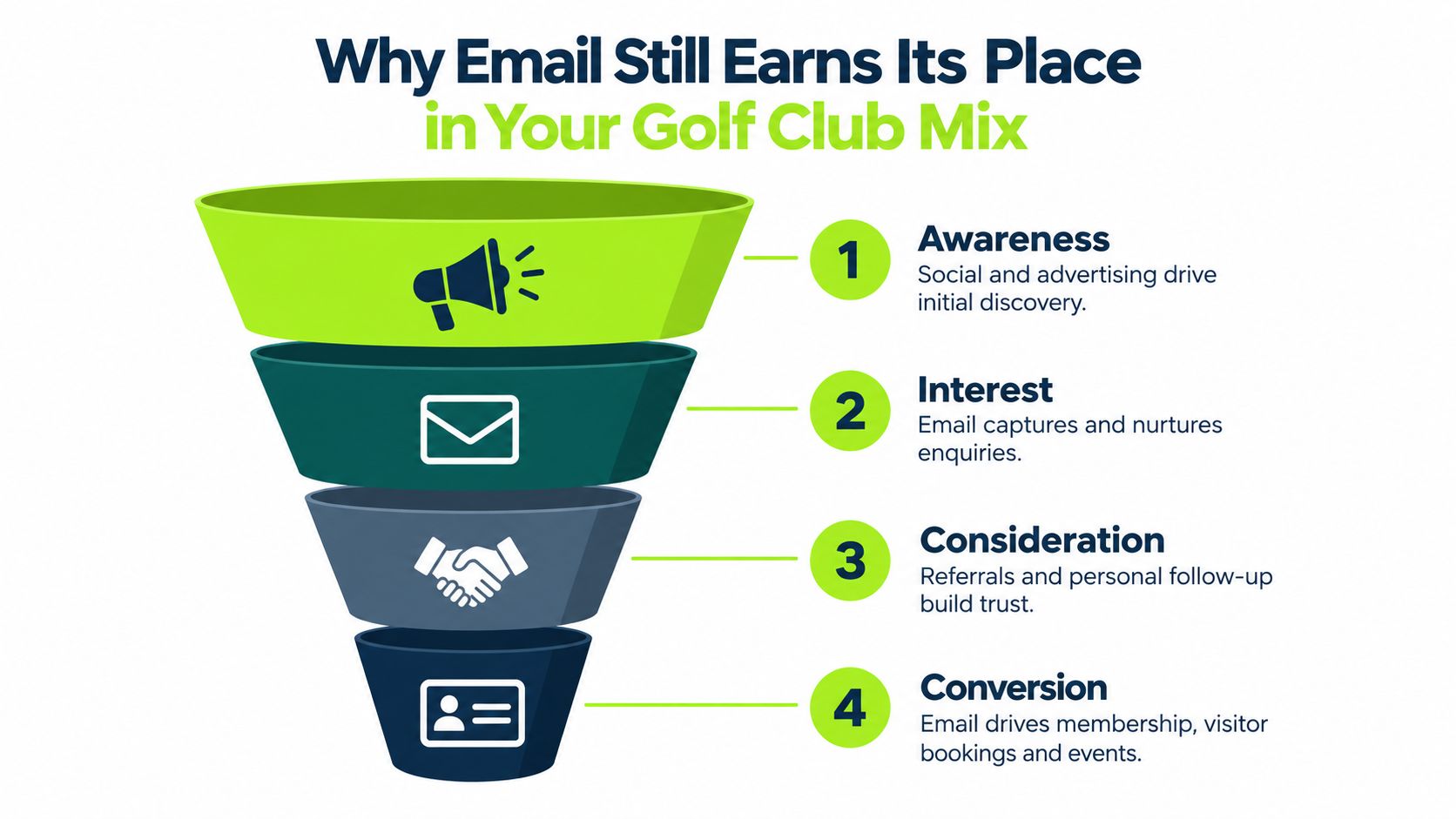
Email connects the four stages
GolfRep uses a practical sequence:
- Attract: Social media, advertising, search and referrals create attention.
- Nurture: Email answers questions, sets expectations and keeps the club visible while a golfer considers the options.
- Convert: Targeted messages support membership visits, visitor bookings, society enquiries and events.
- Retain: Relevant communication supports onboarding, renewals, repeat visits and re-engagement.
A broadcast newsletter mainly serves people who already engage with the club. It works for news and fixtures, but it cannot respond properly to every recipient's situation. A golfer asking about flexible membership needs different information from a member approaching renewal, a visitor who played once or a society organiser planning next year's event.
Managers reviewing execution standards can use an email marketing services portfolio to compare layouts, calls to action and brand treatment. The useful question is whether each message has a measurable job, rather than whether it looks polished.
Judge the system by commercial actions. Delivery and opens indicate whether messages reach an audience, while qualified clicks, booked visits, membership applications and renewals show whether email is helping the club generate revenue and retain relationships. A CRM-linked lifecycle system makes those actions visible and gives each contact a more relevant next message.
Setting Goals KPIs and Your CRM Data Foundations
Before writing a campaign, decide what the club needs the recipient to do. “Send more emails” isn't a commercial objective. A useful objective might be to turn membership enquiries into booked visits, bring previous visitors back during quieter periods, support society rebooking or reduce lapsed-member drift.
Start with one commercial outcome
Choose a primary outcome for each journey, then attach supporting measures to it.
| Commercial objective | Useful supporting measures | Final outcome |
|---|---|---|
| Membership acquisition | Qualified clicks and visit requests | Booked visit or application |
| Visitor revenue | Offer engagement and booking-page visits | Completed visitor booking |
| Society growth | Organiser replies and date enquiries | Confirmed society booking |
| Retention | Renewal-page visits and unanswered reminders | Renewal or recorded decision |
| Win-back | Re-engagement clicks and replies | Return visit or reactivation |
Open rate belongs in context, not at the top of the dashboard. Apple Mail Privacy Protection makes open data less dependable, and the DMA figures show why clicks deserve closer attention. A campaign can appear healthy on opens while producing little movement towards a visit, booking or sign-up.
Your CRM should record enough information to explain the next best message. At minimum, organise records by relationship stage, commercial interest, member status and consent status. A prospect might be interested in full membership, a visitor might be eligible for a repeat-round message, and a former member might need a win-back conversation rather than a discount.
Clean data before adding automation
A short data review prevents a long list of automation failures.
- Centralise records: Keep enquiries, visits, membership decisions and relevant booking history connected where your systems allow it.
- Remove duplicates: One person appearing under several email addresses makes reporting and suppression unreliable.
- Tag intent: Record whether the person asked about membership, visitor golf, coaching, societies or events.
- Record ownership: Give the relevant membership lead, secretary, PGA professional or events contact responsibility for human follow-up.
- Check permission: Store how and when a person agreed to receive marketing, rather than relying on an old spreadsheet.
- Suppress unsuitable contacts: Stop sending promotional campaigns to people who have opted out or no longer meet the relevant criteria.
A CRM is only useful if the team trusts what it contains. GolfRep's guide to golf club CRM foundations is a practical reference for connecting records, ownership and follow-up without turning the system into a second job.
Email signatures deserve attention too. Consistent details help recipients recognise the sender and know how to reply, so a SigFinch team branding guide can help clubs review the practical presentation of staff emails alongside campaign templates.
Practical rule: If a campaign can't be linked to a segment, a responsible person and a commercial outcome, it isn't ready to automate.
Segmentation and Campaign Planning That Feels Personal
A general newsletter and a lifecycle campaign aren't competing formats. They serve different jobs.
A newsletter is suitable when the information applies to most of the club, such as a major clubhouse update, a competition announcement or an important operational notice. A lifecycle email is narrower. It responds to what a recipient has done, asked about or failed to complete.
| Audience Segment | Campaign Purpose | Primary KPI |
|---|---|---|
| New membership prospect | Answer questions and invite a visit | Visit request |
| Trialist or open-day attendee | Resolve hesitation and present the joining route | Application or joining conversation |
| Recent visitor | Encourage a repeat booking or membership discussion | Repeat booking |
| Society organiser | Confirm satisfaction and secure a future date | Rebooking enquiry |
| New member | Support early engagement and orientation | Key onboarding action |
| Current member | Share relevant information and support renewal | Renewal completion |
| Lapsed contact | Understand the reason for leaving and reopen dialogue | Reply, visit or reactivation |
The difference is relevance. A full-membership prospect shouldn't receive a generic message about a society package. A society organiser doesn't need the same sequence as a golfer who played a casual visitor round. Broad sends save preparation time, but they ask the reader to do the work of finding relevance.
Clubs should use segmentation with restraint. Start with fields the team can maintain accurately, then add behavioural signals such as a form submission, visit attendance, booking activity or a renewal date. A practical guide to market segmentation can help teams decide which groups deserve separate treatment before creating a complicated matrix nobody updates.
Give every campaign one clear job
A good email usually has one main call to action. “Book a visit”, “reply with your preferred date”, “view membership options” and “confirm your society requirements” are stronger than a message containing six unrelated buttons.
Subject lines should identify the reason for contact without overpromising. Preview text should add useful context, not repeat the subject line. The body should answer the question most likely to delay action, such as what happens during a visit, who the membership suits, what a society organiser needs to arrange or how a renewal is completed.
A workable calendar balances three content types:
- Operational value: Course updates, competition information, booking guidance and member services.
- Commercial nurture: Helpful answers, visit invitations, package explanations and relevant proof.
- Direct promotion: Open days, visitor availability, society dates or event packages with a clear next step.
The commercial manager should review the calendar against capacity. If the visitor tee sheet is already strong at weekends but quiet during selected weekdays, email can support that specific inventory. If the club is in renewal season, the priority may be a clear, well-timed member journey rather than another acquisition broadcast.
Automated Nurture Flows From Enquiry to Visit to Sign Up
Automation should remove repetitive remembering, not remove judgement. The system can acknowledge an enquiry, send useful information and flag inactivity. A person still needs to handle questions, objections, pricing discussions and the final joining conversation.
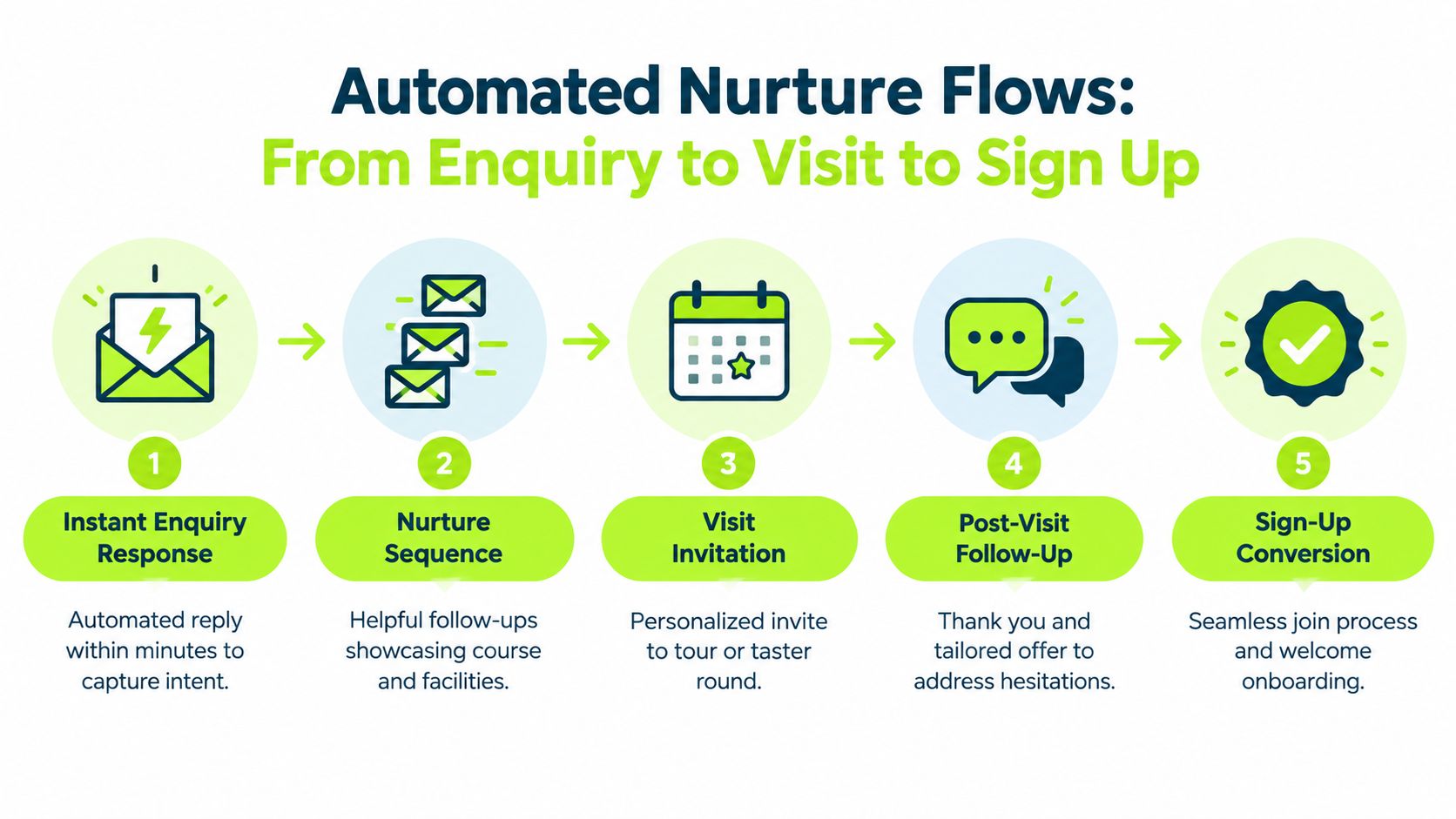
Build the journey around triggers
1. Enquiry acknowledgement
Trigger the first email when a prospect completes a membership form or sends a relevant enquiry. Confirm receipt, reflect one detail from the form and explain what happens next. If the form identifies a preferred playing time or membership type, use that information so the reply feels connected to the original question.
The CRM should create a task for the appropriate team member at the same time. Email can preserve momentum, but it shouldn't pretend to be a substitute for ownership.
2. Consideration nurture
Follow with messages that answer practical questions. Cover the course experience, member categories, playing opportunities, facilities, joining process and what a prospective member can expect during a visit. Send different content to someone asking about junior golf than to someone asking about flexible access.
The sequence should stop or change when the person books a visit, replies with a question or becomes a member. Otherwise, automation keeps talking after the recipient has moved to a different stage.
3. Visit invitation and preparation
Invite the prospect to a tour, taster round or membership conversation when the earlier messages have established enough context. Once the visit is booked, send preparation details such as arrival instructions, who they'll meet and what they should bring. This reduces uncertainty and gives staff a consistent standard of service.
For visitor golf, the same principle can support a repeat booking journey. A post-round message can ask for feedback, present a relevant next option and route anything negative to a member of staff before another promotion is sent.
4. Post-visit follow-up
Send a thank-you message after the visit and make it easy to respond. The email should address the next decision, not just say that the club hopes the prospect enjoyed the course. If the visitor raised a concern about playing rights, cost, distance or social integration, route a specific answer to the responsible person.
A useful follow-up flow combines an automated prompt with a visible human handover. GolfRep's resource on automated follow-up for golf clubs covers the operational detail behind that approach.
5. Joining and onboarding
Once the prospect joins, remove them from acquisition messages and start onboarding. Welcome emails should explain the first practical steps, introduce relevant contacts and encourage early participation. The same CRM record should later support renewal communication, so the club doesn't lose the relationship after the initial sale.
A UK golf-club case study reported 86 enquiries, a £99,430 pipeline and 23 deals after introducing a consistent email programme with automated workflows for pre-visit messaging, post-round feedback and rebooking in the published case study. The transferable lesson isn't that every club will produce those figures. It's that the system connected email activity to pipeline and deals rather than stopping at newsletter engagement.
For a low-staff club, begin with the journeys closest to revenue and easiest to maintain. Membership enquiry acknowledgement, visit preparation, post-visit follow-up and renewal reminders usually deserve priority over a large library of elaborate campaigns.
Deliverability GDPR and Staying Compliant With Confidence
A prospective member can complete an enquiry form at lunchtime, receive nothing by evening and choose another club the next day. A club can also damage trust by sending marketing without a defensible permission record. Treat deliverability and compliance as part of the CRM lifecycle, from enquiry through visit and sign-up, rather than as technical work left to an email platform.
Broad industry benchmarks can provide context, but they do not predict inbox placement for an individual club. Monitor delivery failures, clicks and commercial actions separately. A clean list, sensible sending pattern and relevant content usually matter more than comparing your results with a headline benchmark.

Protect sender reputation
Start with usable data. Deduplicate contacts, correct obvious errors, remove stale records where appropriate and suppress addresses that repeatedly fail. Set a clear process for unsubscribes and complaints, then make those updates flow back into the CRM. Continuing to email every historical address because it remains in a database weakens list quality and can reduce future inbox placement.
Treat opens cautiously. Apple Mail Privacy Protection can inflate or distort open reporting, so clicks, replies, bookings and completed forms provide safer optimisation signals. An enquiry who opens several emails but never responds may still need a better message, a clearer call to action or a human follow-up.
Apply UK rules in plain English
Under UK PECR, organisations normally need consent before sending unsolicited electronic marketing to individual subscribers, unless the soft opt-in applies under the ICO's electronic-mail guidance. Consent must be freely given, specific, informed and unambiguous, with a record showing what the person agreed to receive.
The soft opt-in is narrow. The ICO says it can apply when an existing customer bought or negotiated to buy a similar product or service, received a clear opt-out when their details were collected and can opt out easily from every marketing message in its PECR guidance. A renewal, lesson, society or bay-booking relationship may be relevant, but check the facts and original permission process before including the contact in a marketing journey.
Corporate subscribers are treated differently. PECR does not generally require consent for marketing emails to corporate subscribers such as limited companies and LLPs, although data protection law still applies in its guidance for small organisations. This distinction matters when contacting corporate event buyers, hotels or business account holders.
Use a visible unsubscribe link, separate service messages from marketing, preserve the permission record and refer uncertain cases to a data-protection adviser. Compliance protects trust while keeping the enquiry-to-membership system commercially usable.
Testing Measuring and Improving Email Revenue Over Time
A monthly email report should help a manager decide what to change next. It shouldn't just display a flattering open-rate graph.
Review the funnel in order:
- Delivery: Were messages accepted and did any important segments experience failures?
- Engagement: Which qualified clicks and replies showed genuine intent?
- Progression: How many recipients booked a visit, requested a date, submitted an application or renewed?
- Commercial value: What revenue or confirmed opportunity can the CRM associate with those actions?
- Operational response: Did the responsible team member complete the handover and record the outcome?
Test one meaningful variable at a time. A subject line test may improve initial engagement, but it won't solve a weak membership proposition or a broken booking form. Content tests can compare a course-led message with a practical answer to a common objection. Timing tests should respect staff availability, tee-sheet demand and the point in the customer journey.
A useful decision rule is simple:
- If delivery is weak, fix list hygiene and sending practice.
- If clicks are weak, review relevance, copy and the call to action.
- If clicks are healthy but visits are scarce, inspect the landing page, booking process and staff handover.
- If visits occur but sign-ups don't, examine the proposition, sales conversation and objections.
- If members join but don't engage, improve onboarding and usage communication.
The Hillier Hopkins 2025/26 survey reported email campaigns as the most successful marketing activity for 23% of members' clubs, compared with 49% for social media and 55% for member referrals in the survey report. Email remains established, but it isn't automatically the strongest channel. Its value depends on where it fits in the club's commercial constraint.
For teams building a more disciplined reporting habit, an Otter A/B trend guide offers useful context on reading changes over time rather than reacting to a single result. The same principle applies to golf club email marketing. Improve the weakest stage, measure the effect, then move to the next constraint.
Predictable performance comes from relevance, clean data, clear ownership and revenue attribution, not from sending more frequently. A club that knows which journey supports which outcome can make sensible decisions even with a small team and a changing marketing mix.
GolfRep helps UK golf clubs connect acquisition, CRM, email nurture, sales follow-up, conversion and retention into a measurable commercial system. If you want to identify the constraint in your own enquiry-to-membership journey and decide what to improve first, visit GolfRep.
Ready to tap into our proven growth system?