Golf Club Pro Shop Marketing for Higher Spend

Consumer spending on golf was estimated at £5.165 billion, equivalent to approximately £964 per adult golfer, in the UK golf satellite account. That figure doesn't tell your professional what to promote next week. It does show why a shop shouldn't rely on whoever happens to pass the counter. Golfers already spend across equipment, apparel, lessons and fittings. Your job is to earn a larger, more profitable share of spending that's already there.
Why a Bigger Membership Can Miss the Till
England recorded 750,071 club members in 2025, up 2.66% year on year, while average rounds at surveyed members' clubs fell from 32,000 to 30,000, according to the 2025/26 Hillier Hopkins golf clubs survey. That's the commercial tension. A longer membership list doesn't automatically produce more shop transactions if each member plays a little less often.
The same survey rated member referrals as the most successful marketing activity at 55% of members' clubs, followed by social media at 49%, with email campaigns reported by only 23%. Those are industry figures, not a forecast for your till. They do suggest many clubs are better at creating general visibility than at giving a known golfer a timely reason to buy.
The argument in one line
Golf club pro shop marketing is the work of creating the right buying occasion for the right golfer, then proving it in margin and repeat purchase.
That leads to five jobs:
- Match the message to the product cycle: Balls, gloves, clubs and apparel don't respond to the same trigger.
- Make the floor earn its space: Layout is a sales decision, not housekeeping.
- Speak differently to members and visitors: Their relationship with the club, and their next likely purchase, aren't the same.
- Use events as a reason to buy: A fitting, clinic or welcome session should be stocked and followed up properly.
- Report by category: Total sales can hide weak margin, poor conversion and neglected visitors.
The online range and communications calendar sit alongside those jobs. By the end, you'll have a campaign map you can take to the professional and test against the till, rather than another list of promotions to try when time allows.
Match Each Offer to the Buying Cycle
Start with the split in the till, because it changes the marketing decision.
| Category | 2024 unit trend | Best trigger | Measure that matters |
|---|---|---|---|
| Golf balls | Up 10% | Competition week, weather, replenishment reminder | Repurchase interval and gross margin |
| Gloves | Up 4% | Wet weather and the start of the season | Units per active golfer |
| Irons | Down 16% | Fitting appointment, demo and trade-in | Fitting-to-purchase rate |
| Woods | Down 3% | Demo day and a clear performance reason | Demo-to-sale rate |
| Crested apparel | Not in the Circana set | New member, open day or visitor round | Sell-through and sales per square metre |
| Lessons and repairs | Service, not a retail unit | A relevant note after the lesson or repair | Share of visits that add a shop purchase |
Circana Golf Datatech reporting cited by TGI Golf showed that in the reported 2024 season, on-course pro-shop unit sales of golf balls rose 10% and gloves rose 4%, while irons fell 16% and woods fell 3%. Those are national retail figures, so replace them with your own till data once you've a season recorded properly. The pattern is still useful.
Consumables need timing, not persuasion
Balls and gloves are replenishment purchases. A regular player loses balls, wears through gloves and notices both problems close to a round. Competition weeks, poor weather, the start of the season and a reminder based on the last purchase can therefore work without heavy discounting.
Keep the offer simple. Before medal season, tell known ball buyers that their usual model is in stock and can be collected at check-in. When the forecast turns wet, put rain gloves where players will see them and send a short note to those booked to play. You're not creating a new need. You're making sure the club shop, rather than an online retailer or the nearest sports store, gets a purchase that's already due.
Don't judge that activity by email opens or social reach. Track repurchase interval, units per transaction and gross margin. If golfers buy sooner or add a glove to a ball purchase without margin collapsing, the trigger is doing its job.
Clubs need confidence before they need an offer
Irons and woods sit in a different cycle. They're considered, deferrable and easy to postpone when the golfer isn't convinced the new club will perform better than the one in the bag. Another percentage off rarely answers that doubt. A fitting, a proper demo and a clear trade-in value do.
Performance-led content should support that process. Show what changed in ball flight, dispersion or strike during a fitting. Invite a defined group, such as members using older irons or players who've recently had lessons, rather than advertising a driver promotion to the whole database. Then measure fitting-to-purchase rate separately from shop sales.
Don't run one shop-wide percentage off across balls and irons. It discounts the purchase that was already coming and still doesn't resolve the uncertainty holding back the expensive one.
Crested apparel sits between those cycles. It sells on belonging and occasion: joining the club, representing it, playing an open or taking home a reminder of a visit. Lessons and repairs are service moments. They create a relevant opening for a grip, glove, training aid or equipment conversation, but they shouldn't be treated as categories to push with blanket offers. A considered approach to adding relevant items to an existing shop visit protects trust as well as margin.
For the next quarter, I'd keep the plan deliberately small:
- Choose two consumable triggers: For example, competition-week balls and wet-weather gloves.
- Choose one club trigger: Booked fittings with a trade-in conversation agreed in advance.
- Report them apart: Keep consumable margin and repurchase separate from fitting bookings and club conversion.
That discipline tells you whether golf club pro shop marketing is creating demand, capturing replenishment, or moving revenue from one week to another at a lower margin.
Make the Shop Floor Earn Its Space
Burhill Golf Club gives you a useful worked example, provided you treat it as one club's result rather than a promise. During its 2023 refurbishment, Burhill expanded its retail space by 33%, improved layout and visual merchandising, and gave more room to club-crested apparel and hardware, as reported by Golf Retailing. The shop was closed for three months and still recorded an 18% sales increase against 2022. Burhill Group's wider retail figures rose by 9% over the same period, described in that report as above the industry average.
Most clubs can't add a third more space. They can still improve what each bay earns.
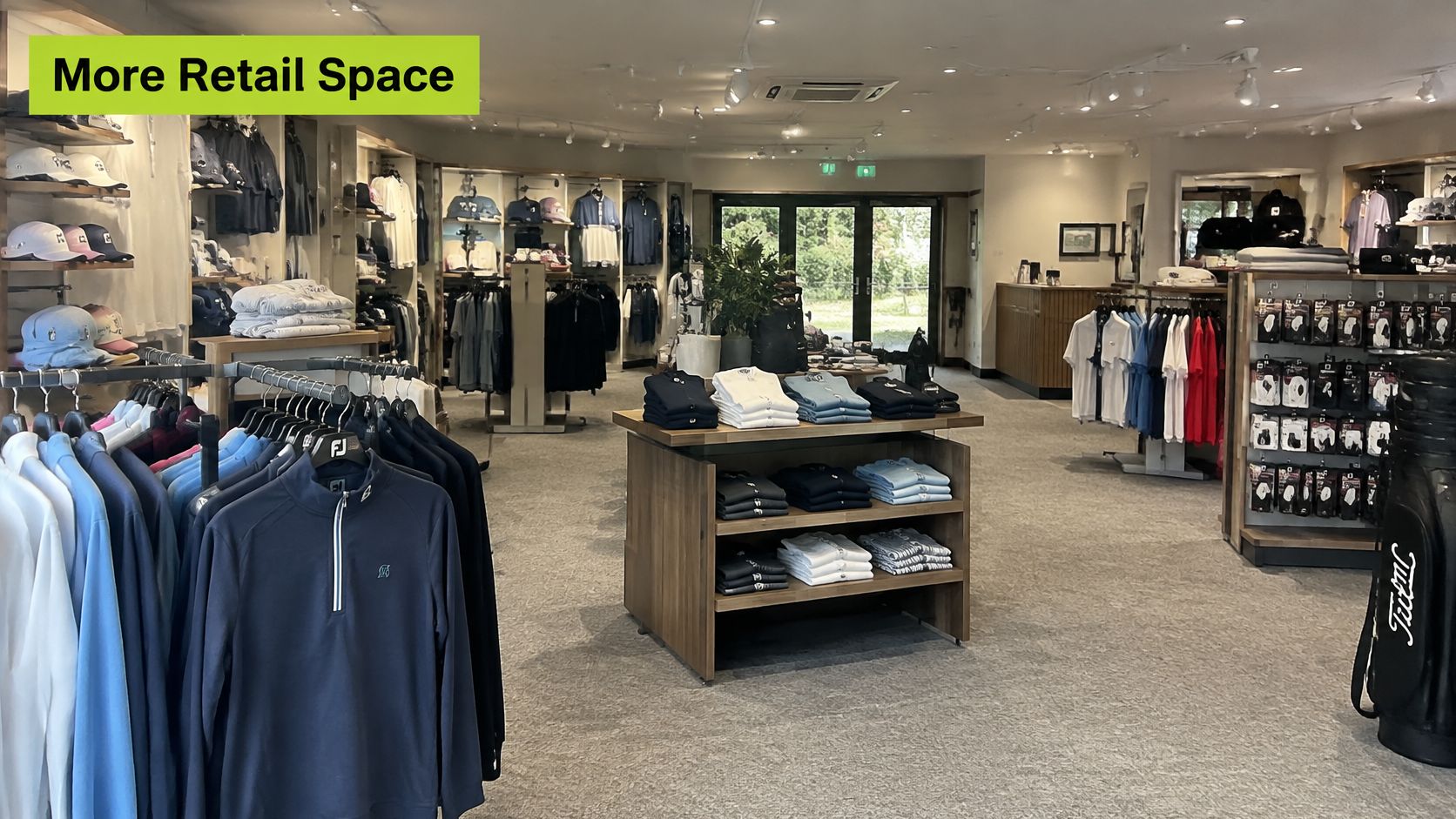
Walk the floor in buying order
- Put replenishment on the playing route: Balls and gloves belong at eye level between the locker room, counter and first tee, not behind slower-moving stock.
- Present crested apparel as club identity: Group shirts, caps and mid-layers together. Mixing them through unbranded stock weakens the reason to buy from you rather than anywhere else. If range planning is part of the problem, golf apparel sourcing advice from 2ndShotMVP is a useful starting point for thinking about the range before you commit cash to it.
- Give demo clubs a next step: Use a clear card inviting the golfer to book a fitting or speak to the professional. A handwritten discount says less and gives margin away sooner.
- Create a small visitor and beginner bay: A glove, a few balls, tees and a clear route into advice should be easy to find without local knowledge.
- Swap bays with the season: Winter gloves and waterproofs shouldn't hold prime space unchanged through summer, and summer apparel shouldn't block winter essentials in October.
After any move, compare category sales, gross margin and sales per square metre with the same months last year. Allow for closures, weather and the competition calendar. Don't keep a layout because it looks smarter. Keep it if the bay earns more margin than the stock it replaced.
Speak to Members and Visitors Differently
England Golf data cited by the Golf Club Managers' Association recorded approximately 730,000 club members across 1,735 affiliated clubs in 2024, equivalent to roughly 421 members per affiliated club. The same data showed more than 10.2 million scores submitted during 2024, with general-play rounds increasing from 3.9 million to 4.4 million.
The audience is also wider than the membership list. More than 55,000 iGolfers, about 7% of all golfers with a handicap, played without traditional club membership and submitted nearly half a million scores annually. The average iGolfer was 43 years old, while the average age of club members fell from 56.18 to 54.99.
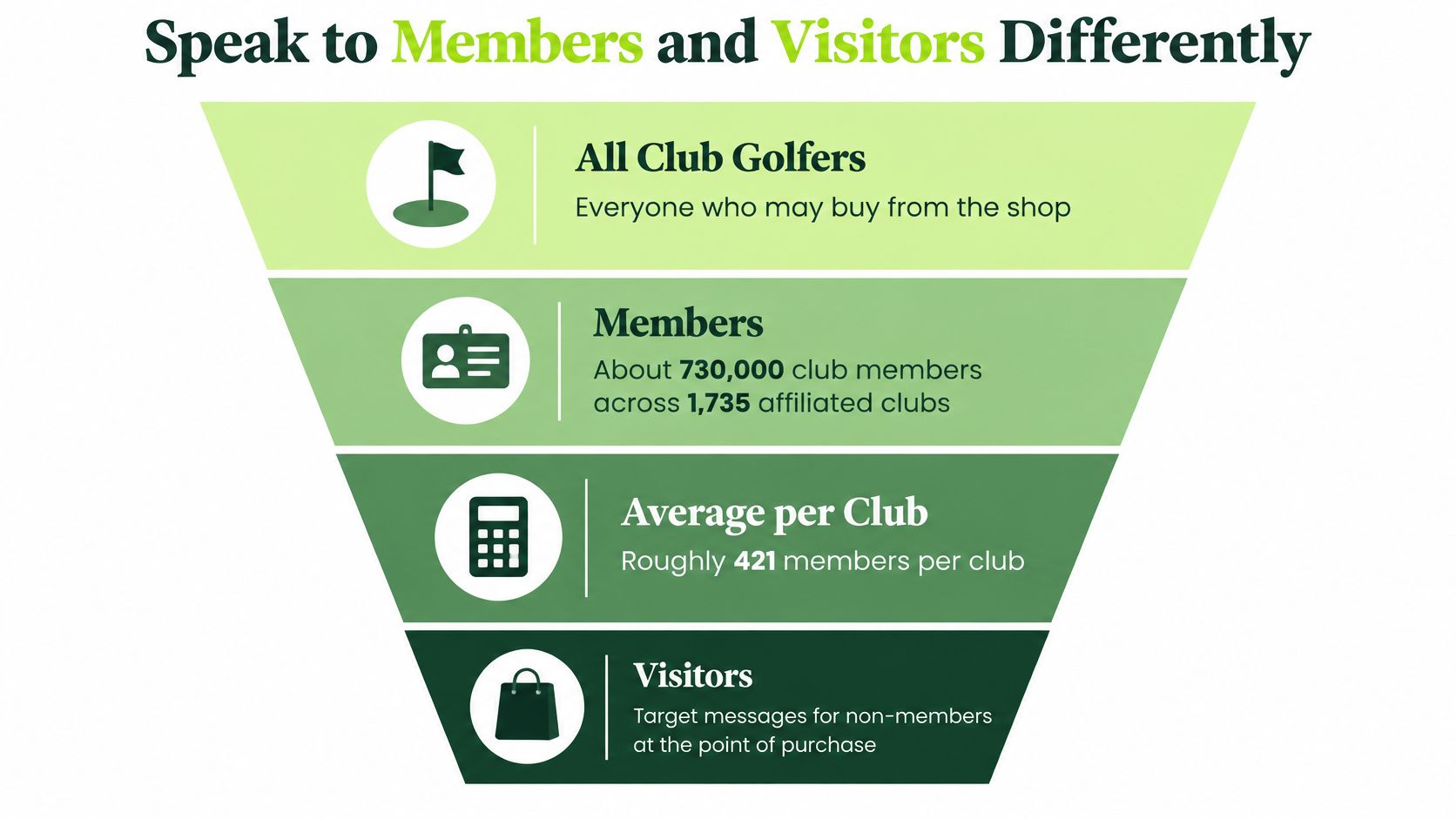
Use records you already hold to build five practical audiences.
Five audiences, five different messages
- The competition member: Send a concise ball and glove note tied to the next medal or board competition. Don't send the whole catalogue.
- The weekday member: Build the message around when they play, such as a winter bundle, twilight essentials or a weekday fitting slot.
- The visitor: After the round, offer a logo ball, glove or fitting and give them a reason to return. The purchase can begin a relationship, but it shouldn't feel like a hard sell.
- The independent or iGolfer: Invite them to a fitting, lesson or casual nine holes. A membership push on first contact asks for commitment before you've earned familiarity.
- The junior and parent: Talk about progression, correct sizing and the next stage in the pathway. Price starter items so a parent can say yes without feeling they're buying kit that'll be outgrown immediately.
You don't need a complex marketing stack to start. Record the membership number at the till where applicable, capture email consent properly, note the last purchase date, and distinguish whether someone played, had a lesson, attended a fitting or only visited the shop.
That's enough to stop sending one promotion to everybody. It's also the point at which golf club pro shop marketing becomes commercially useful. The message follows the golfer's relationship with the club, not the stock you most want to move.
Plan Member, Visitor and Social Messages
A small calendar beats sporadic posting whenever somebody remembers. Keep the channels within the professional's available time.
A workable monthly rhythm
- Member email: Send one shop email a month from the professional to consented members, tied to the playing calendar. A ball and glove note before medal season and a winter bundle in October are more relevant than a generic sale announcement. Keep shop preferences distinct from lesson and membership mail where your system allows.
- Visitor follow-up: Send one short email or text within 48 hours of a visitor round, using consent captured at check-in. Offer a glove, logo ball or fitting, and make booking or collection easy.
- Social posts: Post weekly in season around a buying cycle, such as a demo day, the arrival of a new season ball or crested kit being worn in competition. Answer product and fitting questions the same day. If paid social enters the plan, learn how to choose audiences for Facebook page ads before spending, so members, local golfers and past visitors aren't bundled together.
- In-shop cards: Use one card per bay, changed monthly, naming the product, the reason to buy now and the price.
Track clicks through to the shop or fitting page, units sold to people on the list and unsubscribes. If a channel produces no sales after two months of fair testing, drop it and give the time to a trigger that does.
Run Events That Give a Reason to Buy
An event isn't a poster with a date on it. It's a stocked occasion with a named audience, an owner and a follow-up.
Four events that fit a club calendar
A pre-medal ball and glove clinic works on the practice ground for players already in that week's draw. Take a small rail of matching stock outside rather than moving half the shop. The professional can check glove fit, talk through ball choice and send players inside with a specific product in mind.
A demo day should feature a brand your golfers already play or realistically want to try. Use a booked fitting sheet and agree the trade-in approach before the day. The professional shouldn't be negotiating values from memory while the next golfer waits. Capture consent and record exactly what each person tried.
A new-member shop welcome belongs in the first fortnight. Fifteen minutes with the professional or shop team is enough to show crested kit in the right size, note what the member already owns and explain repairs, regripping and fittings. It also prevents the first shop conversation from happening only when something breaks.
A junior or new-golfer starter hour should include a parent where appropriate. Cover glove fit, a sensible ball choice and whether a half set makes sense yet. Finish with an invitation back to the range or a casual format, so the purchase supports participation rather than sitting in a garage.
For societies, offer the organiser a short apparel and prize option when the package is agreed. Coordinate it with food and beverage spend so the shop feels like a planned extra, not a surprise invoice. A joined-up approach to promoting club events helps the shop, clubhouse and course support the same booking.
Checks before you commit stock and staff time
- Stock committed a week ahead: Don't promote sizes or models you can't supply.
- One person owns bookings: Names, times and consent shouldn't sit across scraps of paper.
- The offer matches what was tried: Follow up about the club they hit or glove that fitted while the visit is fresh.
- The margin still works: Abandon the event if the promoted club is already too thin to support staff time and follow-up.
Don't run an event the professional can't staff properly, and don't invite the same members every month. A busy room isn't success if fittings don't convert or the same discounted stock goes to people who'd have bought anyway.
Keep the Online Range Small and Useful
American Golf's reported annual figures, covered by The Herald, showed in-store sales falling from £100.7 million to £97.8 million, while internet sales increased from £33.9 million to £36 million, a 9% rise in like-for-like online sales. Your club shop isn't American Golf, and shouldn't try to copy its catalogue. The useful lesson is narrower: physical and online trading can move in different directions, so don't judge them as one channel.
A club can lose casual footfall and still serve members who prefer to reorder from home. Keep the range focused on products you can fulfil accurately:
- The ball used most often in club competitions: Make reordering and collection straightforward.
- Two or three core gloves: Cover the common sizes and hands without listing every variation you might occasionally stock.
- Crested caps and a mid-layer: These carry club identity and suit members, visitors and gifts.
- A fitting booking link: Don't build pages for every iron set if the next step is a conversation with the professional.
Make collection the default and state when the item will be ready at the counter. Offer delivery only where it makes commercial sense, such as members who live beyond easy driving range. After an order or fitting enquiry, send one relevant follow-up. Ball and glove buyers may need replenishment later. Somebody who viewed clubs needs a fitting reminder, not a code covering the whole shop.
Range rule: An out-of-stock crested shirt listed online does more harm than no product page at all.
Measure online revenue, gross margin after postage, repeat purchase rate and how many digital buyers also played, booked a lesson or visited again. Ignore traffic that produces none of those outcomes. If you haven't a shop site yet, a simple members' order form for the ten products that already sell every month is a better start than a full catalogue nobody can maintain.
Report Margin and Repeat Purchase
Keep a one-page shop report separate from the membership dashboard. It should prompt decisions, not just display activity.
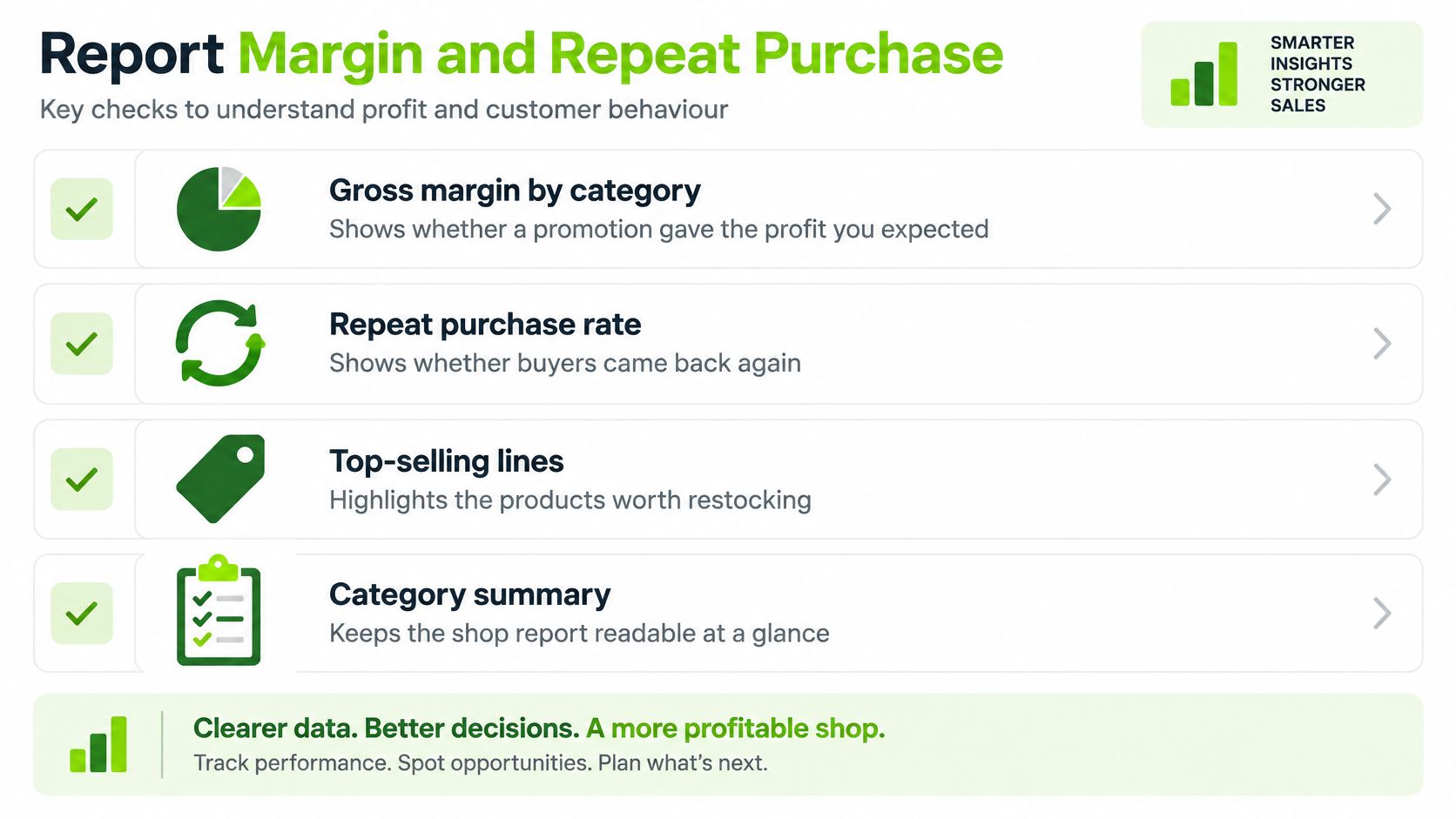
| Measure | What it shows | When to review | Decision rule |
|---|---|---|---|
| Gross margin by category | Whether a promotion gave profit away | Monthly | Stop the offer if margin falls below the club's floor |
| Sales per square metre | Whether a bay earns its space | Quarterly and after any move | Reallocate space from a weak bay |
| Units per transaction | Whether a second item is being added | Weekly in peak months | Coach the counter if the figure stays flat |
| Fitting-to-purchase rate | Whether demos become club sales | After each demo day | Change the follow-up or trade-in if bookings do not convert |
| Consumable repurchase interval | How often balls and gloves return | Quarterly by member and visitor | Adjust the reminder if the gap widens |
| Non-member share of shop revenue | Whether visitors and casual golfers buy | Monthly | Build a visitor offer if the share is near zero |
Gross margin by category reveals whether a campaign sold profitably. Sales per square metre tests layout changes. Units per transaction shows whether staff are adding a relevant glove or sleeve of balls to a visit. Fitting-to-purchase rate should count only golfers booked into a fitting or demo, so you can see whether club marketing works when replacement decisions are being deferred.
Split consumable repurchase interval between competition members and visitors. Their playing frequency and reminder timing won't match. Non-member share of shop revenue shows whether visitors are customers or merely passing the window.
None of these is a national benchmark. Use the first month as your baseline, then judge improvement against your own club. Over time, the important question is whether a shop customer becomes more valuable through repeat purchases, lessons, fittings and continued club engagement, which is why understanding customer lifetime value in a golf club context helps you avoid judging every campaign on one transaction.
Choose One Shop Constraint for the Season
Name the current limit in one sentence before you plan another promotion. If golfers walk past stock, your constraint is the floor, so spend the next month on layout and sales per square metre. If balls and gloves sell only at the counter, the constraint is replenishment, so test competition and weather reminders to golfers who already buy them.
If demo days are busy but club sales aren't, fix the step after the fitting. If visitors play and never appear on the till, build the visitor offer. Measure one change against the shop report, then move to the next constraint. Don't launch a shop-wide discount to hide all four problems.
GolfRep works with UK clubs on the wider acquisition and revenue system around membership, visitors, societies and events. The first call with GolfRep is an open, strategic conversation, not a sales pitch, where we look at your current setup, goals and challenges and map out what a growth system could look like. You can still make the shop decision this week without that conversation.
If your shop plan is sound but wider demand, follow-through or retention is limiting revenue across the club, GolfRep can help you identify the constraint and build a practical growth system around it. Visit us to start with a strategic conversation about your current setup, goals and challenges, and leave with a clearer view of what to improve first.
Ready to tap into our proven growth system?