Golf Club Not Getting Enough Enquiries?

The most common advice for a golf club not getting enough enquiries is simple. Run more ads. Post more on Facebook. Refresh the website. Send another email. Boost awareness.
That advice is incomplete.
At GolfRep, we see the same pattern repeatedly. Clubs assume the top of the funnel is the problem, when the actual issue sits in the middle of the process. An enquiry comes in. Nobody owns it. The reply goes out late. There is no next action. The prospect cools off. Then the club concludes it needs even more enquiries.
That is a leaky bucket. More marketing poured into a weak process just means more waste.
A Golfshake survey highlighted in GolfRep's analysis found that 19% of non-members planned to join a club within the next 12 months, which tells you there is real interest in the market, but clubs often lose those prospects because enquiries are handled badly, not because nobody wants to join Golfshake survey findings on lost membership demand. If you're trying to solve this with only front-end promotion, you're probably attacking the wrong constraint.
That is why we push clubs to think less like advertisers and more like operators. The job is not only to create attention. It is to build a response system that catches interest, qualifies it, follows up properly, and turns it into visits and memberships.
Some clubs also need better communications infrastructure around enquiry handling. If your phones, forms, messages, and follow-up are spread across too many people and too many tools, even a good campaign underperforms. That is where a stronger platform for growing businesses can be useful as a broader reference point for thinking about customer contact, routing, and responsiveness.
We have written before about why broad marketing activity often disappoints when the process behind it is weak. If that sounds familiar, our breakdown of why most golf club marketing fails will probably feel uncomfortably accurate.
Introduction The Real Reason Your Club Lacks Enquiries
When a manager says, “we're not getting enough enquiries”, there are usually two possible truths.
The first is that visibility is weak. The club isn't showing up often enough in local search, social, or community conversations. The second is harder to admit. Enquiries are arriving, but the club doesn't treat them like sales opportunities.
Most clubs overestimate the first and underestimate the second.
The quiet problem behind a quiet inbox
A prospect doesn't care how busy your office is. They care whether they heard back, whether the answer was clear, and whether someone moved them towards a visit. If the process relies on one person checking a shared inbox between meetings, the club has no sales system. It has hope.
Practical rule: Every enquiry needs a timestamp, an owner, a next action, and a visible status.
That rule matters because membership buying is rarely instant. People compare clubs. They ask a partner. They think about cost, location, usage, and whether they will feel comfortable. If you fail to respond well the first time, you may never get the second chance.
Why fixing follow-up pays first
Spending more to generate traffic before fixing response handling is usually the expensive route.
A club can improve performance materially without changing its budget by tightening how leads are captured and followed. That means removing hidden handoffs, making ownership obvious, and creating a visible pipeline instead of relying on memory.
A practical way to think about it is this:
| Area | Weak setup | Strong setup |
|---|---|---|
| Lead capture | Email inbox or paper notes | Central form and CRM entry |
| Ownership | “Someone will call them” | Named person responsible |
| Follow-up | Ad hoc and manual | Structured sequence |
| Visibility | Nobody knows lead status | Pipeline visible to team |
| Decision making | Based on gut feel | Based on tracked outcomes |
If you're serious about solving the problem of a golf club not getting enough enquiries, start by asking a blunt question. Are you short of demand, or are you losing demand in the gap between interest and action?
Is the Problem Enquiries or a Leaky Funnel
Most clubs don't need a brainstorming session. They need an audit.
If you want to know whether the issue is low enquiry volume or poor lead management, inspect the path from first contact to signed membership. Do it as a manager, not as an optimist.
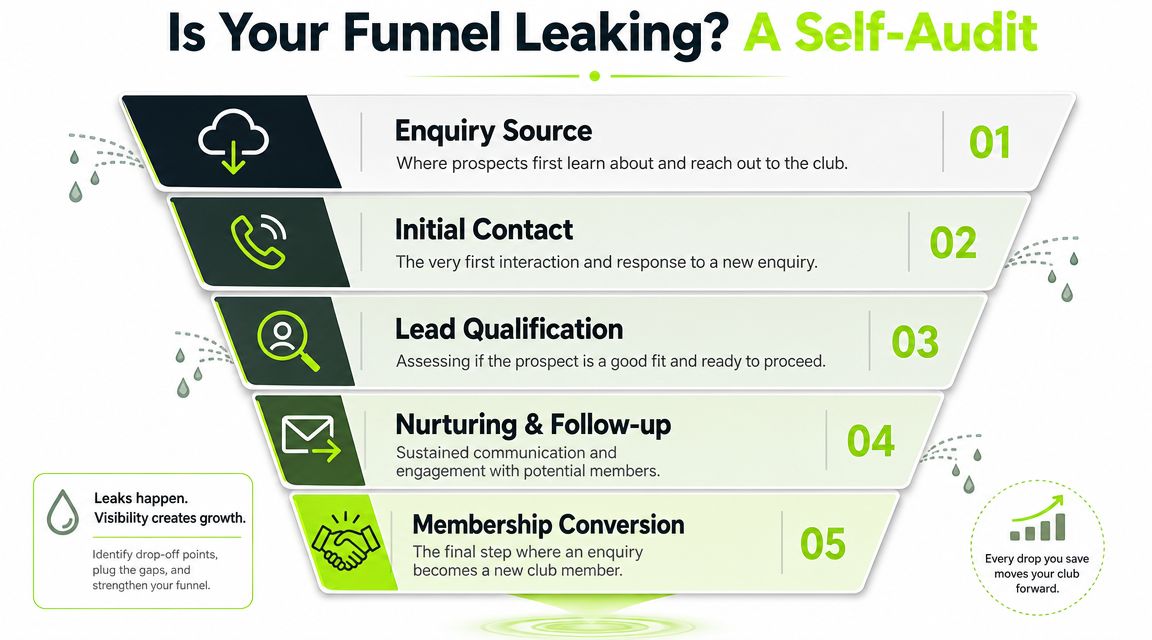
Five questions that expose the leaks
Start with these:
Where does every enquiry arrive
Does it come through website forms, email, phone calls, social messages, or walk-ins? If the answer is “a bit of everywhere”, that is already a warning sign.Who owns the lead
Not in theory. In practice. One named person should own the next action.Can you see status at a glance
New, contacted, qualified, visit booked, proposal sent, won, lost. If that visibility does not exist, your club is managing enquiries in the dark.What happens after the first reply
Many clubs reply once and then wait. That is not follow-up. That is abandonment with good manners.Can you trace source to outcome
If you cannot connect the original source with the eventual result, you cannot judge what marketing is worth continuing.
A useful benchmark from club sales practice is to plan for 7 to 9 distinct touchpoints before a prospect converts, because significant financial decisions rarely close on first contact. The same source also points to a 40%+ capture rate target in waitlist-heavy markets, and notes that about 75% of membership directors still operate without proper CRM systems or automated marketing campaigns private-club waitlist and attrition benchmark data.
That should change how you view “poor lead quality”. In many clubs, the lead was not poor. The process stopped too early.
What a broken funnel usually looks like
A leaky funnel is rarely dramatic. It looks ordinary.
- The email sits unread because the membership person is off that day.
- The phone message gets passed on but no one confirms whether the callback happened.
- The prospect receives a brochure but nobody asks for a visit.
- The manager assumes no reply means no interest even though the prospect was busy, undecided, or waiting for a nudge.
Clubs don't usually lose leads in one obvious mistake. They lose them through small delays and missing steps.
This is why we encourage clubs to build a visible sales process, not just a marketing function. A proper golf club sales pipeline turns scattered conversations into trackable opportunities.
A simple self-audit table
Use this with your team:
| Checkpoint | If your answer is no | What it means |
|---|---|---|
| Every lead is logged | Some are in inboxes or notebooks | You are losing visibility |
| Every lead has an owner | Shared responsibility | Nobody is accountable |
| Every lead has a next step | Waiting for prospect to reply | Pipeline stalls |
| Follow-up is scheduled | Done when someone remembers | Conversion becomes inconsistent |
| Source is recorded | You “roughly know” | Spend decisions are guesswork |
The clubs that improve fastest are not always the clubs with the loudest campaigns. They are the clubs that stop leads from disappearing between contact and decision.
Optimising Your Digital Front Door
Your website should not behave like a brochure pinned to a noticeboard.
For most prospects, it is the first conversation with the club. If that experience is vague, slow, or awkward on mobile, enquiry volume and conversion both suffer. People rarely announce that the site put them off. They just leave.

What your website must do
A strong golf club website does three basic jobs well.
First, it tells the visitor what to do next. Second, it removes friction. Third, it reassures them that the club is active, welcoming, and organised.
That means your key actions should be obvious on every membership-related page. Not hidden in a dropdown. Not buried in a PDF. Buttons such as Book a Tour, Ask About Membership, or Talk to the Membership Team work because they are specific.
If the only route is a long enquiry form, you are making a warm prospect work too hard.
The mobile test most clubs fail
Most managers still review their website on desktop. Prospects often find it on mobile.
Open your own site on a phone and check these points:
- Can a visitor enquire quickly without pinching, zooming, or hunting for the form?
- Do membership pages load cleanly with current information and clear pricing structure?
- Are calls to action visible early rather than after several scrolls?
- Does the form ask only what you need instead of every possible detail?
The clubs that generate consistent enquiries usually keep the first step simple. Name, contact details, area of interest, maybe preferred membership type. That is enough to start a conversation.
Reduce routine friction with automation
There is another operational reason to improve your digital front door. Staff time is often swallowed by repetitive questions.
The National Golf Foundation estimated that U.S. golf courses spent over 6 million hours on phone calls, costing over $100 million in staff time, which is a useful benchmark for the communication burden clubs face and why routine query automation matters NGF research on golf's phone problem.
That matters because every minute spent answering the same basic questions is a minute not spent nurturing a serious membership prospect.
If staff are tied up explaining dress code, green fees, or opening times all day, membership follow-up will always slip.
Simple tools can help. A chatbot for routine questions. Automated acknowledgement when a form is submitted. Structured routing so membership enquiries go to the right person. A dedicated CRM workflow. GolfRep is one option clubs use for that kind of lead capture and follow-up system, alongside other CRM and communications tools.
A good reference point for what a modern club site should do is a site designed not just to inform, but to convert. Our thinking on golf course online goes deeper on that shift from brochure website to working acquisition tool.
Winning the Local Search Battle
Some enquiry problems start before anyone reaches your website. The club isn't visible enough when local golfers search.
That does not require a technical SEO overhaul to improve. In many cases, the fastest gains come from cleaning up local search basics that have been neglected for months or years.
Start with your Google Business Profile
If your Google Business Profile is incomplete, inaccurate, or stale, you create doubt before the prospect even clicks.
Check these first:
- Opening details must be current, including seasonal changes where relevant.
- Phone number and website link should route cleanly to the right destination.
- Membership-related photos should reflect the club accurately, including clubhouse, practice areas, and course condition.
- Review responses need attention, especially when prospects are judging culture and service.
A local golfer who searches for a club near them is not researching the sport in general. They are comparing nearby options. That means trust signals matter as much as rankings.
Use search intent, not club language
Many clubs write online copy the way committees speak internally.
Prospects do not search that way. They search with practical intent. Membership cost. Flexible membership. Golf club near me. Visitors welcome. Beginner friendly. Society bookings. Lessons. Driving range. Open competitions.
Your local pages and profile should answer those commercial questions clearly. If you hide useful information because you want people to call instead, you often lose them to a club that answers more directly.
The club that looks easiest to understand often gets the first enquiry.
A one-hour local visibility reset
You can improve your local search position quickly by doing one focused clean-up session.
| Task | Why it matters |
|---|---|
| Update core business details | Removes avoidable trust issues |
| Upload recent images | Gives prospects a current impression |
| Review membership page titles and copy | Aligns with real search behaviour |
| Check enquiry routes from profile to site | Prevents drop-off after the click |
| Reply to recent reviews | Shows the club is active and responsive |
This is not glamorous work. It is effective work.
For a club that feels it is not getting enough enquiries, local search is often the most practical place to recover visible demand without jumping straight into a bigger ad budget.
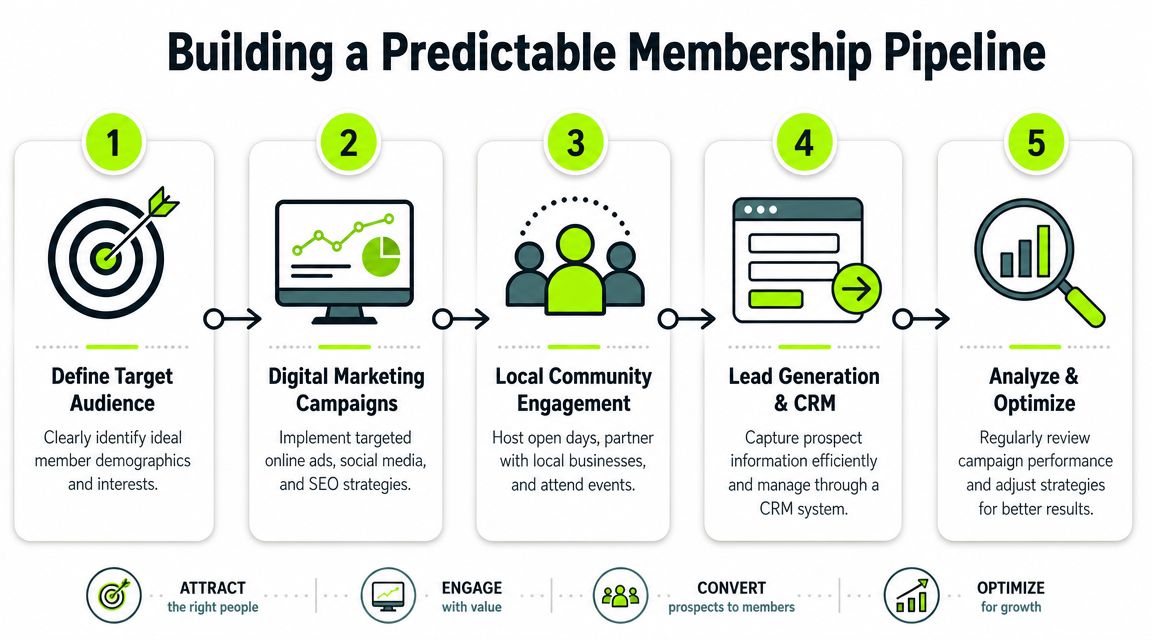
Campaigns That Build a Predictable Pipeline
Once the internal process is stable and the digital front door is fit for purpose, then it makes sense to push harder on acquisition.
That sequence matters. Campaigns work best when every lead enters a managed system rather than disappearing into email chains.
NGCOA reported that in 2023 member referrals fell 7.5% versus 2022 and organic leads declined 5% versus the previous year, which is a clear warning that clubs cannot rely on word-of-mouth alone to maintain enquiry flow NGCOA lead and referral trend data.
Campaign example one behind-the-scenes club tour
This works well for clubs with a strong course, a good social atmosphere, or facilities that are hard to appreciate from a website alone.
The message is not “join now”. It is closer to “come and see how the club works”. A guided visit lowers commitment and creates a reason to enquire without forcing an immediate pricing conversation.
A practical campaign flow looks like this:
- Target local golfers and lapsed players through paid social and search.
- Offer a simple booking action for a hosted tour or discovery event.
- Push the lead straight into a CRM with source recorded.
- Trigger same-day follow-up by email and phone.
- Move the prospect into a nurture path if they do not book immediately.
This type of campaign is effective because it creates a middle step between awareness and membership decision.
Campaign example two flexible membership promotion
Some prospects want to join, but they do not think the traditional full category fits their schedule or budget.
A campaign aimed at flexible packages, off-peak access, younger adult categories, or staged membership entry can open a conversation with a segment that would ignore a generic membership advert. The mistake is promoting the offer without building a proper pipeline around it.
Here the creative should answer practical objections. Time, flexibility, ease of use, and how the membership fits modern life. The back-end must then sort by intent. Some people want immediate contact. Some need more information first. Some are browsing and need nurturing.
A broader view on structuring lead flow can come from outside golf too. This piece on Zenfox.ai for lead generation insights is useful for thinking about how lead sources, qualification, and follow-up fit together, even though the market context is different.
What predictable actually means
Predictable does not mean every campaign produces the same result every week. It means the club knows:
- Which audience is being targeted
- What offer or message they are seeing
- Where the lead enters the system
- What happens after the enquiry
- Which channels are worth repeating
That is the difference between a campaign and a pipeline. One creates a burst. The other creates control.
Turning Enquiries Into Members With Systems
Most clubs do not lose enquiries because staff do not care. They lose them because care is not a system.
A proper conversion process removes guesswork. It creates a standard response path for every new prospect, while still leaving room for personal contact where it matters.
Ofcom reports that 93% of UK adults use the internet daily, which is why slow follow-up now feels out of step with normal consumer expectations and why delayed response becomes a conversion problem, not just a service issue digital-first response expectations in the UK.
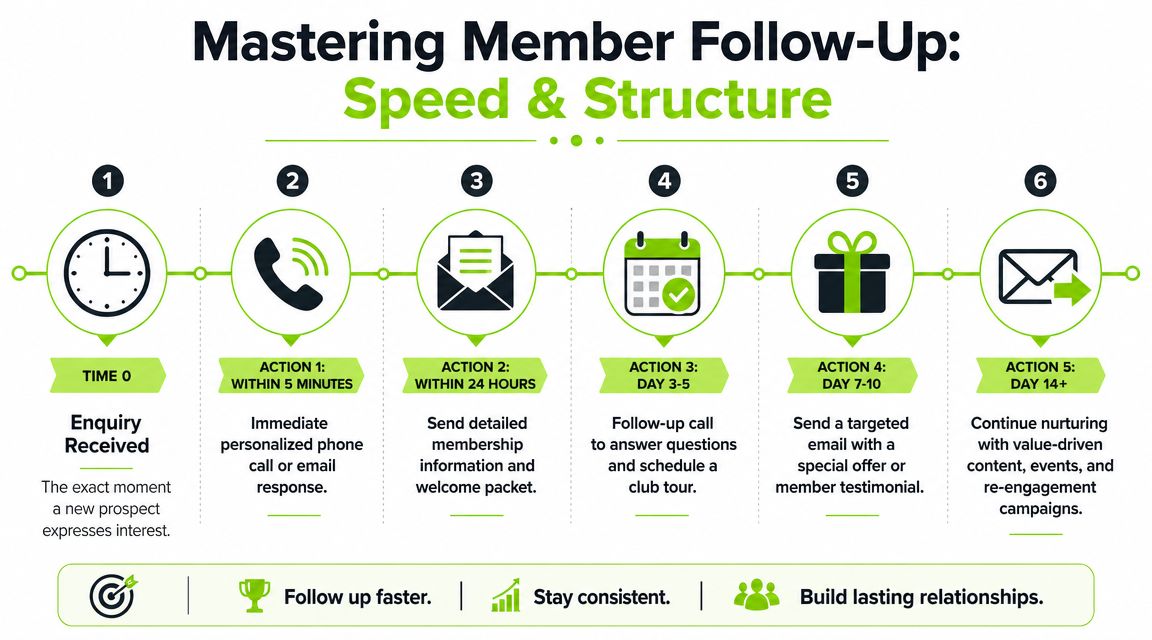
A workable follow-up rhythm
Most clubs need a simple structure, not a complicated sales script.
A practical sequence might look like this:
- Immediate acknowledgement so the prospect knows the enquiry was received.
- Fast personal contact by phone, email, or text from the right staff member.
- A clear invitation to visit, tour, or talk through options.
- Scheduled follow-up if there is no reply.
- Longer nurture for people who are interested but not ready.
The key is consistency. Every lead should move somewhere. Nobody should be left sitting in a form inbox with no next action.
Fast response is only half the job. Structured follow-up is what carries a prospect from curiosity to commitment.
What good lead ownership sounds like
The first response should feel human and useful.
Not: “Please find attached our membership brochure.”
Better: thank them for the enquiry, acknowledge the type of membership they asked about, answer the obvious next question, and offer a specific next step. A visit. A call. A trial experience. A conversation with the membership lead.
That response should also be tracked. If you cannot see whether the call happened, whether the email was sent, or whether the visit was booked, then you cannot manage conversion.
Measure the process, not just the outcome
Clubs often judge performance only by memberships sold. That is too late.
Watch the operational points in between:
| Process point | What to look for |
|---|---|
| New enquiry handling | Was it acknowledged and assigned quickly |
| Contact attempt | Did the prospect get a real first response |
| Next step booked | Was there a visit, call, or meeting arranged |
| Pipeline movement | Did the lead advance or stall |
| Reason lost | Was it timing, price, fit, or failed follow-up |
That is where conversion improves. Not through vague optimism, but through operational discipline.
If your team wants a broader view of measuring website and funnel performance, this guide to optimizing conversion rates with analytics is a useful companion to the lead-handling side.
If your club feels stuck on the problem of not getting enough enquiries, the first move is not always more promotion. It is usually better lead handling. GolfRep helps golf clubs build that system by combining enquiry generation, CRM visibility, and structured follow-up so prospects do not vanish between first contact and membership decision.
Ready to tap into our proven growth system?