Your Golf Club Aging Membership: A 2026 Playbook

If you're managing a golf club right now, you probably don't need a report to tell you the membership is getting older. You can see it in tee sheets, committee conversations, weekday usage patterns, and in the same names coming up every time renewal risk gets discussed.
The problem is that many clubs still treat golf club aging membership as a marketing issue when it's really an operating issue. They assume the answer is more visibility, more adverts, more enquiries. In practice, the bigger failure usually sits further down the line. The product is dated, the database isn't segmented properly, and enquiries are handled in a way that leaves too much to chance.
That matters because this isn't a short-term wobble. It's a structural challenge. If your club depends heavily on older cohorts and you don't have a deliberate replacement plan, time does the damage for you.
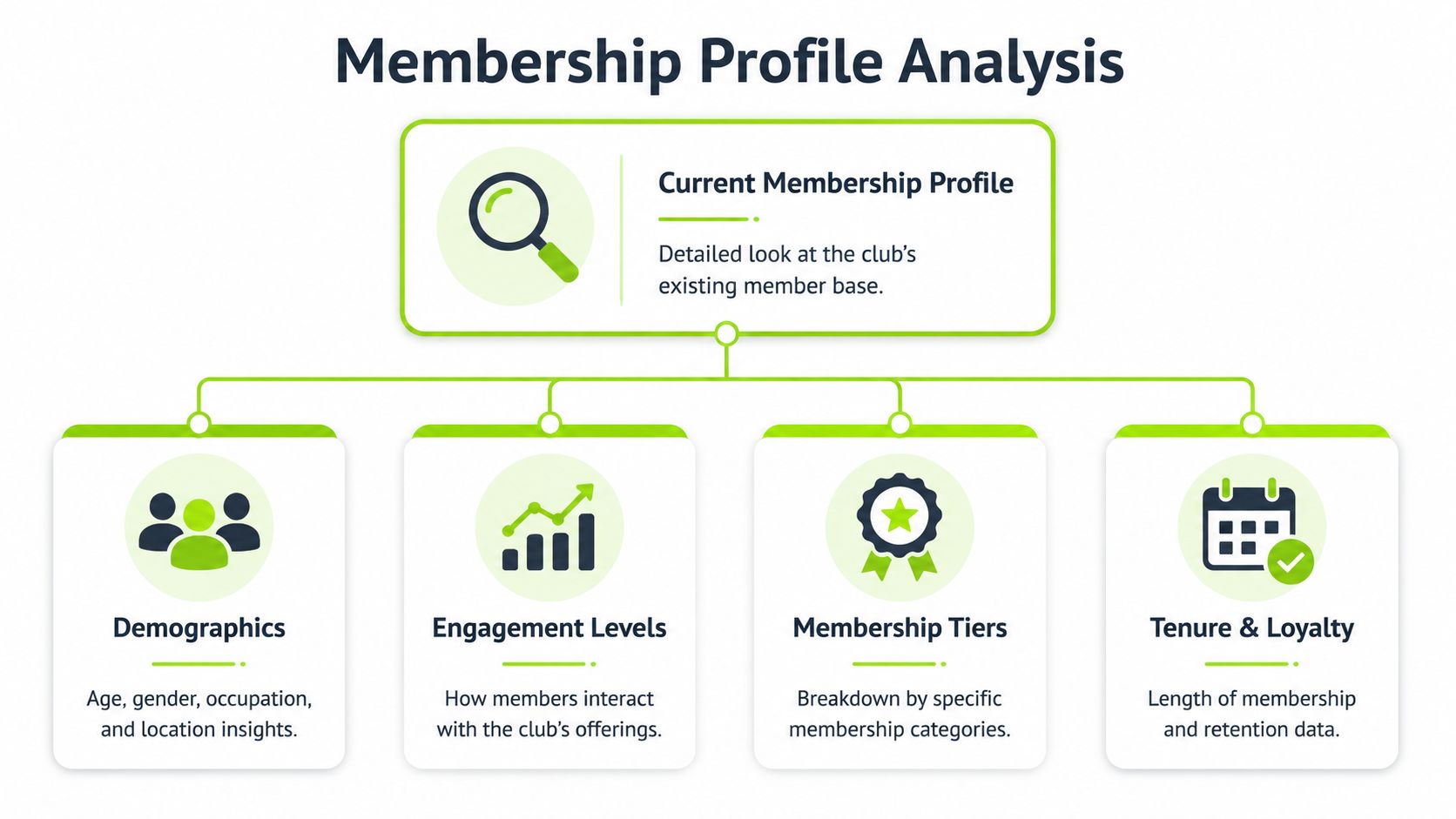
First Understand Your Current Membership Profile
Most clubs start with a vague diagnosis. They say the membership feels older, that younger golfers don't commit, or that recruitment is harder than it used to be. None of that is precise enough to make decisions from.
You need a real picture of your member base. Not just total member count. Not just whether subscriptions are up or down. You need to know who is in the club, how they use it, what they pay, and which groups create the biggest risk over the next few years.
Start with age, but don't stop there
A useful first pass is to segment your database into age bands, then layer in tenure, category, and usage. UK club demographics discussed in this Golf Club Atlas thread on age distribution and replacement risk suggest many clubs may have roughly 25% to 33% of members over age 60, with a practical replacement challenge inside a 5 to 10-year horizon.
That doesn't mean every member over 60 is leaving soon. It means you can't afford lazy reporting. A club can look stable on headline numbers while gradually losing future capacity because older members aren't being replaced fast enough by younger cohorts.
Practical rule: If your monthly reporting only shows total members and subscription income, you're missing the real story.
Build one working view of risk
Pull your membership data into a single working sheet or CRM view and review it by:
- Age band: Group members into sensible bands that reflect your club's categories and likely life-stage changes.
- Tenure: Separate long-standing members from recent joiners. Newer members often need different support to established ones.
- Membership type: Full, five-day, junior, intermediate, social, flexible, corporate, family-linked.
- Engagement signals: Tee bookings, competition entries, coaching, dining, social events, academy usage, committee or volunteer involvement.
- Renewal status: Paid, due soon, overdue, resigned, at-risk, paused, downgraded.
Many clubs realize the issue isn't just age. It's concentration. A small number of categories may hold a disproportionate share of revenue and loyalty, but also carry the highest succession risk.
Ask harder questions of your own data
Don't ask whether your club is attracting members. Ask where replacement pressure sits.
A short internal review can expose a lot:
| Question | Why it matters |
|---|---|
| Which age bands are growing, flat, or thinning out? | This shows where your future adult pipeline is weak. |
| Which categories have the lowest engagement? | Low engagement often precedes poor retention. |
| Where is revenue concentrated? | Losing a stable revenue cohort hurts more than losing a lightly engaged one. |
| Which members haven't used the club meaningfully in recent months? | These members need intervention before renewal comes due. |
If your club is already seeing slippage, it helps to compare your profile against the operational warning signs discussed in this look at a golf club losing members.
Treat anecdote as a clue, not evidence
Committee members will usually have strong views on why younger people aren't joining. Some will blame price. Others will blame time, family pressures, or the local market. There may be truth in all of that.
But until you've segmented your own database properly, you're still guessing. Clubs that handle golf club aging membership well usually start by getting honest about cohort risk, category fit, and where engagement is already fading.
Redesign Your Membership Products for Modern Golfers
An aging membership often points to an aging product.
If your main offer still assumes that every golfer wants a traditional annual commitment with a standard access pattern, you're narrowing your own market before the first enquiry even arrives. Many younger professionals and families don't reject golf. They reject inflexibility.

Why the old model creates its own recruitment problem
Independent analysis of private club transitions notes in this review of tiered membership models that clubs are increasingly using tiered membership to attract new revenue and appeal to a younger generation, rather than relying on one-size-fits-all structures.
That shift makes sense. Younger golfers are often balancing work, travel, childcare, and irregular schedules. If your only serious offer is full commitment from day one, many will enquire politely and disappear.
That doesn't mean you should dilute the club. It means you should design a pathway into it.
Products that tend to make sense
The most effective membership structures usually protect the core category while giving newer or younger golfers an easier first step.
Consider the difference:
Traditional full membership only
- Strong for committed golfers
- Weak for hesitant joiners
- Harder to sell from a cold enquiry
Layered membership ladder
- Full membership remains the premium core
- Transitional products create entry points
- Easier to convert visitors into future full members
Clubs don't usually have a demand problem first. They have a fit problem. The offer doesn't match how the prospect wants to start.
What to build instead
A practical membership architecture often includes a few distinct routes:
Transitional memberships
These work for younger adults, returning golfers, and players who want commitment to feel earned rather than imposed. Think limited-day access, off-peak entitlement, points-based golf, or a defined stepping-stone category before full membership.
Household and family-linked options
These matter when one golfer in the home is keen but the household isn't ready to absorb a full family commitment. Add-ons, linked social access, and simple family pathways can make the club feel usable beyond one person's golf.
Flexible trial-to-member routes
This isn't about discounting everything. It's about reducing friction. A structured route from academy use, coaching, roll-ups, or casual play into a better-defined membership category is often more effective than pushing everyone straight into the most expensive option.
For ideas on how clubs are reshaping offers to appeal to new age groups, this guide on how to attract younger golf club members is a useful reference point.
Protect the core while widening the front door
The common objection is obvious. Existing members worry that flexibility cheapens the club. That concern is valid if the categories are badly designed.
The answer isn't to avoid new products. It's to structure them properly. Keep access rules clear. Protect peak value. Define upgrade paths. Make sure each category has a purpose and a ceiling.
A club with no entry route is usually not preserving exclusivity. It's preserving stagnation.
Building Your Predictable Lead Generation Engine
Once the offer is right, recruitment gets easier to run properly. Not easy in the casual sense, but clearer. You can target the right people with the right proposition instead of throwing generic membership messaging at the whole catchment.
That distinction matters because broad participation recovery doesn't automatically solve age imbalance. In the sector context discussed through DePaul's club benchmark review, adult male membership was noted as up about 3% and adult female membership up about 1.5%, while the average member age in England remained 54+. Recovery and renewal are not the same thing as succession.
Stop relying on passive demand
Many clubs still depend on three channels that feel comfortable but are hard to control:
- Word of mouth: Valuable, but inconsistent
- Website contact pages: Useful, but passive
- General brand awareness: Fine for reputation, weak for targeted recruitment
A predictable engine works differently. It starts with a target segment, then matches message, landing page and follow-up to that segment.
A younger competitive golfer doesn't respond to the same message as a family-led beginner. Someone considering an intermediate category needs different information from someone comparing full membership across three local clubs.
What a modern local campaign should include
A sensible acquisition setup usually combines:
Search intent capture
When someone is actively searching for local golf membership, beginner golf, flexible golf access, or a nearby club, you want a page built for conversion rather than a generic membership PDF.
Paid social for demand creation
Social media works best when the club has a clear product to promote. Family pathways, flexible access, beginner-friendly routes, and club lifestyle content often create interest from people who weren't planning to search that day.
Landing pages by audience
One page rarely does the job. Build separate landing experiences for different segments so the message feels relevant and the enquiry form reflects their likely concerns.
If your club is rebuilding this part of the pipeline, these proven lead generation tips from LeadBlaze are worth reviewing because they reinforce the basics clubs often skip, especially clarity of offer and conversion-focused page design.
Measure channel quality, not channel activity
A busy campaign can still be a poor campaign. Clicks, impressions, and page views don't tell you much on their own. What matters is whether a channel produces the right type of enquiry for the membership products you want to grow.
A campaign isn't successful because people noticed it. It's successful when the club can identify, respond to, and convert the right enquiries consistently.
For a practical view of how clubs can structure this properly, this article on a golf club lead generation system is useful because it treats lead generation as one part of a wider pipeline rather than the whole answer.
Why Your System Is More Important Than the Enquiry
Most clubs leak growth at this point.
They celebrate an enquiry, forward it to the office, hope someone calls, and assume the sales process is underway. In reality, the prospect may wait too long, receive inconsistent information, or get no structured follow-up after the first touch. The club then concludes that lead quality was poor.
Usually, the system was poor.
Enquiries don't convert themselves
A membership enquiry isn't a sale. It's a signal of interest, often from someone still comparing options, discussing timing with family, or testing whether your club feels welcoming.
If your process depends on one staff member remembering to call, one committee member checking a shared inbox, or one spreadsheet being updated manually, you'll lose opportunities for reasons that have nothing to do with demand.
The clubs that handle golf club aging membership best don't treat enquiries as admin. They treat them as pipeline stages with clear ownership.
What the conversion system needs to do
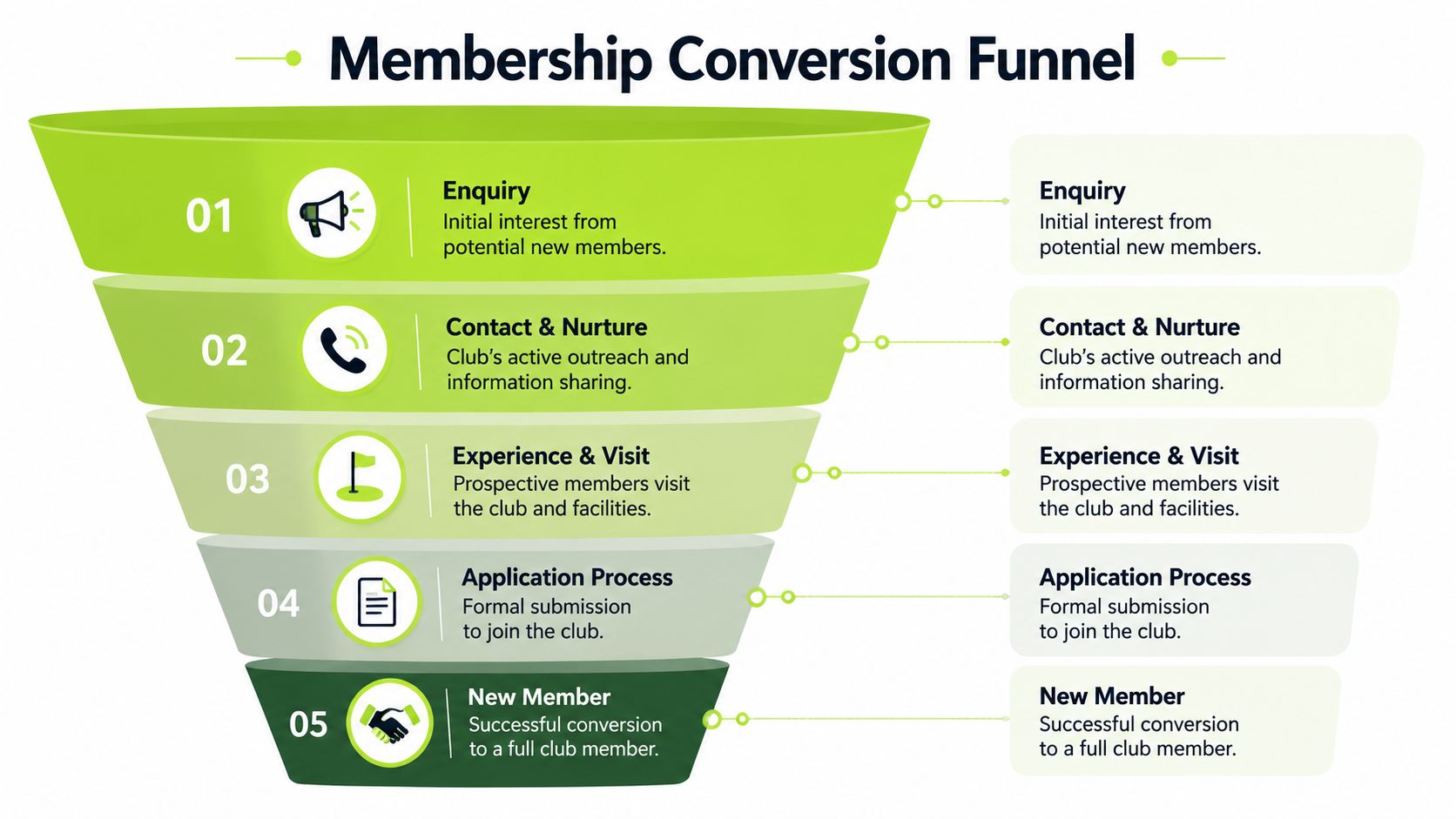
A working recruitment system should cover the full path from first enquiry to joined member:
| Stage | What the club must control |
|---|---|
| Enquiry received | Capture source, product interest, and contact details properly |
| First response | Reply quickly with relevant next steps |
| Follow-up | Schedule calls, emails, and reminders, not vague intentions |
| Visit or experience | Book and confirm the club visit or trial touchpoint |
| Decision | Track outcome, objection, delay reason, or lost lead status |
Tools matter. A CRM gives the club visibility. Automation helps acknowledge and route enquiries quickly. Task workflows stop leads being forgotten. GolfRep is one option clubs use for CRM setup, follow-up automation, and conversion tracking, but the principle matters more than the platform name. The process needs to exist.
Retention starts before the member joins
Peer-reviewed research in this country club membership study found that involvement level and perceived value are strongly linked to satisfaction and intention to renew. That has a practical implication for managers. The experience of becoming a member should already be building involvement and value, not just processing paperwork.
A weak joining process creates future retention problems. A strong one starts social connection early, introduces relevant events, and nudges usage before first renewal comes into view.
Operational test: If you can't see every open enquiry, last contact date, next action, and outcome in one place, your conversion process is still too fragile.
Missed calls and delayed replies cost more than clubs admit
Many membership prospects enquire outside office hours or call when the team is busy. If nobody picks up and nothing happens next, the prospect often departs unnoticed. That's why practical missed-call workflows matter. For clubs reviewing response handling, My AI Front Desk's guide gives a useful example of how missed-call text-back processes can reduce dead ends.
The point isn't to automate everything into a robotic sequence. It's to make sure interest gets acknowledged immediately and progressed consistently.
The common mistakes are very ordinary
Most failures aren't dramatic. They're small and repetitive:
- Slow first contact: Staff mean to respond later and the lead cools off.
- No source tracking: Nobody knows which campaigns produce serious prospects.
- Loose follow-up: A visit is discussed but never booked.
- No nurture: Prospects receive price information but no reasons to care.
- No reporting: The committee debates lead quality with no evidence.
Managers often ask how to get more enquiries. A better first question is how many current enquiries the club can confidently convert with its present process.
Creating a Deliberate Junior to Adult Pathway
A healthy junior section is encouraging, but it isn't succession planning on its own.
Recent England Golf discussion noted in this video on membership demographics and retention described junior membership as up over 30%, while general member retention was often cited at only 6% to 9% in normal conditions. That combination creates both opportunity and risk. More juniors coming in means very little if the club has no structure for keeping them connected through the years when life starts pulling them away.
Why clubs lose them later
The drop-off rarely happens because a junior suddenly stops liking golf. It usually happens because the club stops presenting a believable next step.
School changes, university, early work years, travel, and changing friendship groups all affect continuity. If the only next offer is full adult membership with adult expectations and adult pricing, many young players drift out of the system.
Build a pathway, not a cliff edge
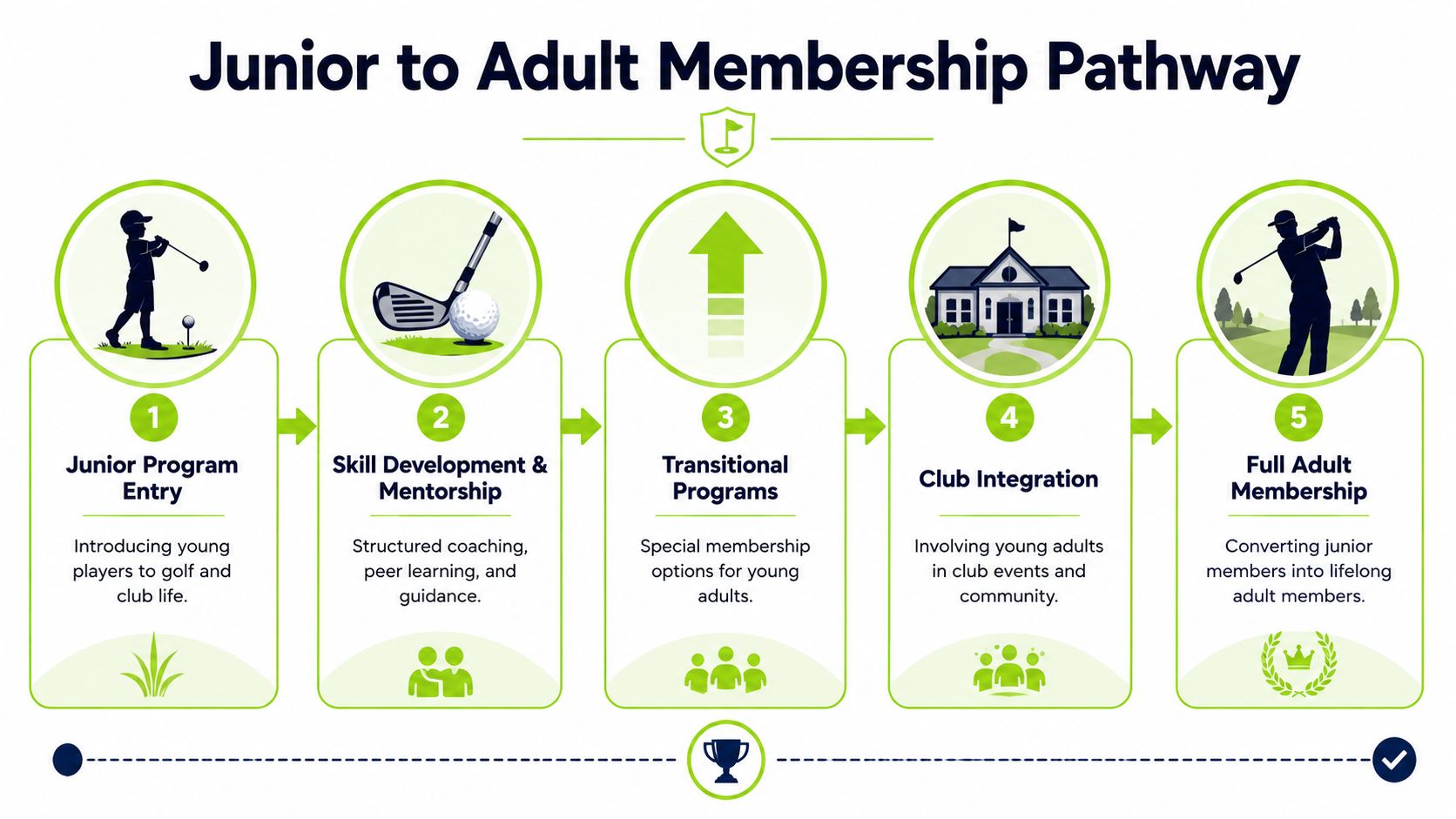
A proper junior-to-adult model needs continuity across several stages:
Keep contact beyond coaching
If your communication with juniors sits only inside coaching sessions, you lose the relationship once attendance changes. Maintain direct contact with players and parents, with permission and good process, so the club remains visible.
Parents often need practical guidance too. Resources like Live Tourney's guide for junior golf parents are helpful because they show the wider support structures families look for around junior participation.
Create transitional categories
Young adults need membership categories that reflect unstable schedules and developing finances. That category should feel like belonging, not a watered-down afterthought.
Give them a social reason to stay
Young golfers remain where they have peers, competitions, informal events, and visible routes into club life. If every social space and competition format feels designed for someone decades older, the pathway breaks even when the golf is good.
The junior section isn't a separate success story. It's the earliest stage of your future adult membership pipeline.
Track progression intentionally
Clubs should know which juniors are likely to transition, which are disengaging, and which have gone quiet after major life changes. That means tracking more than handicap progress.
A practical review list might include:
- Age and stage: School, university, apprenticeships, first jobs
- Current engagement: Coaching, competitions, casual play, social attendance
- Family link: Whether parents or guardians are connected to the club
- Transition readiness: Interest in intermediate or young adult membership
- Communication status: Last meaningful conversation and next planned contact
If you leave this to chance, you'll keep celebrating junior growth while losing adult succession.
Measuring What Matters for Predictable Growth
Many clubs still report activity instead of outcomes.
They talk about website traffic, brochure requests, social media engagement, or whether a campaign felt busy. Those signals can be useful, but they don't tell a manager whether the membership pipeline is healthy or whether the club is buying the right kind of demand.
Track the points where value is created
For membership growth, the most useful measures are the ones that expose movement through the pipeline.
Focus on questions like these:
- How many genuine enquiries came in by channel and by membership product
- How quickly each enquiry received a first response
- How many enquiries progressed to a visit, call, or meeting
- How many visits turned into applications
- How many applications became active members
- Which membership categories retain and engage well after joining
This shifts the conversation from vague marketing discussion to operational accountability.
Vanity metrics versus decision metrics
A simple comparison helps.
| Vanity metric | Better decision metric |
|---|---|
| Website visits | Qualified membership enquiries |
| Social engagement | Enquiries by audience type |
| Number of calls | Booked club visits |
| Campaign spend alone | Cost per qualified enquiry |
| Total joiners | Joiners by source and product type |
If your reporting stops at the enquiry, you still don't know which channels deserve budget. If it stops at joined members, you still don't know whether those members engage, renew, or fit the categories your club needs.
Give the committee a clearer picture
Managers often struggle because committees ask fair questions but don't have good reporting. They want to know whether marketing works, whether new categories are worth keeping, and whether staffing or software investment is justified.
Those questions become easier when the club can show a clean pipeline view. Not a pile of anecdotes. A real view of source, status, progression, outcome, and early engagement.
If you can't explain where new members came from and what happened to the enquiries that didn't convert, you don't yet have a predictable growth model.
Use measurement to improve operations, not just report them
The point of tracking isn't to produce nicer board papers. It's to improve decisions.
If one landing page attracts poor-fit enquiries, change the message. If one category drives visits but not applications, review the offer. If one staff handover point causes delay, redesign the workflow. If a product attracts joiners who barely engage, fix onboarding instead of blaming price sensitivity.
Clubs that make progress on golf club aging membership usually become much more disciplined in this area. They stop chasing abstract awareness and start managing conversion, category fit, and retention with far more precision.
Conclusion From Hope to a System for Growth
Aging membership isn't solved by one campaign, one discount, or one committee debate about younger people. It changes when the club treats growth as a system.
That system starts with honesty. Know your current profile properly. Understand where risk is concentrated. Stop hiding behind total member numbers if the age mix underneath them is moving the wrong way.
Then fix the offer. A club that wants younger members but only presents old membership structures is creating its own bottleneck. Modern golfers need sensible routes in, not a take-it-or-leave-it proposition designed for another era.
After that, build the pipeline properly. Recruitment should not depend on sporadic word of mouth or whether someone happens to answer the phone at the right moment. It needs targeted lead generation, relevant landing pages, and a visible conversion process from first enquiry to visit to signed member.
Above all, stop treating lead generation as the whole answer. For many clubs, the bigger issue isn't a lack of interest. It's weak enquiry handling, poor follow-up, no central visibility, and too much manual process. That's where opportunities get lost and where confidence in marketing breaks down.
The same principle applies to long-term retention. Juniors don't become adult members because the club hopes they will. Younger joiners don't renew because they filled in a form once. Members stay when the club gives them a clear route in, a reason to engage, and a structure that supports involvement early.
That is the playbook for golf club aging membership. Diagnose accurately. Design products people can buy. Build a dependable enquiry engine. Install a conversion system that staff can run consistently. Measure what moves members through the pipeline. Then keep strengthening the pathway after they join.
Clubs that do this stop reacting to decline and start managing growth with intent.
If your club needs help building that kind of membership pipeline, GolfRep works with golf clubs on the practical side of growth: lead generation, CRM structure, follow-up automation, and conversion tracking, so enquiries don't just arrive, they move.
Ready to tap into our proven growth system?