Golf Club Membership Marketing: A Practical Playbook
Most golf club membership marketing advice starts in the wrong place. It talks about more ads, more posts, more awareness, as if enquiries automatically turn into members once the form is filled in. In practice, clubs lose people after the enquiry lands, because the response is slow, the follow-up is inconsistent, and nobody owns the next step.
That's the core issue GolfRep sees across the sector. A club can spend properly on traffic and still underperform if the enquiry sits in a shared inbox, the secretary is away, or the committee assumes someone else has handled it. The playbook that works is built around response speed, lead visibility, and structured follow-up, not just demand generation.
Why Most Membership Campaigns Underperform
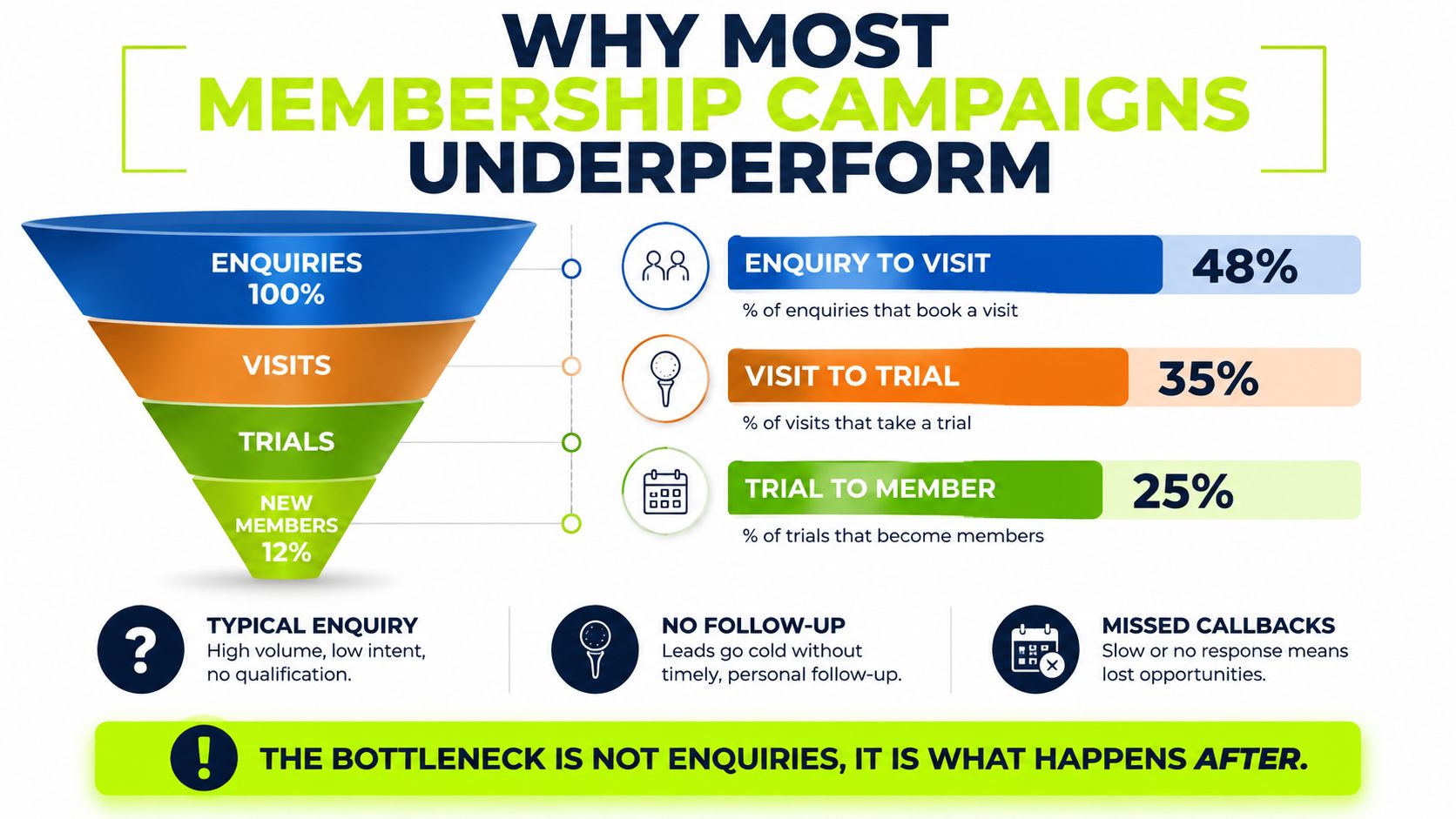
The common mistake is treating enquiries as the finish line. They're not. They're the start of a short operational race, and most clubs drop the baton before the prospect ever books a visit.
GolfRep's UK analysis reports that the average response time to membership enquiries is 47 hours and 32 minutes, and that a lead answered within one hour is five times more likely to convert than one left waiting 24 hours. That gap explains why so many campaigns feel busy but don't produce enough sign-ups. The club got the lead, then missed the moment.
The usual failure pattern
A committee approves a campaign, ads go live, and a burst of forms arrives. Then reality takes over. The secretary is on the course, the inbox is shared, and nobody has a defined handover for who calls first, who logs the lead, or who books the visit.
That's why speed matters so much. A prospect who hears back quickly feels noticed and taken seriously, while a prospect who waits a day or two starts looking elsewhere or loses interest. The campaign didn't fail because the club lacked demand. It failed because the process after the enquiry was loose.
Practical rule: if a club can't answer fast, it should do less with paid traffic and more with the response system first.
The right way to think about Golf club membership marketing is as a conversion chain. Enquiry, acknowledgement, qualification, visit, application, join. If any one of those steps is left to chance, the whole drive leaks.
Segmenting Your Membership Audience Before You Spend a Penny
A strong membership drive starts with audience choice, not channel choice. Clubs that try to speak to everyone end up speaking clearly to no one. Different prospects have different motives, different objections, and different decision paths.
A practical starting point is to split the pool into young professionals, family joiners, lifestyle movers, returning golfers, and corporate enquiries. Each group needs a different angle. Young professionals may care about convenience and social value, while returning golfers often need reassurance that the club still suits their game and their schedule.
For a useful external framing on this, Viral.new's guide to divide your audience for targeted content is a clear reminder that segmentation is about relevance, not complexity. A club doesn't need a huge database model to begin. It needs a spreadsheet with segments, objections, and the next action for each group.
A private members' club looking to fill a defined number of places should map each segment to three things.
- Likely source: referrals, local search, paid social, or community partners.
- Main objection: time, value, family fit, or confidence in the club environment.
- Conversion path: brochure, open day, taster round, or direct membership chat.
The strongest acquisition channel for many clubs is referral-led. GolfRep's UK source reports that member referrals are the most effective acquisition channel for 53% of clubs, ahead of social media at 24% and general advertising at 38%. That doesn't mean every campaign should become referral-only. It does mean the club should start by identifying who already trusts the club enough to recommend it.
A good internal reference point is this market segmentation guide, because the club's own segments should stay simple enough for staff to use in real time. If the structure needs a consultant to interpret it, it's too complicated.
A club that knows who it is talking to can write a sharper offer, choose a better channel, and waste less time on the wrong leads.
Choosing Paid and Organic Channels That Fit a Club
Channel choice should come after segmentation, not before it. The best question isn't “Where can we advertise?” It's “Which channel gives us qualified enquiries we can handle?”
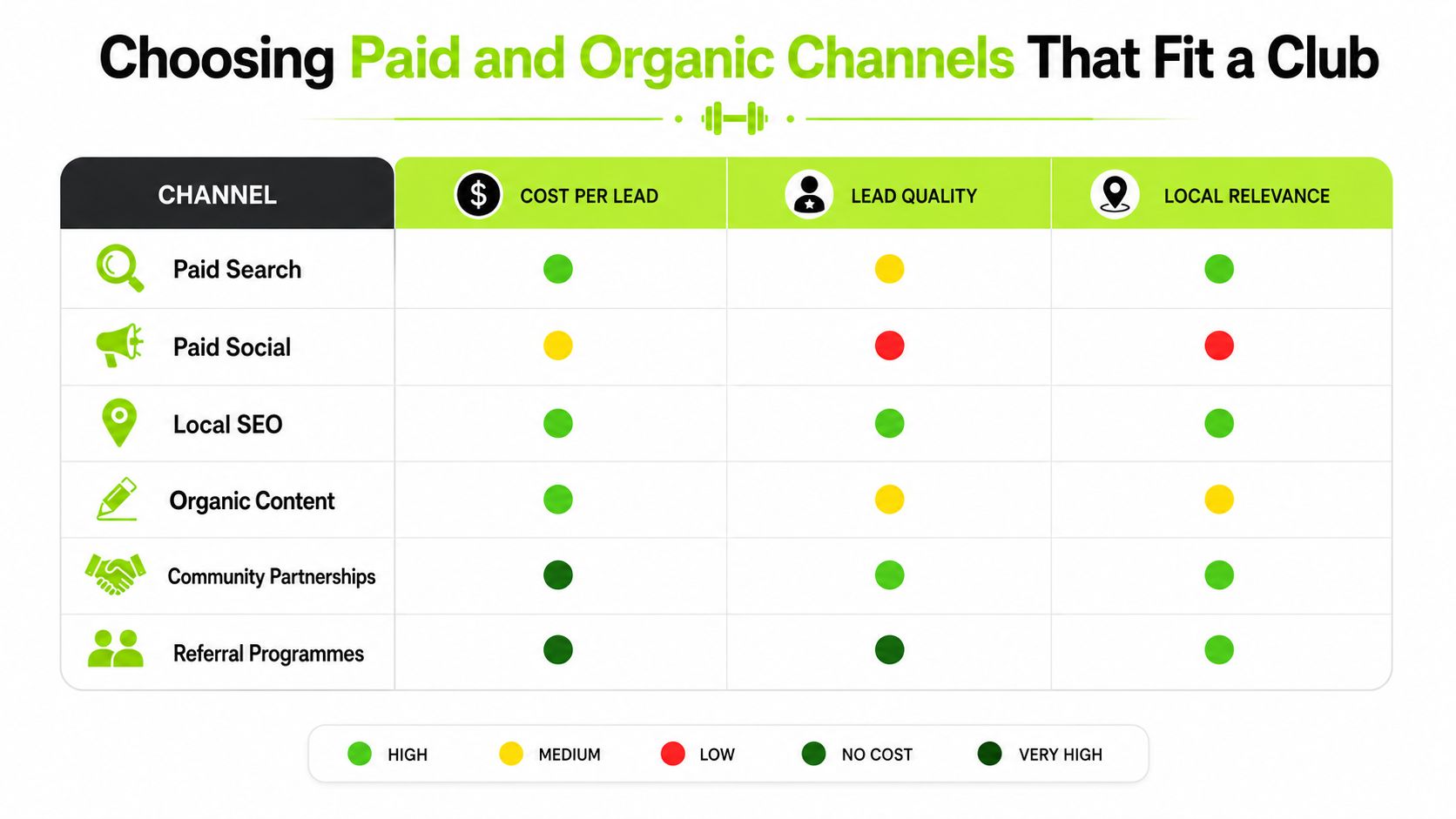
For a golf club, the three useful decision criteria are cost per qualified enquiry, time to first visit, and controllability for a small team. Paid search often works when the intent is strong, because people searching for membership are already close to action. Broad social reach can create attention, but attention alone doesn't book a visit.
What to favour first
Local SEO, referral programmes, and community partnerships usually fit clubs with limited time and limited staff best. They're easier to explain internally, easier to track, and easier to align with a real membership offer. Organic content helps too, but only if it points to a clear next step, not a vague “find out more” page.
The common UK mistake is running Meta ads to a generic homepage. That wastes money. If a prospect clicks an ad about joining, the page should talk about joining. It should have one call to action, one offer, and one next step.
Community partnerships can work well when the club already has local relationships. Think schools, businesses, charities, and nearby lifestyle groups. Referral programmes also matter because the club gets a warmer lead from an existing member who already understands the social fit.
A sensible test mix for an eight-week drive is usually modest and controlled. Start with a strong local search presence, a dedicated landing page, a referral push, and one or two paid channels that can be paused quickly if they underperform. That keeps the club from overcommitting to anything it can't follow up properly.
The right mix is rarely about doing everything. It's about choosing channels that your team can convert.
Designing Lead Capture and the First Response Workflow
Most clubs lose the sale at this stage. A prospect clicks, fills in a form, and then waits. If the landing page is weak or the follow-up is slow, the enquiry decays before anyone has a conversation.
A club needs a landing page that does a few simple things well. It should offer one membership proposition, use a short form, include a trust strip, give a calendar or callback option, and send data into a system that tracks source properly. If the form asks for too much, people abandon it. If it asks for too little, the club can't qualify the lead.
If you need a practical tool reference for structuring the form, create lead form for sales is useful context because it keeps the focus on form design rather than page decoration. The point is not prettier design. The point is a cleaner handover from interest to contact.
The first 48 hours should be tightly scripted.
- Instant acknowledgement. The prospect should know the enquiry landed.
- Same-day substantive response. A phone call, SMS, or WhatsApp message should confirm the next step.
- Qualification. Ask a small set of questions about timing, interest, and fit.
- Invite to visit. Offer an open day, taster, or direct membership conversation.
- Follow up after three days. If there's no reply, don't leave it.
- Close the loop at campaign end. Every open enquiry should have a status.
GCMA reports that top performing clubs follow up on membership enquiries 100% of the time, while average clubs do so only around 20%. That gap isn't about ambition. It's about habit and ownership.
The practical checklist sits in this follow-up system guide. The message is simple, each enquiry should have a named owner, a next action, and a deadline.
If a club can't tell you who speaks to the lead next, the lead isn't really in the pipeline yet.
Building CRM Nurture Flows That Convert
Once a lead is in the CRM, the job is not to keep pushing. The job is to move the prospect through a clear follow-up path without relying on staff memory. That starts with the right data, because a CRM with thin fields turns into a list, not a pipeline.
At minimum, the club should capture name, contact details, source, segment, intent, visit status, and current stage. If a prospect came from a referral, that should be tagged. If they asked about family membership, that should be tagged too. Without those fields, the club cannot tell which enquiries deserve attention, which offers fit the lead, or where the pipeline is leaking. The same logic applies to every stage of golf club lead nurture. If the record is incomplete, the follow-up will be too.
A useful nurture sequence does not need to be flashy. It needs to be consistent and easy for staff to run every time. A six-touch mix of email and SMS is enough to stay visible without becoming noise, provided each message has a clear job.
| Day | Channel | Purpose | Trigger |
|---|---|---|---|
| Day 0 | Confirm enquiry and set expectations | Form submitted | |
| Day 0 | SMS | Prompt fast reply or call-back choice | No immediate reply |
| Day 2 | Answer likely objections | No booking yet | |
| Day 4 | Call or SMS | Invite to visit | Prospect still unbooked |
| Day 7 | Share club proof and next step | No response | |
| Day 10 | SMS | Final nudge before cooling | Still inactive |
GolfRep's UK case data cites a 6-email nurture sequence converting 28% of engaged prospects into members at Downes Crediton. That is a useful reference point because it shows nurture is not a side task. It is part of the conversion engine, and it only works when the club follows the sequence without gaps.
The handover from marketing to the membership secretary should be simple. The lead has been tagged, the source is known, the last action is logged, and the next action is assigned. That avoids the common problem where marketing hands over a name and then loses sight of what happens next. It also stops the club from arguing about ownership when the prospect goes cold.
The practical detail matters. A prospect who clicks, opens, or replies is signalling intent. The CRM should use that signal to trigger the next message instead of waiting for someone to remember the sequence. If a manager wants a working example of how that follow-up logic is set up in practice, the clearest reference is the club's own nurture workflow, not a generic sales template.
Pricing, Offers and Referral Mechanics
Discounting is the easy lever, and that's exactly why clubs overuse it. It creates activity, but it can also cheapen the offer and train prospects to wait for a better deal. A more disciplined approach is to use structured offers that fit the segment.
That can include joining fee waivers for a specific group, family bundles, trial rounds, or corporate packages. The key is that each offer should match a real objection. If the barrier is uncertainty, a taster round helps more than a blunt price cut. If the barrier is family logistics, a bundle may make the decision easier.
Hillier Hopkins' 2024/25 survey found that 94% of members' clubs plan to increase subscription fees by an average of 6%, and that 71% now use member referrals as a marketing method, up from 64% in 2023. That tells you two things. Clubs still believe pricing can be managed, and they're leaning harder into referral-led acquisition rather than just chasing volume.
A referral programme should be designed like a proper process, not a vague request at the bar. Give members a simple reason to refer, a clear way to introduce someone, and a visible follow-up path so they know the enquiry was acted on. The CRM should attribute each referral back to the source member, because that's how the club learns who drives quality introductions.
Referral systems work when they are easy to explain and easy to track. If members have to chase for an update, the momentum dies.
This is also where a club can use GolfRep as one operational option, because its system combines lead capture, qualification, automated follow-up, and pipeline visibility rather than treating marketing as isolated campaigns. That matters more than flashy offers. The club keeps control of pricing while still giving prospects a reason to act now.
KPIs, Reporting and Continuous Improvement
A membership drive only becomes a system when the club measures it properly. Without reporting, staff end up arguing about opinions, not pipeline quality. With reporting, the club can see whether the issue is traffic, response, visits, or closing.
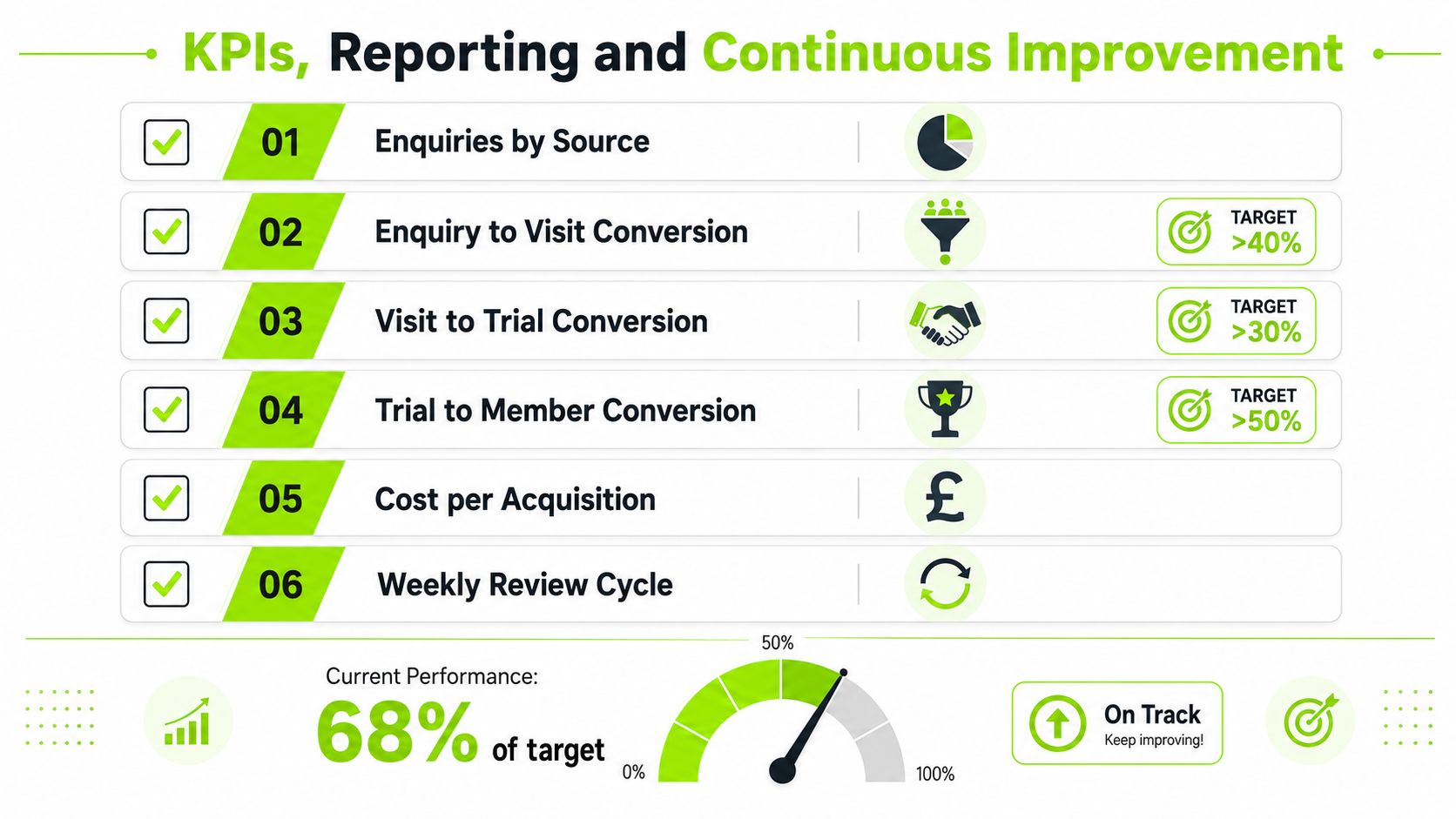
The weekly dashboard should stay lean. Track enquiries by source, enquiry to visit conversion, visit to application conversion, cost per new member, and average response time. Add retention signals too, especially first-year onboarding engagement, because acquisition means little if new joiners drop away quickly.
How to read the numbers without overreacting
Weekly data will bounce around. That's normal. One quiet week doesn't mean the channel is dead, and one strong week doesn't mean the campaign has cracked it. What matters is direction, consistency, and whether enquiries are being handled the same way every time.
A simple dashboard in a CRM or spreadsheet is enough if it's updated. If the club has a report that only counts leads, it's not enough. If it can show which source produced the visit, which visit turned into an application, and how quickly the team replied, then the committee can make better decisions.
For a practical set of templates and dashboard ideas, marketing dashboard tools and templates is a useful reference point because it helps clubs think about visibility rather than guesswork. The point is not complex analytics. The point is one shared view of what's working.
GolfRep's UK case data reports that a post-membership onboarding sequence improved first-year retention by 35% at Bidston Golf Club. That matters because membership growth isn't just about bringing people in, it's about making sure they stay engaged after joining.
A sensible 30-day rollout looks like this. Week one, audit enquiry handling and assign ownership. Week two, segment the audience and fix the landing page. Week three, stand up CRM nurture and referral mechanics. Week four, launch the tracked campaign and review it weekly.
Screenshot checklist for the committee
- Are all enquiries logged in one place?
- Do we know who replies first?
- Can we see source, visit, and join status?
- Are referrals tracked by member name?
- Do new joiners get an onboarding sequence?
- Are we improving the system before spending more?
That is the central point. Golf club membership marketing is a systems problem, not a spend problem. Clubs that fix response design, follow-up, and tracking usually get more from the same budget than clubs that buy more traffic.
If your club wants a membership pipeline that's built around response speed, CRM follow-up, and proper visibility, speak to GolfRep. We help clubs turn enquiries into booked visits and signed members with a system the team can run, not just another campaign to manage.
Ready to tap into our proven growth system?