Golf Club Membership Ideas: Proven Strategies for 2026
Most UK clubs are not short of interest. They're short of control. Enquiries come in, staff mean to reply, and then the lead sits in inboxes, WhatsApp threads, memory, or a spreadsheet that nobody trusts. That's why golf club membership ideas too often fail in practice. The idea is sound, but the club has no system to capture the prospect, qualify intent, or move them from enquiry to visit to sign-up.
GolfRep works from a different assumption. Growth doesn't start with more leads. It starts with better handling of the leads a club already has, with clear ownership, visible pipeline stages, and follow-up that doesn't depend on someone remembering to chase. That matters in a market that has expanded materially, with England Golf reporting 737,021 affiliated golf club members in England in February 2022, up from 647,224 a year earlier and roughly 100,000 above pre-pandemic levels (England Golf membership figures reported by Fairways Mixed Golf).
The eight ideas below are not just marketing tactics. Each one only works when the club can see the enquiry, assign it, track it, and respond on time. That's the true membership lever.
1. Tiered Membership Structure
Tiered membership works because it gives a golfer more than one route to join. A player who will not commit to full membership today may still take a social, weekday, or entry tier if the offer is clear, premium, and easy to understand. The error many clubs make is treating tiers like a discount menu. That weakens the brand and creates confusion at the point of enquiry.
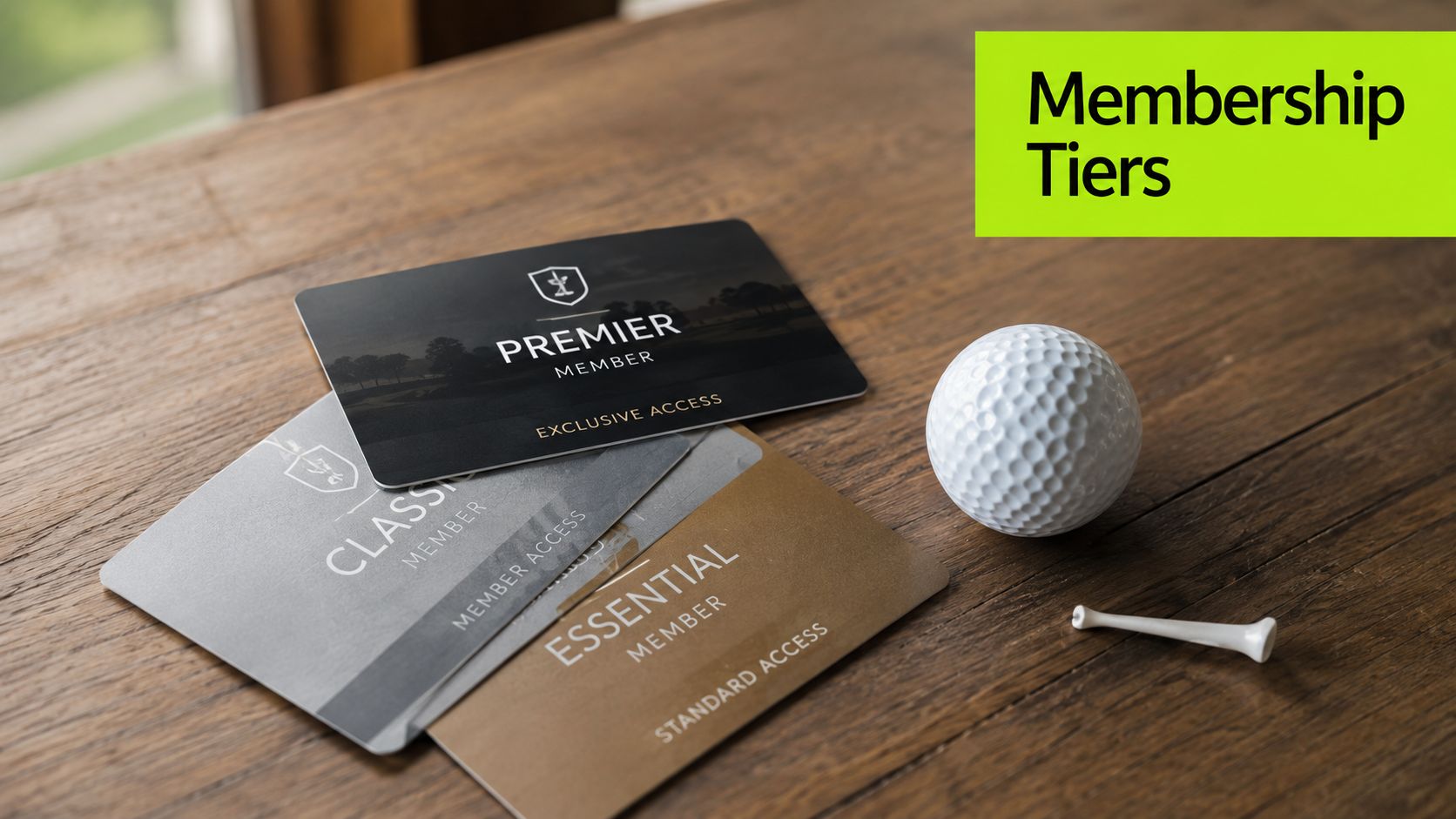
The better model is to treat each tier as a step in a journey, not a permanent label. Social members, weekday members, and flexible entrants should have a clear route into fuller participation when their usage changes. Structured tier migration matters. If someone starts on a lighter option and then plays more often, the CRM should trigger a review instead of waiting for the member to ask.
Practical rule: define tiers from actual usage, not from what sounds attractive in a brochure. A tier only earns its place if it converts cleanly and creates an upgrade path.
That approach fits the current UK market. Hillier Hopkins reported that 59% of members' clubs and 55% of proprietary clubs had more than 600 playing members in 2024/25, which tells you most clubs are already managing established bases, not empty buildings (Hillier Hopkins golf clubs survey 2024/25). In that setting, the job is not to add more categories. It is to make every category easier to buy, easier to track, and easier to upgrade.
For clubs refining the offer architecture, GolfRep's pricing strategy guidance is the right place to start. Golf Problems notes the new initiative in Golf Problems notes the new initiative, and the point holds for UK clubs too, segmentation works best when the club can move members through the journey, not just sell the first step.
Make the upgrade path visible
The strongest tiered structure is one your team can explain in one minute. If a social member hits their monthly limit, the system should flag it. If a weekday member starts using the club more often, the club should invite them to move up. That is where most clubs leave money on the table. They create the tier, then fail to operationalise the transition.
- Write tier rules in plain English: Staff should know exactly what each tier includes, what it excludes, and when a member should be offered the next step.
- Automate tier eligibility messages: Do not rely on a casual conversation at the bar. Let the CRM send the invitation at the right moment.
- Track movement monthly: Watch which tiers convert best and which sit idle.
- Link follow-up to usage: If the member is using the club more than expected, the system should notice before staff do.
2. Flexible Payment Plans and Installment Options
Many UK clubs still sell membership as a single annual commitment. That is the wrong shape for a buyer who likes the club but hesitates at the upfront outlay. Monthly, quarterly, or seasonal payment plans remove that barrier without cheapening the membership, provided the admin is tight and the follow-up is consistent.
The headline price matters less than the way it is paid. A monthly option feels easier to accept, even when the total cost stays the same. Clubs should use that to match how people budget their cash flow, not to turn membership into a bargain bin offer.
The test is operational. Failed payments, reminders, and status changes need to be visible to staff the moment they happen. If the club waits until a member has already gone quiet, the plan has failed in practice even if it looked sensible on paper.
Golf Property Analysts reported that average membership fees across surveyed clubs increased by 3.81% per year from 2020 to 2024, with cumulative increases averaging 20.97% over five years, while entrance fees rose about 23% per year and nearly tripled over the same period (Golf Property Analysts cost trends). The lesson for club managers is straightforward. Price changes are not the problem on their own, the problem is whether the club has a payment structure and follow-up process that keeps people engaged after they say yes.
A payment plan only works if the club can see the member's status today, not three weeks after the issue began.
The CRM should handle reminders before the due date, show failed collections straight away, and record who has already been contacted. That same discipline applies to offer design. GolfRep's package deal guidance is useful because payment structures work best when they sit inside a clear offer, not a vague promise.
Build the payment journey into enquiry handling
Start at the enquiry stage. Ask prospects how they prefer to pay before the membership offer goes out. That one question cuts friction later and helps staff place the prospect into the right plan. It also stops payment failures being treated as random admin noise when they are often a sign that the original offer did not suit the buyer.
A better process looks like this. Staff qualify the prospect, match the plan to the buyer's budget, and keep every stage visible inside the CRM. If someone misses a payment, the club knows immediately who should respond, what should be said, and whether the member needs a reminder, a call, or a change of plan.
- Set reminders automatically: Use a fixed reminder schedule before each due date.
- Flag failed payments instantly: Staff should know the moment a payment fails.
- Offer the plan during qualification: Do not leave it until after the decision is made.
- Compare completion rates by tier: Some tiers will always pay more reliably than others. Know which ones.
3. Corporate and Company Membership Programs
Corporate membership should be treated like a sales process, not a general membership offer. The buyer isn't just purchasing golf access. They're buying convenience, prestige, and a simple way to entertain staff or clients. That means the enquiry has to be qualified properly, the response has to be fast, and the proposal has to be easy to understand.
The strongest corporate programmes don't try to please everyone. They use a clear matrix of benefits, access rights, and pricing so the prospect can compare options quickly. That clarity matters because corporate buyers often look at more than one club at the same time. If your response is vague, you've already lost ground.
Macdonald Hotels & Resorts is a strong example of how centralised account handling can support multiple sites. Its corporate membership approach uses a CRM-led structure to manage accounts and usage patterns across locations, which is exactly the kind of operational discipline that keeps corporate membership from becoming messy. Golf clubs should take the same view, even if they only operate one site.
If you want corporate membership to contribute real income, build a list of local businesses, qualify them by size and sector, and separate genuine corporate demand from casual curiosity. Then respond quickly. In this segment, speed matters more than most clubs realise. A prospect comparing venues will notice who replies first and who replies with substance.
A strong corporate proposal doesn't need to be long. It needs to be useful.
- Make the offer easy to compare: Use a simple benefits matrix with clear access rules.
- Separate prospect types: A company looking for team benefits is not the same as a business seeking client entertaining.
- Use educational nurture first: Send facility guides, benefits breakdowns, and relevant examples before a sales call.
- Set a rapid response target: Corporate buyers move quickly, and your club should too.
For clubs shaping this area, GolfRep's corporate membership marketing guidance gives the right framework. The point isn't to send more emails. It's to build a proposal process that makes it easy for the company to say yes.
Treat corporate enquiries like a pipeline
If a company asks for information, assign one owner and one next step. Don't leave the prospect floating between the secretary, the club manager, and the pro shop. Proposal clarity and response time are conversion levers, not admin details. When they're missing, the deal stalls.
4. Trial or Introductory Membership
Trial membership works best as a qualification stage. It shows whether the prospect uses the club, how often they come in, which facilities they value, and how seriously they are considering a full commitment. Clubs that treat it as a short-term entry offer and then go quiet waste the most useful part of the process.
The value is not reduced risk. It is evidence. You can see whether the prospect plays regularly, whether they use the bar, range, or practice areas, and whether their behaviour matches the profile of someone who will renew. That gives your team something concrete to work with in the conversion conversation, instead of relying on guesswork.
This only works properly when the CRM is set up to monitor activity and timing. If a 90-day trial is running, the follow-up should begin well before the end date, because waiting until the last day leaves too much room for drift. Staff need clear visibility of who is active, who is slipping away, and who needs a direct conversation. Without that, trial membership becomes a dead end.
GolfRep's approach is straightforward. Give the trial member one named owner, a visible end date, and a conversion sequence that starts early enough to matter. If the member is using the club regularly, make the upgrade simple. If usage is weak, intervene while there is still time to change the outcome.
Trial membership functions as a qualification stage. It reveals usage patterns and intent before commitment, rather than simply reducing risk.
That mindset matters because clubs often fixate on price when the uncertainty is the main issue. The prospect wants to see the club in action before committing, and your job is to make that period count. If the trial ends without a decision, the club has handled an enquiry badly and lost momentum it already paid for.
Turn trial activity into upgrade pressure
The strongest trial programmes create pressure through actual use. A member who is already playing regularly has shown they fit the club, which gives the committee or manager a clear basis for a direct upgrade ask. At that point, polite delay helps nobody.
- Track trial end dates from day one: Keep them visible in the CRM and out of an inbox backlog.
- Trigger outreach before disengagement: Start conversion contact well before expiry, while the member is still engaged.
- Use usage as the trigger: Active trials justify a firmer upgrade conversation.
- Offer a clear next step: A waived joining fee or a defined first-year incentive can work if it is used deliberately.
5. Family and Junior-Led Membership
Family membership is a retention tool, and clubs should treat it that way. A junior pathway linked to a family package can turn one enquiry into more than one long-term relationship, which is far better than relying on isolated adult sign-ups with no wider tie to the club.
The weak point is usually conversion, not interest. Many clubs run decent junior coaching, then let the momentum fade because there is no clear handover into family membership. Parents stay engaged for a while, the child enjoys the programme, and then the club loses the thread. Goodwill alone does not fill that gap.
Start with the enquiry process. If a parent asks about junior coaching, capture the family context straight away and present the relevant membership options at the same time. If the junior joins, the CRM should prompt a family follow-up within a set period. That is how youth activity becomes a membership route, not just a coaching offer.
Clubs with strong junior academies already have the raw material. The task is to make the next step obvious and to keep the follow-up tight. Parents do not need a hard sell on day one. They need a clear route, a named contact, and a process that does not lose interest between conversations.
Make the handover part of the system
A junior growing into adult membership should feel like the next stage of the same relationship. Clubs that plan that transition keep families inside the club. Clubs that leave it to memory or informal chat often lose the member just as they become most valuable.
- Capture family intent at first contact: Ask about junior and parent interest as part of the initial enquiry, not later.
- Set automatic family follow-up: The CRM should prompt contact, so the opportunity does not sit with one person's inbox.
- Plan the junior-to-adult path early: Make the next stage visible before the junior reaches that point.
- Review junior cohorts properly: Track which intake years convert into family or adult membership, and use that to shape how the club handles future enquiries.
6. Corporate Golf Days and Hospitality Membership
Hospitality membership is different from regular playing membership. The buyer wants a venue that helps them host, impress, and move people through a day without friction. They care about event flow, food and beverage, guest handling, and the quality of the welcome. That means the membership offer has to be built around event use, not just golf access.
Many clubs blur the message. They sell hospitality like a normal membership with a few extra perks. That confuses the prospect and makes the sales process longer than it needs to be. A hospitality buyer needs to see how the day will work, what support is included, and how easy it is to return.
The right CRM structure matters here. Hospitality enquiries should not sit in the same bucket as personal membership prospects. Their buying triggers are different, and so are their booking patterns. If a club sees every enquiry as the same, it misses the chance to respond properly.
Hotels and resort operators often understand this better than standalone clubs. They package event access, room use, and golf together because they know the buyer wants a complete experience. That same logic applies to golf clubs that host corporate entertaining.
A good hospitality membership process should feel operational, not promotional.
- Segment these enquiries separately: Don't mix hospitality with standard membership leads.
- Respond fast with the right materials: Send facility photos, group pricing, and proof from similar clients.
- Track event frequency and spend: You can't manage what you can't see.
- Build visible workflows: Staff should know where each event is in the process.
Use hospitality enquiries as a visibility test
If an event enquiry arrives and nobody owns it, the club has already created friction. Hospitality buyers notice slow responses and vague details quickly. GolfRep's recommendation is to put the booking, response, and coordination steps into one visible system so the handover is clean and the service feels organised.
7. Loyalty and Longevity Reward Programs
Retention is where many clubs leave easy money untouched. They work hard to sign up new members, then send a generic renewal notice and hope for the best. Loyalty programmes fix that by rewarding tenure, usage, referrals, and repeated commitment in ways members can clearly see.
The best loyalty schemes are not flashy. They are practical. A member who has stayed for years should feel noticed. A member who refers a friend should see that effort acknowledged. A member who keeps using the club should feel that the relationship matters. None of that requires complicated branding. It requires consistent automation and a visible renewal journey.
Clubs with mature membership bases and long waiting lists should treat retention as a system, not a nice extra. If the club keeps more of the members it already has, it does not need to rely so heavily on new volume to stay healthy.
GolfRep's view is straightforward. Start loyalty communication well before renewal, not after. Make the member aware of what they have earned, what they have gained, and why staying matters. If you leave that conversation until the expiry notice, the club is already reacting instead of leading.
Members renew when they feel genuinely valued by the club, and consistent recognition of tenure and engagement matters more than a routine renewal notice.
That simple truth should shape the whole programme. Reward the behaviour you want more of, then make sure the system keeps delivering the message without staff having to chase it manually.
Make loyalty visible before renewal
The renewal window is the wrong time to start caring. The member should already have had several signals that they matter to the club. That is what turns a renewal from a transaction into a continuation.
- Automate tenure-based rewards: Let the CRM trigger them without manual effort.
- Start renewal messaging early: Build value into the conversation before expiry.
- Track referral sources: Reward members who bring people in.
- Compare loyalty impact monthly: Check whether the programme improves retention.
8. Strategic Partnerships and Associate Memberships
Partnerships are one of the cleanest ways to widen access without diluting the club's identity. Hotels, corporate parks, residential developments, and PGA professionals can all provide steady access to new audiences if the terms are clear and the follow-up is disciplined. The issue is not whether the partnership sounds good. It's whether the club can track where members came from and what happens after they join.
The associate model works best when the primary relationship already exists. A hotel guest, resident, or corporate tenant has a reason to try golf through a familiar channel. That lowers friction at the point of entry, which is exactly what a conversion-focused club should want. But the club still needs a proper nurture path after sign-up, or the relationship never matures.
Macdonald Hotels & Resorts offers a useful example again here, because centralised CRM lets the group track sourcing and conversion patterns across multiple properties. That kind of visibility makes it easier to judge which partners are worth keeping and which terms need adjusting.
For clubs considering this route, the process should be tight from the start.
- Track the partner source in CRM: Every associate should carry the right channel label.
- Set terms clearly: Decide pricing, referral expectations, and renewal triggers up front.
- Nurture the associate early: Don't wait until month six to explain the full membership route.
- Review partner performance quarterly: Keep the relationships that drive quality, not just volume.
Treat partner channels as accountable pipelines
A partnership that brings in warm enquiries is useful. A partnership that brings in untracked sign-ups is not. GolfRep's position is that every associate route should be measurable from first referral to full membership, otherwise the club is guessing which relationships are worth the effort.
8-Point Golf Membership Comparison
| Option | Implementation complexity | Resource requirements | Expected outcomes | Ideal use cases | Key advantages |
|---|---|---|---|---|---|
| Tiered Membership Structure | Medium–High, design tiers, rules, communications | CRM automation, pricing analysis, marketing, staff training | Higher conversion, tier migration, diversified revenue mix | Clubs with mixed demographics seeking segmentation and upsell paths | Captures broader market, enables structured upgrades, data-driven pricing |
| Flexible Payment Plans and Installment Options | Medium, payment integration and failure workflows | Payment processor, accounting/CRM integration, automated reminders | Reduced upfront barrier, steady recurring cash flow, higher sign-ups | Price-sensitive markets or prospects deterred by lump-sum fees | Lowers entry friction, improves cashflow predictability |
| Corporate and Company Membership Programs | High, long sales cycles, customised contracts | Dedicated sales/account manager, CRM pipeline, tailored proposals | Large single transactions, multi-year revenue, lower churn | Clubs near business hubs or targeting corporate benefits programs | Significant revenue per sale, reliable baseline income, event spend |
| Trial or Introductory Membership | Medium, trial tracking and conversion workflows | CRM triggers, targeted comms, engagement activities | Increased conversions if engaged; usable data for upsell | Campaigns to convert hesitant prospects or boost short-term intake | Lowers perceived risk, creates urgency to convert |
| Family and Junior-Led Membership | Medium–High, family linking, safeguarding, programming | Junior coaches, programme management, CRM family accounts | Long-term lifetime value, multi-member household sign-ups | Clubs prioritising junior development and family recruitment | Builds lifetime affinity, captures multiple members per household |
| Corporate Golf Days and Hospitality Membership | Medium–High, event ops and hospitality workflows | Event staff, catering partners, booking systems, CRM segregation | High ancillary revenue, predictable event calendar, repeat bookings | Clubs serving corporate entertainment, hotels, resorts | Access to high-spend clients with lower expectation of regular play |
| Loyalty and Longevity Reward Programs | Medium, reward rules and automation | CRM automation, budget for rewards, analytics tracking | Improved retention, higher referrals and usage, reduced churn | Clubs with established member base aiming to improve retention | Raises lifetime value, encourages advocacy and repeat spend |
| Strategic Partnerships and Associate Memberships | Medium, partner contracts and performance tracking | Partner management, co-marketing resources, CRM partner tags | Predictable referral streams, access to new customer segments | Clubs near hotels, developments, corporate parks or with PGA partners | Low acquisition friction, steady qualified leads from partners |
Building a Predictable Membership Pipeline
Every idea above has the same limit. It only works when the club can see the enquiry, assign it, follow it, and measure what happened next. That's the part most clubs miss. They focus on adding more offers, more pages, more promotions, and more ways to ask people to join, while the problem sits inside the process between interest and conversion.
The evidence in the UK market points in the same direction. Clubs are managing significant membership bases, many are operating with waiting lists or high occupancy, and pricing has moved steadily over recent years (Hillier Hopkins golf clubs survey 2024/25, Golf Property Analysts cost trends). That means growth isn't only about creating demand. It's about handling demand properly.
There's also a pipeline problem. The 2024 SMG Technology report found that only 22% of UK leisure businesses consistently tracked conversion rates across the member journey, which shows how many operators still can't see where prospects are dropping out (UK leisure conversion tracking coverage). If you can't see enquiry-to-visit or visit-to-sign-up performance, you're not managing membership growth. You're hoping for it.
That's why GolfRep's approach is built around structured follow-up, one named owner per enquiry, clear status tracking, and CRM-enabled automation. The goal is simple. Make sure every good enquiry has a next step, every step is visible, and every lead is moved with discipline rather than memory. That's what turns a good membership idea into predictable growth.
The practical next step is obvious. Audit your enquiry response time, your pipeline visibility, and your follow-up discipline before you add another tier, package, or campaign. If those basics are weak, no membership idea will fix the conversion problem. If those basics are strong, the ideas in this article become much easier to sell, track, and scale.
GolfRep helps golf clubs build the systems behind membership growth, not just the lead generation layer. If you want to turn enquiries into booked visits and sign-ups with clearer pipeline visibility, visit GolfRep and see how the Growth System supports clubs with CRM-led follow-up, automation, and measurable conversion tracking.
Ready to tap into our proven growth system?