Golf Club Membership Growth: A Playbook for 2026
Most advice on golf club membership growth starts in the wrong place. It tells clubs to run more ads, post more often, and generate more enquiries.
That sounds sensible until you look at how most clubs handle demand.
The issue usually isn't a lack of interest. It's what happens after someone clicks, calls, fills in a form, or replies to a campaign. Enquiries land in a shared inbox. A committee member sees them late. A spreadsheet gets updated when someone remembers. Follow-up depends on who is on shift, who is off sick, or who feels confident calling a prospect. Good leads go cold in plain sight.
That's why predictable growth doesn't come from promotion alone. It comes from a system. If a club can capture every enquiry, respond quickly, track progress, and move prospects towards a visit, membership growth becomes manageable. If it can't, even strong demand gets wasted.
Why More Enquiries Is Not the Answer to Membership Growth
The market doesn't suggest a demand problem. The 2025 Golfshake membership survey found 86% of responding golfers were already golf club members, and 30% said their club had a waiting list. That is not a weak market. It's a market where interest is already present.
The same survey also showed pressure building in the wrong places. The share of members paying under £1,000 per year fell from 47% to 41%, which points to growing price sensitivity in the UK club market. In simple terms, clubs can't assume demand gives them permission to be slow, vague, or disorganised. Prospects are interested, but they're still comparing value.
Demand is healthy but handling is often weak
A club can have a strong local reputation and still lose prospective members every week.
That usually happens because the operational layer is missing. There's no single system for form fills, no automated acknowledgement, no ownership of follow-up, and no visibility on which enquiries turn into visits. Managers then conclude they need more leads, when the actual problem is that existing enquiries aren't being converted properly.
More enquiries into a weak process don't solve a growth problem. They just hide it for a while.
The clubs that grow steadily tend to do the boring things well. They reply fast. They keep notes in one place. They know which campaign produced each enquiry. They can see, at any point, who needs a call, who has booked a visit, and who has gone quiet.
Activity is not the same as visibility
One reason clubs misread their pipeline is that they confuse marketing activity with commercial control. Posting on social media can help awareness, but awareness doesn't tell you whether membership growth is improving. If your team wants a simple way to track your social media performance alongside lead flow, use that as a reporting discipline, not as a substitute for conversion tracking.
A lot of club marketing fails for this exact reason. The channel gets blamed when the process is the issue. That's why this breakdown of why most golf club marketing fails is useful. It highlights the gap between generating attention and turning that attention into an enquiry that gets handled.
The core lesson is straightforward. Golf club membership growth is rarely blocked by visibility alone. It's blocked by poor response time, inconsistent follow-up, and a lack of system ownership after the enquiry arrives.
The Foundation A System for Every Enquiry
Clubs often ask which campaign they should run next. A better question comes first. Where does every membership enquiry go, and who can see it?
If the honest answer is “it depends”, there's your problem.
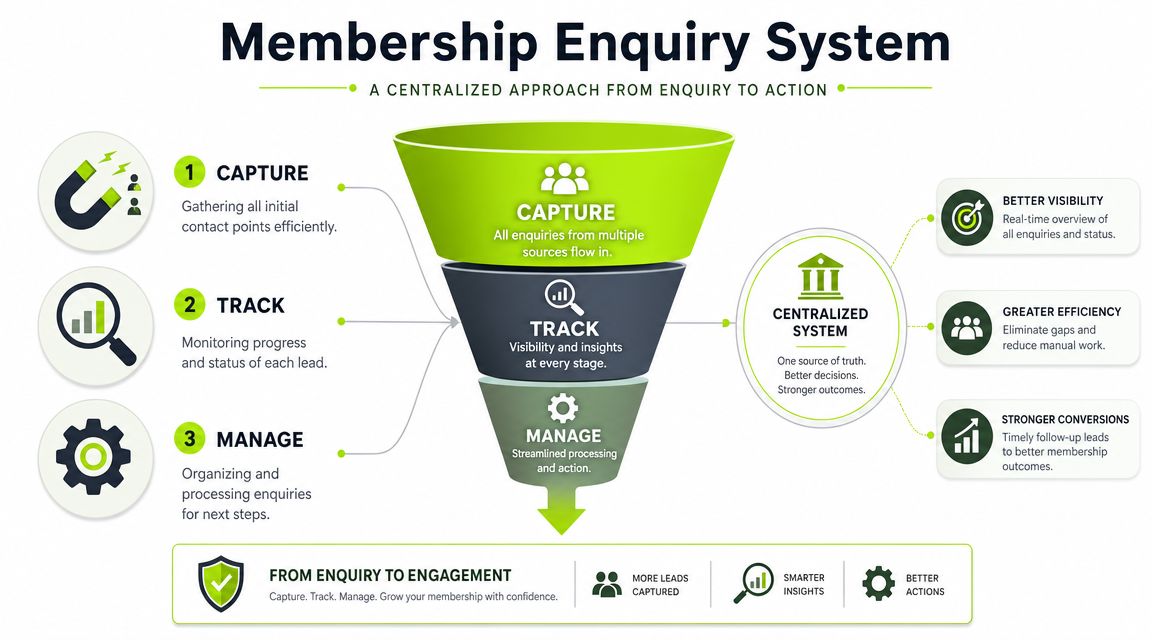
A manual setup breaks under even moderate demand. One enquiry arrives by website form, another by Facebook message, another by email, another by a phone call taken at reception. Notes sit in different places. Staff rely on memory. Nobody has a clean view of the pipeline, so nobody can manage it properly.
Why centralisation matters now
This isn't just an efficiency point. It's a risk-control point.
NGCOA reporting showed that member referrals dropped by 50% from 2021 and that the time to close a new member deal lengthened to 14.7 days in 2023. That matters because many clubs still act as if referrals and casual demand will carry the whole membership plan. They won't. Organic flow is too volatile to be your only engine.
When referrals soften, clubs need a process they can control. That means a CRM, not a spreadsheet. It means each enquiry is logged automatically, assigned a status, and visible to the people responsible for moving it forward.
Practical rule: If an enquiry can be lost because one person is away from the club, you do not have a system. You have a dependency.
What the system needs to do
A workable membership system doesn't need to be complicated. It needs to be consistent.
At minimum, it should handle these jobs:
- Capture every source: Website forms, Meta lead forms, email replies, calls logged by staff, and walk-in enquiries should all end up in one record set.
- Track status clearly: New enquiry, contacted, qualified, visit booked, visited, proposal sent, joined, closed lost. Everyone should use the same stages.
- Assign ownership: Each live enquiry needs a named person responsible for the next action.
- Store context: Budget, membership category of interest, playing frequency, family situation, objections, and visit notes should sit in one place.
- Trigger follow-up: The system should prompt or automate the next message so prospects don't disappear into silence.
What doesn't work
The old club method is familiar. Shared inbox, handwritten notes, verbal handover, occasional spreadsheet cleanup. It feels manageable because it's familiar.
It isn't manageable. It creates four predictable failures:
| Problem | What happens |
|---|---|
| Slow first response | Prospects lose intent before anyone replies |
| No pipeline view | Managers can't see bottlenecks or forecast joins |
| Inconsistent follow-up | Strong leads get different treatment depending on staff habits |
| Weak attribution | Clubs spend on marketing without knowing what created members |
A central CRM solves none of this by itself unless the club uses it daily. But without one, paid advertising and referral activity both become harder to manage profitably.
One practical option is a structured platform built for golf club pipelines, whether that's a general CRM configured properly or a specialist setup such as GolfRep's CRM-led membership system, which combines lead capture, automated follow-up, and enquiry tracking in one workflow. The tool matters less than the discipline behind it.
Golf club membership growth becomes predictable when every enquiry enters the same machine.
Attracting the Right Golfers with Targeted Advertising
Once the system is ready, then advertising starts to make sense.
The mistake many clubs make is promoting membership to everyone in the area with a generic message. That brings volume, but not always fit. Better campaigns start by deciding who the club wants to attract more of.

Start with member fit, not offer hype
A strong campaign usually targets one or two clear profiles rather than trying to appeal to every golfer at once.
For example, a club may want:
- Committed local golfers who play regularly and are frustrated with visitor-only flexibility
- Lapsed members elsewhere who want better access, better atmosphere, or a more practical location
- Families or younger professionals who value easier onboarding and clearer communication
Each audience needs different copy, different imagery, and often a different landing page. “Join now” is too blunt on its own. A better message explains why this club suits that golfer.
What to put in the advert
The advert should answer practical questions quickly. Not every detail, just enough to earn the enquiry.
Useful themes include:
- Convenience: location, tee access, booking ease
- Belonging: competitions, social life, member culture
- Progression: academy support, coaching, beginner pathways
- Clarity: membership types, next steps, simple enquiry process
Heavy discounting usually creates the wrong conversation. It pulls attention towards price first and fit second. In a market where clubs need long-term members, that's often the wrong order.
A better top-of-funnel approach is to invite the right prospect into a low-friction next step such as a membership guide request, a callback, or a club visit enquiry. For clubs using Meta, this guide to golf club Meta ads is a useful reference for structuring local campaigns around actual member acquisition.
Match the creative to the platform
Facebook and Instagram still work well for local golf club demand because they allow tight geographic targeting and flexible creative formats. But the content has to suit the platform.
Short-form video is often useful when a club wants to show atmosphere rather than just explain features. If your team is testing video as part of the mix, this breakdown of how to maximize Instagram Reels customer reach is a practical guide to improving distribution.
The best membership adverts don't try to persuade everyone. They help the right golfer recognise themselves.
Good advertising feeds the system with qualified interest. Poor advertising fills the inbox with curiosity and no intent. That distinction matters more than raw lead count.
Automating Qualification and Nurturing Enquiries to Visits
Most clubs lose momentum in the period between enquiry and visit. Not because prospects aren't interested, but because nobody has built a reliable path from first contact to a booked appointment.
This middle stage is where golf club membership growth becomes operational rather than promotional.
The National Golf Foundation reports that the potential golfer pool is 37% larger than in 2019, but many are interested but non-committed. That's the exact audience many clubs now need to handle better. These people often won't chase the club. They expect timely replies, straightforward communication, and an easy next step.
The sequence that moves enquiries forward
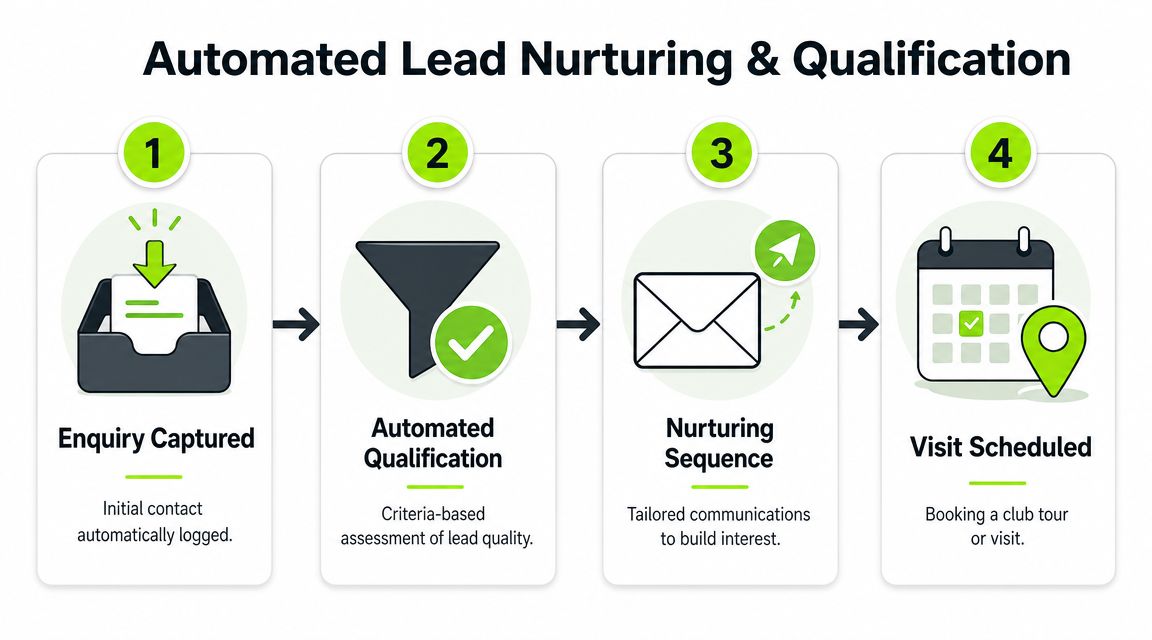
A useful nurture flow is not a long stream of generic emails. It is a short, structured sequence that qualifies intent and keeps the conversation moving.
A practical setup often looks like this:
Instant acknowledgement
The prospect should receive an immediate confirmation by email or SMS. This message should thank them, confirm receipt, and explain the next step clearly.Early qualification
Ask a small number of useful questions. Which membership category interests them? Have they been a member elsewhere? Are they looking for full membership, flexible options, family access, or something else?Prompt human follow-up
A real person should then contact qualified prospects quickly. Automation opens the door. Staff still need to guide the conversation.Visit booking prompt
Every message should gently move towards a visit, trial experience, or meeting. Without that call to action, the sequence becomes informative but passive.
What the messaging should include
Most clubs over-explain and under-direct. They send long brochures, dense pricing PDFs, or generic “let us know if you have questions” replies.
Instead, the nurture should do three jobs:
- Reduce uncertainty: explain what membership looks like in practice
- Build fit: show the prospect why the club suits their goals
- Create movement: ask for a visit booking or a call at the right moment
Operational note: A nurture sequence should answer the question the prospect is likely to ask next, not the ten questions they haven't asked yet.
A useful message mix might include:
- a welcome email with a named contact
- a short follow-up sharing relevant membership options
- a message focused on club experience, competitions, or member life
- a clear invitation to book a tour or conversation
Qualification should help staff, not replace them
Some clubs worry that qualification feels impersonal. It only feels impersonal when it's poorly written.
Good qualification helps staff spend time where it matters. It separates active buyers from casual browsers and gives the membership team context before the call. Tools that support AI lead qualification for golf clubs can make that process faster by tagging intent signals, routing leads, and prompting next actions, but the principle is simple even without advanced software.
Use automation for speed, consistency, and reminders. Use people for judgement, reassurance, and closing.
Why this stage decides the result
The prospect who enquires today may be comparing three clubs. The one that replies clearly, follows up properly, and makes booking easy usually gets the visit. The club that waits for a committee member to “pick this up later” usually loses the chance without ever knowing why.
That's why systems matter more than marketing volume. The enquiry itself is only the start. The conversion happens in the follow-up.
Converting Visits and Retaining Members for Long Term Value
A booked visit is not the finish line. It is the moment the club has to prove that the promise made online matches the actual experience on site.
Too many visits are treated as informal walkarounds. A staff member points out the course, mentions the bar, and hopes the prospect will come back with a decision. That approach leaves far too much to chance.
Run the visit like a joining conversation
A strong membership visit needs structure. Not a hard sell, but a planned experience.
That usually means:
- Preparing beforehand: know who is coming, what type of membership they asked about, and why they enquired
- Tailoring the route: show the parts of the club that match their priorities, whether that is competition golf, family use, practice, coaching, or social atmosphere
- Explaining next steps clearly: don't end with “let us know”. End with a defined follow-up and owner
A visit should answer three questions for the prospect. Can I see myself here? Does this club suit the way I play? Is joining straightforward?
Clubs often lose warm prospects after a good visit because nobody sends a proper follow-up while intent is still high.
That follow-up should be fast, personalised, and specific. Recap what mattered to them. Attach the right membership information. Offer the next action. If there is an approval step or joining process, make it easy to understand.
Growth without retention is unstable
Many clubs cease operational thinking at this point. They focus heavily on acquisition, then assume retention will take care of itself.
That is risky. Club Marketing notes that waitlists are becoming common, with an average of 70 prospective members per club, but it also warns that successful clubs are the ones investing in infrastructure and retention systems. Strong demand can hide weak retention for a while. It doesn't fix it.
A club that grows quickly without onboarding properly often creates future churn. New members feel unclear about competitions, social routines, booking rules, or how to settle in. The club thinks it has solved growth. In reality, it has delayed an attrition problem.
Use the CRM after the sale
The CRM should not go quiet once someone joins.
It should support:
- Onboarding journeys: welcome emails, key contacts, first-month guidance
- Segmented communication: different messages for families, regular competitors, newer golfers, and infrequent users
- Renewal preparation: identify members who appear less engaged and act before renewal season
- Member value analysis: understand which categories stay longer and which need more support
If a manager wants a simple way to think about member economics, a basic lifetime value calculation can help frame the conversation. The point isn't to produce a perfect finance model. It's to show why keeping the right member is often more valuable than chasing another enquiry.
The clubs that sustain golf club membership growth treat retention as part of the same system, not as a separate admin task.
The Scorecard KPIs for Predictable Growth
Most clubs measure success too late. They count new members at month end and work backwards by instinct.
That doesn't give you control. It gives you a result after the fact.
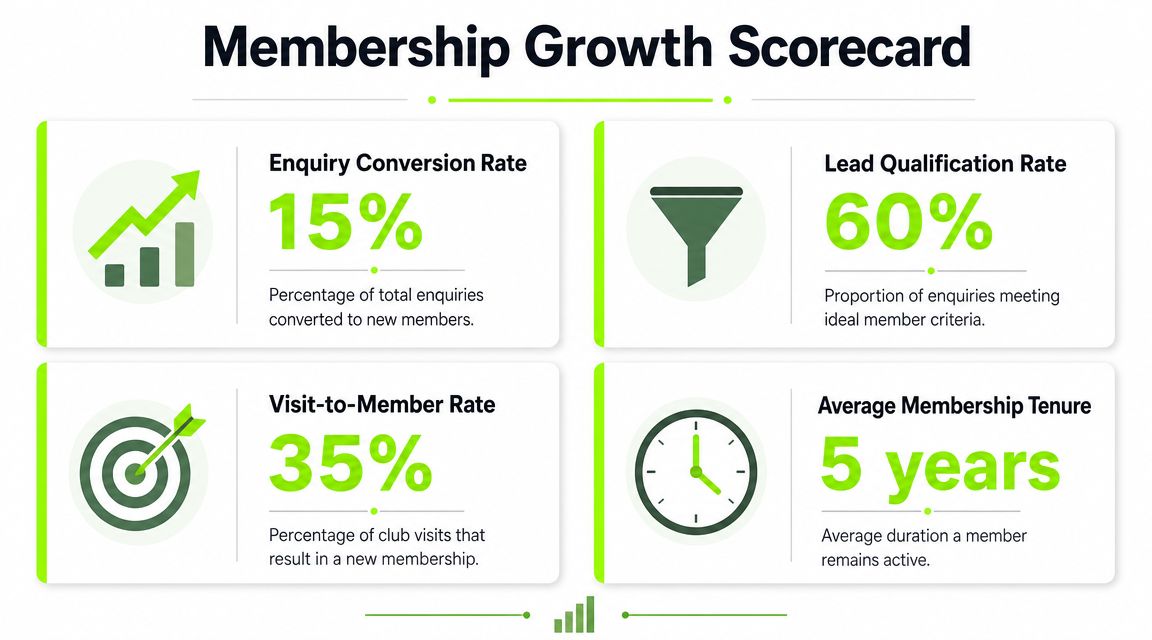
A proper scorecard shows where the pipeline is strong, where it is leaking, and what needs attention this week. New members still matter, but they are an output. Managers need leading indicators as well.
The numbers that actually help you manage
Use a scorecard built around the pipeline, not just the outcome.
| KPI | Why it matters |
|---|---|
| Enquiry volume | Shows whether campaigns and referral activity are feeding the pipeline |
| Lead-to-visit rate | Tells you whether follow-up is creating real sales conversations |
| Visit-to-member rate | Reveals the quality of the on-site experience and post-visit follow-up |
| Cost per enquiry | Helps assess channel efficiency without pretending every lead is equal |
| Cost per acquisition | Shows what it actually costs to win a new member |
| Renewal rate | Keeps retention in view rather than treating growth as acquisition only |
How to read the scorecard properly
A rising enquiry count with a weak lead-to-visit rate usually points to poor follow-up or low lead quality.
A healthy visit-to-member rate with low visit volume usually points to a top-of-funnel or nurture issue.
High acquisition cost can be acceptable if retention is strong and the member profile is right. Low acquisition cost can still be a problem if the club keeps attracting poor-fit joiners who don't stay.
Key takeaway: The scorecard should help a manager decide what to change next, not just report what already happened.
Keep reporting simple and regular
The best reporting rhythm is the one your team will maintain. Weekly pipeline reviews often work better than long monthly post-mortems because they force action while leads are still live.
A useful reporting habit includes:
- Checking response gaps: who has not been contacted, and why
- Reviewing stage movement: which enquiries are stuck
- Comparing channels: which sources produce visits, not just form fills
- Flagging retention risk: which members may need attention before renewal
Golf club membership growth becomes predictable when you can see the whole path from first enquiry to recurring revenue, then improve the weak points one by one.
If your club wants a more structured membership pipeline, GolfRep works with UK golf clubs to build the underlying system: lead generation, CRM visibility, automated follow-up, and conversion tracking that help enquiries turn into visits and visits turn into long-term members.
Ready to tap into our proven growth system?