Golf Club Growth Strategy: A Practical UK Playbook

Most golf clubs are told that growth starts with more leads. That advice is incomplete. A club can increase enquiries and still struggle to grow if nobody responds promptly, nobody knows which prospects need attention, and nobody follows up consistently after the first conversation.
The UK market is already substantial. England had 750,071 affiliated golf members in 2025, the highest level for at least 13 years, while the wider UK participation pool includes 5.356 million adults who play golf at least once a year. Those figures point to a sizeable opportunity, but they also expose the key challenge. Clubs don't need a bigger database of uncontacted names. They need a reliable system that turns interest into visits, visits into memberships, and existing memberships into renewals.
At GolfRep, we work from that operational reality. Advertising has a role, but predictable growth comes from the mechanics after the enquiry arrives.
Why Most Golf Clubs Grow Slower Than They Should
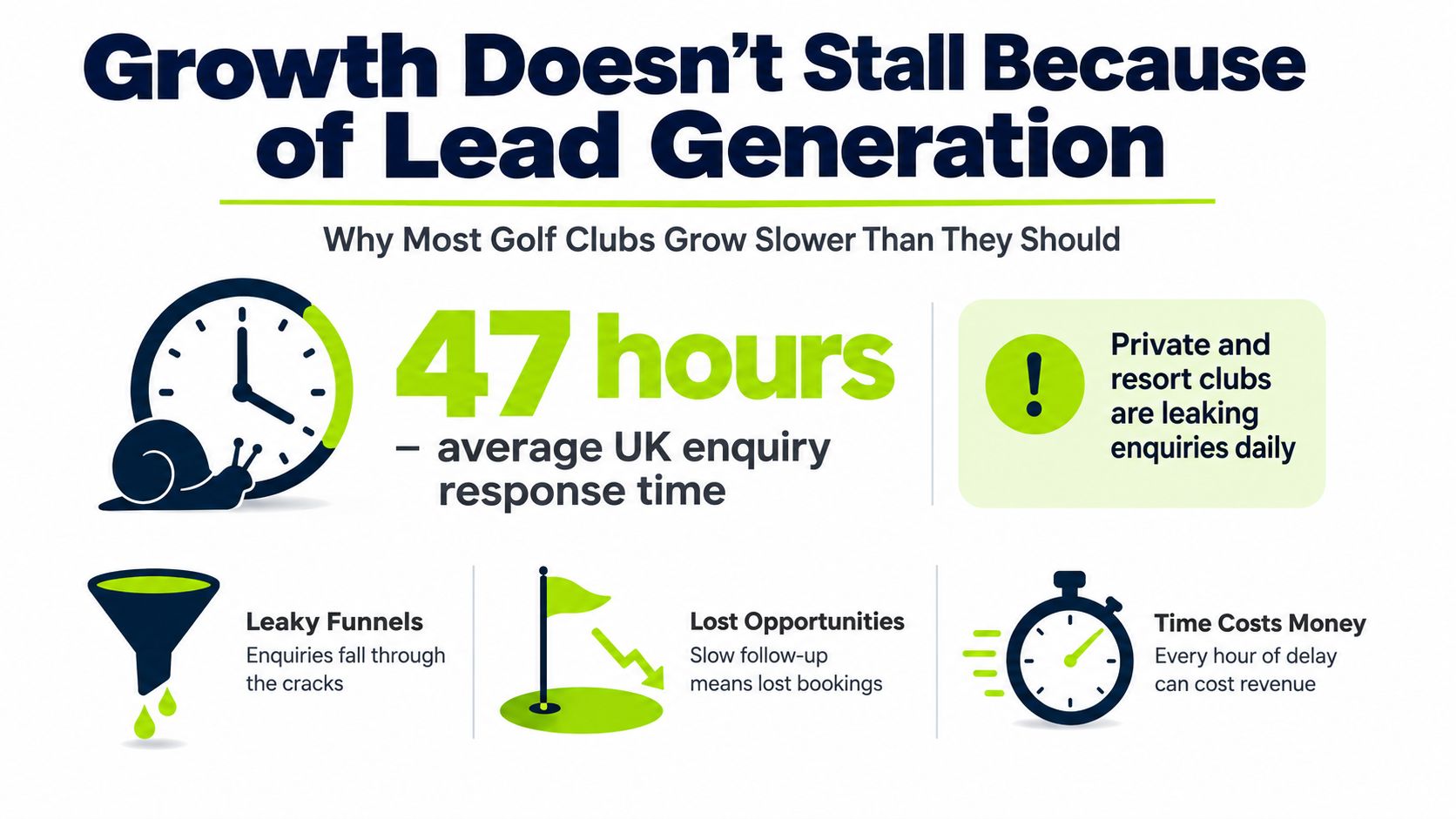
The popular assumption is that a club's growth stalls because it isn't generating enough enquiries. In practice, many clubs are losing potential members before advertising becomes the limiting factor. A Hillier Hopkins survey of golf clubs recorded an average UK business response time of 47 hours, while 78% of customers bought from the first company to respond and only 7% of businesses responded within five minutes.
That gap matters because a membership enquiry is usually fragile. A golfer may submit a form during a lunch break, ask about availability after visiting a driving range, or message several clubs while comparing options. If the first useful reply arrives nearly two days later, the prospect may already have booked a visit elsewhere.
The real bottleneck sits between enquiry and visit
A lead isn't a result. It's an opportunity that still needs qualification, reassurance and a reason to visit. Clubs often focus on the cost per enquiry while failing to measure the stages that follow:
- Enquiry visibility: Can the team see every form, phone call, walk-in and social message in one place?
- Response time: How quickly does a human or useful automated reply reach the golfer?
- Visit booking: How many qualified prospects choose a date and time?
- Membership conversion: How many visitors receive a clear next step?
- Source attribution: Can the club identify whether the enquiry came from a referral, Google search, a society day or an on-site conversation?
Manual spreadsheets and inbox searches rarely answer those questions reliably. They create gaps between the receptionist, membership secretary, PGA professional and general manager. A prospect can be contacted twice by different people, or not at all.
Practical rule: Don't increase campaign spend until you know where qualified enquiries disappear.
A club should first shorten the response window, create clear ownership and record every stage. That may outperform another round of advertising because it improves the value of demand already being generated. For broader context on actionable growth tips for small businesses, the same principle applies across sectors: consistent execution often matters more than creating more activity.
This is the foundation of a workable golf club growth strategy. The objective isn't maximum lead volume. It's a visible, measured pipeline in which every serious prospect receives the right response and a clear route to a visit.
Sizing the UK Opportunity Beyond Your Current Members
England's 750,071 affiliated members in 2025 provide a useful market baseline, but they're only one layer of the opportunity. The England Golf membership report recorded the country's highest membership level for at least 13 years, while the R&A's 2023 UK satellite account estimated 5.356 million UK adults play at least once a year and 2.357 million play at least once every four weeks.
That difference changes how a club should define its market. The local pool isn't “people looking for full membership”. It includes current members who may need better engagement, lapsed members within a practical travel radius, casual golfers who already pay to play, society organisers, range users and people who've only recently returned to the game.
A practical participation funnel
| Segment | Approx. UK headcount | Typical LTV signal | Conversion difficulty | Best route |
|---|---|---|---|---|
| Affiliated club members | 750,071 | Established recurring value | Lower for retention, higher for switching | Renewal and referral programmes |
| Regular golfers | 2.357 million | Strong playing habit | Moderate | Trial visits and flexible packages |
| Annual golfers | 5.356 million | Wider potential value | Higher | Education, nurture and low-friction visits |
| Lapsed local members | Not specified | Existing familiarity can help | Moderate | Reactivation and personal outreach |
| Casual and off-course golfers | Not specified | Depends on frequency and package fit | Higher | Mid-tier, pay-and-play or flexible offers |
A club should also account for its own local demographics rather than rely on national assumptions. England Golf's data places the average age of members at 54.99, with male members averaging 53.78 and female members 62.98. The average age fell from 56.18, which supports messaging that serves established members while making the club accessible to adjacent age groups. The same dataset records 1,735 affiliated clubs across England, showing how distributed the market is. These figures are available through England Golf's club and membership overview.
For a 500-member club, the first exercise is not to guess a conversion rate. Build a local pool by listing current members, lapsed contacts, nearby society organisers, pay-and-play visitors, lesson clients and off-course golfers. Remove duplicates, identify the last meaningful interaction, then separate people by likely product fit. That work tells the club whether its first priority is renewal, reactivation, a flexible package or new acquisition.
Use this guide to identifying market opportunities to structure the exercise, but keep the final segmentation grounded in the club's own catchment, tee-sheet capacity and membership rules.
Mapping Where Local Golfers Actually Come From
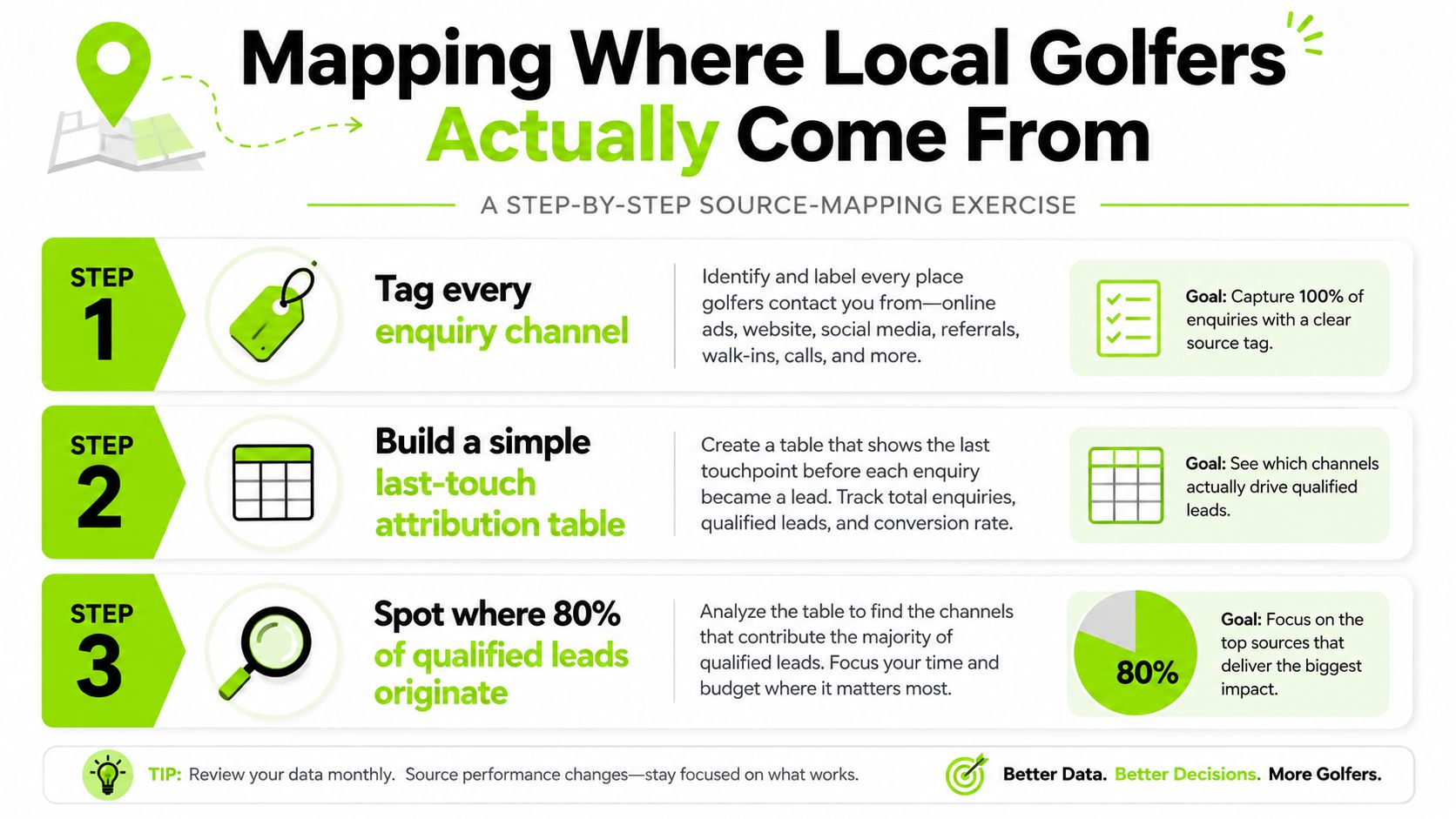
Most clubs can name their busiest marketing channels. Far fewer can show which channels produce qualified visits and signed memberships. A source map fixes that by making every enquiry answer one basic question: where did this golfer first come from, and what happened next?
Start with a single source field in the CRM. Give staff a short list rather than a blank text box, such as Google Business Profile, organic search, paid search, member referral, society enquiry, walk-in, phone, email, social message, open day or existing database. If a source doesn't fit, add it deliberately rather than allowing inconsistent labels.
Build a simple last-touch table
A spreadsheet is enough to begin. The important point is that every row connects the source to an outcome.
| Enquiry date | Contact | Source | Enquiry type | Intent score | First response | Visit booked | Outcome |
|---|---|---|---|---|---|---|---|
| Date | Name | Referral, search, walk-in | Full, flexible, visitor | High, medium, low | Time or status | Date or blank | Open, joined, lost |
| Date | Name | Source label | Product interest | High, medium, low | Time or status | Date or blank | Open, joined, lost |
The source alone doesn't tell you enough. A member referral that asks to book a tee time is normally warmer than a paid search click asking only about membership cost. A society organiser may have high commercial value but a longer decision cycle. A walk-in who has already seen the clubhouse needs a different follow-up from someone who has never visited.
Use intent scoring to route, not to create false precision. Record practical signals such as a requested visit date, preferred playing times, group size, current club status and membership category. market segmentation for golf clubs becomes useful here. The purpose is to make the next action more relevant.
The first two weeks of tagging
- Days one to three: Agree source names, update enquiry forms and brief every staff member who handles prospects.
- Days four to seven: Record every new enquiry, including phone calls and conversations that would previously have stayed in someone's notebook.
- Days eight to ten: Review missing fields and remove duplicate source labels.
- Days eleven to fourteen: Compare sources by qualified visits, not raw enquiry count.
After that first review, shift attention towards the sources that produce useful conversations. A source that creates plenty of low-intent questions may need better landing-page information, while a referral source may deserve a faster response route. Measurement should change how the team works, not sit in a monthly report nobody uses.
Qualifying and Routing Enquiries With 24/7 Automations
A useful automation system doesn't try to replace the membership team. It makes sure the team receives the right information quickly and doesn't lose prospects outside office hours.
The starting point is a single CRM ledger. Web forms, phone notes, walk-ins and social direct messages should create or update one contact record. The record needs enough context for a staff member to act without asking the golfer to repeat everything.
Use six fields that support a decision
A simple scoring matrix can include:
- Budget band, whether the stated budget fits the available packages.
- Preferred tee time, especially whether the golfer wants peak, weekday or off-peak access.
- Group size, which may indicate a family, couple, society or individual opportunity.
- Current club status, including existing, lapsed, casual or first-time golfer.
- Timeline to join, such as this week, this month or later in the season.
- Visit readiness, whether the person has suggested a date or accepted an invitation.
Each field should lead to an action. Don't build a complicated score that nobody understands. Categorise prospects into three practical routes:
- Hot: A visit could happen within seven days. Send the booking link, alert the responsible team member and create a call task.
- Warm: The prospect needs more information or time, usually over a longer nurture period. Send relevant package details and invitation-led follow-up.
- Cold: The contact is seasonal, exploratory or a referral partner. Keep the relationship active without treating it like an immediate sales opportunity.
The response rule should be simple. Send an SMS within five minutes where appropriate, followed by an acknowledgement email that answers the initial question and asks one useful qualifying question. A delayed personal call can then follow during staffed hours.
A fast acknowledgement earns attention. A relevant follow-up earns the visit.
Consider two enquiries. A 32-year-old couple asks about weekend flexible membership. Their route should highlight shared playing times, social use and a visit at a suitable weekend slot. A 58-year-old solo player asks about full seven-day access. That route should focus on access, playing availability, competitions and the member experience.
The automation should branch on those differences. It shouldn't send both prospects the same generic brochure. For a deeper treatment of AI lead qualification for golf clubs, the key principle is the same: automation should capture context, prompt action and leave staff with a clear next step.
Turning Enquiries Into Visits and Sign-Ups Through Nurture Flows
A nurture flow should feel like helpful continuity, not a series of reminders from a machine. The prospect needs a reason to visit, evidence that the club suits them and an easy way to choose a time.
Start with a 30-day sequence containing 14 planned touches, but write each message around a decision rather than a channel. The first contact confirms receipt and asks whether the golfer wants weekday, weekend or flexible access. The next message should offer a specific visit slot, not a vague invitation to “find out more”.
A practical sequence
- Minute five: SMS confirming the enquiry and offering a booking link.
- Hour one: Email with a customized visit invitation and the most relevant package.
- Day two: Short video from the captain or membership lead explaining the club atmosphere.
- Day five: Retargeting message featuring genuine member experiences or club activities.
- Day seven: Direct call attempt, with a voicemail that gives one clear next step.
- Day ten: A tee-time availability prompt, only where the club can support it truthfully.
- Day fourteen: Personal visit recommendation based on the golfer's stated needs.
- Remaining touches: Two hold-out branches for non-responders, with different wording and a sensible pause between contacts.
A one-click booking link reduces friction. Some clubs may also test a refundable visit deposit, provided the terms are clear and the approach fits the club's brand. A short pre-visit briefing can cover parking, arrival time, dress expectations, facilities and who the prospect will meet. That removes uncertainty before the golfer reaches the clubhouse.
For teams building their reporting model, this explanation of funnel analysis provides useful context. Track each movement separately: enquiry received, response sent, conversation started, visit booked, visit attended, offer made and membership joined. A single “lead conversion” figure hides the stage that needs attention.
Sample SMS:
Thanks for your enquiry about flexible membership. Would you prefer to visit on a weekday or at the weekend? You can choose a convenient time here: [booking link].
Sample email:
Thanks for getting in touch. Based on your interest in flexible access, the most useful next step is a short visit so we can show you the course, clubhouse and available options. Choose a time that suits you, and we'll have the right person ready to answer your questions.
The sequence should be adjusted when the prospect replies. Automation is there to maintain momentum, not to continue sending messages after a human conversation has changed the situation.
Protecting Growth With Retention and Reactivation Systems
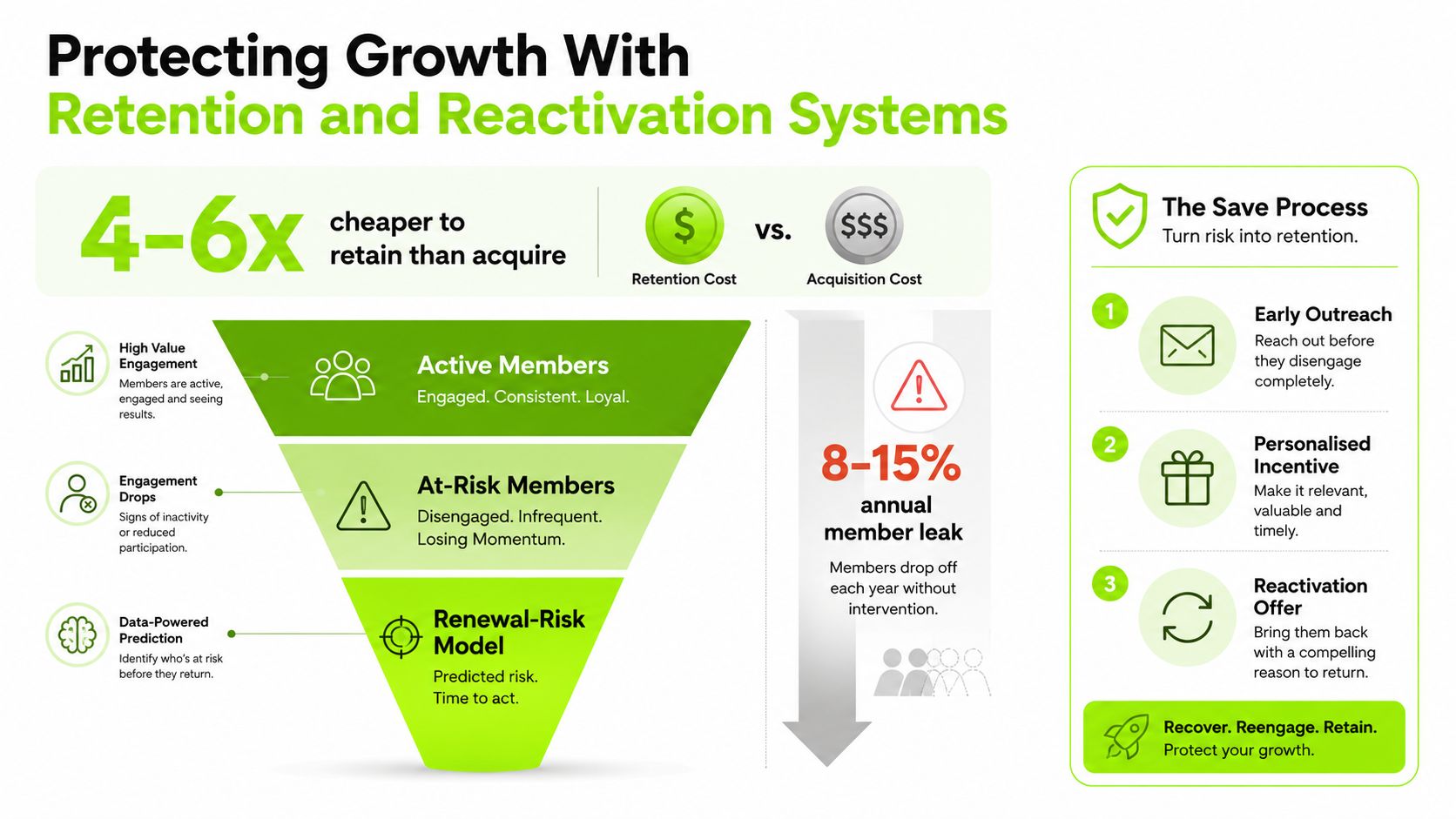
Acquisition gets attention because it looks active. Retention often creates the cleaner commercial result because the club already knows the member, their playing history and their likely reasons for staying. A Hillier Hopkins golf-club survey found that 24% of members' clubs reported more leavers than joiners. Average joiners rose from 70 in 2022 to 73 in 2023, while average leavers rose from 48 to 56.
That pattern makes annual renewal administration too late as a first intervention. A club needs a monthly renewal-risk list, organised by tenure, engagement and service history. Golfshake's October 2025 renewal survey found 77.9% planned to renew, while 18.3% were undecided and 3.8% did not plan to renew. The undecided group deserves structured attention before a final decision is made.
Signals that should trigger action
Use available operational data rather than waiting for a member to announce dissatisfaction:
- Playing frequency falls: Compare recent booking activity with the member's normal pattern.
- Bookings stop: A period without a tee-time or competition booking should create a check-in task.
- Service issues remain open: Escalate unresolved complaints before renewal communication begins.
- Payment retries fail: Contact the member quickly and make the resolution straightforward.
The save process should become more personal as risk increases. Start with a genuine check-in from the general manager or membership lead. If disengagement continues, offer a relevant reason to return, such as a coaching session or guest opportunity where appropriate. For members facing a temporary barrier, a pause or flexible arrangement may be more sensible than forcing an immediate cancellation.
Reactivation needs its own campaign
Lapsed members shouldn't sit in a dormant spreadsheet. Create a reactivation route with a clear reason to return, a one-off comeback option where commercially appropriate and a later SMS for people who didn't respond. Waiting-list management can also support growth. The Hillier Hopkins survey reported that 59% of clubs keep waiting lists informed, and an average of 21 members per club moved from waiting list to membership at the last renewal in 2024.
The dashboard should show renewal risk, saves, cancellations and reactivations by cohort. That links member experience to the wider growth plan and tells the club whether its packaging, service or communication needs attention.
Pricing, Packaging and KPI Tracking That Compounds Over Time
A club can't separate growth from the product it offers. If every prospect is pushed towards one full membership category, the club creates avoidable friction for golfers whose schedules, budgets or playing habits need a different entry point.
Review the current structure against local alternatives, not national chains that operate under different cost bases and access models. Possible packages include seven-day, five-day and off-peak memberships, flexible points, pay-and-play bundles, corporate access and family add-ons. Each option needs a clear purpose. A flexible category should lead suitable casual players towards deeper participation, not just discount access for people who would have bought full membership.
One dashboard, several decisions
A monthly dashboard should connect marketing activity with revenue and retention. Useful measures include:
| KPI | Benchmark target | Trigger action |
|---|---|---|
| Cost per enquiry | Establish a reliable club baseline | Review source quality before increasing spend |
| Visit-booking rate | Improve through faster response and clearer invitations | Rewrite the first reply or simplify booking |
| Membership conversion rate | Compare by source and package | Inspect the visit and offer stages |
| Average revenue per member | Monitor by membership category | Adjust packaging, access or add-ons |
| Retention rate | Review by member cohort | Start renewal-risk interventions earlier |
| Lapsed-member reactivation rate | Track by campaign and reason for lapse | Refine the comeback offer and message |
The dashboard only matters if it changes a decision. If paid search produces enquiries but few visits, the issue may be the landing page or response sequence. If referrals produce fewer enquiries but more memberships, protect the referral experience and give members a reason to introduce suitable golfers. If a flexible package attracts people who rarely play, examine the onboarding rather than assuming the package has failed.
A 30, 60 and 90-day implementation plan
First 30 days: Audit every enquiry route, define source labels, connect forms and phone notes to one ledger, and agree ownership for first response. Measure the current gap between enquiry, reply and visit booking.
By 60 days: Launch the hot, warm and cold routes, add a booking link, create renewal-risk tasks and start reporting source-to-membership outcomes. Hold a short weekly review so staff can correct missed follow-ups while the process is still new.
By 90 days: Compare packages by demand and retention, move budget towards qualified sources, refine automation triggers and formalise a monthly board or committee report. Keep the system simple enough for the team to use every day.
GolfRep's growth system combines lead generation, 24/7 qualification, structured follow-up and CRM reporting for golf clubs that need visibility from first enquiry to recurring membership revenue. Visit GolfRep to discuss a practical pipeline review and identify where your club is losing conversions before increasing acquisition spend.
Ready to tap into our proven growth system?