10 Golf Club Marketing Trends 2026

Most advice about golf club marketing trends 2026 still points clubs in the wrong direction. It says the answer is more leads, more traffic, more campaigns, more visibility. That sounds sensible until the enquiries start arriving and nobody can say, with confidence, who followed up, how quickly they replied, which prospects booked a visit, or what led to revenue.
That is the main issue.
Across the UK golf market, demand is there. Participation has risen significantly over the past decade, younger golfers are entering the category, and clubs have more ways than ever to reach local prospects. Yet many clubs still rely on inboxes, spreadsheets, staff memory, and manual chasing. The result isn’t a lack of interest. It’s leakage. Good enquiries go cold. Trial visitors disappear after the first conversation. Membership teams spend money generating demand, then lose it in the handover.
That’s why the most important shift in golf club marketing trends 2026 isn’t flashy creative or the latest platform update. It’s the move from campaign thinking to system thinking.
The clubs that grow consistently don’t just advertise well. They respond quickly, qualify leads properly, nurture interest over time, track every stage from first click to sign-up, and keep visibility high enough that management can see what’s working. They build processes that survive staff holidays, busy weekends, and committee bottlenecks.
Technology matters, but only when it supports that system. An AI tool that scores leads is useful. A mobile app can improve experience. A virtual tour can reduce friction. None of that solves anything if the enquiry sits unanswered or follow-up depends on one member of staff remembering to call back.
The list below focuses on what is changing, and what works for UK clubs. Some trends will help you generate more demand. The more important question is whether your club can handle, convert, and retain that demand in a predictable way.
1. AI-Powered Lead Qualification and Scoring
The biggest practical use of AI in golf club marketing isn’t writing ad copy. It’s deciding who needs attention first.
Most clubs don’t struggle because nobody enquired. They struggle because every enquiry gets treated the same. A casual visitor asking about a Sunday lunch package sits beside a high-intent membership prospect, and both land in the same inbox. Staff then work through them manually, usually when they have time. That’s expensive leakage.
An AI-led qualification layer helps sort that. It uses behaviour, enquiry type, page views, form responses and engagement signals to identify who looks like a serious membership prospect and who needs a different route.

What good scoring changes
At GolfRep, we’ve seen the difference between clubs that “have enquiries” and clubs that can rank them by likely value.
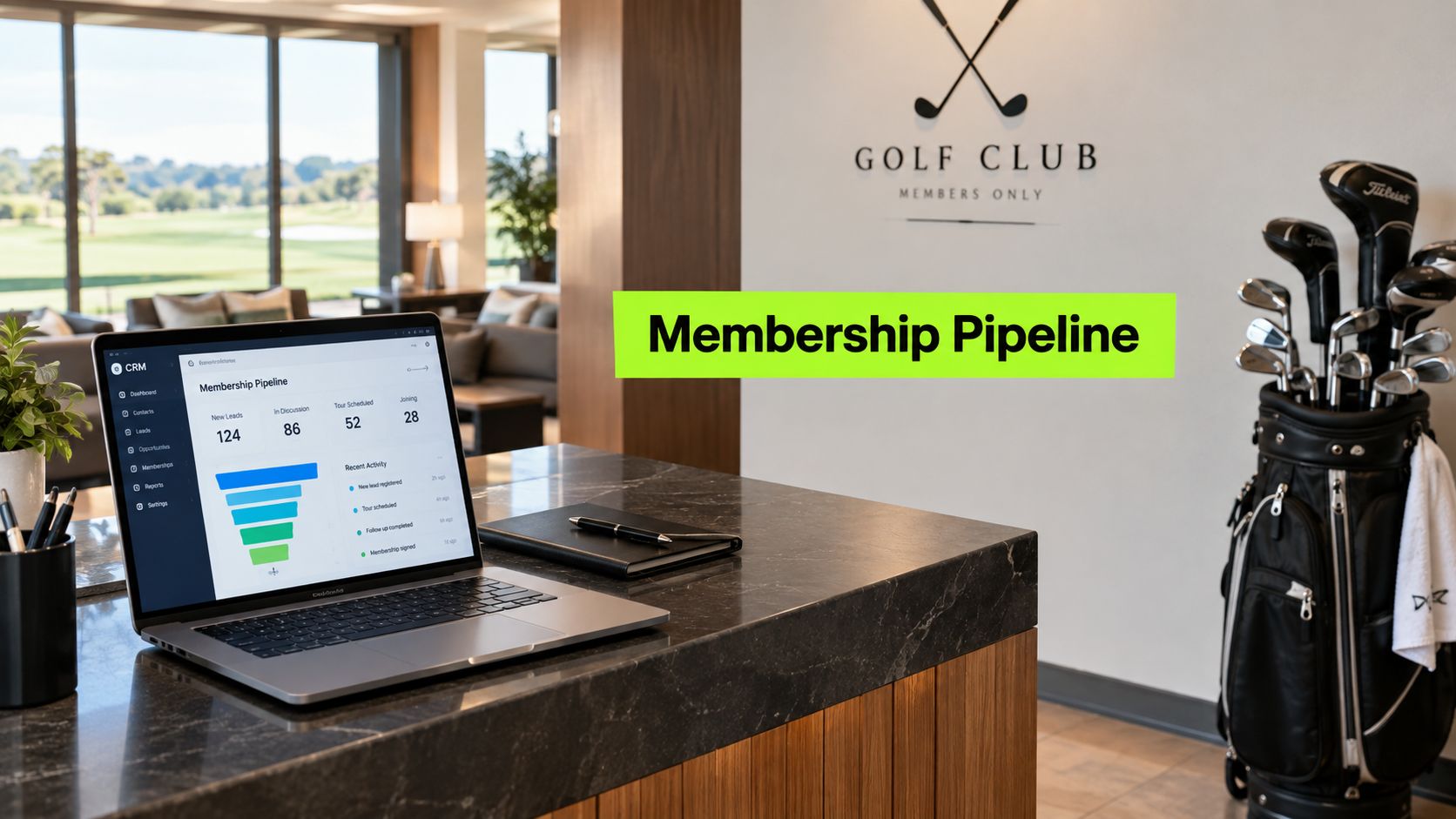
A centralised CRM with automated scoring means a membership team can open the day knowing which leads need a call, which need nurture, and which aren’t ready yet. That’s far more useful than another spreadsheet export. Clubs exploring a proper golf CRM system usually find the same thing quickly. The problem wasn’t traffic alone. It was a lack of lead visibility.
The strong version of this trend isn’t mysterious. It’s operational. Teams use scoring to support action, not replace judgement.
Practical rule: If staff can’t explain why a lead is marked as high priority, the system is too opaque to be trusted.
Where clubs get this wrong
Some clubs jump straight to automation before sorting data hygiene. That creates bad scoring on top of messy inputs.
Start simpler than most software demos suggest:
- Define your best-fit member: Know whether your club values full members, younger joiners, flexible categories, corporate buyers, or lifestyle users most.
- Clean your enquiry sources: Website forms, Meta leads, phone notes and referral enquiries should feed into one place.
- Use scoring to prioritise response: AI should help staff move faster, not avoid personal contact.
- Review it regularly: The best prospect profile changes as your club’s offer changes.
GolfRep’s work with clubs such as Bidston Golf Club and multi-site operators like Macdonald Hotels & Resorts points in the same direction. Consistent processing beats ad hoc enthusiasm. AI isn’t the trend worth following on its own. Better triage is.
2. Hyper-Localised Programmatic Advertising
Broad awareness campaigns sound impressive in committee meetings. They usually waste budget.
Most private clubs don’t need national reach. They need relevance inside a realistic drive-time catchment. That’s where hyper-localised advertising has become one of the more useful golf club marketing trends 2026.
The principle is simple. Serve the right message to the right local prospect, at the right time, based on geography, behaviour and local conditions. That could mean different creative for beginners, lapsed golfers, family decision-makers or players comparing nearby clubs. It could also mean adjusting spend when local search intent rises or when your club has seasonal capacity to fill.
Precision beats reach
The strongest local campaigns don’t rely on one message for everyone. They reflect what nearby golfers care about.
A serious golfer within easy distance may respond to course quality, tee availability and competition calendar. A younger prospect may care more about flexibility, social atmosphere and whether the club feels welcoming rather than formal. A hotel-resort buyer may look at weekend experience, dining and overnight options.
This matters more now because younger golfers are reshaping what “value” means. The shift away from pure exclusivity and toward community, wellness and social connection is one of the defining changes described in this private golf and country club membership trends analysis for 2026.
What works in practice
Local media buying works best when clubs stop trying to look bigger than they are.
- Set a real catchment area: Don’t target half the county if your members mostly come from a tighter radius.
- Match the message to the segment: Trial rounds, coaching-led entry points, flexible memberships and corporate packages need different campaigns.
- Use local context: Weather shifts, event dates and competitor positioning all affect response.
- Watch lead handling capacity: There’s no value scaling local demand if no one follows up properly.
We’ve seen this with clubs that wanted “more exposure” when what they really needed was stronger market share in the right postcodes. Hyper-local wins because it’s disciplined. It respects geography, decision patterns and budget.
3. Membership CRM Nurture Automation Flows
The lead is not the win. The system that handles the lead is.
Golf clubs still lose good enquiries for ordinary reasons. The prospect asked for details during a busy week. The membership PDF answered the wrong questions. Nobody followed up after the first email. Or the club kept chasing without moving the decision forward. In practice, the difference between steady membership growth and wasted ad spend often sits inside the CRM, not the campaign.
Membership sales rarely happen in one step. Prospects compare categories, check budget with a partner, wait for a quieter work period, or hold off until the season feels right. Clubs that rely on ad hoc replies usually mistake delay for disinterest. Clubs with structured nurture flows keep the conversation alive until timing and intent line up.
Good automation supports the sales process
The better setups do more than send a generic sequence. They reflect how people decide.
A prospect who downloaded membership pricing needs different follow-up from someone who booked a visitor round. A parent considering a family package needs proof that the club fits everyday life, not just a list of benefits. A corporate contact usually wants clarity on hosting, guest access and account handling before they care about course architecture.
That is why the strongest flows are built around stage and intent, not just time since enquiry.
What a useful flow includes
Clubs can learn a lot from these lead nurturing best practices for golf clubs, but the structure should stay practical:
- Segment by buying context: Solo golfers, families, lapsed joiners and corporate prospects should not receive the same sequence.
- Give each message one job: Book a tour, answer a pricing concern, explain categories, or prompt a call.
- Address common objections: Tee access, joining fees, dress code, club atmosphere, usage flexibility and value all need plain answers.
- Trigger staff involvement at the right point: Repeated page visits, tour clicks or replies should prompt a human follow-up.
- Use scarcity carefully: Waiting lists, limited trial places or seasonal deadlines only work if they are true and operationally relevant.
Follow-up should help a prospect make a decision, not remind them that the club exists.
The trade-off is simple. More automation creates consistency, but too much of it makes the club feel generic. That is why the CRM should route warmer prospects to a person quickly and leave lower-intent leads in a lighter sequence. Used properly, automation does not replace the membership team. It protects their time, keeps enquiries from going cold, and turns marketing activity into a more predictable conversion engine.
4. Interactive Virtual Club Tours and 3D Facility Visualisation
A prospect doesn’t always want to book a visit before they know whether your club feels right. That hesitation is reasonable, especially if they’re comparing several clubs or they’re new to membership environments altogether.
Virtual tours reduce that friction.
Used properly, they help a prospect understand the course, clubhouse, practice areas, dining spaces and general atmosphere before speaking to anyone. Used badly, they become a glossy distraction with no connection to the enquiry journey. This is what virtual tours are really for.

What virtual tours are really for
This isn’t mainly about overseas buyers or novelty. It’s about reducing uncertainty.
A younger buyer who’s unsure whether the club feels too formal may look at the lounge and terrace first. A family may want to understand the wider environment, not just the first tee. A corporate organiser may care more about event spaces than bunker lines.
That’s where clubs often miss the point. They build a virtual tour around what they’re proud of, not what buyers need to evaluate. Signature holes matter, but so do arrival, welcome, social spaces, and signs of everyday use.
Make it part of conversion, not decoration
The best uses are practical:
- Link ad traffic to relevant views: Send membership prospects to the clubhouse and lifestyle areas, not only course flyovers.
- Use it inside nurture: Include tour links in follow-up emails for people not yet ready to visit.
- Keep it current: If the imagery no longer reflects the experience, it damages trust.
- Optimise for mobile: Most first interactions happen on a phone, not a desktop screen in an office.
A good virtual tour should increase confidence and shorten the path to a real visit. A bad one delays action because it gives people something to browse instead of something to book.
The trade-off is cost and upkeep. If a club won’t maintain the content, it’s better to invest in strong photography, clear landing pages and a straightforward booking journey. Technology should remove friction. It shouldn’t add a new layer of brochure polish that staff never use in follow-up.
5. Predictive Analytics for Member Lifetime Value and Churn Risk
Many clubs still judge marketing success too early. They ask which campaign produced the enquiry, or which advert drove the first visit. Those questions matter, but they don’t go far enough.
The better question is which members stay, spend, engage and renew.
That’s where predictive analytics starts to matter. Not as a technical vanity project, but as a way to stop treating every new member as equal from a revenue and retention point of view. Retention is a quieter commercial issue.
Retention is the quieter commercial issue
Golf participation growth can hide a more difficult truth. Clubs are bringing new people into the game through alternative formats and off-course experiences, but many still lack a clear process for converting and retaining those newer entrants into long-term membership value. That gap is described well in this industry note on the retention blind spot behind growth.
For clubs, the lesson is obvious. Acquisition reporting can look healthy while long-term value remains weak.
A predictive approach helps membership and operations teams identify patterns such as:
- Who engages early: Event attendance, lesson bookings, repeat rounds and food and beverage use often tell you more than the original lead source.
- Who looks at risk: Long periods of inactivity, low integration into club life and weak first-year engagement are warning signs.
- Who may upgrade: Some members begin on an accessible category and become stronger long-term customers if handled properly.
Start with useful signals, not complex software
Most clubs don’t need an advanced model on day one. They need structured data and a habit of reviewing it. Data-driven golf marketing is less about dashboards for their own sake and more about tying marketing to member outcomes.
"If you can't see which type of member stays longest, you're still judging campaigns on the easiest metric, not the most important one."
The practical trade-off is this. Predictive tools are only as good as the data culture behind them. If departments don’t log interactions, attendance and spend patterns consistently, churn analysis becomes guesswork with nicer charts.
This trend matters because it shifts the conversation. Marketing doesn’t end at enquiry or even sign-up. It should help the club attract members who fit, stay and contribute over time.
6. Corporate and Group Membership Digital Marketing
Consumer membership campaigns get most of the attention, but many clubs leave corporate demand underdeveloped because they market it like an ordinary membership category.
That rarely works.
Corporate and group sales involve different buyers, longer timelines and more internal approval. The person filling in the form may not control the budget. The person attending the site visit may not sign the contract. The decision may depend on how the club compares with hotels, hospitality venues or other client entertainment options.
The sale is slower and more structured
A consumer prospect might respond quickly to a clear offer and a friendly follow-up call. A corporate buyer usually needs better packaging.
That means separate landing pages, different nurture sequences, and messaging that speaks to hosting, team experience, relationship-building and ease of organisation. Clubs that lump this into the same enquiry flow as individual memberships usually create friction for both audiences.
We’ve seen this especially with clubs offering society days, business memberships, event packages and hospitality combinations. The demand exists, but the route to conversion needs more structure than “contact us for details”.
What improves conversion
Strong corporate marketing usually includes a few basics that clubs often skip:
- Decision-maker-specific messaging: HR, finance and office management teams care about different things.
- Clear package architecture: If buyers can’t understand what’s included quickly, they delay.
- Fast commercial follow-up: Corporate prospects lose confidence when pricing and availability take too long.
- Dedicated ownership: One person should manage the relationship from first enquiry through booking or membership discussion.
This trend also links back to systems. A corporate pipeline is hard to manage manually because several contacts may sit inside one opportunity. Without a CRM, notes get lost, pricing conversations drift, and follow-up becomes inconsistent.
The trade-off is operational readiness. There’s little point advertising corporate packages if the club can’t quote quickly, host visits confidently, and keep communication organised. Corporate growth doesn’t usually fail because the ad was wrong. It fails because the process after the click wasn’t built for B2B decision-making.
7. User-Generated Content and Member Ambassador Programmes
Polished club photography still matters. It just doesn’t carry the same trust on its own.
Prospects increasingly want to see what the club looks like when members use it naturally. They want to see atmosphere, not only architecture. That’s why member-generated content and ambassador programmes are becoming more useful than many clubs expect.
Authenticity matters more than perfection
This is particularly relevant as younger audiences continue reshaping the market. The wider industry picture shows younger golfers are playing a bigger role in future membership demand, and clubs are under pressure to present value in ways that go beyond old signals of exclusivity. For that audience, a real member post from a morning round or a social event can do more than a paragraph of formal brochure copy.
The best clubs don’t leave this to chance. They make it easy for members to share moments, tag the club and contribute to a visible sense of community.
What good ambassador activity looks like
A proper ambassador programme doesn’t mean asking members to become unpaid salespeople. It means giving willing advocates simple ways to help tell the story of the club.
- Feature real routines: Morning golf, post-round coffee, mixed events, lessons and social evenings are more persuasive than endless sunset shots.
- Give light guidance: A few messaging prompts help members talk about the club accurately without sounding scripted.
- Reuse content well: Member photos and comments can strengthen email nurture, social campaigns and landing pages.
- Reward contribution appropriately: Recognition, small perks and visibility usually work better than hard incentives.
Field note: The clubs that get the best member content usually create good member moments first. The content is a by-product. There is a trade-off: User-generated content can become messy or off-brand if no one curates it. Clubs still need standards. But many have overcorrected for years, producing only formal marketing assets that feel distant from everyday club life.
If your current content says “prestige” but member behaviour says “community”, prospects will trust the members.
8. Privacy-First, First-Party Data Marketing Strategies
Many clubs still rely too heavily on platform reporting and too lightly on their own data. That’s risky.
Privacy changes, tracking limitations and stricter expectations around consent mean clubs need to own more of the relationship directly. In practical terms, that means building first-party data through forms, email sign-ups, enquiry histories, preference capture and CRM activity, then using it responsibly.
Better data starts with better value exchange
People won’t hand over useful information just because a form appears. Clubs need a reason for the prospect to engage. That could be access to membership information, event updates, visitor offers, trial booking, academy news or relevant follow-up based on interest.
Once that data is captured, the club can personalise communication without relying on shaky third-party tracking.
The wider retail and golf market points the same way. In 2026, golf businesses are leaning more heavily on digital channels, experiential selling and centralised CRM use rather than treating demand generation and customer data as separate issues, as discussed in this golf industry outlook on brands and green grass retail.
What clubs should do
Privacy-first marketing doesn’t need to be complicated:
- Offer clean opt-ins: Membership guides, event calendars and visitor updates are better hooks than generic newsletters.
- Use preference centres: Let members and prospects choose what they hear about.
- Segment intelligently: Membership status, interest type, engagement and life stage all matter.
- Keep records clean: Compliance and conversion both suffer when lists are messy.
A first-party approach also improves lead handling. If your data sits inside a proper CRM, staff can see source, enquiry type, follow-up history and response behaviour in one place. That helps clubs move away from guesswork.
The trade-off is discipline. First-party data only becomes an advantage if teams collect it consistently, store it properly and use it to improve communication. Otherwise it becomes another neglected database exported once a quarter for committee slides.
9. Community-Building and Local Events Marketing
Not every growth problem should be solved with paid media.
For many clubs, especially private member clubs with strong local identities, events and community activity still create some of the most credible marketing available. They generate word of mouth, produce useful content, and help prospects experience the club in a less pressured setting than a formal membership meeting.
Community is no longer a soft benefit
This shift matters because newer golfers don’t always arrive looking for tradition first. They often want belonging, flexibility and a reason to return beyond access to the course.
That means beginner events, women’s initiatives, social gatherings, mixed-format days, charity activity and local partnerships can all support membership growth if they connect to a clear next step.
The common mistake is treating events as isolated diary items. A well-attended event with no capture process, no follow-up and no membership pathway creates noise, not pipeline.
Tie every event to a system
Clubs that make events work usually do three things well:
- Capture attendee data: Registration should feed directly into the CRM.
- Define the next action: Beginner attendees might get an academy sequence, while local business guests may enter a corporate flow.
- Use events as proof: Photos, stories and testimonials can support future campaigns.
This is also where clubs can challenge an old assumption. Community activity isn’t “less premium” than traditional membership marketing. For many prospects, it’s the clearest evidence that the club is alive, welcoming and worth joining.
We’ve seen clubs host strong events and then fail to convert interest because no one owned the post-event journey. That’s avoidable. If an open day, beginner clinic or social evening doesn’t trigger structured follow-up, the club is wasting one of its most persuasive marketing assets.
10. Mobile-First Membership Experience and App Integration
Golf clubs still lose good prospects on mobile for a simple reason. The enquiry journey was built for desktop, while the prospect is standing in a car park, on a train, or scrolling between meetings.
That gap now affects far more than lead generation. It shapes response speed, booking completion, member satisfaction after join-up, and how well the club can keep people engaged once they are in the system.

Mobile experience affects conversion and retention
For many clubs, “mobile-first” still means shrinking the website to fit a smaller screen. That is too narrow. The primary job is to make the full membership journey work properly on a phone, from first click to booked visit, from member updates to tee times, event registration and account access.
That matters because the app or mobile portal often becomes part of the membership product. If booking is clumsy, if member notices are buried in email, or if service requests require a phone call during office hours, the club creates friction that marketing then has to work harder to overcome. Good mobile tools do the opposite. They support conversion at the front end and reduce avoidable frustration once someone has joined.
What to fix first
A club does not need a custom-built app on day one. It needs a phone-friendly journey tied into the systems behind it.
- Cut form length: Capture enough to start the conversation, then collect more later.
- Make actions easy to complete on mobile: Tour booking, callback requests and enquiry forms should work cleanly with one thumb.
- Pass mobile activity into the CRM: Staff should see what page a prospect viewed, what membership option they checked, and whether they started booking.
- Use app features where they solve a real problem: Tee booking, event sign-up, push reminders and account access can improve retention if members use them.
The trade-off is straightforward. Clubs can spend heavily on polished app features that look modern but do little for growth. The better approach is to start with the revenue path and the retention path. Can a prospect find the right package, enquire in under a minute, receive a prompt follow-up, and book a visit from their phone? Can a member then manage the parts of club life they use most without calling the office?
If the answer is no, mobile-first work is still unfinished. The club has not yet turned technology into a predictable growth system.
Golf Club Marketing Trends 2026: 10-Point Comparison
| Strategy / Trend | Implementation complexity | Resource requirements | Expected outcomes | Ideal use cases | Key advantages |
|---|---|---|---|---|---|
| AI-Powered Lead Qualification and Scoring | High – ML models and CRM integration | Clean data, data science/engineering, CRM connectors | Faster qualification, higher conversion, lower CAC | Clubs with high enquiry volumes or seasonal spikes; multi-site operators | 24/7 prioritisation of high-intent leads; improves over time |
| Hyper-Localised Programmatic Advertising | High – programmatic setup and dynamic creatives | Ad budget, DSPs/data feeds, creative variants, technical setup | Improved local ROI, reduced wasted spend, quicker optimisation | Clubs competing in tight local markets or near chains | Precise geo-targeting, dynamic messaging, competitor-aware bidding |
| Membership CRM Nurture Automation Flows | Medium – automation platform + CRM mapping | CRM, content sequences, SMS/email tools, setup time | Consistent follow-up, shorter sales cycles, higher conversion | Committee-led clubs or those with steady enquiry pipelines | Scales personalised follow-up; clear pipeline visibility |
| Interactive Virtual Club Tours & 3D Visualisation | Medium–High – production and UX integration | Professional 360/3D production, hosting, periodic updates | More tour bookings, fewer no‑shows, stronger remote appeal | Premium clubs, targeting relocations, corporate and international prospects | Differentiated landing experience; rich shareable content |
| Predictive Analytics for Member LTV & Churn Risk | High – modelling + long-term data | 12+ months historical data, analytics team, tracking integration | Proactive retention, informed pricing, improved lifetime revenue | Clubs with historical CRM data and retention focus | Targeted interventions; revenue and cohort insights |
| Corporate & Group Membership Digital Marketing | Medium – B2B processes and custom sales workflows | Sales resources, LinkedIn/CRM, proposal/configurator tools | Higher-value contracts, stable recurring revenue, longer terms | Multi-site resorts, clubs near corporate hubs, event venues | Large account revenue; recurring contracts; upsell opportunities |
| User-Generated Content & Member Ambassador Programmes | Low–Medium – programme design and moderation | Community manager, incentives, moderation/curation tools | Increased authenticity, organic referrals, lower content costs | Community-driven clubs and younger demographics | Authentic social proof; continuous fresh content; higher engagement |
| Privacy-First, First-Party Data Marketing Strategies | Medium – CDP and consent management | CDP, consent flows, surveys, compliance processes | Sustainable targeting, reliable personalization, regulatory compliance | GDPR/CCPA regions; long-term marketing strategies; niche audiences | Data ownership; compliant personalization; reduced reliance on third parties |
| Community-Building & Local Events Marketing | Medium – event planning and partnerships | Staff time, event budgets, PR/partnership coordination | Stronger retention, word-of-mouth referrals, local media coverage | Clubs aiming to grow beginners, families, and local engagement | Emotional loyalty; local visibility; secondary revenue streams |
| Mobile-First Membership Experience & App Integration | Medium–High – mobile UX and integration | Dev resources (PWA/app), hosting, maintenance, UX design | Higher mobile conversions, frictionless bookings, better tracking | Booking-heavy clubs; mobile-first prospect journeys; frequent users | One‑click booking; improved conversion metrics; push engagement |
From Trends to a Predictable Growth System
These ten trends matter, but not in the way many clubs assume.
On their own, they’re just separate tools and tactics: AI scoring without fast follow-up won’t fix conversion; local advertising without a CRM just creates more unmanaged demand; virtual tours without a booking path become decoration; events without data capture become good intentions; a mobile journey without internal ownership still ends in missed calls and cold enquiries.
That is the main point behind golf club marketing trends 2026. The clubs that win won’t necessarily be the ones testing the most new ideas. They’ll be the ones building a joined-up system that turns interest into action, action into membership, and membership into long-term value.
At this point, many clubs still get stuck. They think in channels instead of stages. They ask whether Meta ads are working, whether email is worth it, whether they should invest in a virtual tour, or whether they need a booking app. Those are reasonable questions, but they’re incomplete. The more useful question is whether each part of the journey connects properly to the next one.
Can the club see which campaign drove the enquiry?
Can staff respond quickly and consistently?
Can the system tell the difference between a casual browser and a serious buyer?
Can follow-up continue automatically when the office gets busy?
Can management track movement from first click to visit, sign-up and renewal?
Can the club identify where good leads are being lost?
If the answer is no to most of those, the issue isn’t a missing tactic. It’s a missing growth engine.
At GolfRep, that’s the lens we use: Not “what campaign can we run next?”, but instead, “what system will help this club grow predictably without relying on memory, manual chasing or discounting?” In practice, this means combining lead generation with structured qualification, CRM visibility, automated nurture and conversion tracking. It also means giving clubs a clearer view of where enquiries come from, how they’re handled, and what becomes recurring revenue.
That approach also respects a reality many committees and management teams know well. Golf clubs don’t operate in neat conditions. Staff wear multiple hats. Enquiry volumes rise at awkward times. Decision-making can be shared across managers, owners and committees. Manual processes break under pressure. Systems don’t remove the human side of membership sales, but they do make it more consistent.
The strongest clubs in the next phase of the market will still care about brand, service and member experience. None of that changes. What changes is the discipline underneath it: They’ll stop treating marketing as a series of disconnected campaigns and start treating it as a measurable commercial process.
That’s the shift worth paying attention to.
In 2026, predictable growth won’t come from chasing every trend in isolation. It will come from choosing the few that fit your club, connecting them properly, and building a process that handles demand as well as it generates it. That’s what turns busy inboxes into booked visits, sign-ups and retained members. And for most clubs, that’s the difference between activity and true growth.
If your club is generating interest but struggling to turn enquiries into booked visits and members, GolfRep helps build the system behind the marketing. That means qualified lead generation, structured follow-up, CRM visibility and conversion tracking that gives your team a predictable pipeline instead of a pile of unworked enquiries.
Ready to tap into our proven growth system?