Golf Club Marketing Plan for Predictable Growth

Most advice on a golf club marketing plan gets the priority wrong. It tells clubs to post more on social media, run another open day, or spend more on ads. That's not where most growth stalls.
The problem is what happens after someone enquires.
A club can generate interest all day long and still miss its target if nobody replies quickly, nobody owns the next step, and nobody can see where that prospect sits in the pipeline. That's why the strongest clubs don't rely on ad hoc follow-up. They build a system that handles, tracks, and converts enquiries without depending on memory, goodwill, or whoever happens to be in the office.
Understanding the Real Marketing Challenge
Most clubs don't have a lead problem. They have a conversion handling problem.
That's especially true in committee-led and volunteer-run environments, where responsibility for membership enquiries often sits across several people. One person checks email. Another handles tours. Someone else speaks to the prospect a week later. By then, the momentum has gone.
Existing advice for UK clubs usually stays at the level of basic tactics. It talks about websites, posts, and visibility. It rarely deals with the harder operational issue: how volunteer committees can implement structured follow-up without technical expertise, as highlighted in GolfRep's view on why most golf club marketing fails and the wider issue described in this GolfRep analysis of golf club marketing strategy.
Why enquiry handling matters more than another campaign
A prospect who fills in a form is not a win. It's the start of a process.
If your club can't answer three basic questions, your golf club marketing plan is incomplete:
- Where did the enquiry come from so you can judge source quality
- Who owns the next action so prospects don't sit untouched
- What happens after first contact so interest doesn't cool
Practical rule: If a prospect can enquire without entering a visible pipeline, your club is guessing, not managing.
Manual follow-up creates blind spots. Staff go on leave. Committee members are busy. Phone notes stay in notebooks. Email replies sit in personal inboxes. Then clubs wonder why “marketing didn't work”.
The shift clubs need to make
A useful marketing plan starts with process before promotion.
That means centralising enquiries in one system, assigning ownership, and building follow-up that continues even when the office is closed. It also means measuring response handling, not just lead volume.
The clubs that grow predictably tend to do ordinary things with discipline. They respond fast. They keep visibility on every lead. They follow up consistently. They know which enquiries booked a visit and which disappeared.
That's less exciting than chasing the latest tactic, but it works.
Defining Objectives and Positioning
Clubs waste time on marketing plans that start with channels, creative ideas, and committee preferences. Start with a commercial target instead. If the target is vague, the campaign will be vague, the follow-up will be inconsistent, and the budget will drift.

Start with a board-level objective
Set one objective that can be measured in revenue, member count, or conversion rate. Anything softer creates confusion for staff and gives committees too much room to change direction mid-campaign.
Useful objectives usually fall into four categories:
- Grow one membership line such as junior, academy, flexible, or 7-day
- Increase recurring membership revenue without training the market to wait for discounts
- Raise enquiry-to-visit and visit-to-join conversion through better response standards and tighter follow-up
- Build a qualified pipeline ahead of a known intake period so the club is not relying on last-minute seasonal demand
Pick one primary target first.
A club trying to win families, low-frequency golfers, handicap improvers, and corporate buyers with the same plan usually ends up with generic messaging and a weak joining process. A club with one clear target can set a realistic budget, assign ownership, and build the right response sequence around that audience.
Position the club for the buyer you actually want
Positioning is not a slogan. It is the reason a specific type of golfer should choose your club instead of the two or three alternatives they are already comparing.
Weak positioning sounds familiar and forgettable. “Friendly club.” “Great course.” “Warm welcome.” Every club says that, so none of it helps the prospect choose.
Strong positioning is narrower and easier to prove:
| Positioning angle | What it sounds like in practice |
|---|---|
| Family and junior pathway | A club with coaching, competition, and a clear route from beginner to committed young member |
| Flexible participation | A club for golfers who want regular play and club benefits without a rigid traditional model |
| Competitive member experience | A club for golfers who care about fixtures, handicaps, standards, and a full calendar |
| Social and lifestyle value | A club where golf, events, dining, and community matter as much as the scorecard |
Your positioning should also shape how enquiries are handled. A family-focused club needs a different response path from a competitive members' club. Parents want clarity on coaching, safety, timings, and cost. Low-frequency adult golfers want to know how easy it is to get started and whether the product fits real life. Positioning is not just marketing language. It sets the sales conversation and the follow-up structure.
Use current participation trends to narrow the brief
The market direction is clear. England Golf reported continued growth in membership and participation products in its 2023/24 annual report. That should push clubs to stop writing one broad membership message for everyone.
The practical conclusion is straightforward. Junior pathways, flexible products, and structured entry routes deserve separate objectives, separate budgets, and separate follow-up rules. If your club treats them as minor add-ons, you will under-resource the very categories that are bringing new people into club golf.
This is also where risk control matters. If you promote a flexible or academy route without agreeing the conversion plan, you create cheap enquiries that stall. Set the next step before launch. Decide who calls, how quickly they respond, what gets sent after the first enquiry, and when the prospect is asked to visit.
Build a short internal brief before any campaign goes live
Keep it simple. One page is enough.
Who you want more of
Name the segment clearly.What entry route you are selling
Membership, trial, academy, junior pathway, points product, or flexible category.Why this club fits that buyer
Write one sentence that a prospect would care about.What must happen after an enquiry
Set response time, owner, visit target, and follow-up sequence.How success will be judged
Measure booked visits, show-up rate, joins, revenue, and time to conversion.
That brief does two jobs. It sharpens the message, and it stops the club from generating enquiries it is not prepared to convert. In practice, that is where a good golf club marketing plan starts paying for itself.
Mapping Target Segments and Personas
Poor segmentation wastes budget long before a campaign fails. If your club targets “local golfers,” you are not segmenting. You are guessing.
The clubs that grow membership predictably sort demand into clear buyer groups, then match each group to a specific offer, message, and follow-up path. That matters because the primary difference in results is rarely the ad. It is how well the club handles the enquiry that follows.
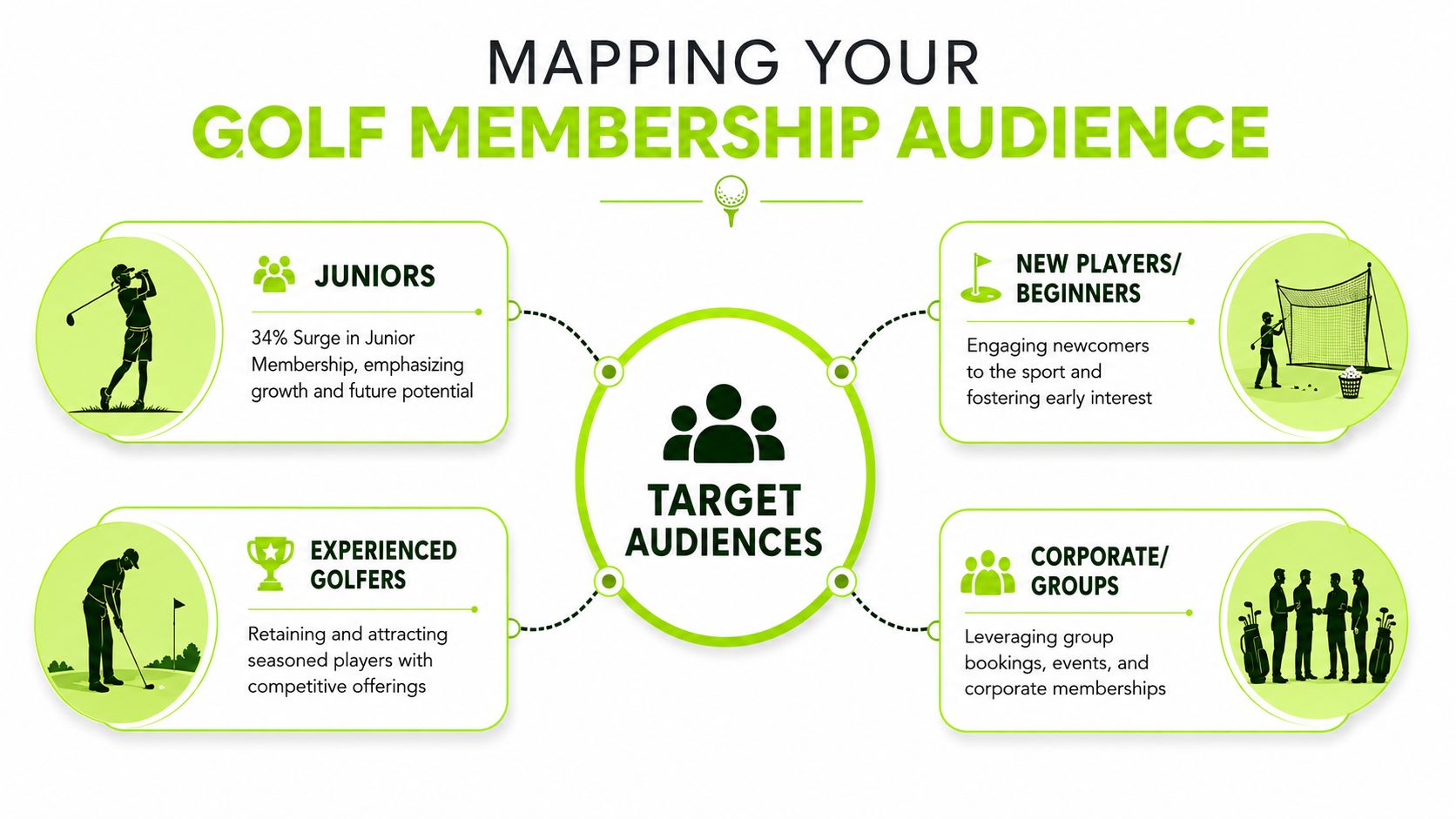
The segments worth mapping first
As noted earlier, junior growth and flexible entry products are changing where demand comes from. That should shape your segmentation immediately. Start with four groups.
Juniors and parents
The parent is usually the decision-maker. Sell coaching structure, safety, scheduling, and a clear path into regular play.Beginners and returners
This group buys reassurance before it buys membership. Remove confusion. Give them an easy first step, plain pricing, and a process that does not make them feel out of place.Experienced golfers comparing clubs
These prospects already know what good looks like. They want course standards, competition access, fixture depth, pace of play, and confidence that switching clubs is worth the effort.Corporate and group buyers
They are not shopping for membership in the usual sense. They are assessing hosting value, convenience, service levels, and whether the club helps them look organised in front of clients or colleagues.
If your club also sells points products, trial memberships, or academy routes, treat those as separate buying journeys rather than bolt-ons. One audience can enter through several offers, but each offer still needs its own conversion plan.
Build personas around decisions
Demographics alone will not improve conversion. Age, postcode, and job title might help with targeting, but they do not tell your team what to send, what to ask, or what objection to handle on the first call.
A useful persona is operational. It should help staff respond faster and move the prospect to a visit. If you want a practical model for that handoff, this guide to the golf club membership funnel shows how segment, stage, and next action fit together.
Use this framework:
| Persona field | What to capture |
|---|---|
| Trigger | What causes them to enquire now |
| Desired outcome | What they want from the club |
| Main objection | What might stop them progressing |
| Best channel | Where initial contact is most likely to land |
| Required proof | What they need to see before booking a visit |
Practical examples
A junior pathway persona should be built around the parent's decision.
- Trigger A parent wants a structured sport with coaching and progression
- Desired outcome A welcoming club, reliable coaching, and a clear pathway
- Main objection Concern that the club feels exclusive, expensive, or hard to access
- Best channel School links, referrals, social content, website enquiry
- Required proof Junior timetable, coaching lead, first-session details, simple joining route
An experienced golfer persona is different in every useful way.
- Trigger Frustration with current club value, access, or competition calendar
- Desired outcome Better golf, stronger fixtures, and a club culture that suits them
- Main objection Switching effort, unclear benefits, concern about fit
- Best channel Referral, direct website visit, paid social, search
- Required proof Hosted tour, fixture list, membership options, credible follow-up from a member of staff
That level of detail improves response quality. It also reduces risk. Clubs in the UK often spend modest monthly budgets generating enquiries, then lose them because the message, the form, and the follow-up all assume the same buyer. A parent asking about junior coaching should not receive the same email sequence as a low-handicap golfer comparing full membership categories.
What this changes in practice
Segmentation should change three things immediately.
First, your messaging. Junior campaigns speak to parents. Beginner campaigns lower anxiety. Full membership campaigns prove standards and club life. Corporate outreach focuses on outcomes, not atmosphere.
Second, your response rules. Different segments need different scripts, proof points, and timings. A corporate lead can wait for a scheduled call. A beginner lead should get a fast, clear reply while confidence is still high.
Third, your budget control. Once segments are mapped properly, you can see which offers bring high-intent enquiries, which ones create price shoppers, and where follow-up gaps are killing conversion. That is how clubs stop blaming lead volume for what is really a handling problem.
Mapping the Membership Funnel
Most clubs can describe how a golfer finds them. Fewer can explain, step by step, how that golfer becomes a member. That gap is where revenue leaks.
A proper funnel gives every enquiry a path, an owner, and a next action.
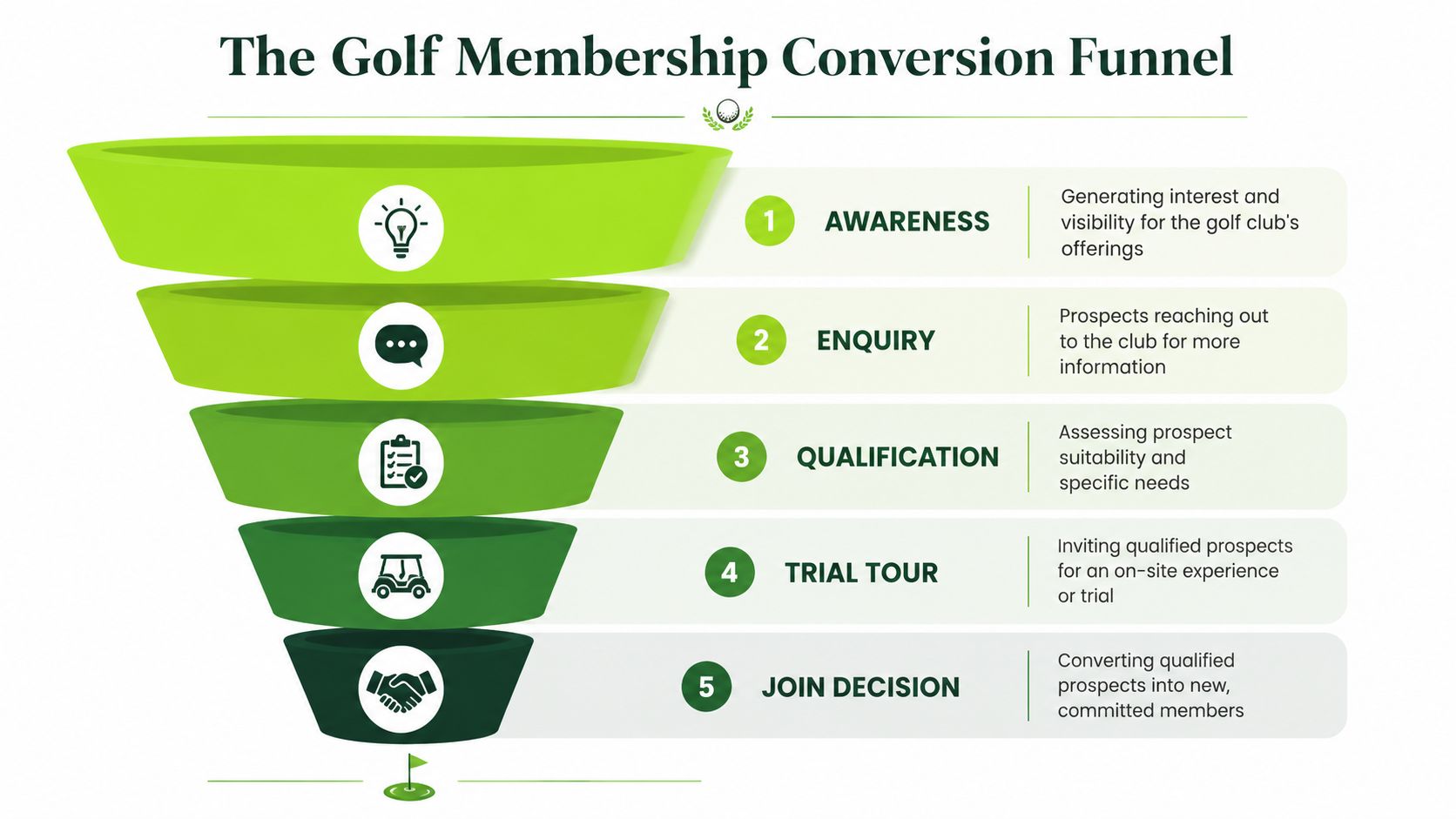
The five stages that matter
Most clubs don't need a complicated model. They need a visible one. A practical structure looks like this:
Awareness
The prospect sees the club through ads, referrals, events, local search, or club communications.Enquiry
They submit a form, call, message, or reply to an ad.Qualification
The club identifies what they're interested in and whether they fit a membership route.Trial tour
They visit the club, take a tour, attend a trial experience, or meet the right person.Join decision
The club follows up, answers objections, and moves them to application or sign-up.
The middle of the funnel is where clubs lose people
The most common mistake is treating the enquiry like the finish line. It isn't. The enquiry is just permission to begin a sales process.
A structured follow-up sequence should include three to four distinct touches over two to four weeks, keeping the club visible while the prospect decides. Clubs can also see measurable conversion improvements within 60 to 90 days when that process is properly managed, according to this guide to response time and conversions.
That means your funnel needs timing, not just stages.
| Funnel stage | What the club should do |
|---|---|
| Awareness | Drive the prospect to a clear action |
| Enquiry | Confirm receipt immediately and assign ownership |
| Qualification | Ask a small number of useful questions |
| Trial tour | Offer dates, remove friction, confirm attendance |
| Join decision | Follow up with relevance, not generic chasing |
For a deeper operational view, this membership funnel breakdown for golf clubs is useful because it puts ownership and tracking at the centre rather than the campaign creative alone.
Set standards for each step
A funnel only works when each stage has a rule.
Response ownership
One named person or role owns first contactPipeline visibility
Every enquiry sits in a central CRM, not in private inboxesProgression logic
Every lead has a next step or a reason for stallingTour discipline
Visits should be booked, confirmed, and followed up systematically
If a prospect says “I'll think about it”, that isn't the end of the process. It's the point where disciplined follow-up starts.
Many clubs are better at getting attention than converting intent. A visible funnel fixes that because it forces the team to manage reality, not assumptions.
Planning Channel Strategy and Budget Timeline
A golf club marketing plan needs a calendar, not just a list of channels. Otherwise clubs spend reactively, dabble across the year, and can't tell which activity produced members.
The budget should follow demand patterns and operational capacity. If the club can't handle enquiries well in peak acquisition months, it shouldn't increase spend until the follow-up process is organised.
Put the budget where membership demand is strongest
For UK clubs running membership campaigns, directing 70% of the annual advertising budget to January through June and pairing Facebook ads with a centralised CRM plus weekly email nurture flows can produce a 10:1 ROI, according to this analysis of golf club membership campaign performance.
That point matters for two reasons. First, timing matters more than most committees think. Second, paid ads only work properly when the club can track the journey from enquiry to tour to join.
Here's the simplest version of the split.
| Period | Budget Percentage |
|---|---|
| January to June | 70% |
| July to December | 30% |
Build the year around channel roles
Not every channel should do the same job.
Paid social should create enquiry volume during the strongest acquisition window. CRM email should nurture undecided prospects and keep the club visible. Open days and trial events should give qualified leads a reason to visit. Referral and partnership activity should support trust, especially for family and community-led segments.
A useful annual rhythm looks like this:
January to March
Launch main membership acquisition campaigns, tighten lead handling, and book tours fast.April to June
Keep ad pressure on, run nurture flows weekly, and convert undecided leads before summer distraction sets in.July to August
Reduce broad acquisition intensity if capacity is tight. Focus on follow-up, family pathways, and flexible participation.September to October
Re-engage warm leads, support autumn trial activity, and prepare renewal and retention messaging.November to December
Plan next year's campaigns, clean CRM data, review source quality, and define the next offer.
Don't spread spend evenly for the sake of neatness
Even budgets feel sensible to committees. They're usually inefficient.
The market doesn't behave evenly across the year, and your golf club marketing plan shouldn't either. Front-loading spend into the period when people actively consider joining is more practical than preserving a tidy monthly average.
A better channel mix looks like this
Instead of asking “which platform is best?”, ask what each channel must do.
- Facebook ads generate initial response from local audiences
- CRM workflows stop that response going cold
- Email nurture keeps attention during consideration
- Tours and open events convert abstract interest into a real buying decision
- Referral prompts add trust where formal marketing can't
The clubs that grow consistently aren't using more channels than everyone else. They're using a few channels with clearer jobs and tighter tracking.
Implementing Automation and Nurture Flows
Automation isn't a luxury for golf clubs. It's basic infrastructure. If your response process depends on office hours, memory, or someone remembering to “just give them a call tomorrow”, your pipeline is fragile.
That's why the most practical golf club marketing plan includes automated acknowledgement, structured qualification, and scheduled follow-up from day one.
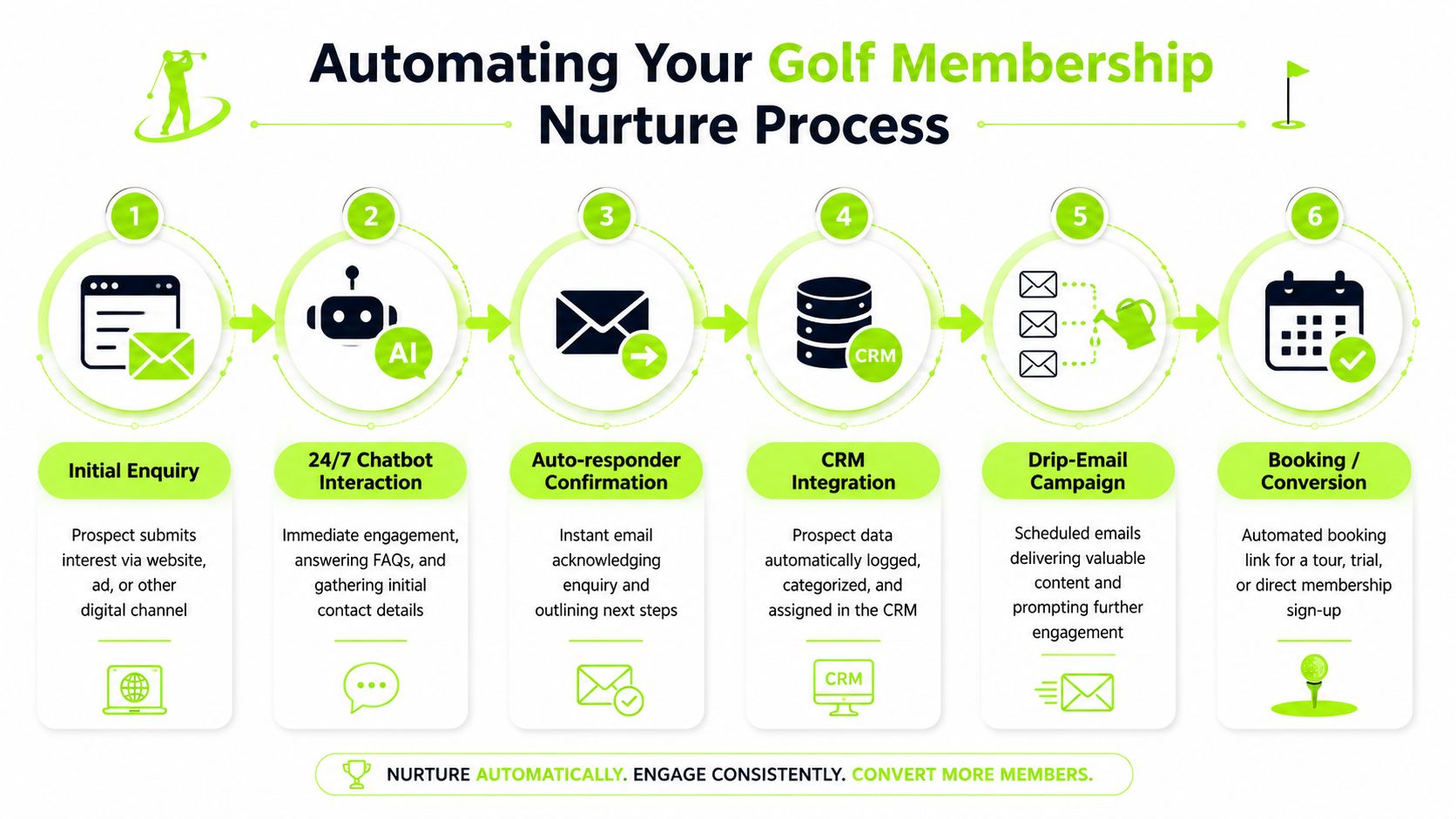
What the minimum automation stack should do
At a minimum, every enquiry should trigger four actions:
Immediate confirmation
The prospect gets an instant reply confirming receipt and setting expectation.CRM logging
The lead enters one central system with source and status attached.Internal assignment
A staff member or committee contact gets a task with clear responsibility.Nurture sequence
The lead receives scheduled follow-up until they book, join, or opt out.
That's not complicated. It's organised.
Clubs often overestimate the difficulty here. The technical side matters less than the workflow design. Good automation ensures no lead disappears because somebody got busy.
A simple nurture flow that works
A strong sequence doesn't need to be clever. It needs to be timely and relevant.
Touch one
Confirm the enquiry and offer the clearest next stepTouch two
Answer likely questions based on the person's interestTouch three
Prompt a visit, trial, or direct conversationTouch four
Re-engage politely before the lead goes cold
The content should change by segment. A parent asking about juniors should not receive the same sequence as an experienced golfer comparing full membership options.
Operational advice: Write follow-up messages as if the recipient has forgotten who you are. Because many of them have.
Volunteer-led clubs need simpler systems, not weaker ones
Many guides make a critical error: they assume clubs have a marketing manager and a sales administrator. Many don't.
Volunteer-led clubs need automations that are easier to maintain, with fewer moving parts and clearer hand-offs. One inbox is better than several. One CRM view is better than scattered spreadsheets. One agreed sequence is better than everyone writing their own replies.
For clubs reviewing process design, these Lynkro.io insights on AI processes are useful because they frame automation as workflow discipline, not just software.
A practical setup guide for clubs is this GolfRep resource on golf club automation, which focuses on structured follow-up and central visibility rather than flashy tools.
Message templates to put in place
You don't need polished copywriting. You need clear communication.
| Message type | Purpose |
|---|---|
| Enquiry confirmation | Acknowledge interest and explain the next step |
| Qualification email | Clarify interest, timing, and membership route |
| Tour invitation | Offer dates and reduce booking friction |
| Reminder message | Lower no-show risk and keep the visit top of mind |
| Post-visit follow-up | Answer objections and move toward decision |
When clubs install this properly, they stop relying on heroic effort. The system does the routine work, and staff can focus on the conversations that close members.
Tracking Performance and Sample Campaign Calendar
A club does not need more reports. It needs a scoreboard that shows whether enquiries are being handled properly and whether marketing spend is producing joined members.
If you cannot link a new membership sale to source, response speed, follow-up path, and tour attendance, your reporting is too shallow to guide budget decisions. For golf clubs, the point of tracking is simple: keep spending on channels that produce booked visits and memberships, and cut activity that only fills the inbox.
Review this weekly. Review it properly monthly. End-of-season summaries are too late to fix handling problems that were costing you joins in April and May.
Track the metrics that expose handling quality
Plenty of clubs obsess over impressions and clicks, then miss the numbers that decide conversion. Track the measures below because they show where revenue is being won or lost.
Enquiry response time
How fast the club acknowledges an enquiry and starts the next stepLead visibility
Whether every live enquiry sits in one shared system with a clear ownerFunnel progression
How enquiries move from first contact to tour, proposal, and joinMember acquisition cost
What the club spends to secure one new memberTour no-show rate
Whether reminders and confirmations are doing their jobFollow-up completion rate
Whether staff send the calls, emails, and reminders the process requires
This matters in the UK because clubs often set budget by habit, copy a nearby club's offer, and hope the season carries them through. That is weak management. Use your own cost-per-join figures, your own source data, and your own tour-to-member conversion rates. The outside benchmark is less useful than a disciplined internal baseline.
For a wider view on campaign measurement and review cadence, this guide for Shopify merchant campaign success is worth reading. The sector is different, but the principles around attribution, decision-making, and stopping weak campaigns early carry across well.
A sample campaign calendar clubs can run without adding chaos
Your calendar should tie spend, follow-up, and review into one operating plan. If those pieces sit separately, leads get generated faster than the club can convert them.
| Month block | Main activity | Support task |
|---|---|---|
| Early season | Membership ads, referral pushes, and tour promotion | Check response times twice a week and review booked visits every Friday |
| Mid-season | Open day campaigns and segmented nurture for families, younger members, and lapsed prospects | Re-contact warm leads, confirm visit attendance, and record objections consistently |
| Late season | Flexible joining routes, waiting list management, and retention-linked messaging | Audit source quality, clean the database, and set next season budget assumptions |
A practical rule. Do not increase ad spend in any month where response times are slipping or tours are not being confirmed properly. Fix handling first. Then scale.
Keep a risk checklist beside the calendar
Campaign failure usually comes from process gaps, not bad creative.
Slow response risk
Set an automatic acknowledgement and assign each enquiry to a named personVisibility risk
Keep all notes, status changes, and follow-up tasks in one CRMBudget drift
Review source quality every month and stop weak spend before it drains the season's budgetMessage fatigue
Refresh offers and adapt follow-up by segment instead of sending the same sequence to everyoneStaff capacity risk
Reduce campaign volume during peak operational weeks if the team cannot handle enquiries properly
One more point matters. A campaign calendar should include working copy, not just dates and channel names. Keep approved versions ready for ad headlines, tour invitations, parent emails, and post-visit follow-up. Clubs lose consistency when staff have to write from scratch every time.
If your club wants a more predictable way to grow membership, GolfRep helps build the full system behind it. That means lead generation linked to structured follow-up, CRM visibility, and automation that keeps enquiries moving until they become booked visits and joined members.
Ready to tap into our proven growth system?