Golf Club Marketing Ideas: Boost Membership in 2026
A lot of golf clubs are sitting on the same problem right now. Enquiries come in through the website, Facebook, email, phone calls, and contact forms, but the follow-up is patchy. One prospect gets a quick reply. Another waits until the next morning. A third asks for membership details on social media and never gets a proper answer at all.
That's where membership growth stalls.
At GolfRep, we see the same pattern repeatedly across UK clubs. The issue usually isn't a lack of interest. It's the gap between enquiry generation and conversion. Clubs spend time worrying about getting more leads, when the primary problem is often what happens after someone raises their hand. Slow replies, no visibility on lead status, no structured follow-up, and too much dependence on one busy manager or secretary.
Some clubs lose prospective members because nobody owns the process from first enquiry to booked visit to signed application. Manual systems make that worse. Spreadsheets get out of date. Inbox messages get buried. Staff assume someone else replied.
The answer isn't more admin. It's better systems.
The eight golf club marketing ideas below are built around that reality. They're practical, not theoretical. They focus on capturing every lead, responding quickly, tracking what happens next, and giving your team a repeatable process that doesn't rely on memory or guesswork. If you want more reliable membership growth in 2026, start by closing the conversion gap.
1. Lead Response Automation and CRM Integration
Most clubs don't have an enquiry problem. They have a handling problem.
A prospect fills in a form at night, sends a Facebook message at lunch, or rings while the office is busy. If those touchpoints stay disconnected, leads drift. Staff end up chasing old messages manually, and nobody has a clear view of who enquired, who replied, and who booked a visit.
That's why the first of these golf club marketing ideas should be a central system.
Put every enquiry into one place
Your website, email inbox, phone notes, and social channels should all feed into one CRM. That gives the club a single record for each prospect and stops the usual confusion of duplicate outreach, missed callbacks, and handovers that go nowhere.
GolfRep has seen this make a major difference in clubs where one person used to hold the entire process in their head. Once the club moves to a proper workflow, follow-up becomes visible and consistent. If you want a practical starting point, a golf club CRM system should capture the lead, trigger the first response, assign ownership, and show the next action.
Practical rule: If a lead can sit in a staff member's inbox without anyone else seeing it, the system is too fragile.
Bidston Golf Club is a strong example of what structured follow-up can support. The club implemented a full CRM workflow that captured enquiries and automated first contact, helping support a turnaround from near-closure to more than double membership and six-figure recurring revenue. Macdonald Hotels & Resorts also shows the value of centralised handling across multiple properties, with visibility on lead quality by location and consistent nurture across sites.
Build response standards, not good intentions
Clubs often say they reply quickly, but few define what “quickly” means.
Set a response benchmark for business hours and use automation out of hours so every prospect gets an immediate acknowledgement. Then split your follow-up by prospect type. A membership lead needs a different sequence from a society organiser or a visitor booking enquiry.
A simple starting framework works well:
- Map entry points: List every place enquiries arrive, including forms, calls, emails, and social messages.
- Assign ownership: Name who follows up first, who books tours, and who updates the CRM.
- Create templates: Write first-response messages, booking confirmations, and reminder emails in advance.
- Review regularly: Check lead quality, response times, and conversion outcomes each quarter.
What doesn't work is relying on staff to “remember to chase them later”. Later is where leads disappear.
2. Targeted Local Digital Advertising with Conversion Tracking
Paid advertising can fill the top of the funnel quickly. It can also waste budget just as quickly if the club sends traffic to a generic homepage and has no idea what happened after the click.
That's the difference between advertising and a proper acquisition system. Good campaigns don't just generate interest. They generate identifiable enquiries that the club can track and convert.
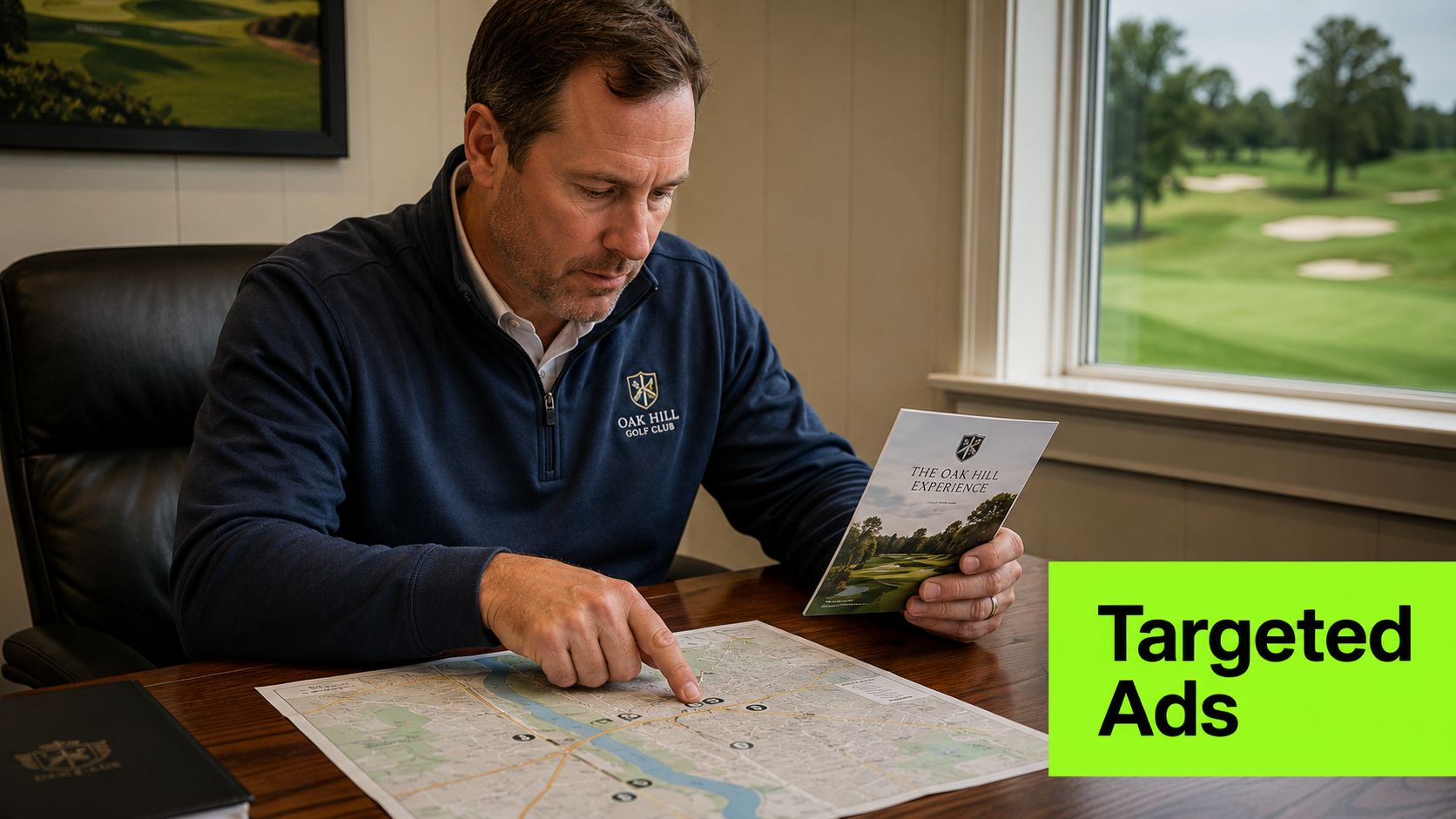
To show the principle, this is the kind of local, intent-led presentation that tends to support response when paired with the right offer and landing page:
Advertise offers, not vague awareness
One of the most useful golf club marketing ideas is to stop promoting the club in broad terms and start promoting a specific reason to enquire. New member campaigns, guest rates, beginner offers, corporate packages, and trial opportunities should each have their own campaign and their own landing page.
That matters because each audience responds to different language. A new resident considering membership isn't thinking like a society organiser. A beginner looking for lessons isn't ready for the same message as an experienced golfer comparing full membership options.
Clubs like Downes Crediton have used focused membership campaigns that drove qualified enquiries to conversion-led pages, rather than broad-reach messaging. Addington Palace is another example of using seasonal campaigns to stay visible with corporate groups and local prospects moving into the area.
If you're running Meta campaigns, the structure matters as much as the creative. GolfRep's view on Meta ads for golf clubs is simple: target locally, match the message to the audience, and track the enquiry all the way through to outcome.
Track the conversion, not just the click
A campaign can look busy and still perform badly. Clicks and impressions don't tell you whether the club got good prospects, whether staff replied quickly, or whether booked visits turned into members.
Use conversion tracking on every landing page and tag each lead by campaign source. Then review performance weekly. If one message consistently brings in the wrong type of prospect, stop defending it and cut it.
A better operating rhythm looks like this:
- Define the audience: Target by location, likely fit, and intent, not “everyone interested in golf”.
- Separate campaign themes: Keep membership, guest play, events, and corporate offers distinct.
- Retarget interested visitors: Many prospects need more than one visit before enquiring.
- Connect ads to follow-up: Paid traffic without email or SMS nurture usually underperforms.
What doesn't work is paying for attention and then treating every lead the same once it arrives.
3. Email and SMS Nurture Sequences
Most clubs send one reply, maybe two, and then assume silence means no interest.
In practice, many prospects are still considering the club. They're busy, comparing options, checking costs, speaking to a partner, or waiting for the right time to visit. If your club disappears after the first email, you leave the decision to chance.
Use sequences that answer real objections
A proper nurture sequence should move someone from enquiry to action. That action might be booking a tour, replying to a call, attending an open day, or starting a trial. The messages should feel like a guided path, not a random set of reminders.
Bidston Golf Club implemented a structured onboarding email sequence for new enquiries that covered the course, member benefits, pricing, and a clear joining opportunity. That kind of consistency is what clubs need. Multi-site operators often use centralised email sequences with local tailoring for the same reason. It keeps standards high without losing the club's own voice.
Most prospects don't need more information. They need the right information in the right order.
Email does the heavier lifting. SMS is useful for immediacy. Confirmation messages, tour reminders, and short prompts to reply can work well when they support the sales process rather than interrupt it.
Keep it short, relevant, and timed properly
Long sales emails rarely help. Most clubs do better with short messages that answer one question and ask for one next step.
A good sequence usually includes a mix of:
- Welcome messaging: Confirm the enquiry and explain what happens next.
- Benefit-led follow-up: Show what membership is like, not just what it costs.
- Objection handling: Address common sticking points such as commitment, playing time, or club culture.
- Social proof: Share recent member experiences, photos, or visit invitations.
- Decision prompt: Give the prospect a simple reason to book or reply now.
The mistake is sending generic newsletter content to warm membership leads. A prospect who has asked about joining doesn't need another captain's update. They need clear next steps, fast answers, and a steady rhythm of contact until they decide.
4. Content Marketing and SEO for Local Authority and Organic Traffic
SEO is slower than paid advertising, but it's often more durable. A good local content strategy helps your club be found for lessons, membership options, junior golf, corporate days, or golf clubs in your area.
The mistake is treating content as a branding exercise with no commercial purpose. Clubs publish a few course updates, then wonder why nothing changes. Content only works when it targets real search intent and points people towards a clear next action.
Answer the questions prospects already ask
Start with the questions your office hears every week. How much is membership? Is the course suitable for beginners? Are there junior options? Can I visit before joining? Do you host corporate golf days?
Those questions should become pages, articles, and landing content on your website. Plain English beats polished waffle. If a prospect wants to know whether your club is welcoming, show them how the joining process works, what the social calendar looks like, and how a first visit is handled.
Clubs that build useful content around lessons, membership types, local golf access, and event enquiries usually create a steadier flow of organic interest than clubs that only post internal news. Better still, that traffic often arrives with stronger intent because the prospect is already researching a specific need.
Build for local search, then connect content to conversion
A lot of clubs miss simple local signals. They talk about the club without naming nearby towns, villages, or areas they serve. That weakens search visibility and makes pages less relevant to local prospects.
Your content should support both discovery and conversion:
- Create local relevance: Include area names naturally on membership and lesson pages.
- Write service-specific pages: Separate membership, juniors, lessons, events, and corporate golf.
- Use clear calls to action: Every article should point to a tour, guide, enquiry form, or contact route.
- Link intelligently: Send readers from helpful content to the page where they can take the next step.
A blog post that gets traffic but produces no enquiry path is unfinished work.
What doesn't work is chasing broad vanity terms and ignoring commercial intent. Ranking for a general golf phrase sounds good. Ranking for the specific searches that lead to tours and applications is better.
5. Member Referral and Advocacy Programmes
Referral programmes sound simple, but many clubs handle them badly. They announce a reward, mention it once in a newsletter, then wonder why nothing happens.
Members will recommend the club when two things are true. First, they enjoy being there. Second, the process is easy enough that they don't have to chase the office, explain awkward rules, or guess whether anyone tracked their referral.
Referrals become one of the most practical golf club marketing ideas. They're trusted, local, and often far warmer than cold enquiries.

Make the referral process frictionless
A strong referral programme should be easy to explain in one sentence. If it needs a long document full of conditions, staff won't promote it well and members won't bother with it.
The best versions tend to include a simple referral form or tracked link, a clear definition of what counts as a successful referral, and prompt reward processing once the new member joins. Clubs also get better results when they tell members exactly who they want introduced. New residents, returning golfers, younger families, and colleagues from local firms are all easier to picture than “anyone who might be interested”.
Pair incentives with member confidence
The incentive matters, but confidence matters more. Members are much more likely to refer someone if they know that person will receive a fast reply, a professional welcome, and a good first experience.
Useful ways to improve participation include:
- Give members tools: Provide a referral link, a printable card, or a short email template.
- Keep rules visible: Make the reward and process easy to find on member channels.
- Recognise advocates: Public thanks often encourages more participation than clubs expect.
- Track attribution properly: Use your CRM so referrals aren't lost or disputed.
What doesn't work is launching a referral scheme while member satisfaction is weak. If the clubhouse experience is inconsistent or new joiners get poor follow-up, your existing members won't market the club for you. They'll stay quiet.
6. Membership Trial Periods and Low-Friction Entry Options
A full membership commitment can feel like too much too soon, especially for prospects who like the idea of joining but still have unanswered questions. They may be unsure about the club culture, whether they'll use it enough, or whether the course suits them.
That's why low-friction entry points work. They reduce the pressure of the initial decision and let the prospect experience the club properly.
To make that work, the trial has to feel welcoming from the first touchpoint.
Remove uncertainty, not value
Clubs sometimes worry that trials cheapen membership. In reality, the right trial does the opposite. It gives the prospect enough confidence to make a proper commitment.
That could be a short trial membership, an accompanied guest round, an introductory package, or a structured tour plus follow-up experience. The key is clarity. The prospect should know exactly what they get, how long it lasts, and what happens if they want to join.
A poor trial is vague, hard to redeem, and unsupported once the prospect arrives. A good trial feels organised from start to finish.
Treat trialists like future members
The operational side matters more than the offer itself. Staff should know who's visiting. The pro shop should be ready. The first email should explain parking, dress expectations, where to check in, and who to speak to on arrival.
A solid approach usually includes:
- Simple sign-up: Don't make prospects fill in unnecessary forms to try the club.
- Internal briefing: Let front-of-house and golf ops staff know who the trialists are.
- Mid-trial check-in: Ask how the experience is going and deal with questions early.
- Clear conversion follow-up: Send a joining prompt while the visit is still fresh.
If a trial member has to ask basic logistical questions on arrival, the club has already added doubt.
What doesn't work is offering a trial with no conversion process behind it. Trials generate interest. Systems convert it. Without follow-up, you're just giving people a taste and hoping they join on their own.
7. Corporate and Group Golf Packages
Many clubs leave corporate revenue to chance. They wait for an occasional phone call, put together a package manually, and price each event from scratch. That approach creates friction for the buyer and admin for the club.
A better approach is to package corporate and group offers properly. When a business wants to host clients, reward staff, or run a charity day, they want clarity. They don't want to build the event for you.
Sell a ready-made experience
Clubs that do this well don't pitch “a golf day”. They pitch specific packages with clear inclusions, clear pricing structure, and one point of contact. That could include green fees, food, scoring, nearest-the-pin setup, prizes, welcome signage, and optional photography.
This is one of the most overlooked golf club marketing ideas because it sits between sales, operations, and hospitality. But it can be a powerful route into both immediate revenue and future membership interest, especially when attendees experience the club for the first time through a well-run event.
Downes Crediton is a useful example of pairing corporate outreach with a membership growth strategy rather than treating them as separate activities. That joined-up thinking matters. Corporate contacts can become repeat buyers, and attendees can become prospects if the follow-up is handled properly.
Run events through a proper commercial process
Group golf should have the same operational discipline as membership sales. Every lead should be logged, quoted consistently, and followed through to event delivery and post-event contact.
That usually means:
- Create package tiers: Give buyers distinct options rather than endless custom combinations.
- Appoint one owner: One staff member should manage each enquiry from first call to event day.
- Collect attendee details: Use registration to support post-event follow-up where appropriate.
- Keep momentum after the event: Send thanks, photos, future date options, and membership invitations.
What doesn't work is treating each booking like a one-off. When there's no structured process, the club loses repeat business and fails to capture the longer-term value of the event.
8. Member Retention and Engagement Campaigns
Clubs often put all their energy into acquisition and very little into keeping existing members engaged. That creates a constant need to replace people who drift away.
Retention is not just a service issue. It's a marketing issue too. If members don't feel informed, involved, and recognised, renewal becomes weaker and referrals become less likely.
Track engagement before people disappear
Most clubs know when someone has resigned. Fewer know when someone is at risk of resigning.
That's where systems matter again. Use your membership database to spot reduced engagement, low event attendance, long gaps in play, or new members who never really settled in. Then act on those signals early. A personal call, a targeted invitation, or a useful check-in can prevent avoidable churn.
GolfRep's approach to golf club member retention is built around visibility. You need to know who's active, who's drifting, and what actions improve member connection over time.
Bidston Golf Club is a strong reminder that growth doesn't come from acquisition alone. Rebuilding membership after a difficult period also required structured engagement, events, and a stronger member experience.
Build a communication rhythm members actually value
Retention campaigns shouldn't feel like constant promotion. Members need a balanced mix of useful updates, community recognition, and relevant invitations.
A practical retention structure often includes:
- Segmented communication: Different member groups need different messages.
- Welcome pathways: New members need guidance during their early weeks, not just a joining confirmation.
- Regular events: Create reasons for social, competitive, family, and newer members to stay involved.
- Recognition moments: Celebrate milestones, achievements, and long-standing membership.
Clubs lose members quietly first, formally later.
What doesn't work is sending the same generic bulletin to everyone and assuming engagement will look after itself. Strong retention comes from steady attention, clear systems, and early intervention when member behaviour starts to change.
8-Point Golf Club Marketing Comparison
| Strategy | Implementation complexity | Resource requirements | Expected outcomes | Ideal use cases | Key advantages |
|---|---|---|---|---|---|
| Lead Response Automation and CRM Integration | Medium–High: CRM setup, workflows, integrations | CRM platform, integration dev, staff training, clean data | Faster responses; higher enquiry-to-booking conversion; pipeline visibility | Clubs with high enquiry volume or multiple channels; multi-site operations | Eliminates missed leads; consistent follow-up; data-driven optimisation |
| Targeted Local Digital Advertising with Conversion Tracking | Medium: campaign setup, tracking and optimisation | Ad budget, PPC specialist, creatives, landing pages, tracking pixels | Immediate qualified traffic; measurable cost-per-lead; rapid testing | Short-term membership drives, seasonal offers, local prospect acquisition | Precise geo/intent targeting; scalable spend; fast measurable results |
| Email and SMS Nurture Sequences | Low–Medium: sequence design and automation setup | Email/SMS platform, content, segmentation, CRM integration | Improved engagement; lower cost-per-contact; higher conversion over time | Nurturing enquiries, trial follow-ups, post-event outreach | Personalisation at scale; low cost; measurable open/click/conversion metrics |
| Content Marketing and SEO for Local Traffic | Medium–High: ongoing strategy, content and technical SEO | Writers, SEO specialist, time, multimedia production, GMB optimisation | Growing organic traffic; long-term inbound leads; increased authority | Long-term membership growth, local visibility, junior programmes | Sustainable, compounding ROI; supports ads and email; builds trust |
| Member Referral and Advocacy Programmes | Low–Medium: programme design and tracking | Rewards budget, referral tracking in CRM, member communications | High-quality leads; higher close and retention rates; lower CAC | Clubs with satisfied members and strong community | Trusted recommendations; cost-effective acquisition; better retention |
| Membership Trial Periods and Low-Friction Entry Options | Medium: onboarding, staff coordination and tracking | Trial admin, onboarding materials, staff time, CRM flows | Higher trial-to-member conversion; faster commitment decisions | Hesitant prospects, competitive markets, local converts | Lowers barrier to entry; first-hand experience increases conversions |
| Corporate and Group Golf Packages | Medium–High: package creation and event logistics | Sales effort, event coordination, catering, booking/invoicing systems | Large single transactions; exposure to potential members; repeat business | Corporate clients, charities, team-building, off-peak revenue generation | High revenue per booking; introduces non-members; scalable packages |
| Member Retention and Engagement Campaigns | Medium: segmentation, ongoing events and outreach | CRM, event staff, communications, analytics | Reduced churn; higher lifetime value; increased advocacy | Clubs seeking sustainable profitability and community strength | More profitable than acquisition; stronger community; predictable revenue |
Next Steps for Sustainable Growth
The biggest mistake golf clubs make is treating marketing as a lead generation exercise only. That's only part of the job. Enquiries matter, but the ultimate commercial result comes from what happens next. How quickly you respond, how clearly you track the prospect, how consistently you follow up, and whether the team can see the same information in one place all have a direct effect on membership growth.
That's why these golf club marketing ideas work best in sequence rather than isolation.
Start with an enquiry process audit. Look at every way a lead can enter the club, then check what happens after that point. Who replies first. How long it takes. Where the lead is recorded. Whether anyone can see the status. Whether there's a defined next step after the initial contact. Most clubs find gaps quickly once they map the process thoroughly.
Then put the right system behind it. A CRM with lead visibility, templated first responses, automated follow-up, and clear ownership removes a huge amount of inconsistency. It also stops the club relying on memory, inboxes, and verbal handovers. That's the foundation. Without it, paid ads, referral schemes, trial offers, and nurture campaigns all become harder to manage properly.
Once the system is in place, layer the rest in deliberately. Run local digital campaigns with conversion tracking. Build landing pages for distinct offers. Add email and SMS nurture so leads don't go cold after one message. Improve your website content so local prospects can find you through search and move naturally towards an enquiry. Strengthen referrals, trial pathways, corporate packages, and retention campaigns only when the underlying process can support them.
This is how clubs move from irregular results to predictable pipeline.
At GolfRep, we don't view club growth as a collection of disconnected tactics. We look at the full path from first click to signed member, and we pay close attention to the part most clubs overlook. The handling, response, and conversion process. That's where preventable losses happen, and that's where structured systems create the biggest operational improvement.
If your club is generating interest but not turning enough of it into members, the answer usually isn't another broad campaign. It's tighter follow-up, better lead visibility, faster response, and a process your team can repeat with confidence. Put that in place and your marketing starts working like a growth system rather than a set of hopeful activities.
If you want a clearer view of where your club is losing enquiries and what to fix first, GolfRep helps golf clubs build predictable pipelines with lead generation, CRM setup, and structured follow-up systems that turn interest into membership growth.
Ready to tap into our proven growth system?