Golf Club Marketing Chester: Boost Your Membership in 2026

Most advice on golf club marketing in Chester starts in the wrong place. It starts with ads, reach, and lead volume.
That sounds sensible until a club has plenty of enquiries sitting in inboxes, social forms, WhatsApp messages, and website submissions, yet very few of those people visit, trial, and join. The issue usually isn't visibility alone. It's what happens after someone raises a hand.
In practice, clubs don't lose growth because nobody is interested. They lose it because follow-up is inconsistent, ownership is unclear, and nobody can see where an enquiry went cold. A manager replies when they can. A committee member chases some leads but not others. Reception takes messages. The pro speaks to a few visitors. Then everyone wonders why marketing “didn't work”.
For Chester clubs, that gap matters even more because this is a market where buyers compare experience, reputation, convenience, and value very quickly. A better process beats a louder campaign.
Beyond Enquiries A New Model for Chester Golf Clubs
The biggest mistake in golf club marketing Chester is assuming the answer is always more enquiries.
A club can run Facebook ads, promote an open day, collect lead forms, and still struggle to grow membership. That doesn't mean demand isn't there. It usually means the club is leaking opportunity between enquiry, visit, and decision.
The leaky bucket problem
A familiar pattern looks like this:
- An enquiry arrives outside office hours. Nobody replies until the next working day, or later.
- No qualification happens. The club doesn't know if the person wants full membership, flexible access, lessons, social golf, or a corporate option.
- Follow-up depends on memory. Staff chase some leads and forget others.
- The on-site experience feels disconnected. The sales promise and the actual club experience don't match.
That last point is where many clubs find momentum slipping away. Discount-led promotion often fills the top of the funnel, but it can weaken perceived value if the club has no structured member journey behind it. The BGIF 2025 UK Golf Industry Survey states that 68% of UK golf club members report discount-driven marketing erodes perceived value and long-term loyalty, and the same brief notes that 42% of new members in Chester-area clubs quit within 12 months because of poor on-site experiences, not lack of marketing.
Practical rule: If a club can't track enquiry response, booked visits, show-up rates, and joins, it doesn't have a lead problem. It has a process problem.
What actually needs fixing
Most clubs don't need more random interest. They need a system that handles interest properly.
That means:
| Stage | What often happens | What should happen |
|---|---|---|
| Enquiry | Lead sits in email or on a form | Lead is acknowledged quickly and logged centrally |
| Qualification | Staff guess intent | The club captures membership interest, timing, and location |
| Follow-up | One call, then silence | A structured sequence keeps the conversation moving |
| Visit | Tour feels improvised | Visit is booked, confirmed, and tailored |
| Decision | No consistent close | Clear next steps and timely follow-up |
The important shift is mental as much as operational. Membership growth isn't a pure advertising challenge. It's a conversion system challenge.
Clubs in and around Chester often work hard. That isn't the issue. The issue is that hard work without structure creates uneven results. One good month is followed by a quiet one. One staff member leaves and pipeline visibility disappears with them.
A sustainable model doesn't rely on heroic manual effort. It relies on a repeatable way to capture, qualify, nurture, and convert the right type of golfer.
Building Your Chester-Focused Digital Presence
Your digital presence isn't a brochure. It's your first sales environment.
When someone searches for a club near Chester, Tarporley, Ellesmere Port, or the wider Cheshire area, they're usually making an early judgement before anyone at the club knows they exist. They'll scan reviews, photos, course presentation, membership clarity, and whether the club feels current or neglected.

Treat Google and your website as the digital pro shop
GolfNow's consumer research found that 52% of golfers check online ratings and reviews before booking, rising to 74% among GolfNow users, which makes review signals part of the booking decision, not a side issue, as summarised in this industry marketing reference.
For a Chester club, that changes priorities. A polished homepage matters, but so does the Google Business Profile, recent imagery, review recency, and how clearly the club explains what happens next.
Focus on these basics first:
- Google Business Profile accuracy. Opening times, contact details, category selection, fresh photos, and direct enquiry routes must be right.
- Clear membership pathways. Don't bury options in a PDF. Visitors should understand whether you offer full, flexible, beginner, trial, or corporate routes.
- Visible calls to action. “Book a visit”, “Request membership information”, and “Arrange a trial round” are better than a generic contact page.
- Recent proof of life. Outdated course photos and stale notices make the club feel static.
A strong local search presence also depends on relevance. If someone searches for membership near their home or work, your digital assets should reflect local intent, not generic golf copy. That includes page titles, landing page language, map data, and nearby location references.
Reviews are part of conversion
Review management is often treated as admin. It should be treated as sales support.
A practical review process looks like this:
- Ask after a positive touchpoint. Trial round, visitor day, society event, lesson package, or clubhouse function.
- Route unhappy feedback privately first. Clubs need visibility on service issues before they appear publicly.
- Reply consistently. A thoughtful response shows the club is active and attentive.
- Watch patterns. If reviews repeatedly mention slow replies, poor welcome, or unclear joining information, that's operational feedback.
For clubs that want a stronger baseline, this guide on building a golf course online presence is useful because it frames digital visibility as an operational system rather than a design exercise.
A club's website should answer the questions a prospective member would ask in person, before they ever need to call.
That's the standard. If the digital experience creates trust, enquiries come in warmer and conversions become easier.
Targeted Campaigns to Attract Cheshire Golfers
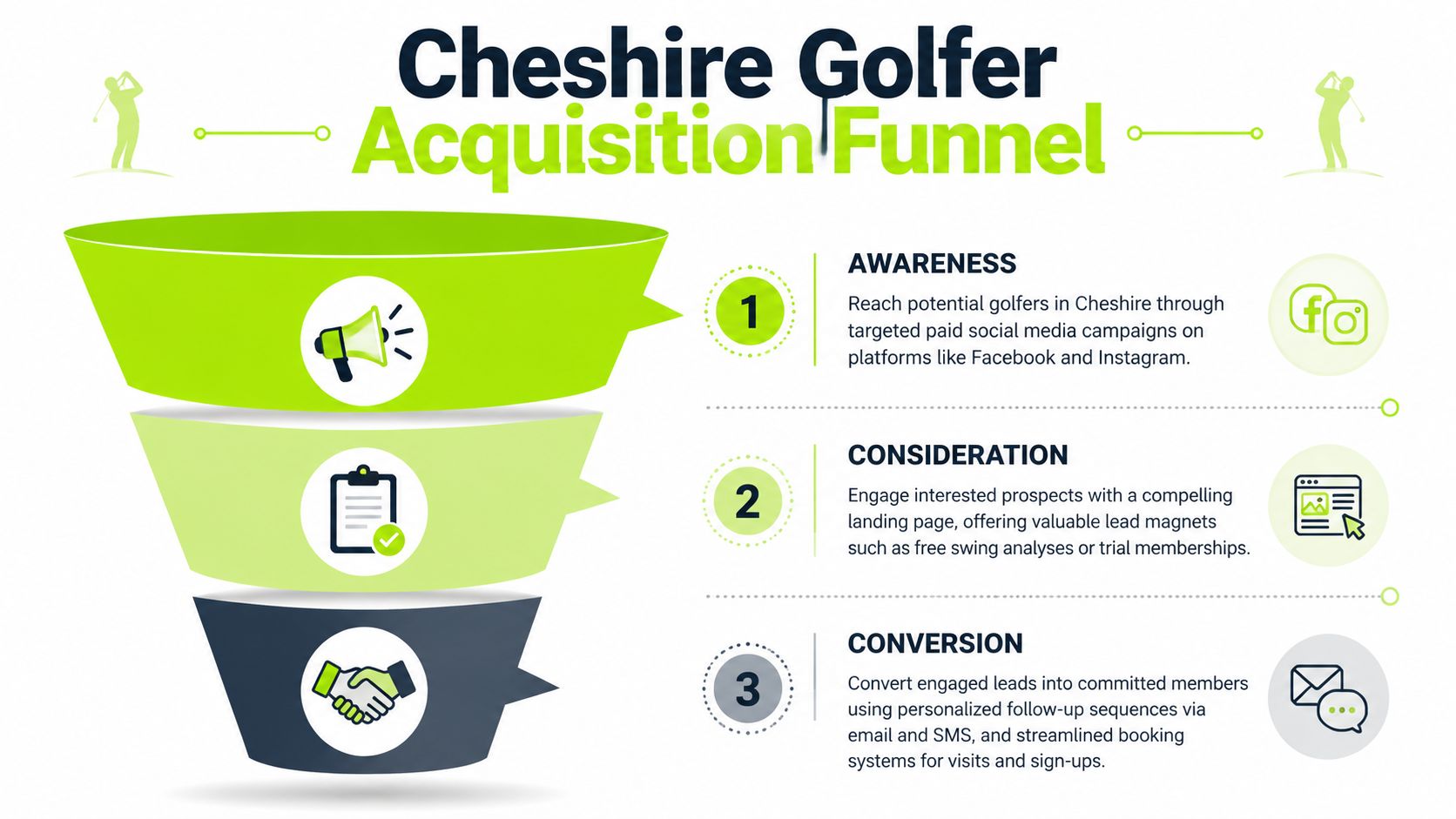
Local campaign performance improves when the audience definition gets narrower, not broader.
Too many clubs run ads aimed at “anyone interested in golf” across a wide radius. That approach burns budget and fills forms with weak intent. Better campaigns start with the type of golfer the club suits.
Start with segments, not adverts
According to Sport England's Active Lives Adult Survey, around 1.9 million adults in England played golf in the previous 12 months, giving clubs a real participation base to segment rather than relying on broad awareness, as noted in this golf participation summary.
That matters in Chester because one campaign rarely speaks to every prospect. A lapsed golfer in West Cheshire doesn't need the same message as a city-centre professional looking for flexible access.
Useful audience groups often include:
- Lapsed local golfers. They respond to convenience, ease of returning, and clear joining steps.
- Time-poor professionals. They care about access, pace, flexibility, and booking simplicity.
- Beginners or returners. They need reassurance, a welcoming tone, and a low-friction first step.
- Corporate prospects. They think in terms of hospitality, networking, and usable business value.
Match the message to the audience
Campaigns improve when the offer fits the prospect's actual concern.
A few examples:
| Audience | Better angle | Weak angle |
|---|---|---|
| Lapsed golfer | Return to regular golf without friction | “Join now for a limited deal” |
| Young professional | Flexible play that fits work and family life | Long heritage copy with no practical details |
| Corporate buyer | Relationship-building and client golf | Generic membership page |
| Beginner | Friendly first visit and clear next steps | Technical course language |
Paid social and paid search should work together. Meta can create local interest and generate enquiry forms. Google captures active intent when someone is already looking for membership or a course nearby.
For clubs wanting a practical breakdown, this resource on golf club Meta ads covers the mechanics of building audience-specific campaigns rather than relying on generic boosted posts.
What to avoid in Chester campaigns
The local market punishes lazy messaging. Don't lead with vague claims like “something for everyone” or “join our friendly club” unless the campaign gives specific proof.
Avoid these common errors:
- Sending traffic to the homepage. A campaign needs a focused landing page.
- Asking for too much too early. Start with a visit, trial, or information request.
- Using one creative for all audiences. Different segments need different reasons to enquire.
- Measuring clicks instead of quality. A cheap lead that never visits isn't progress.
Good campaigns don't attract the most people. They attract the right people and move them to the next step.
That's the difference between advertising activity and pipeline building.
Turning Enquiries into Members with Automated Systems
Most clubs already know how to generate interest. Fewer have a reliable mechanism for handling it.
Golf club marketing Chester often breaks down. The ad works. The form comes in. Then the club slips back into a manual process built around email inboxes, missed calls, sticky notes, and whoever happens to be on shift.

The manual model loses momentum
Take a simple scenario. A prospect submits a membership enquiry on Saturday evening after seeing a social advert. They're interested now.
If nobody responds until Monday afternoon, interest cools. If the reply is a generic email with a brochure attached, the club still hasn't qualified the lead. If no one follows up after that, the prospect moves on or forgets.
That isn't a staff effort issue. It's a systems issue.
A better process looks like this:
- Instant acknowledgement confirms the enquiry has been received.
- Qualification questions identify intent, timeline, and membership fit.
- Automated follow-up keeps the conversation moving until a human steps in.
- Central lead visibility lets staff see exactly where each prospect sits.
- Visit booking and reminders reduce drop-off before the club tour or trial.
Automation is no longer out of reach
There's still a belief in golf that automation is expensive, impersonal, or only realistic for large operators. That's increasingly outdated.
GCMA data notes that 31% of UK clubs piloted AI automation tools in 2025, with 78% achieving positive ROI within 6 months, and that location-based marketing increased inquiry conversion by 44% for UK clubs. The practical lesson isn't that every club needs complex software. It's that structured automation is becoming a normal operating layer for clubs that want faster response and cleaner conversion.
Some clubs also need help on the phone side, especially when front-of-house teams are stretched. A useful reference on fonea customer service automation gives a practical view of how small organisations can reduce missed-call friction without building a large support team.
The best automation doesn't replace staff. It protects leads until staff can have the right conversation at the right moment.
What a workable system actually includes
A CRM-led nurture setup doesn't need to feel technical from the club side. It needs to do four things well:
- Capture every enquiry in one place
- Show who has or hasn't been contacted
- Trigger timely follow-up automatically
- Track the journey from enquiry to visit to join
A system such as GolfRep's automated follow-up approach can be useful alongside other CRM and messaging tools, because it focuses on enquiry handling and pipeline visibility rather than advertising alone.
A key gain is consistency. Staff can still make the relationship personal. The system ensures no lead disappears because the office got busy, the manager was off-site, or the enquiry arrived at the wrong time.
Smart Pricing and Local Partnerships for Growth
Price strategy matters, but most clubs approach it too bluntly.
They either keep one rigid membership structure for everyone or they fall into discounting to create short-term movement. Neither approach is ideal in a market like Chester, where prospects compare value carefully and existing members notice quickly when pricing feels chaotic.
Protect value while widening access
A UK golf-club revenue-management trial reported that combining dynamic tee-sheet pricing, visitor-focused digital marketing, and benchmarking against UK-market KPIs increased green-fee sales by 32% in six months and web traffic by 43%, with the operator also tracking toward 35% annual visitor-revenue growth, according to this UK golf club revenue-management case study.
The lesson for Chester clubs isn't that every site should copy the same pricing model. It's that pricing can be used strategically without devaluing core membership.
Better options usually include a mix of:
- Flexible access products. Useful for younger professionals or irregular players who won't commit to traditional full membership immediately.
- Twilight or off-peak formats. These widen access while protecting prime-time member value.
- Corporate bundles. Strong for clubs near business hubs that want weekday use and hospitality alignment.
- Visitor incentives tied to booking behaviour. These can improve data capture and reduce phone friction without advertising a cheap brand.
Local partnerships create better-fit demand
The strongest growth channels often sit outside paid media.
A Chester club can create durable demand by building relevant local partnerships such as:
| Partner type | Opportunity | Why it works |
|---|---|---|
| Estate agents | New-resident welcome introductions | Timely offer when people are rebuilding routines |
| Hotels | Stay-and-play visitor pathways | Captures golfers already travelling into the area |
| Employers and business parks | Corporate golf access | Connects the club to business development and client use |
| Local coaches and golf instructors | Beginner pathways | Creates a structured route into membership |
Partnerships work best when they solve a real need. A hotel doesn't need a vague reciprocal arrangement. It needs a clear booking process and a reliable experience for guests. An estate agent needs a simple welcome proposition for movers, not a stack of leaflets.
This is the broader point. Growth is stronger when pricing, packaging, and partnerships support the club's positioning. That approach builds value. Discounting on its own usually weakens it.
Your 90-Day Growth Plan and Key Performance Metrics
Most clubs don't need another abstract strategy document. They need a short operating plan and a handful of numbers that tell the truth.
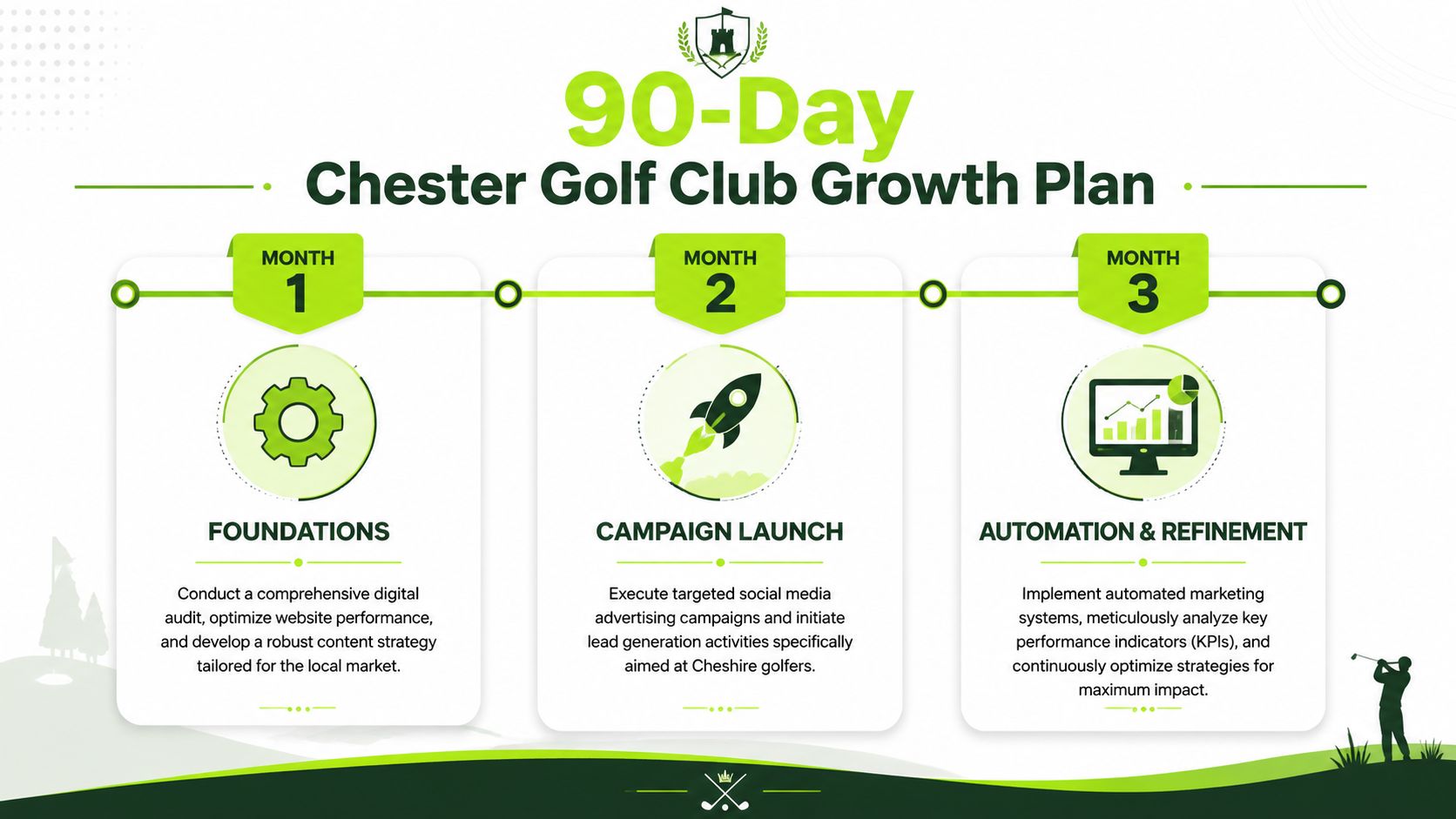
A good 90-day plan for golf club marketing Chester should tighten the system first, then launch campaigns, then refine based on what the data shows.
Days 1 to 30 set the foundations
Start by auditing the entire enquiry path.
Check where leads currently arrive, who owns responses, how visits are booked, what information is captured, and whether anyone can see conversion by source. Most clubs discover quickly that data sits in too many places and no one has a full picture.
Priorities in the first month:
- Audit digital touchpoints. Website forms, Google profile, social lead forms, email routes, and phone handling.
- Define target audiences. Don't market the same way to every golfer in the area.
- Set up a single lead view. One CRM or central tracking process is far better than fragmented spreadsheets.
- Clarify the visit offer. Prospects should know the next step and how to book it.
A club that also wants to sharpen internal operations may find this guide on optimizing golf club management useful, because better member growth depends on stronger operational follow-through.
Days 31 to 60 launch with structure
By this stage, campaigns can go live because the club has a better chance of converting what comes in.
Use focused paid search and paid social campaigns tied to specific landing pages. Turn on automated acknowledgement and follow-up. Make sure every enquiry receives the same standard of response whether it arrives midweek, on a Sunday, or during a busy competition day.
Track process metrics from day one:
| Metric | Why it matters |
|---|---|
| Enquiry source | Shows what is producing usable demand |
| Response status | Prevents lead neglect |
| Visit booked | Marks movement beyond casual interest |
| Visit attended | Shows whether reminders and qualification are working |
| Membership joined | Ties marketing to actual outcome |
Days 61 to 90 refine what works
Once the first wave of data is in, the next step is tightening quality.
UK golf-club marketing benchmarks suggest that a healthy club typically converts 8% to 12% of qualified inquiries into memberships, with natural attrition usually at 5% to 8%, according to these golf benchmarking standards. The same benchmark also points clubs toward 50% to 65% of weather-adjusted available tee times as a practical utilisation target.
Those numbers help clubs judge the system properly. If enquiry volume looks healthy but membership conversion is weak, the fault may sit in qualification, follow-up, on-site visit quality, or offer structure. If new joins are decent but net growth is flat, retention and member experience need attention.
Track fewer numbers, but track the ones that connect marketing activity to joined members and retained revenue.
For most clubs, the right KPI set is simple:
- Qualified enquiries
- Booked visits
- Visit attendance
- Membership conversions
- Attrition
- Tee-time utilisation
That's enough to make better decisions without drowning the team in reporting.
GolfRep helps golf clubs build predictable membership pipelines by combining lead generation with CRM tracking, automated follow-up, and clearer conversion visibility. If you want a practical view of where your current system is leaking enquiries, explore GolfRep.
Ready to tap into our proven growth system?