Golf Club Management Training for UK Clubs

72% of participants in the 2024/25 UK and Ireland club survey said some checks, audits, mandatory certificates or training weren't always up to date, according to the GCMA's safety and compliance report. That reframes golf club management training: the test isn't whether someone has attended a course, but whether they can keep the club under control.
At GolfRep, our view is that training should produce evidence of competence. A qualification matters, but so do the budget, staffing plan, compliance register and commercial decisions that show a manager can apply it.
Who Club Management Training Is For
20% of approximately 7,000 active PGA members in the UK and Ireland held management positions, roughly 1,400 professionals, according to a PGA survey reported by The Herald. The same report describes the diploma launched in 2016 by the PGA, British and International Golf Greenkeepers Association and Golf Club Managers' Association.
Those management roles vary. But consider a PGA professional moving from coaching and retail into running a private-members' club: their new responsibilities might include payroll decisions, committee reporting, membership categories and resolving disagreements about course access.
Golf knowledge gives them context. It doesn't automatically equip them to explain a budget variance or manage an employee's performance.
Match training to the actual job
Golf club management training is relevant to general managers, club managers and secretaries, owners and operators, commercial managers, PGA professionals and committee members. Indoor golf facility owners also need commercial and people-management competence, even though their operational environment differs.
Our guide to golf club managers explores the responsibilities behind the title. Before choosing training, ask:
- What does this person control? Separate their decisions from those reserved for the committee, owner or course manager.
- Where is competence missing? Look at membership, operations, finance, marketing and retention.
- What would prove improvement? Name a document, decision or operating result.
Practical rule: Choose training for the responsibility the manager must fulfil, not simply for the position they hope to hold.
A whole-club qualification, targeted CPD and technical course-management training solve different problems. Start by identifying which problem the club has.
Recognised Training Routes at a Glance
Recognised golf club management training routes
| Route | Who it suits | Entry requirement | Structure | Evidence to keep |
|---|---|---|---|---|
| GCMA Diploma in Golf Club Management | Managers and secretaries running the whole club | GCMA Associate Membership to enrol | Three Level 5 certificates within 18 months | Certificates and CPD log |
| GCMA accreditation Level 1 | People already in a management role | At least 1 year of experience | 40 CPD points on application and renewal | Accreditation record |
| GCMA accreditation Level 2 | Effective managers of a small or medium club | Normally at least 3 years of experience | 80 CPD points on application, 40 per renewal year | Accreditation record |
| GCMA accreditation Level 3 | Highly proficient managers of medium or larger clubs | Normally at least 5 years of experience | 100 CPD points initially, 40 per renewal year | Accreditation record |
| Golf Course Manager apprenticeship | Course managers and greenkeeping supervisors | Level 3 greenkeeping or equivalent plus supervisory experience | Minimum 36 months in the workplace | Workplace evidence and assessment |
| GCMA advanced management programme courses | Experienced managers seeking focused CPD | Check the individual course's stated eligibility | Short courses | CPD record towards renewal |
The diploma and accreditation entries are drawn from the GCMA Diploma in Golf Club Management and the GCMA accreditation criteria. For the apprenticeship, the Skills England occupational standard specifies the minimum 36-month benchmark and the usual technical and supervisory foundations.
The table combines education, professional recognition and workplace development. They work in different ways. A diploma develops breadth, accreditation recognises professional standing, and an apprenticeship develops competence in a defined occupation. Treat a certificate as one piece of evidence, then ask what club document or commercial result shows the learning has been applied.
Check the purpose before booking
Use shorter courses to address a specific weakness, such as chairing difficult meetings or interpreting financial reports. The GCMA's professional-development update describes advanced management opportunities, but course satisfaction isn't evidence that a particular programme will solve your club's problem.
- For breadth: Consider structured whole-club learning.
- For maintained competence: Build a relevant CPD plan.
- For technical leadership: Use the course-management pathway.
Keep workplace evidence alongside every certificate. A budget variance note, an accreditation record or an assessment file gives the training a practical test. It shows what the manager can do with the learning, not just what they attended.
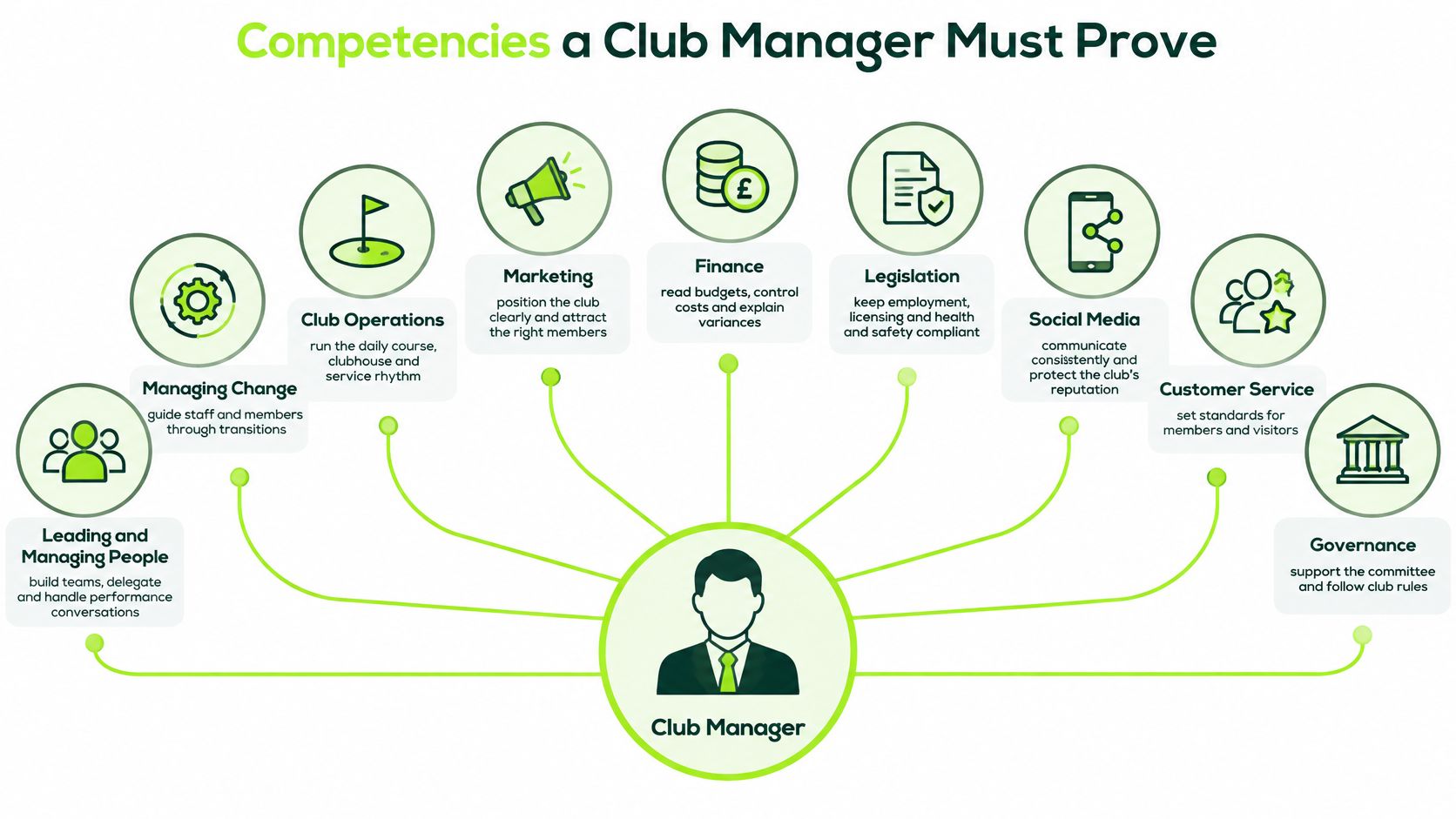
Competencies a Club Manager Must Prove
Golf club management competencies and the evidence to ask for
| Domain | What training should build | Evidence to review |
|---|---|---|
| Leading and managing people | Supervision, standards and accountability | Staffing plan and review notes |
| Managing change | How decisions are introduced and followed through | Written change log for a live project |
| Club operations | Day-to-day control of the clubhouse, course interface and standards | Operations calendar and issue log |
| Marketing | How the club reaches the right golfers and groups | Plan linked to a named revenue line |
| Finance | Budgets, pricing effects and reporting | Annual budget and variance note |
| Legislation | Safety, employment and compliance duties | Compliance register with review dates |
| Social responsibility | Community, environmental and ethical duties | A current action with an owner |
| Innovation and growth | A measured improvement, not a slogan | Documented project with a before-and-after measure |
| Personal and entrepreneurial skills | Judgement, communication and ownership | Personal development record and CPD log |
These are the nine management areas in the GCMA Diploma in Golf Club Management, awarded through Associated Sports Qualifications after three Level 5 certificates, which candidates can complete within 18 months, with at least Associate Membership of the GCMA required for enrolment.
The evidence column is our recommended appraisal framework, not an additional qualification requirement. Its purpose is to turn course subjects into things a committee can inspect.
Read the documents together
Start with the staffing plan. Can the manager explain who covers busy periods, who deputises and how service standards are checked? Review notes should demonstrate supervision, not just confirm that a conversation happened.
Then examine a live change project and the operations calendar. A revised competition-booking process, for example, needs member communication, staff instructions, a launch decision and a way to record problems.
Marketing and finance belong beside each other. A visitor campaign might generate bookings but still disappoint commercially if the package leaves insufficient contribution after catering and staffing, or displaces more valuable tee times.
The compliance register should identify responsibilities and review dates. Social responsibility needs a real action, such as an agreed environmental or community initiative, rather than a broad statement on the website.
For innovation and personal development, ask what the manager changed and what they learned. A project write-up should acknowledge an unsuccessful test as readily as a successful one.
Assess application, not confidence
The VideoLearningAI competency training guide is a useful companion for understanding how to structure learning around demonstrated capability. In a club appraisal, use that principle to distinguish someone who can describe a process from someone who can run it.
For committee members, narrow the development requirement to their responsibilities: governance, chairing and strategic planning. They don't all need the manager's full curriculum, but they do need to understand delegated authority and how to scrutinise performance without taking over daily operations.
A polished presentation isn't proof of control. Ask the manager to explain a decision using the document they actually work from.
Mark each domain red, amber or green. Red means the manager needs support to perform it reliably; amber means they can do it with supervision; green means they can demonstrate consistent independent practice.
Qualifications and CPD Levels by Role
GCMA accreditation levels and CPD points
| Level | Who it is for | Usual experience | CPD on application | CPD each renewal year |
|---|---|---|---|---|
| Level 1 | People already in a management role | At least 1 year | 40 points | 40 points |
| Level 2 | Effective managers of a small or medium club | Normally at least 3 years | 80 points | 40 points |
| Level 3 | Highly proficient managers of a medium or larger club | Normally at least 5 years | 100 points | 40 points |
The GCMA accreditation criteria specify these experience and application thresholds, with 40 CPD points required per 12-month renewal cycle for the listed levels. Experience is part of the framework, not a substitute for demonstrating the required management capability.
A qualification records completed learning. Accreditation and continuing professional development provide a framework for maintaining professional standing as responsibilities change.
Match the level to the post
A newly appointed secretary might use entry-level accreditation as a development target once eligible, alongside beginning diploma study. Their immediate evidence could include accurate committee papers, a working compliance calendar and a clear understanding of who can authorise expenditure.
They shouldn't be expected to acquire every skill simultaneously. The chair and secretary should agree which responsibilities need supervision while learning is under way.
An established manager of a small or medium club needs a different conversation. If they already control budgets and staffing, introductory management training may add little; targeted learning on financial forecasting, employment matters or change management could be more useful.
Their development review should test judgement. Can they explain why subscriptions are behind budget, distinguish a timing issue from a recurring shortfall, and propose a proportionate response?
A highly proficient manager at a larger club should be assessed against complexity, not just tenure. For a resort or group role, useful evidence might include consistent reporting across departments or sites, documented delegation and decisions about competing uses of capacity.
A larger job title doesn't automatically establish eligibility for a higher accreditation level. Match the published criteria to the person's demonstrated work.
Build a relevant CPD record
Shorter advanced management programmes can contribute to ongoing development, subject to the relevant course recognition and accreditation rules. They shouldn't stand in for broad management education where the person is missing much of the operating model.
Keep a CPD log that records more than attendance:
- Learning need: The responsibility the activity was intended to improve.
- Application: What the manager changed afterwards.
- Evidence: The report, process or decision that demonstrates it.
- Next action: Any weakness that still needs support.
Prioritise red domains, then address amber areas that carry significant risk. Green areas still need maintenance when legislation, systems or the manager's responsibilities change.
The aim isn't to collect unrelated learning activities. It's to maintain a manager whose competence matches the club they are employed to run.
Course Manager Training Versus Club Leadership
The Golf Course Manager apprenticeship typically requires a minimum of 36 months to reach full competence, according to the Skills England apprenticeship standard. Its usual entry profile includes a Level 3 greenkeeping qualification or equivalent, supervisory experience, recommended Level 1 ICT, and generally GCSE grade C or above in English and mathematics, with employers ensuring Level 2 English and maths where that threshold hasn't been met.
This is a course-management occupation, not a whole-club general-management qualification. The distinction matters when a committee chooses development for a head greenkeeper, course manager or aspiring general manager.

Assess technical leadership in stages
Course decisions combine agronomy with labour, machinery, safety, environmental responsibilities and cost. Someone can understand turf exceptionally well while needing development in procurement, digital records or explaining resource requirements to a committee.
Use staged workplace checks alongside the formal programme:
- Confirm foundations. Review technical competence and supervision through work allocation, briefings and responses to changing course conditions.
- Test operational control. Examine budget monitoring, procurement decisions, machinery planning, work orders and compliance records.
- Require an improvement project. Assess a documented attempt to reduce irrigation use, machinery downtime or overtime while preserving agreed playing-quality standards.
Quarterly reviews are a practical coaching rhythm. They don't replace the apprenticeship's formal assessments or turn this checklist into a qualification.
Judge the trade-off, not just the saving
Suppose a course manager proposes changing machinery maintenance schedules. The committee should ask how the proposal affects servicing costs, equipment availability and the ability to complete essential work during suitable weather.
A lower maintenance bill isn't automatically a better result if breakdowns interrupt preparation. Equally, an additional purchase needs a reasoned case rather than an appeal to course quality without supporting records.
Our guide to maintenance of golf courses provides further operational context. For training purposes, the manager should be able to connect the maintenance plan to staffing, available resources and the playing conditions the club has agreed to deliver.
Assessment question: Can the course manager explain both the agronomic reason for a decision and its operational consequences?
A general manager needs enough understanding to challenge and support that work intelligently. They still need separate competence in governance, commercial decisions and membership management; greenkeeping credentials alone don't demonstrate readiness to lead the whole club.
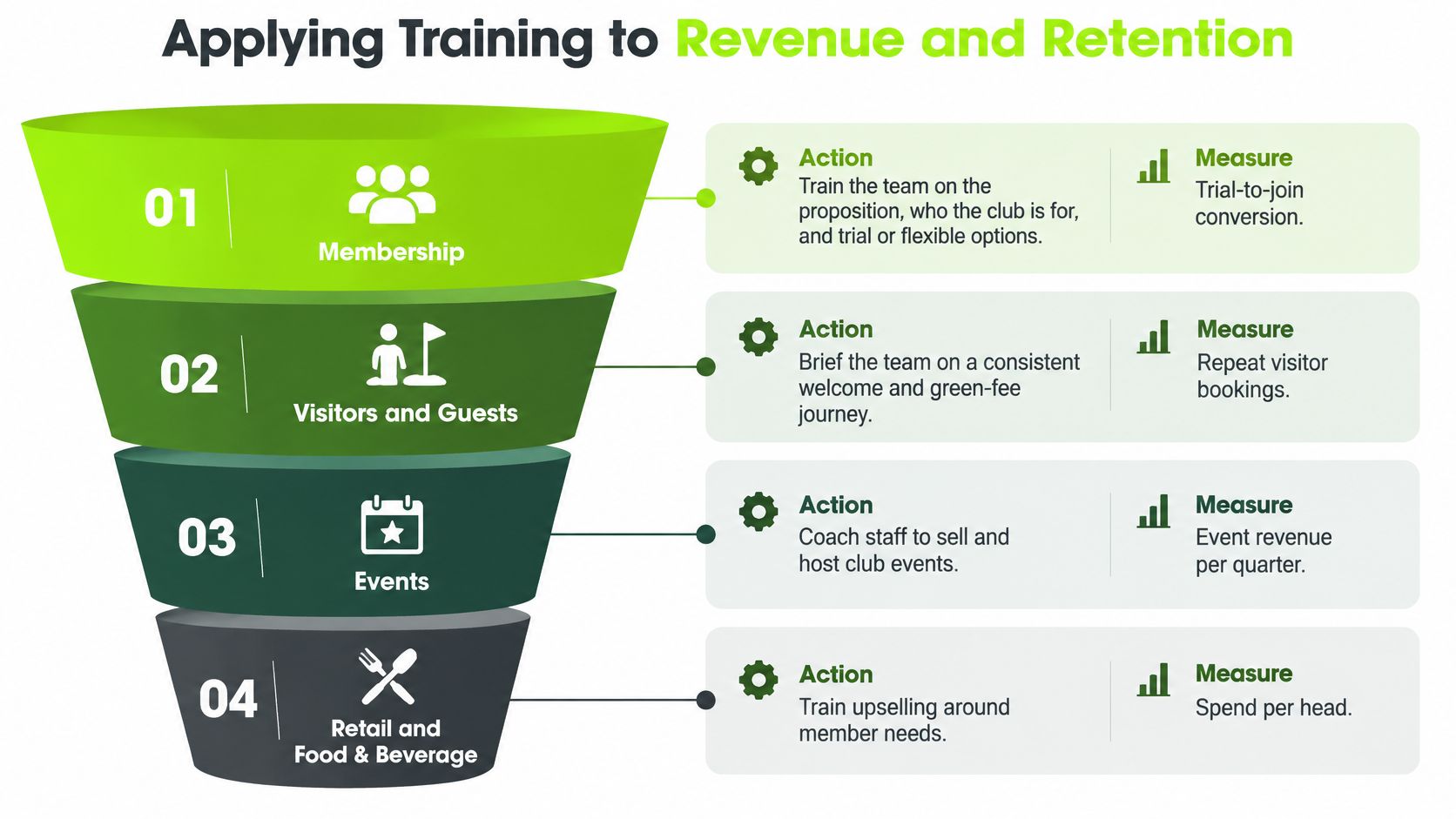
Applying Training to Revenue and Retention
A certificate shows someone attended a course. Commercial value shows up when staff practise a defined routine, produce the records that routine requires and let a manager review the outcome. Treat membership, operations, marketing and retention as four separate applications, because a generic customer-service session will not cover any of them properly.
The GCMA's membership-strategy guidance stresses consistent enquiry follow-up and structured onboarding. The practical task for the club is to decide who does what, what gets recorded and when a manager steps in.
Membership and operations
Membership training should clarify the proposition. Staff need to explain who the club suits, how the categories differ and whether a trial or flexible option fits the golfer in front of them.
Give onboarding a named owner and a written contact plan. Measure visit-to-join performance and retention at the 90-day mark, as GolfRep recommends, rather than treating enquiry volume as the outcome.
Operations needs a different exercise. Turn the legislation and people-management learning into a live compliance register and staffing plan, then practise what happens when a check is overdue or the responsible person is away.
- Action: Record each obligation, owner, review date and evidence location.
- Measure: Review overdue actions and unresolved staffing gaps, with named responsibility for closing them.
A diary reminder leaves no proof a task happened. The manager needs the supporting certificate, inspection record or documented action.
Marketing and retention
For marketing, ask the trainee to build a campaign around a named revenue line. A midweek society package needs a different audience, booking process and capacity decision from a membership open day, so the plan should show which of those the club is selling.
Then follow the money. Track each source through to paid business in the club's CRM or booking records, because revenue by source tells a manager far more than a list of clicks. Read it alongside delivery costs and the tee times or clubhouse capacity the campaign consumed.
Retention training should help staff recognise disengagement without jumping to conclusions. Low playing frequency might reflect injury, work commitments or dissatisfaction, and each situation needs a different conversation. Use member usage to guide contact, start renewal conversations well before membership lapses and keep a short win-back list for recent leavers. Our guide to golf club customer retention develops the member-experience side of this work.
Keep the review manageable
GolfRep recommends reviewing stage-by-stage conversion, speed-to-lead, visit-to-join performance, source-level revenue and retention at the 90-day mark. Define each measure the same way every time, including who belongs in the relevant joining cohort, or the figures will shift with whoever compiles them.
Automate the acknowledgements, booking prompts and renewal reminders where appropriate. Keep the personal conversation for membership fit, questions about the course and specific concerns. An automated message can confirm that a visit request arrived; a trained member of staff should still discuss whether the available playing access suits that golfer.
That split is the discipline in miniature. Software records and reminds. Trained people judge and reassure.
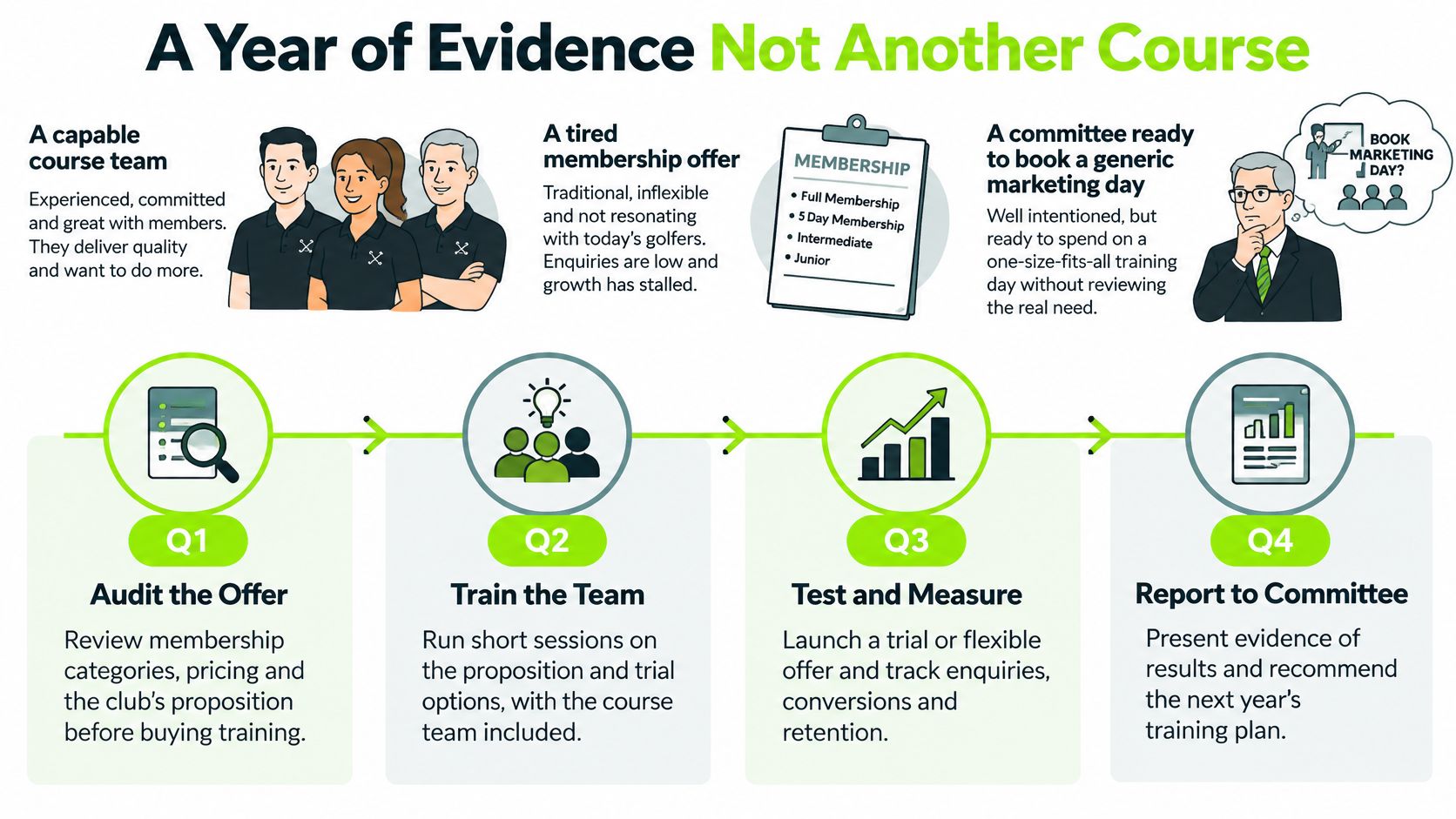
A Year of Evidence Not Another Course
Say a members' club has a capable course team, a tired membership offer and a committee ready to book a generic marketing day. The secretary brings a competency map to the meeting instead.
It shows sound operational control but weak commercial reporting and inconsistent membership conversations. The committee agrees a development plan tied to live work, rather than sending everyone on whichever course happens to be available.
Diagnose before changing the offer
In the opening quarter, the secretary updates the compliance register, reconciles joiners and leavers, and checks where visitor and society revenue comes from. They review membership categories, access restrictions and the reasons golfers give for declining to join.
The important discovery might be an unclear proposition rather than an unattractive price. Before recommending a discount, the secretary needs to establish whether staff can explain the existing offer consistently.
During the next quarter, the club runs a focused improvement project: rewrite the membership conversation and the initial onboarding contact plan. The membership lead owns delivery, and the secretary reviews visit-to-join performance monthly.
The training is specific. Staff practise explaining categories, discussing playing access and recording reasons for a decision, rather than memorising a sales script.
Extend the discipline, then appraise it
In the third quarter, the manager applies the same discipline to an existing non-membership line, such as midweek societies. The team agrees the package, deposit process, organiser contact and rebooking date.
They don't assume membership training transfers automatically. Society organisers need clear coordination of golf, catering and payment, so the project tests those handovers.
The final quarter is an appraisal of evidence. The committee asks which documents are now usable, what relevant CPD has been recorded and which commercial or operational constraint has changed.
A result needs interpretation. Better conversion with fewer suitable visits might still leave revenue short; stronger revenue accompanied by excessive delivery costs might require a pricing review.
For an indoor facility, replace agronomy-related development with bay utilisation, league retention and off-peak occupancy. Keep the same requirement for quarterly evidence and an accountable project owner.
The minimum annual file should contain:
- Annual budget: Including explanations of material differences from plan.
- Staffing plan: Showing responsibility, cover and development needs.
- Compliance register: With current evidence and review dates.
- Membership-retention note: Recording patterns and agreed responses.
- Project write-up: Stating the starting problem, action, result and next decision.
Sending the head professional, steward and secretary on unrelated short courses doesn't create a management programme. The justification for training spend is a demonstrable change in work the committee already needs to oversee.
Choose the Next Training Priority
The best next course is the one that addresses an important responsibility the manager can't yet fulfil reliably. It might be finance, people management or governance, even when the committee's immediate concern is membership income.
If the weakness is broad management competence, choose the relevant diploma learning and an accreditation ambition that matches the role and experience. If it's technical course leadership, use the occupational pathway and workplace assessment, not a sales course.
Write the decision on a page
Before approving expenditure, give the committee a short brief containing:
- The red domain: What the manager needs to do better.
- The person: Who will learn and who will support them.
- The format: Structured qualification, targeted CPD or workplace development.
- The evidence: The document or operating routine that will change.
- The review: The business measure and agreed review date.
For a commercial constraint, choose a practical review window and train the routine before increasing activity. That could mean improving society rebooking, membership visits or renewal conversations.
Demand still matters. A well-run process with insufficient demand won't deliver growth, while promotion without delivery capacity or clear ownership can waste expenditure.
The choice is therefore between management capability, technical course competence and commercial execution. Identify the current constraint, improve it, measure the effect and then decide what deserves attention next.
Let the certificate support that work, rather than stand in for it.
GolfRep helps golf clubs connect acquisition, sales processes, CRM, follow-up and retention to measurable commercial performance. Visit GolfRep to arrange an open strategic conversation about your current setup, goals and challenges, not a sales pitch, and map what a growth system would need to cover alongside your team's training priorities.
Ready to tap into our proven growth system?