Golf club managers: 2026 Guide to Leadership & Growth

The days of a golf club manager’s job being solely about smooth-running tee times and a well-stocked bar are long gone. Simply overseeing daily operations is no longer enough. Modern leadership requires a sharp focus on building sustainable growth and securing the club's long-term financial health.
The Evolving Role of the Modern Golf Club Manager

The traditional picture of a manager, focused purely on the condition of the course and the quality of the catering, is quickly becoming a relic. Today, you are the strategic hub of your club's entire business, responsible for balancing its cherished heritage with the harsh realities of a competitive leisure market. You're not just a manager; you are the chief architect of your club's future.
Your duties have broadened well beyond the clubhouse walls. They now demand a sophisticated approach to financial forecasting, membership development, and creating predictable revenue. This guide has been put together for ambitious golf club managers, secretaries, and forward-thinking committee members who see this change and are ready to build a more resilient and profitable club.
The Real Challenge Facing Modern Clubs
Many clubs believe their biggest problem is a dip in local interest or a shortage of potential members. From our experience working with clubs across the UK, this is almost never the real issue. The true challenge isn't generating new enquiries. It's having the right process to handle, respond to, and convert them into paying members.
The greatest risk to a club's growth isn't a quiet phone, but a disorganised response to a ringing one. When leads are missed, delayed, or forgotten, potential revenue simply vanishes.
This problem usually comes down to a reliance on outdated, manual systems. An enquiry lands from a web form, gets passed to a general inbox, and then sits there, waiting for someone to find a spare moment to reply. This slow, disjointed approach creates a "leaky bucket," where valuable leads are lost before you’ve even had a chance to show them what your club has to offer.
Systems Over Manual Effort
To get ahead, today's golf club managers must shift from inconsistent, manual methods to structured, repeatable systems. A systematic approach guarantees every single enquiry is captured, responded to instantly, and nurtured professionally from start to finish. This isn't about replacing people; it's about giving your team the tools to work smarter, ensuring absolute efficiency and clear oversight of your entire membership pipeline.
This structured way of working is built on a few key concepts that we'll dive into throughout this guide:
- Enquiry Response Time: How quickly your team makes contact with a new lead. This is a critical first impression that heavily influences conversion.
- Lead Visibility: The power to see and track every potential member’s journey, from their first click on your website to the day they sign up.
- Conversion Tracking: Actually measuring how many enquiries lead to a club tour, and how many of those tours turn into new members.
By putting proper follow-up processes and a robust CRM in place, you can build a predictable pipeline of new members. You'll be turning sporadic interest into a reliable stream of revenue. This guide will give you the practical insight you need to make that change happen.
Defining Key Responsibilities and Performance Metrics
The role of a golf club manager has changed. It's no longer just about keeping the doors open and the course in good shape. Today, it’s about strategic leadership across several distinct, yet deeply connected, parts of the business. The best managers think in terms of strategic pillars and measure what truly matters.
At GolfRep, we find it’s helpful to break the job down into four core areas: Financial Oversight, Membership Growth, Operational Excellence, and Governance. But simply knowing these areas isn't enough. The real shift happens when you attach the right Key Performance Indicators (KPIs) to each one, turning vague goals into hard data that proves your value and builds a case for smart investment.
The Four Pillars of Club Management
Think of your club as a four-legged stool. If one leg is weak, the whole thing becomes wobbly. A great manager knows how to keep all four balanced and strong.
- Financial Oversight: This is far more than just bookkeeping. It’s about steering the ship with strategic budgeting, smart cash flow management, and making sound investment decisions that secure the club’s future for years to come.
- Membership Growth: The absolute lifeblood of any club. This pillar covers everything from attracting that first phone call or email to making sure your long-standing members feel valued. At its heart, this is about building a predictable sales pipeline.
- Operational Excellence: This is the day-to-day magic. It’s the condition of the greens, the service in the clubhouse, the stock in the pro shop, and every little detail that adds up to an outstanding member experience.
- Governance and Compliance: This involves managing your relationship with the committee, staying on top of regulations, and being the ultimate guardian of the club’s constitution and character.
While they're all crucial, your ability to drive membership growth is what fuels the other three pillars. A healthy, growing membership base generates the revenue you need to invest in the course, upgrade facilities, and run a first-class operation.
Moving from Vanity Metrics to Actionable KPIs
Too many clubs get caught up tracking numbers that look good on a report but don’t actually tell you anything useful. Things like website visitors or social media likes are often just "vanity metrics" that feel good but don’t pay the bills. A modern manager needs to zero in on the KPIs that are directly wired to revenue and growth.
This is where you need a proper system. Your focus has to be on measuring how efficiently your membership pipeline is working from start to finish.
The most successful golf club managers are not the ones who generate the most enquiries, but the ones who convert the highest percentage of them. Success is measured in the system, not just the initial interest.
Start tracking these actionable KPIs to get a true reading of your growth engine's health:
- Enquiry Response Time: How long does it take for a new lead to get a personal reply? We’re talking minutes, not hours. Any delay here is the number one reason potential members go elsewhere.
- Enquiry-to-Visit Conversion Rate: Of all the qualified people who get in touch, what percentage actually book and turn up for a tour of the club? This tells you how effective your initial follow-up really is.
- Visit-to-Member Conversion Rate: Out of everyone who tours the facility, how many actually sign on the dotted line? This KPI is a direct reflection of your sales process and how well you present the club's value.
- Total Pipeline Value: What is the total potential annual revenue of all the active leads in your system right now? This gives you a clear forecast of future income. You can dig deeper into this by exploring the real ROI of golf club marketing.
Knowing these numbers gives you a powerful, data-driven story to tell, a world away from the often modest compensation seen in the industry. For example, the average salary for a UK golf club manager sits around £30,253, with top earners hitting about £44,000. You can see more about compensation trends for golf club managers and understand the financial context.
With that kind of pressure, you have to prove your worth with results, not just good intentions. By tracking and improving these KPIs, you build an undeniable case for your strategic importance and justify every penny you ask for to invest in growth.
Navigating the Common Headaches of Club Management
If you’re a golf club manager, you know the role is full of unique pressures. It’s a constant balancing act, from navigating tricky committee dynamics and club politics to the endless struggle for capital to upgrade facilities. These aren't just minor operational bumps; they are persistent hurdles that can genuinely shape the future of your club.
Many managers we speak with feel stuck in the middle. On one side, you have the clear, pressing need to modernise. On the other, a board or committee that prefers the familiar comfort of "how we've always done things." This attachment to anecdote over actual data creates a kind of strategic paralysis, making it incredibly difficult to move the club forwards.
The Real Cost of Underinvestment
One of the most damaging results of this inertia is chronic underinvestment. When tradition trumps strategy, proposing the necessary funding for a clubhouse refurbishment or new technology can feel like an impossible task. This isn't just a hypothetical problem; it’s a reality that's squeezing the financial health of clubs all over the country.
In fact, research shows a staggering 55% of clubs in Great Britain invest less than £50,000 a year into their facilities. With many clubhouses being over a century old and running costs climbing, that sum barely scratches the surface. It might cover essential maintenance, but it leaves nothing for the kind of meaningful improvements that actually attract and keep members. A closer look at the financial health of UK golf clubs shows just how serious a competitive disadvantage this creates.
Are You an 'Ostrich' Club?
This environment has created distinct "personas" for clubs based on how they approach the future. We’ve seen proactive 'Lion' clubs who plan for the long term and well-intentioned 'Meerkats' who see the dangers but struggle to act.
Then there are the 'Ostrich' clubs, which are most at risk.
An 'Ostrich' club is one that buries its head in the sand. It’s defined by a resistance to change, a reliance on anecdotal stories instead of data, and a governance structure that stifles any real progress. The direct results are ageing assets and a long list of missed opportunities.
These clubs often have a governance structure that isn't fit for purpose. Data from Custodian Golf suggests that 40% of boards are run by volunteers, and an incredible 69% have no formal performance reviews for their management teams. If you’re a golf club manager in that situation, you know how hard it is to drive change. You see what needs to be done but are held back by a culture that values tradition more than sustainability.
To help you pinpoint where your club stands, we've developed a simple framework based on our work with UK clubs. Think of it as a health check for your club's strategic mindset.
Club Personas and Their Strategic Health
Identifying your club's persona is the first step. If you recognise the traits of an 'Ostrich' or 'Meerkat', it's a clear signal that the underlying structures need attention before any meaningful growth strategy can take root.
The Hidden Drain of Manual Processes
The financial strain is made so much worse by a reliance on outdated, manual processes, especially for something as vital as membership sales. When your club doesn't have a structured system for handling new enquiries, the true cost is measured in lost revenue. Every lead that gets a slow response or is lost in a cluttered spreadsheet is a potential member walking away.
Think about all the time your team wastes manually chasing emails, updating spreadsheets, and trying to remember who they last spoke to. This isn't just inefficient; it's completely untrackable. It gives you zero insight into your membership pipeline, leaving you unable to answer the most basic questions:
- How many membership enquiries did we get last month?
- How long did it take us to respond to them?
- What percentage of those enquiries led to a club tour?
- And how many of those tours actually converted into a new member?
Without these answers, you’re flying blind. You're left guessing what's working and what isn't, unable to make informed decisions to improve your club's performance. This is the knot that ties so many clubs up. The daily operational firefights and the bigger strategic challenges are all connected. The only way to untie it is to move away from guesswork and embrace a more systematic, data-led approach to growth.
Building a Predictable Membership Growth Engine
If you’ve ever felt the frustration of committee inertia or been buried under manual admin, it’s time to build a system that finally puts you in control. A predictable membership growth engine isn’t a complex machine; it’s simply a structured process that turns sporadic local interest into a steady, reliable stream of new members. It’s about taking command of your club’s financial future.
For too long, many clubs have operated on a strategy of hope. They hope the phone rings, hope the right person answers, and hope that person remembers to follow up. This creates a classic "leaky bucket," where valuable leads, each representing thousands of pounds in potential lifetime value, slip through the cracks due to slow responses or a disorganised follow-up. A proper growth system is designed to plug those leaks for good.
The process of decline for clubs without a system is sadly predictable. The flowchart below shows just how quickly strategic inertia leads to stagnation and, eventually, a noticeable drop in both membership and revenue.
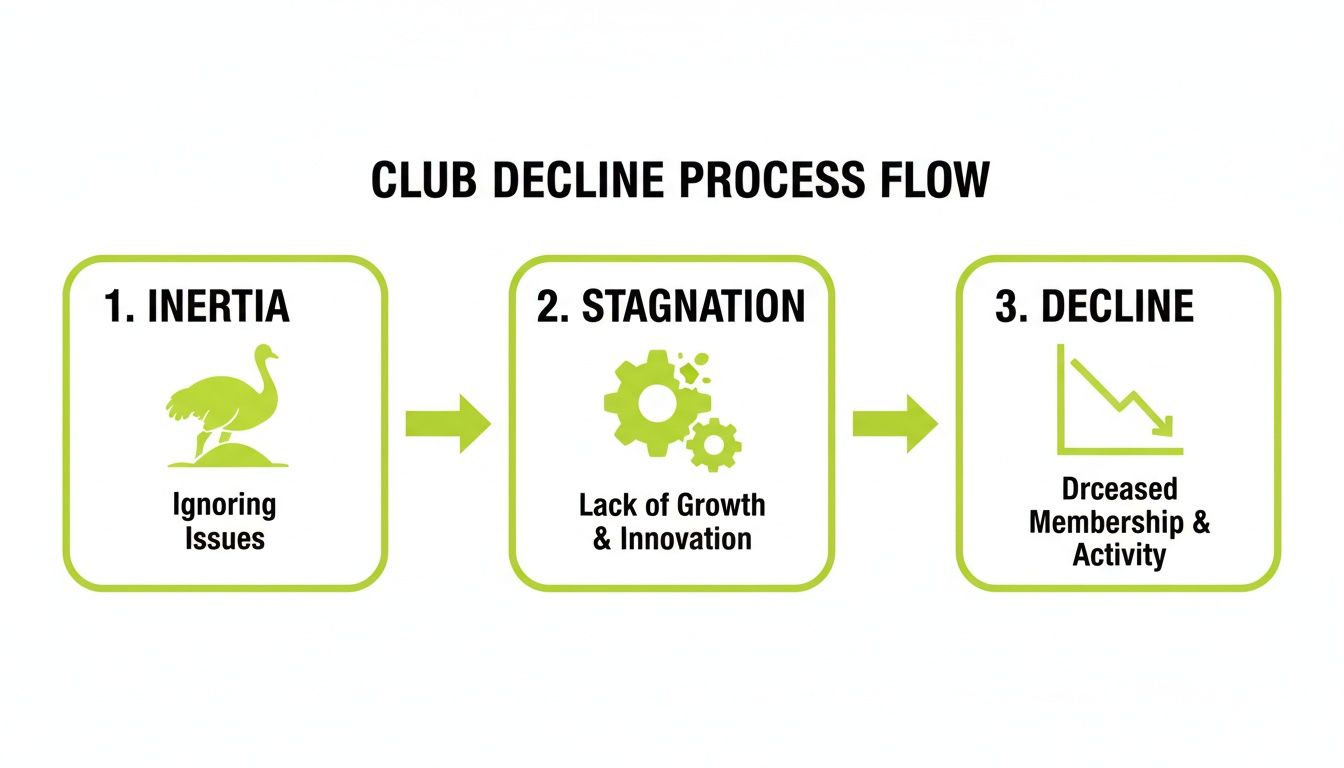
As you can see, the path from having an "Ostrich" mindset to genuine decline is a short one. It highlights why a proactive, systematic approach isn't a luxury for today’s golf club managers; it’s an absolute necessity.
The Three Essential Components of Growth
A modern growth system is built on three core pillars working in harmony. At GolfRep, we combine them to create a dependable pipeline that captures, qualifies, and converts potential members with maximum efficiency, giving you complete visibility over the entire journey.
- Data-Led Advertising: This is all about attracting the right people. Forget generic ads; this means targeting high-value local golfers with precision, whether they're independent players looking for a home club or even members of rival clubs.
- 24/7 Automated Qualification: Here’s your answer to missed opportunities. When an enquiry comes in, day or night, an automated system responds instantly to qualify the lead and gather key information. No potential member is ever left waiting.
- CRM-Powered Nurturing: Think of this as your organised follow-up machine. Once a lead is qualified, they enter a structured communication sequence inside a Customer Relationship Management (CRM) system, guiding them professionally towards booking a visit to your club.
This three-part structure directly solves the biggest headaches we've discussed. It removes the risk of human error, ensures every single lead is treated with urgency, and frees up your staff to focus on what they do best: giving prospective members a brilliant experience during their club tour.
Why Enquiry Response Time Is Everything
If there's one metric that trumps all others in this engine, it's enquiry response time. Just think about your own behaviour. If you enquire about a service and don't hear back quickly, you simply move on to the next provider. Potential golf members are no different.
A slow response is often seen as a sign of poor service. Responding within minutes, not hours, dramatically increases the chances of converting an enquiry into a booked tour. It is the first and most important impression your club makes.
Manual systems make this almost impossible to achieve consistently. An email might sit in an inbox over a weekend, or a phone message might not get passed to the right person. An automated system solves this problem instantly. It captures the lead's details and starts the conversation immediately, establishing your club as responsive and professional from the very first touchpoint. For more on this, you can explore our detailed guide on proven golf club growth strategies.
Gaining True Lead Visibility
The second major failure of most manual processes is the complete lack of visibility. A spreadsheet or a cluttered inbox can’t tell you where a lead is in the journey, what their potential value is, or when they were last contacted. You’re essentially flying blind.
A CRM-powered system, on the other hand, gives you a clear dashboard showing every active lead in your pipeline. For any individual, you can instantly see:
- Where they came from (e.g., Facebook ad, website form).
- Every communication they have received.
- Their current status (e.g., 'new enquiry', 'tour booked', 'decision pending').
- The exact date of their last interaction.
This level of lead visibility is a game-changer. It allows you, as a manager, to see the health of your future revenue at a glance. It also holds the entire process accountable, ensuring that structured follow-ups happen on time, every time, without relying on guesswork or memory. This is the difference between simply reacting and truly leading strategic growth.
Leveraging Data and Automation for Club Success

As a golf club manager, you’re already sitting on a goldmine of information. The real trick is learning how to turn that raw data into a measurable increase in membership sales and revenue. This isn’t about needing a degree in data science; it’s about using the right tools to make smarter, faster decisions that fuel your club's growth.
Data from the World Handicap System (WHS), for example, offers a brilliant starting point. It gives you a clear picture of the golfing population in your area, moving you away from guesswork and towards identifying genuine opportunities for your club. You can pinpoint specific groups, like independent golfers searching for a home club or younger players in the 30-50 age bracket, and create targeted offers that actually speak to them.
This data-led approach is no longer a 'nice-to-have'. With 1,735 affiliated golf clubs across England, competition is stiff. Recent figures show the average member age has dropped from 56.18 to 54.99, a sign that efforts to attract a younger demographic are paying off. But with over 11.83 million WHS scores posted in England just last year, how do you manage that interest without becoming completely overwhelmed? As you can learn from England Golf's data, using these insights to stand out is now essential.
Automation as a Performance Multiplier
This is where automation steps in. Think of it not as a replacement for your team, but as an incredibly efficient assistant that handles the repetitive, time-consuming tasks with perfect precision. It ensures those crucial first steps in your membership sales process are handled flawlessly, every single time.
Imagine it as your digital front-of-house. When a potential new member fills out an enquiry form on your website at 10 PM on a Saturday, an automated system can respond instantly. It can thank them for their interest, send over the membership brochure, and even ask a couple of qualifying questions to get the ball rolling. That immediate contact makes a fantastic first impression and stops that lead from looking elsewhere.
Automation isn't about removing the human touch; it's about enhancing it. By handling the initial, repetitive tasks with perfect consistency, it frees up your valuable team members to focus on high-impact activities like delivering fantastic club tours and building personal relationships.
This kind of system guarantees no enquiry ever falls through the cracks and every follow-up happens right on schedule. It turns your membership pipeline from a source of administrative headache into a well-organised, highly visible asset for the club.
Manual Enquiry Handling vs an Automated System
The difference between a manual process and a systemised one is night and day. A manual approach, still common in many clubs, is prone to delays, human error, and missed opportunities. An automated system, on the other hand, is built for speed, consistency, and complete transparency.
This table gives you a clear, side-by-side look at how much of a difference systemising your enquiry handling can make.
Manual Enquiry Handling vs an Automated System
As you can see, the benefits go far beyond simple efficiency. When you systemise your follow-up, you gain complete control and visibility over your membership pipeline. This allows you to forecast future revenue with far greater confidence and make decisions backed by solid data. By learning more about how a dedicated golf CRM system can help, you can take the practical steps needed to achieve this level of organisation and growth.
Building a Growth-Oriented Culture at Your Club
Having the right systems and technology is a great start, but it’s only half the battle. Real, lasting growth comes from something deeper: shifting your club's entire culture from one that just maintains the status quo to one that actively chases a better future. As a golf club manager, you’re in the driver’s seat to make that happen, championing a growth mindset from the committee room right down to the pro shop.
This means looking beyond the day-to-day operations and becoming the club's chief advocate for progress. It's about translating the value of data and structured systems into a language that everyone understands, especially those more traditional or sceptical members of the board. Success isn't just about managing the present anymore; it's about building a predictable and sustainable future.
Turning Sceptics into Advocates
Getting the committee to sign off on growth-focused spending is often the biggest hurdle for ambitious golf club managers. The secret is to frame the conversation correctly. This isn’t about cost; it’s a critical investment in the club's long-term health. Forget presenting vague marketing ideas. Instead, use hard data from a structured system to build a business case that’s impossible to ignore.
Show them the numbers. Walk them through exactly how every £X invested in targeted lead generation can bring in Y qualified membership enquiries. From there, you can demonstrate how your automated follow-up process converts a reliable percentage of those leads into club tours and, finally, into new members with a clear lifetime value.
When you can present a clear, data-backed forecast showing how investment leads directly to revenue, the conversation changes. It’s no longer about spending money; it’s about allocating capital to secure the club's financial future.
This approach transforms you from a manager simply asking for a budget into a strategic leader presenting a clear path to profitability. If you look at any club that has successfully turned its fortunes around, you'll almost always find a leader who won this argument first, turning a cautious committee into genuine champions for growth.
You Are Central to Your Club's Future
Ultimately, all the strategies and systems we’ve discussed are just tools. How well they work depends entirely on the person using them. You, the manager, are the linchpin in this entire process. By embracing a data-led approach and fostering a culture of proactive growth, you aren't just securing your own role; you're securing the very future of your club.
It all begins with an honest look at how you do things now. Are you still bogged down by spreadsheets and manual follow-ups, or have you built a predictable system for attracting new members? While a strategic partner like GolfRep can provide the framework and expertise, the vision and the drive have to come from you. Taking these steps is how you build a thriving, sustainable club for years to come.
Frequently Asked Questions for Golf Club Managers
After years of partnering with clubs across the UK, we've found that the same key questions come up time and time again. Here are our straightforward, experience-based answers to the challenges that golf club managers are facing right now.
Should I Focus on Getting More Leads?
This is easily the most common question we hear, and our answer usually comes as a surprise. While more leads always sound good, the first place you should look is at how you’re handling the enquiries you already receive.
Most clubs aren’t struggling from a lack of interest. They're struggling with a leaky bucket. Potential members enquire, but slow response times and a disorganised follow-up process mean that valuable interest simply drains away. Before you even think about turning up the volume on advertising, you have to plug those leaks. Get a solid system in place to capture and convert every enquiry first; otherwise, you’re just pouring money into a system that isn't working.
How Much Should a Club Invest in Marketing?
There’s no magic number here, as every club's financial situation and growth ambitions are different. We believe this is the wrong question to ask. It shouldn’t be about the cost of lead generation, but about the return on investment.
The better question is: "For every pound we spend, what can we predictably get back in new member revenue?"
When you have a proper membership growth engine, this conversation with your board or committee changes completely. You can present clear data on cost per lead and cost per new member. It stops being a debate about an expense and becomes a strategic discussion about generating predictable income.
Can We Manage Growth Without a CRM?
Technically, yes, in the same way you could run the club's accounts using a shoebox and a calculator. But trying to manage membership enquiries with spreadsheets and email chains is a recipe for missed opportunities.
A manual approach is fraught with risk. Leads get forgotten, follow-ups are inconsistent, and you have zero real visibility into your pipeline. You’re essentially flying blind, with no way to measure what’s working or identify where you're losing potential members. A Customer Relationship Management (CRM) system is the central nervous system for your growth. It provides the structure golf club managers need to build a sales process that is scalable, measurable, and, most importantly, predictable. Without one, you're just leaving growth to chance.
Are you ready to stop guessing and start building a predictable membership pipeline? At GolfRep, we partner with clubs across the UK to implement the systems and strategies needed for sustainable growth. Learn more about how we can help at https://www.golfrep.co.
Ready to tap into our proven growth system?