Golf Club Lead Generation: The Complete Growth System 2026

Most advice on golf club lead generation starts in the wrong place. It starts with traffic, ad spend, and channel selection, as if the main problem is a lack of enquiries.
For most clubs, that isn't the problem.
A key issue is what happens after somebody clicks, fills in a form, downloads a membership pack, or asks about joining. If that enquiry sits in an inbox, gets one reply three days later, or depends on a busy manager remembering to chase it, the club hasn't got a lead generation problem. It has a conversion system problem.
That distinction matters because it changes where growth comes from. Better golf club lead generation isn't just about producing more names. It's about building a reliable process that captures intent, qualifies it quickly, and keeps moving the prospect towards a visit and a joining decision.
The Real Problem with Golf Club Lead Generation
Clubs are often told to “get more leads” as if volume solves everything. In practice, more enquiries expose weak follow-up faster.
Between 2020 and 2021, UK golf club membership increased by 90,000 members, a 14% rise, taking affiliated club membership to 737,021 across the UK, according to Golf News' report on the boom time of golf. That matters because demand was there. Many clubs didn't miss the opportunity because nobody was interested. They missed it because interest wasn't handled well enough.
A common pattern looks like this:
- The website gets traffic: Prospects read the membership page, check the course, and submit an enquiry.
- The response is delayed: The office is busy, the pro is coaching, or the committee member handling membership only checks messages at set times.
- The follow-up is thin: One email goes out with a PDF attached, then nothing else happens unless the prospect replies first.
- The trail disappears: Nobody can clearly see whether that enquiry booked a tour, visited the club, or joined later.
That isn't a traffic issue. It's a leaky pipeline.
Why more ad spend often makes the problem worse
If you put budget behind a weak follow-up process, you don't create growth. You create more unworked enquiries.
Managers sometimes assume poor results mean Meta ads didn't work, Google search was too expensive, or the offer wasn't strong enough. Sometimes that's true. More often, the weak point is the handoff after the click. If your system doesn't respond quickly, segment intent, and guide the prospect to the next action, even good traffic underperforms.
Practical rule: Don't scale acquisition until you know how enquiries move from first contact to visit, and from visit to member.
That's also why clubs are taking a closer look at automation tools outside golf. A useful example is this practical guide to AI lead gen, not because golf clubs should copy another sector blindly, but because it shows how fast response, structured qualification, and consistent follow-up can be systemised instead of left to chance.
The shift that changes results
The clubs that grow predictably don't treat lead generation as “run ads and hope”. They treat it as an operational process.
That means you need:
- Clear visibility: You should know where each enquiry came from.
- Fast handling: Prospects should get a useful response immediately, not when somebody has time.
- Structured next steps: Every lead should be pushed towards a tour, call, trial round, or another meaningful action.
- Measured conversion points: You need to see where the drop-offs happen, not guess.
If you fix those parts first, your existing traffic often becomes more valuable before you spend another pound on acquisition.
Defining Your High-Value Member Profile
Not every enquiry is equally valuable. Some people want the cheapest possible golf. Some are comparing every club within driving distance. Some are looking for a place to play for years, bring guests, enter competitions, and become part of the club community.
Those groups shouldn't be marketed to in the same way.
A strong golf club lead generation system starts by defining the kind of member you want more of. That sounds obvious, but many clubs skip it and default to broad targeting, generic membership pages, and the same sales message for everyone.
Look beyond age and postcode
Basic demographics matter, but they aren't enough. Two prospects can live in the same area, be the same age, and have completely different reasons for joining.
Your high-value member profile should include:
- Playing intent: Are they serious golfers looking for competition, casual players wanting flexibility, beginners seeking a friendly start, or families looking for shared leisure time?
- Decision triggers: Are they leaving another club, returning to golf after time away, moving house, or finally deciding to join instead of paying green fees?
- What they value: Course condition, tee availability, handicap competitions, social atmosphere, lessons, junior pathway, business use, or member events.
- Buying behaviour: Do they enquire online late at night, respond well to SMS, want to book a tour quickly, or prefer to read details before speaking to someone?
That level of detail changes your marketing. It shapes your ad copy, your landing pages, your forms, and the follow-up sequence that comes after.
Build profiles from real club behaviour
Start with your current membership base, not assumptions.
Look at the members you'd happily duplicate. Which ones stay, play regularly, buy into the club culture, and fit the commercial model of the club? Then work backwards from there.
A practical way to do it is to map three groups:
| Member group | What they usually care about | What your messaging should emphasise |
|---|---|---|
| Competitive golfers | Fixtures, handicap golf, course quality, member standards | Playing calendar, competitions, course presentation |
| Social and lifestyle members | Atmosphere, flexibility, hospitality, belonging | Club culture, ease of joining, social side |
| Newer or returning golfers | Confidence, support, accessibility, lessons | Friendly onboarding, coaching, simple first steps |
This doesn't mean creating endless campaigns. It means avoiding a one-size-fits-all message.
Clubs often describe membership in operational terms. Prospects decide in personal terms.
Turn the profile into decisions
A useful member profile should change what you do next week, not sit in a slide deck.
Use it to answer practical questions:
- Which offer gets attention? A beginner may respond to a guided introduction. An established golfer may want a member-for-a-day visit.
- Which images belong on the page? Competition golf, relaxed clubhouse scenes, practice facilities, or coaching moments all attract different people.
- Which objections should be handled early? Value, time, confidence, culture, or commitment level.
- Which route should the enquiry take? Not every prospect should receive the same email and the same call script.
When clubs get this part right, lead quality improves because the message filters people properly. You don't just attract more interest. You attract the right kind of interest.
Building Your Multi-Channel Acquisition Engine
A healthy acquisition engine does two jobs at once. It creates demand locally, and it captures demand from people already looking.
That's why the strongest golf club lead generation strategy usually combines paid social, paid search, and the channels most clubs underuse.
Meta for local attention and Google for active intent
Meta is useful when you need to put the club in front of nearby golfers who may not be actively searching today. It helps create awareness, shape perception, and drive enquiries from people who hadn't yet decided to look at joining.
Google does a different job. It captures people already expressing intent through searches around golf membership, local clubs, lessons, or joining options. Those prospects are often closer to action, but they still need proper handling after the click.
The trade-off is straightforward:
- Meta is interruption-based: Your creative and offer have to earn attention.
- Google is intent-based: Your landing page and qualification process matter more because the click already signals interest.
A club that relies on only one channel usually leaves gaps. Meta alone can generate curiosity without enough urgency. Google alone can miss people who are open to joining but haven't started searching yet.
The overlooked channel most clubs already own
The most efficient lead generation often comes from the dark funnel of past members and society players. GCMA insights note that ex-members are already familiar with the club, and that familiarity is why they often convert more readily than cold traffic when clubs use structured re-engagement approaches, as discussed in the GCMA piece on activating workshop insights for 2025 and beyond.
At this point, many clubs leave money on the table.
A past member doesn't need a full education on who you are. A society organiser who has already brought groups to the club has seen the course, the team, and the experience. These audiences often need a reason to re-engage, not a full cold-start sales process.
Use separate campaigns for:
- Ex-members: A personalized message that acknowledges prior connection and highlights what's changed or what they valued before.
- Society and visitor golfers: Follow-up that positions membership as the natural next step after repeat visits.
- Referral-driven prospects: Warm introductions from current members, supported by a clear invitation and easy booking route.
Channel strategy works best when the message matches the audience
A broad “Join now” campaign is rarely enough. Different traffic sources need different framing.
For example:
| Channel | Prospect mindset | Better message angle |
|---|---|---|
| Meta | Browsing, curious, comparing lifestyle options | Belonging, local convenience, club experience |
| Actively evaluating clubs | Membership detail, value, next step to visit | |
| Ex-member reactivation | Familiar but disengaged | Reconnection, relevance, ease of return |
| Society follow-up | Enjoyed the venue already | Progression from visitor to member |
That same principle shows up in other service businesses too. This roundup of spa and studio growth tactics is useful because it shows how demand generation improves when operators align message, offer, and buyer stage instead of treating every lead source the same.
The acquisition engine matters. But its job isn't to flood the office with names. Its job is to send the right people into a process that can convert them.
Automated Lead Capture and Instant Qualification
Most clubs don't have a lead shortage. They have a speed and structure shortage.
A web form that sends an email to the office is not a conversion system. It's a message drop. If nobody acts quickly, the lead goes cold while the prospect carries on comparing clubs.
GolfRep has written in detail about AI lead qualification for golf clubs, but the core principle is simple. The first response should happen instantly, and it should move the prospect somewhere useful.
Why instant qualification matters more than another ad tweak
Most clubs lose 60–70% of digital enquiries not because of poor ads, but because they lack a 24/7 automated qualification layer that segments intent and books tours before a human needs to step in, according to GolfRep's piece on a golf club lead generation system.
That loss usually happens in familiar ways:
- The enquiry is vague: “Interested in membership” tells you very little.
- The club asks no follow-up questions: So the team can't tell whether the prospect is serious, suitable, or ready.
- The next step is unclear: The prospect gets a generic response instead of a tour link, a call booking option, or a relevant guide.
- Nothing is tagged properly: So nobody knows what the prospect asked for, how warm they are, or what to send next.
What a good qualification flow looks like
A workable system doesn't need to feel robotic. It needs to feel useful.
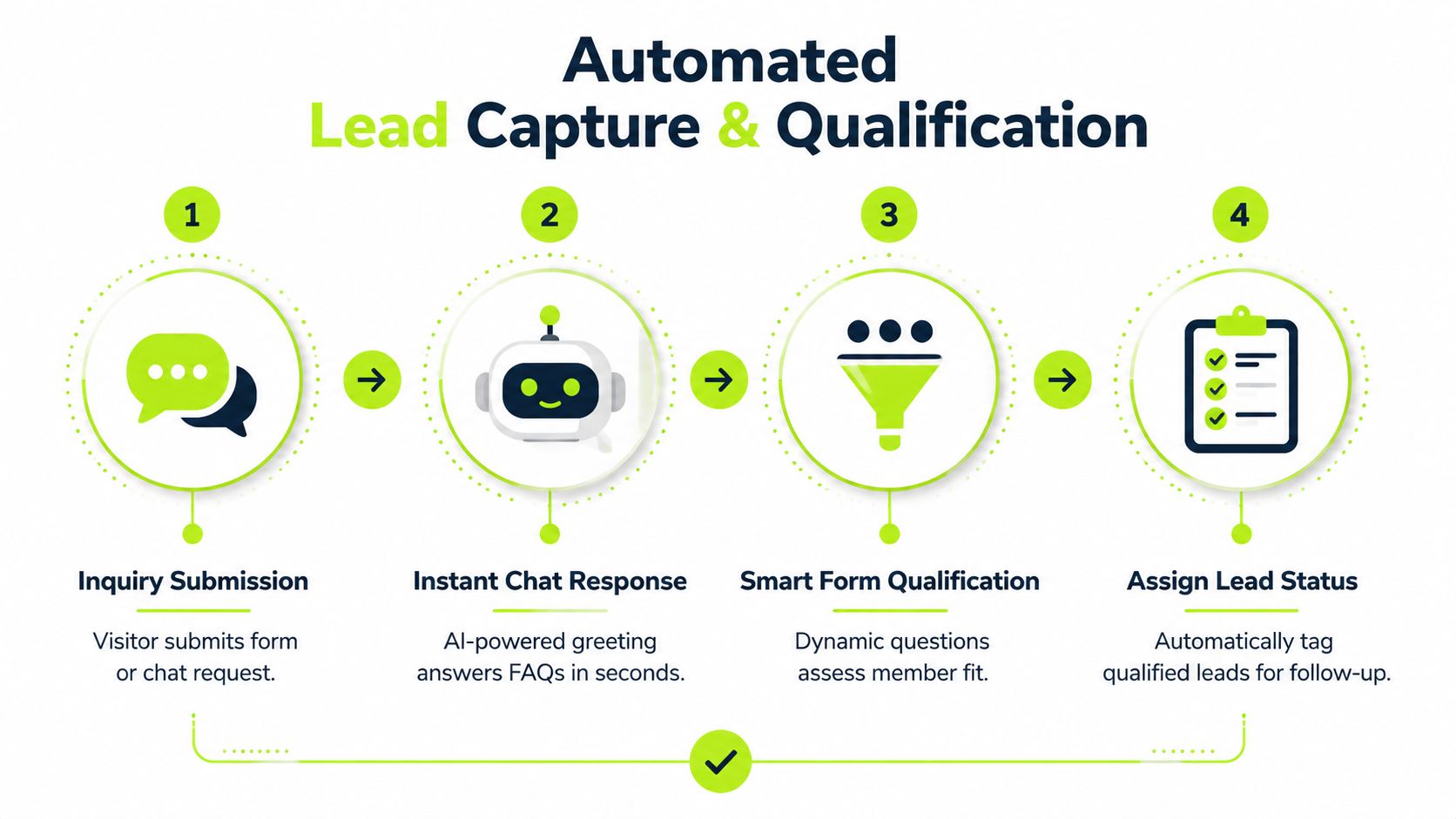
When somebody enquires, the process should gather enough context to route them intelligently. That often includes whether they're a beginner or experienced player, whether they want full membership or are still exploring, and whether they're ready to visit.
A practical qualification flow often includes:
Instant acknowledgement
A website chat or smart form confirms the enquiry immediately and sets expectations.Intent-based questions
Ask a small number of useful questions. Are they looking for membership details, a tour, coaching, or just pricing?Automated routing
Based on answers, the system tags the lead and sends them to the correct next step.Immediate action path
Offer a direct booking link, a membership guide, or a prompt to schedule a call.
If your first response still depends on somebody opening an inbox, your club is slower than it needs to be.
Manual follow-up still matters, but not first
Some managers worry that automation will make the club feel impersonal. In reality, poor manual handling is what feels impersonal. A delayed reply says, “we'll get to you when we can.” A fast, relevant response says, “we're organised and expecting you.”
The key is sequencing.
Use automation for first response, triage, tagging, and scheduling. Then let staff step in where they add the most value: a personal call, a tour, a membership conversation, or answering specific objections. Human time should go into closing, not chasing basic admin.
That's the shift many clubs need. Stop treating every enquiry as a loose email. Start treating each one as the beginning of a managed process.
Designing a High-Conversion Nurture Sequence
A prospect rarely joins because of one form submission and one polite reply. They join because the club stays present long enough, clearly enough, and consistently enough to help them make a decision.
That's why a proper nurture sequence matters. It bridges the gap between first enquiry and real commitment.
What a lead journey usually looks like
Take a common example. A golfer clicks an ad on a Sunday evening, asks for membership information, then gets distracted. They intend to come back to it, but work starts on Monday, family life gets in the way, and the enquiry drifts.
If the club sends one email and stops, that lead is effectively abandoned.
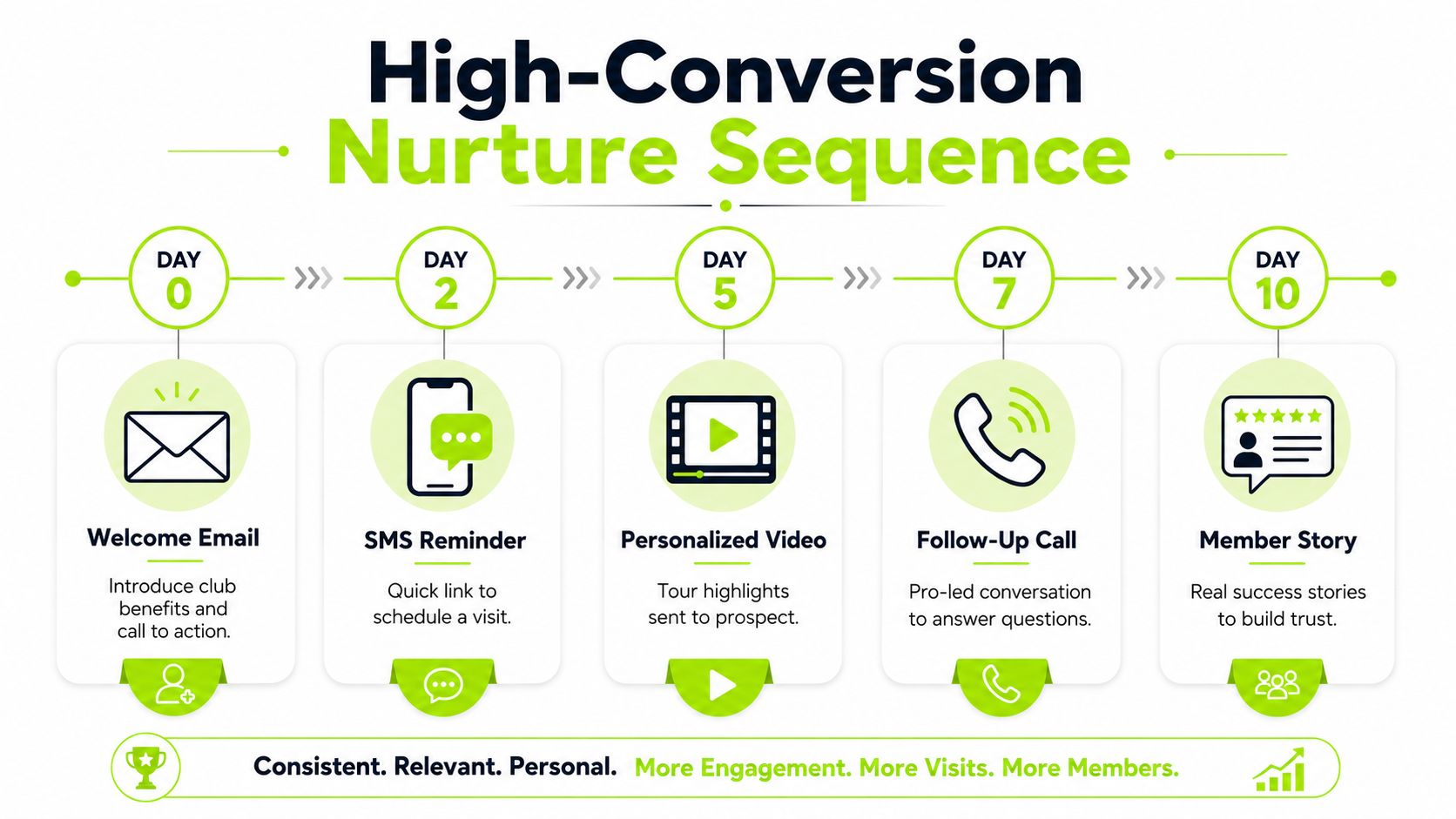
If the club runs a structured sequence, the experience feels different:
- Day 0: A welcome message arrives quickly with a simple next step, such as booking a visit.
- Shortly after: A second touchpoint answers practical questions around membership options, playing access, or club atmosphere.
- Later in the sequence: The prospect sees member stories, visual proof of the experience, or a message from the team.
- Before the sequence ends: A clear invitation to book a tour or speak to the club is repeated in a helpful, not pushy, way.
The point isn't to overwhelm people. It's to reduce the chance that genuine interest gets lost through delay and distraction.
Why one follow-up fails
Implementing a structured 7–9 touchpoint nurture sequence with 24/7 CRM automation can produce a 66.83% win rate for converting enquiries into members, in sharp contrast to the near-zero conversion that comes from a single follow-up, as outlined in GolfRep's article on golf club membership lead generation.
That figure reflects something managers already know from daily operations. People need reminders. They need context. They often need reassurance before they commit.
A good sequence should mix formats and purposes:
| Touchpoint type | What it should do |
|---|---|
| Welcome email | Confirm interest and present the next action clearly |
| SMS reminder | Bring the prospect back quickly with minimal friction |
| Experience-led email | Show what being a member actually feels like |
| Personal outreach | Answer objections and invite conversation |
| Final nudge | Give the lead one more easy route to book or reply |
Keep the sequence practical, not polished for its own sake
Most nurture sequences fail because they're either too generic or too complicated. The strongest ones are simple and relevant.
Use plain English. Link to one action. Don't send long essays about club history when the prospect is still deciding whether it's worth visiting. If you're using email heavily, it's also worth understanding basic inbox placement and list hygiene. This guide on how to boost email deliverability is a useful reference because even a well-written nurture sequence fails if messages aren't being seen.
Membership follow-up works best when every touchpoint answers one quiet question in the prospect's mind: Is this club right for me?
If you want a stronger operational framework for this, GolfRep's own notes on lead nurturing best practices are one practical route. The important part is not the software itself. It's the discipline of making sure every lead gets multiple, relevant chances to move forward.
Measuring Performance and Optimising Your Budget
If you can't see where enquiries stall, you can't improve the system. You're left arguing about ad creative when the underlying issue might be weak tour booking, poor call handling, or low-quality search traffic.
That's why reporting for golf club lead generation should focus on conversion points, not vanity metrics.
The KPIs that actually matter
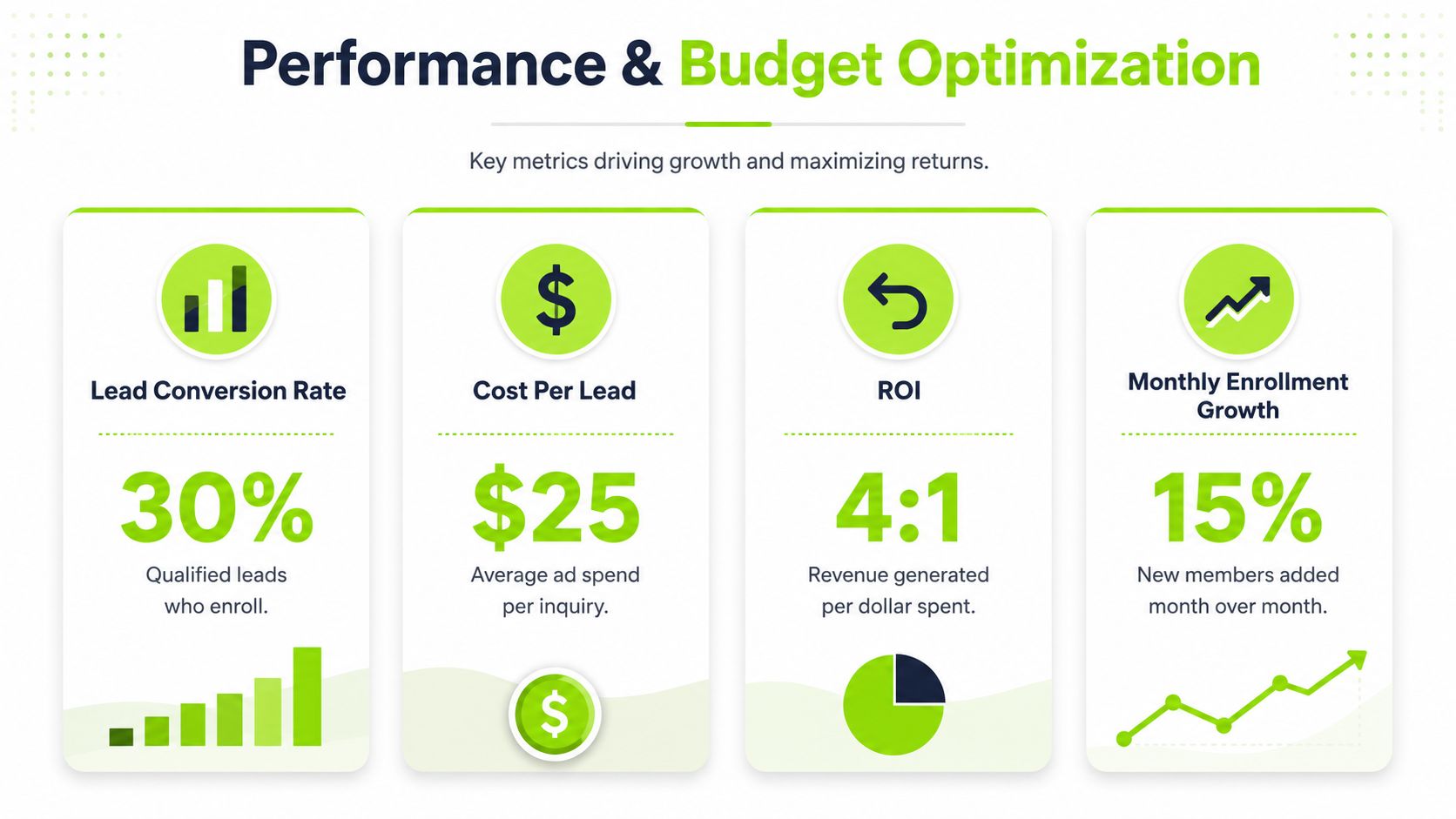
Golf clubs need a small set of metrics tied directly to membership revenue. GolfRep's guidance on membership growth highlights three core KPIs that matter most: lead-to-visit rate, visit-to-member conversion rate, and source-to-member yield, all discussed in its article on golf club membership growth.
Those three numbers tell you very different things:
- Lead-to-visit rate shows whether your first response, offer, and booking process are strong enough to get real engagement.
- Visit-to-member conversion rate reveals whether your sales conversation, tour experience, and package fit are doing their job.
- Source-to-member yield tells you which channels produce actual members, not just form fills.
Many clubs get distracted. They watch clicks, impressions, and page views because those numbers are easy to access. But a campaign with lower traffic can still outperform if the people coming through are better qualified and more likely to join.
Budgeting should follow buying behaviour
A sensible budget isn't spread evenly without context. It follows seasonal demand and lead quality.
A smart annual budget allocates 70% of ad spend to January through June, keeps a £500/month baseline running on Meta and Google, and uses negative keywords such as “cheap” and “jobs” to protect lead quality, based on James Wilkinson's guidance on how to spend a golf club marketing budget.
That has practical implications:
| Budget decision | Why it matters |
|---|---|
| Heavier spend in Jan to Jun | Captures peak demand while intent is strongest |
| Baseline monthly presence | Keeps the club visible even outside peak windows |
| Meta and Google split | Balances local awareness with active search demand |
| Negative keyword filtering | Stops budget leaking into irrelevant traffic |
Build a dashboard your team will actually use
You don't need an overbuilt reporting system. You need visibility.
A club manager should be able to answer these questions quickly:
- How many enquiries came in this month?
- How many booked a visit or call?
- How many became members?
- Which source produced those members?
- Where are leads being lost?
That's the basis of budget decisions. If a source produces enquiries but no visits, fix the qualification and booking process or reduce spend. If visits are happening but conversions are weak, the issue is likely in the club experience, pricing conversation, or follow-up after the visit.
For a deeper view of the commercial side, GolfRep's article on the real ROI of golf club marketing is one useful reference point.
The main lesson is simple. Spend should follow evidence. If you measure the pipeline properly, optimisation stops being guesswork and starts becoming routine management.
If your club is generating interest but not turning enough of it into tours, conversations, and memberships, that gap is usually a systems issue rather than a demand issue. GolfRep helps UK golf clubs build structured pipelines that combine acquisition, instant qualification, CRM follow-up, and conversion tracking so managers can see what's working and where enquiries are being lost.
Ready to tap into our proven growth system?