Boost Golf Club Green Fee Revenue: UK Playbook 2026

Most clubs don't have a green fee problem. They have a visibility problem. Visitor demand comes in, the phone rings, the website form fills up, and someone on the team still has to reply, price it correctly, and turn interest into a booked round before that lead goes cold.
That's the true commercial job behind golf club green fee revenue. The clubs that perform well don't just “raise prices”. They understand what each booking is worth, protect their best tee times, move inventory intelligently, and run a follow-up process that keeps casual visitors coming back. The clubs that struggle usually know their headline rate, but they don't know where revenue is leaking.
In the UK market, that distinction matters. In 2023, nearly 200 golf clubs in the UK and Ireland generated an average of £163,952 in casual green fee income, and that was 8% higher than the previous record year, according to The Golf Business. Another end-of-year report cited by Golf Monthly put average visitor green fee income at £170,000 across more than 200 clubs. Those numbers don't happen by accident. They happen when clubs treat green fees as a system, not a price list.
Understanding Key Revenue Components
A club can have a full tee sheet and still leave money on the table if it treats visitor income as one lump sum. The monthly takings may look healthy, and the committee may be satisfied with the total, but that figure rarely shows where the money originates. Visitor revenue usually has several moving parts, and clubs that separate them make better commercial decisions.
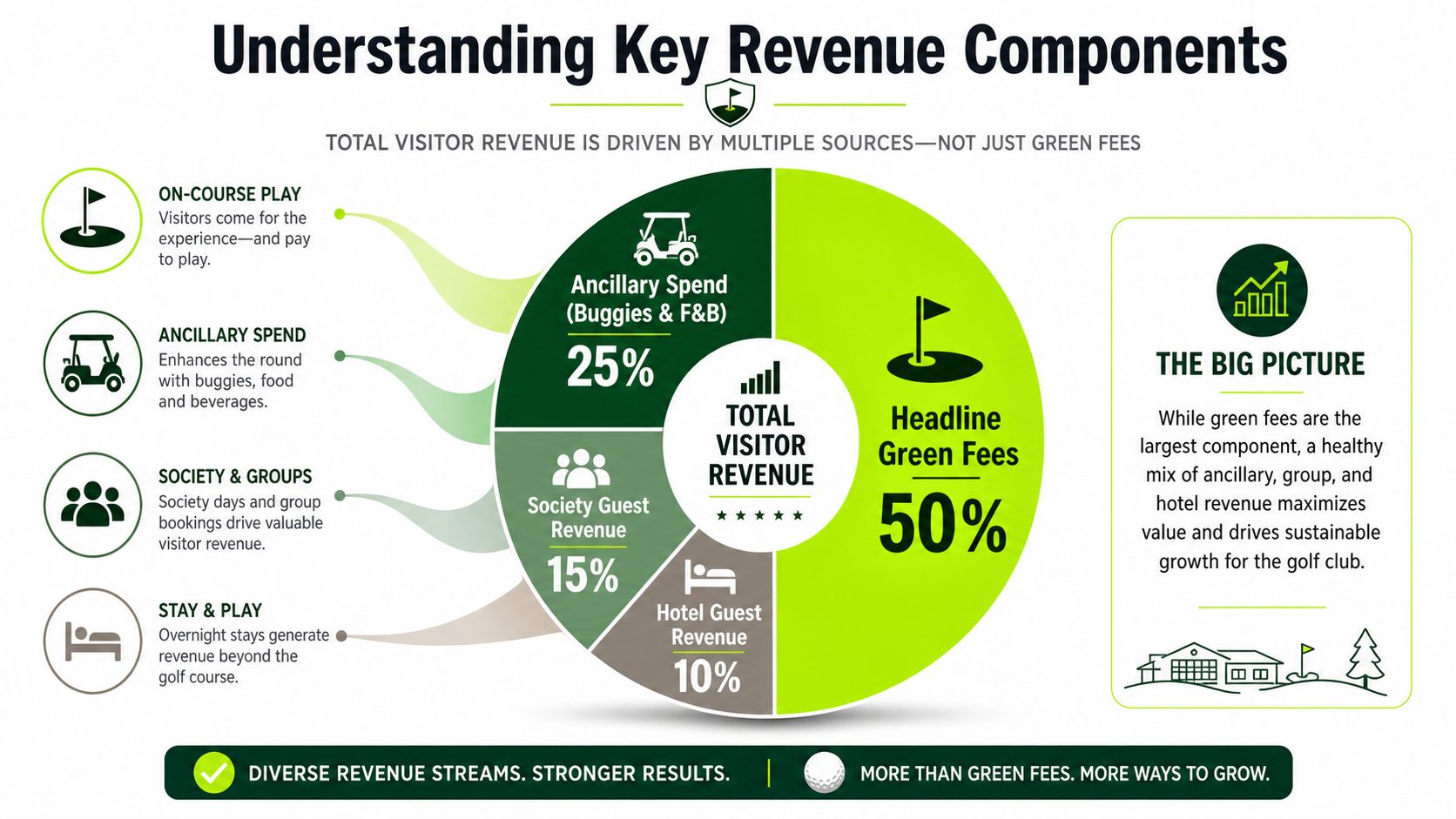
The money isn't all in the green fee
A tee time is worth more than the booking fee attached to it. Buggies, breakfast, bar spend, shop purchases, society add-ons, and hotel guest activity all change the actual value of a round. If a club only watches the headline rate, it can underprice premium inventory and miss the spend that sits around the round itself.
That is why experienced operators track the components separately. The useful split is straightforward, even if the accounting is not always clean. Track headline green fees, ancillary spend, society guest revenue, and hotel guest revenue as separate lines, then compare each one against the same period last year. In practice, one segment often carries more weight than the others, and that imbalance shows where the commercial opportunity sits.
For clubs that want a practical way to organise those moving parts, our guide to structuring golf club revenue streams gives a clear framework for reviewing them as a system rather than as isolated figures.
Practical rule: judge visitor revenue by the mix underneath it, not by one total figure. A busy tee sheet with weak ancillary spend can still be an inefficient tee sheet.
Why RevPAR is the right lens
For UK clubs, the most useful KPI is RevPAR, or revenue per available round, calculated as all green-fee-related revenue divided by course capacity for the same period, as outlined by Sagacity Golf. That matters because a club can post respectable headline rates and still waste inventory on quiet days or sell premium times too cheaply.
RevPAR forces a better question. It is not about what was charged, it is about what each available round earned. That makes it a cleaner diagnostic than average fee per round, because it exposes underused inventory and yield gaps. It also pushes the team to review the tee sheet weekly, not just at month end.
The commercial value comes from discipline. If one daypart is consistently weak, the club can adjust access, pricing, or follow-up. If one visitor segment converts better than another, the team can protect it and keep it visible in the booking mix. Clubs that pair this review with enquiry handling and repeat-visit tracking usually get more from the same tee sheet, because they are not just selling rounds, they are turning casual visitors into higher-value repeat customers.
A proper diagnosis also means knowing which enquiries turn into revenue and which ones disappear. That is where the tee sheet, the booking form, and the CRM need to work together, especially when the club is reviewing opportunities such as 2026 AI market analysis for how enquiry handling and follow-up systems can be improved.
Diagnosing Current Performance
Most clubs jump straight to price changes because price is visible and easy to discuss. That's usually the wrong first move. If the tee sheet, POS data, and CRM aren't aligned, a club can't tell whether the problem is low demand, weak conversion, poor response times, or over-discounting.
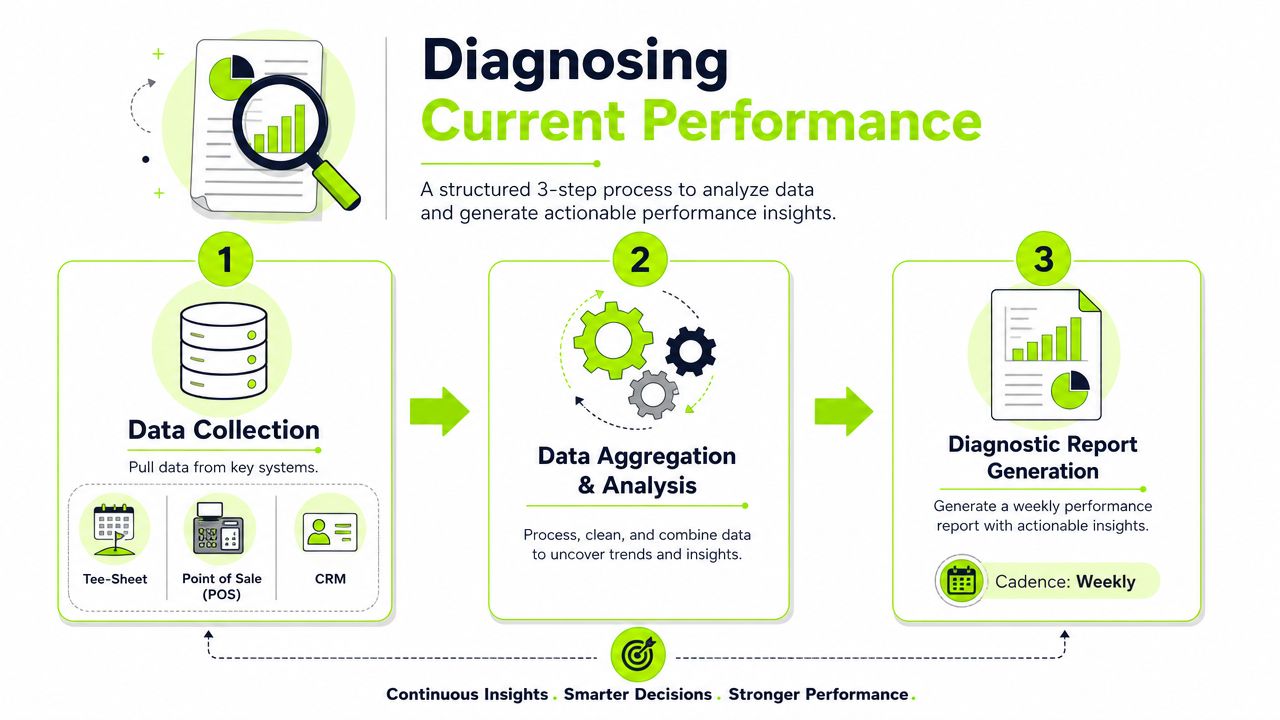
Start with the three systems that matter
Your tee-sheet shows inventory. Your POS shows what visitors spent beyond the round. Your CRM shows who enquired, who replied, who booked, and who disappeared. If those three sources are treated separately, you'll miss the pattern.
A weekly review should answer three questions. Which tee times sold cleanly. Which times needed discounting or manual intervention. Which enquiries were handled fast enough to convert. That sounds basic, but it's where many clubs lose revenue.
The right metric stack is straightforward:
- RevPAR by week: Measures how well available rounds turned into revenue.
- Daypart utilisation: Shows where inventory is underused, especially early, mid-morning, and late afternoon windows.
- Booking window analysis: Reveals whether guests book early, late, or only when discounted.
- Response time and conversion: Shows how quickly your team turns interest into revenue.
This is also where systems beat memory. A manager might remember that Saturday was “quiet”, but the data will show whether the issue was a poor offer, a weak response, or a tee-sheet gap that nobody managed.
For teams trying to map the commercial opportunity against broader market behaviour, Surnex's 2026 AI market analysis is a useful external read because it frames how structured analysis can improve decision-making without replacing commercial judgment.
Read the leaks before you touch the price
A slow lead response can cost you more than a small pricing error. If a visitor enquiry sits unattended, the club loses momentum before the conversation starts. The same is true if premium slots are left exposed to blanket discounting just to “fill the sheet”.
Revenue leaks are usually operational, not mystical. The tee sheet tells you what sold. The CRM tells you what almost sold.
The strongest clubs build a weekly diagnostic report and keep it simple. They look for underused slots, over-discounted periods, and enquiry bottlenecks. That gives them a heat map of where to intervene, rather than a feeling that “we need more traffic”. Often, they already have enough interest. They just aren't handling it well enough.
Applying Pricing and Yield Tactics
Pricing works best when it reacts to demand, not when it sits in a static spreadsheet. Clubs that push one rate across every tee time end up giving away value on busy days and asking too much on quiet ones. The answer isn't complicated, but it does require discipline.
Use rate bands, not one blunt price
Set clear tiers for peak, shoulder, and off-peak periods. Peak inventory should protect premium value. Shoulder times can be used to smooth demand. Off-peak slots can be used selectively, but only when the club wants volume for a reason.
That doesn't mean discounting every slow slot. It means using discounts with a purpose. A low-rate slot that attracts the wrong visitor at the wrong time can create pace-of-play issues, lower spend, and more admin for the team. A targeted offer, on the other hand, can fill a weak window without weakening the rest of the sheet.
The useful commercial habit is to raise rates as tee times sell through, not after the day is nearly over. That protects scarcity. It also trains the market that premium times cost more because they're scarce, not because the club is arbitrarily changing its mind.
Operational rule: If a tee time is likely to sell anyway, don't discount it early. Protect it, watch it, and only loosen price if the data says demand is weak.
There's also a physical capacity lever that many clubs ignore. Reducing tee-time spacing from 10 minutes to 9 minutes can create two extra tee times before noon, which adds roughly 2,920 additional round-selling opportunities per year, according to NGCOA guidance. That doesn't mean every club should do it. It means clubs should test tighter spacing on selected high-demand periods, then check pace-of-play and customer experience before rolling it out.
Automate the rule, not the argument
If the pricing logic lives in one manager's head, it'll break when that person is off-site. Simple rules inside the booking system work better. For example, define when a slot becomes premium, when a discount can appear, and when an offer should disappear. The team then follows the rule instead of debating it every week.
GolfRep often observes a bigger improvement than clubs expect. Not from a dramatic pricing overhaul, but from making the pricing process visible, trackable, and repeatable.
Creating High-Value Products and Packages
A lot of clubs still sell visitor golf as if the round is the product. It isn't. The round is the entry point. The primary margin often comes from the things attached to it, especially when the offer is packaged properly.
Bundle the visit, don't just quote a tee time
Buggies, breakfast vouchers, pro-shop credit, and society add-ons all help push average booking value up if they're presented as part of the booking, not as a last-minute upsell. The strongest offers feel convenient rather than pushy. A visitor wants one clear decision, not four disconnected ones.
Society traffic deserves special attention because it behaves differently from casual one-ball or two-ball play. The booking is often larger, more coordinated, and more sensitive to service quality. Hotel guest rates sit in a different lane again, because they're tied to stay-and-play expectations and broader guest experience.
A useful practical test is to build three variants of the same offer:
- Round only, for price-sensitive solo or two-ball demand.
- Round plus breakfast, for morning traffic.
- Round plus buggy and credit, for higher-value visitor segments.
Then compare which package attracts the strongest booking quality, not just the highest enquiry count. A package with fewer bookings can still win if it lifts average value and reduces friction at checkout.
Price packages against the target guest, not your costs alone
Packages work when they're built around how guests buy. A visitor looking for a Saturday round is not shopping in the same way as a society organiser or a hotel guest. If you try to use one bundle for all three, you dilute the offer.
The strongest pricing starts with the round and then layers value. Don't build the package by adding things until it feels busy. Build it by asking what would make the booking easier for that visitor type.
For clubs planning premium inventory more deliberately, GolfRep's premium tee time strategy guide is a useful companion read because it frames premium slot protection as a revenue decision, not just a schedule choice.
The core idea is simple. If you can raise the total value of each booking without making the path to purchase harder, the tee sheet gets stronger without needing more traffic.
Building Effective Booking Funnels
A lot of clubs still lose revenue after the enquiry arrives. The website gets the visit, the form gets filled out, and then the lead sits in someone's inbox until later that day, or the next. By then, the visitor has often moved on.
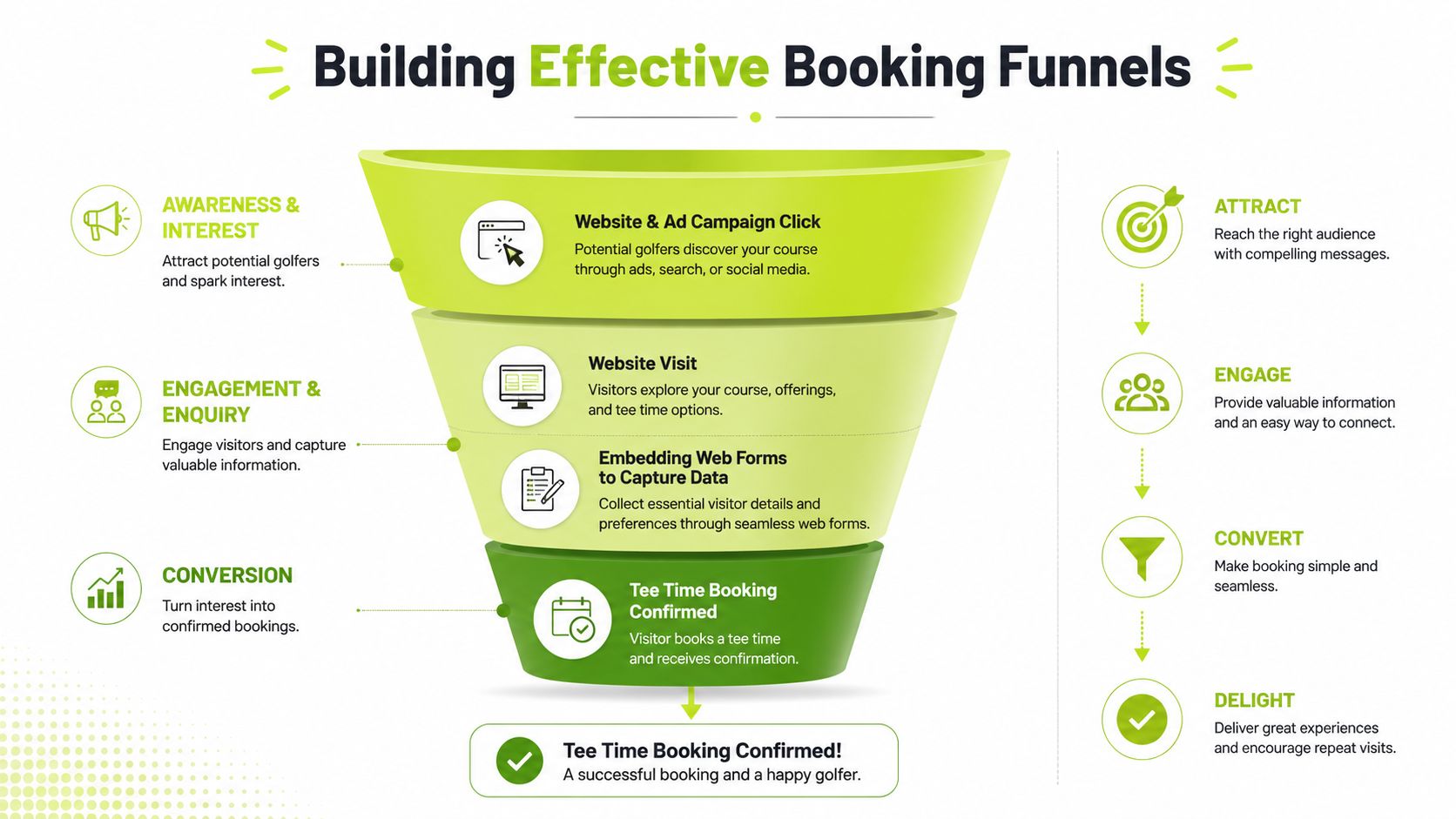
Capture the lead cleanly
Your enquiry form should ask for the basics only, name, contact details, desired date, visitor type, and any special requirement. If the form is too long, people abandon it. If it's too vague, the team wastes time asking follow-up questions that could have been collected upfront.
The key is to make the next action obvious. Once the form is submitted, the enquiry should enter a CRM workflow immediately. That workflow should assign the lead, trigger an acknowledgement, and place the visitor into the right follow-up path based on whether they're a casual guest, society organiser, or hotel guest.
The biggest mistake is leaving this as a manual handoff. Human follow-up is important, but the first response shouldn't depend on someone noticing a notification at the right time.
Respond faster than the competition
UK clubs using HubSpot-based solutions partners report an average response time of 30 hours, and faster responses are linked to higher conversion rates, according to The Revenue Club. That's a warning and an opportunity. If a club can get back quicker, it can often win the booking before the visitor keeps shopping.
Response speed matters because golf enquiries are time-sensitive. The golfer is often comparing dates, prices, and convenience in the same sitting. A slow answer doesn't just delay the sale, it weakens it.
A good follow-up sequence should include:
- Instant acknowledgement: Confirms the enquiry landed.
- Personal reply: Offers the actual tee time, package, or next best option.
- Reminder touchpoint: Keeps the enquiry moving if no booking happens.
- Upsell prompt: Suggests buggy, breakfast, or group add-ons when relevant.
For clubs refining the booking journey itself, Carlos Alba Media's guidance on increasing website conversion rates is a solid external reference because it focuses on conversion mechanics rather than vanity traffic.
GolfRep's own booking system guide fits this section because the core issue isn't the form alone, it's the structure behind the follow-up. The clubs that win usually have the clearest process, not just the prettiest website.
Improving Operational Capacity and Yield
Revenue growth can fall apart on the course itself. If the tee sheet is full but the pace is poor, the starter is overloaded, or the pro shop team can't handle arrivals properly, the experience drops and the commercial value of the day suffers. Yield management has to work with operations, not against them.
Protect the premium windows
Peak tee times need to be guarded carefully. If a club fills its best slots too early with low-value traffic, it limits what the rest of the day can earn. That's why member access, visitor access, and society access should be reviewed together rather than in separate silos.
The staffing pattern matters too. Busy windows need enough support in the pro shop, at the starter point, and around visitor check-in. If a club asks the same team to handle bookings, issue products, answer walk-ins, and manage tee-sheet changes at the same time, small errors start to cost money.
The operational question isn't just whether more rounds fit. It's whether the course can absorb them without degrading the experience. A well-run busy day creates repeat business. A chaotic one creates complaints and fewer returns.
Balance access with yield
Not every slot should be monetised the same way. Some times are better used for members, some for visitors, some for societies, and some for higher-value guest introductions. The right mix depends on course capacity, service levels, and local demand patterns.
You don't need to overhaul the whole schedule at once. Test changes on specific days, review pace-of-play, check staff workload, and watch whether the average fee per round rises or falls. If a change sells more rounds but weakens overall yield, it's the wrong change.
In these situations, clubs often overcorrect. They see a quiet patch and want to flood it with discounted inventory. But if the slot is awkward for the market, the better answer might be to reposition it, not just cheapen it.
The best operational fixes are usually small. A better tee-sheet rule, a cleaner starter handover, or a more disciplined access policy can outperform a big pricing move.
Measuring Impact and Testing Strategies
A pricing change, package tweak, or follow-up sequence only matters if the club can prove what changed in the numbers. Without that, results get blamed on weather, timing, or a busy weekend, and the next decision starts from guesswork again.
Build one dashboard and keep it honest
The dashboard should track RevPAR, average booking value, enquiry conversion, and repeat visitation. Those measures give a clearer commercial read than raw rounds alone, because they show whether each available round is earning more and whether visitors are coming back after the first booking.
Keep the test structure simple enough to read and strict enough to trust. Change one variable at a time where possible. If price, package, and follow-up all shift in the same week, the club may get activity, but it will not know what drove it.
A practical test plan keeps the commercial question front and centre. If the aim is higher booking value, then the club needs to see that value rise without weakening conversion. If the aim is conversion, a busier enquiry inbox does not count unless those enquiries turn into bookings.
Sample A/B Test Plan
| Test Variable | Metric | Target |
|---|---|---|
| Breakfast bundle versus discount offer | Average booking value | Higher booking value without lower conversion |
| Faster enquiry follow-up versus standard reply | Enquiry conversion | More bookings from the same enquiry volume |
| Peak-time rate increase versus static pricing | RevPAR | Better yield on premium tee times |
The clubs that get this right treat the test as a decision tool, not a marketing exercise. Before the trial starts, decide what success looks like and what failure looks like, then stick to that rule when the numbers come in. A change that feels popular but weakens yield is still the wrong change.
There is also a wider market signal to keep in view. According to VerticalIQ, peak public-course fees have risen in line with inflation over the same broad period, which suggests that revenue growth is not just about putting prices up. The stronger gains usually come from tighter enquiry management, better follow-up discipline, and a clearer link between visitor interest and booked rounds.
The clubs that keep improving do not rely on isolated wins. They test, review the numbers each week, and keep the rules that hold up under pressure. That is how visitor revenue becomes repeatable instead of depending on a good run of weather or a single strong month.
If a club wants visitor demand to produce steadier revenue, the starting point is already there, the booking data, the way leads are handled, and the structure of the tee sheet. GolfRep helps clubs connect those pieces into a system that tracks enquiries, follows up properly, and gives managers clearer visibility from first click to booked round. A sensible next step is to review the current enquiry response process and tee-sheet yield together, then decide where a structured CRM workflow would remove the most leakage.
Ready to tap into our proven growth system?