How Golf Clubs Can Maximise Peak Season Revenue
Most advice on how golf clubs can maximise peak season revenue starts in the wrong place. It tells clubs to buy more traffic, run more ads, refresh the website, post more on social media, or chase more visitor bookings.
That can help, but it often misses the actual commercial problem.
The clubs that struggle during peak season usually aren’t suffering from a lack of interest. They’re suffering from weak handling of that interest. Enquiries sit in inboxes. Callbacks happen late. Visitor details never make it into a usable system. Staff rely on memory, paper notes, or a booking platform that stores transactions but not relationships. By the time someone follows up, the golfer has booked elsewhere or gone cold.
Peak season magnifies that weakness. In 2024, UK and Ireland golf clubs reached a record average casual green fee income of £170,462 per venue, up 11% year on year, with online bookings accounting for 68% of the total according to Golfshake’s reporting on The Revenue Club data. That tells you two things. First, the revenue opportunity is real. Second, the clubs that convert digital demand well have an obvious advantage.
A busy tee sheet doesn’t automatically mean a well-run revenue system. Plenty of clubs create demand, then leak value through poor follow-up, unclear pricing, inconsistent staff processes, and no structured way to turn visitors into repeat customers or members.
That’s why the better question isn’t “How do we get more leads?”
It’s “What happens after someone shows interest?”
If your club wants stronger peak season income, start there. Fix the bucket before pouring more water into it. The same issue sits behind most disappointing campaigns, as discussed in why most golf club marketing fails.
The Real Revenue Bottleneck at Your Golf Club
A golf club can spend money on a new website, paid ads, photography, and booking software and still underperform.
Why? Because revenue doesn’t come from marketing activity on its own. It comes from enquiry handling, response speed, and consistent conversion. If those parts are weak, every extra lead exposes the problem faster.
Where clubs usually lose money
The pattern is familiar. A golfer visits the site, checks visitor tee times, looks at society options, or asks about membership. The enquiry arrives. Then one of three things happens:
- It gets a delayed response because the office is busy with member issues, competitions, and day-to-day operations.
- It gets a partial response that answers the immediate question but doesn’t move the person towards a booking or visit.
- It disappears into a silo inside an inbox, on a voicemail, or inside a booking system with no follow-up process attached.
None of that feels dramatic when it happens once. During peak season, it becomes expensive.
Practical rule: If your club can’t see every enquiry in one place, assign ownership, and track what happened next, you don’t have a demand problem. You have a visibility problem.
More leads won’t fix a weak process
A common reaction is to ask the marketing supplier for more volume. More traffic. More leads. More reach.
That’s understandable, but it often makes things worse. A club with no reliable follow-up system doesn’t need more names in the inbox. It needs a process that catches every lead, qualifies intent, sends the right next step, and prompts staff only when human intervention adds value.
A booking engine can record a transaction. It usually won’t build a relationship. That matters if you’re trying to maximise peak season revenue rather than just fill a few spare slots.
The operational view matters
Club managers and committees often treat visitor revenue as a pricing question. It’s also an operational discipline. You need clean handovers between marketing, office, golf operations, and front-of-house. You need a standard for response time. You need a way to see whether web enquiries become booked rounds, whether booked rounds become repeat visits, and whether repeat visits become membership conversations.
Without that, the club isn’t running a pipeline. It’s reacting.
The clubs that handle peak demand best don’t rely on heroic effort from one overworked secretary or manager. They build systems that make good follow-up normal.
Foundations for Growth Yield Management and Smart Pricing
Pricing is where many clubs either leave money on the table or create unnecessary friction.
Fixed pricing is simple to administer, but it rarely reflects actual demand. At the same time, aggressive dynamic pricing can upset members if it feels arbitrary or creates the impression that visitors are being favoured over the club’s core community.
That tension is real in the UK market.

Yield management starts with the tee sheet
For golf clubs, yield management is the discipline of matching price and access to real demand on the tee sheet.
That means separating your inventory into practical categories such as:
- Premium demand windows such as strong summer mornings, popular weekend visitor slots, and periods linked to local tourism or events
- Standard trading windows where demand is healthy but less intense
- Lower-demand periods where occupancy matters more and controlled incentives can help
The mistake is treating every tee time as if it has identical value.
A Saturday morning slot in peak summer doesn’t behave like a late afternoon weekday round. If both are priced and promoted in the same way, the club loses twice. It underprices scarce demand and fails to stimulate weaker periods properly.
What good pricing decisions look like
Smart pricing is not constant fluctuation. It’s disciplined adjustment based on patterns the club already knows.
Start with your own history. Look at booking pace, busiest days, no-show behaviour, weather sensitivity, visitor mix, and how far in advance different segments tend to reserve. That gives you a working demand map.
Then make decisions that are easy to explain:
- Protect premium inventory rather than discounting early out of habit
- Use small, deliberate price differences between stronger and weaker time bands
- Bundle value carefully when direct discounting would damage perceived quality
- Review booking windows so your best slots aren’t released too loosely or too late
Clubs often rush to tactics before setting rules. Rules matter more. Staff need to know when prices can move, who approves exceptions, and how to explain the policy consistently.
The member issue can’t be ignored
Generic advice on this matter often falls apart. Plenty of people recommend dynamic pricing, but they don’t address the club culture around it.
As Sagacity Golf’s guidance on revenue management makes clear, the UK-specific challenge is implementing dynamic pricing without alienating members, avoiding the sense of a “two-tier” club where visitors are managed commercially and members feel overlooked.
If members can’t understand the logic behind visitor pricing, they’ll assume the club is prioritising short-term cash over long-term loyalty.
That doesn’t mean dynamic pricing is off limits. It means it has to be introduced properly.
How to protect member trust
The cleanest way to do this is to separate member value from visitor pricing mechanics.
Members don’t need to approve every commercial decision, but they do need confidence that the club is protecting their experience. In practice, that usually means:
- Ring-fencing member access at the right times.
- Explaining the purpose of visitor pricing in plain language.
- Avoiding erratic price swings that look opportunistic.
- Giving staff a simple script for common complaints.
- Reviewing feedback quickly after rollout rather than letting resentment build.
A club creates trouble when pricing looks secretive or inconsistent. It builds trust when the approach is predictable and tied to obvious demand differences.
What doesn’t work
Several habits repeatedly hurt clubs:
| Approach | Why it fails |
|---|---|
| Setting one visitor rate for the whole season | It ignores obvious differences in demand and leaves premium slots underpriced |
| Discounting too early to “get bookings in” | It trains buyers to wait for deals and weakens rate integrity |
| Changing prices with no explanation | Staff face complaints they can’t answer clearly |
| Copying a nearby club’s prices blindly | Their tee sheet, member mix, and visitor demand may be completely different |
A useful benchmark for thinking about premium inventory is a structured premium tee time strategy. The principle is simple. Your best slots should be managed, not merely listed.
Building a Predictable Pipeline Attract and Capture High-Value Visitors
A full diary of low-intent traffic doesn’t help much. The clubs that improve peak season revenue consistently attract the right visitors, then capture their details in a way the club can use.
That sounds obvious, but many clubs still send paid or organic traffic to pages that ask very little of the visitor and record even less. Someone browses, maybe checks a rate, maybe starts a booking, and then vanishes without leaving a trace the club can work with.
Attract better-fit visitors, not just more visitors
Not every golfer has the same value to your club. Peak season works best when you target segments that fit your offer and spend profile.
That could include:
- Travelling golfers looking for a quality round in your area
- Corporate groups seeking a polished weekday experience
- Local lapsed players who know the club but need a reason to return
- Visitors with higher ancillary spend potential who are likely to use the bar, buggy hire, or shop
The message should match the segment. A scenic destination round needs different wording from a society package or a membership taster pathway. Generic ads create generic leads, and generic leads are harder to convert.
The capture point is where most clubs fall short
A website page isn’t a system. It’s only the front door.
Once someone lands there, the next step must be clear. If the page buries the booking button, uses a long form, asks for unnecessary information, or provides no compelling reason to act now, the club loses momentum immediately.
Strong capture usually includes a mix of:
- A primary call to action tied to the visitor’s intent
- Short forms for non-booking enquiries
- Immediate confirmation so the golfer knows the request has been received
- A route into the CRM so details can be tracked, tagged, and followed up
Most clubs don’t lose leads because nobody was interested. They lose them because nobody built a clean handover from interest to action.
What to capture and why
Clubs often collect too little or too much.
Too little, and you can’t follow up intelligently. Too much, and the form becomes a barrier. The right capture fields depend on the offer, but the principle is the same. Only ask for information that helps the next step happen.
For visitor and enquiry workflows, useful fields often include:
- Contact details so the club can respond on the same channel
- Intended playing date or visit window to identify urgency
- Group type such as solo, fourball, society, or corporate
- Relevant interest flags like buggy hire, food, or membership information
That information becomes commercially useful only if it lands in one place and remains visible to the team.
The CRM is the club’s working memory
Many clubs still operate with fragmented records. The booking system stores rounds. The inbox stores questions. The spreadsheet stores societies. The manager stores key context in their head.
That setup breaks under peak-season pressure.
A central CRM gives the club one working record of who enquired, what they wanted, what happened next, and whether another opportunity exists. It also stops the all-too-common situation where different staff speak to the same prospect with no shared context.
A practical overview of this front-end process sits in GolfRep’s guide to golf club lead generation, but the key point is simple. Lead capture is not the finish line. It is the start of controlled follow-up.
A simple test for your current setup
If you’re unsure whether your club has a capture problem, ask five questions:
- Can you see every enquiry in one system?
- Can you tell which page, campaign, or source generated it?
- Can staff see whether it has been answered?
- Can you segment it by visitor type or commercial value?
- Can you trigger the next communication without relying on memory?
If the answer to those is patchy, the pipeline isn’t predictable yet.
The Conversion Engine Automated Nurture and Follow Up
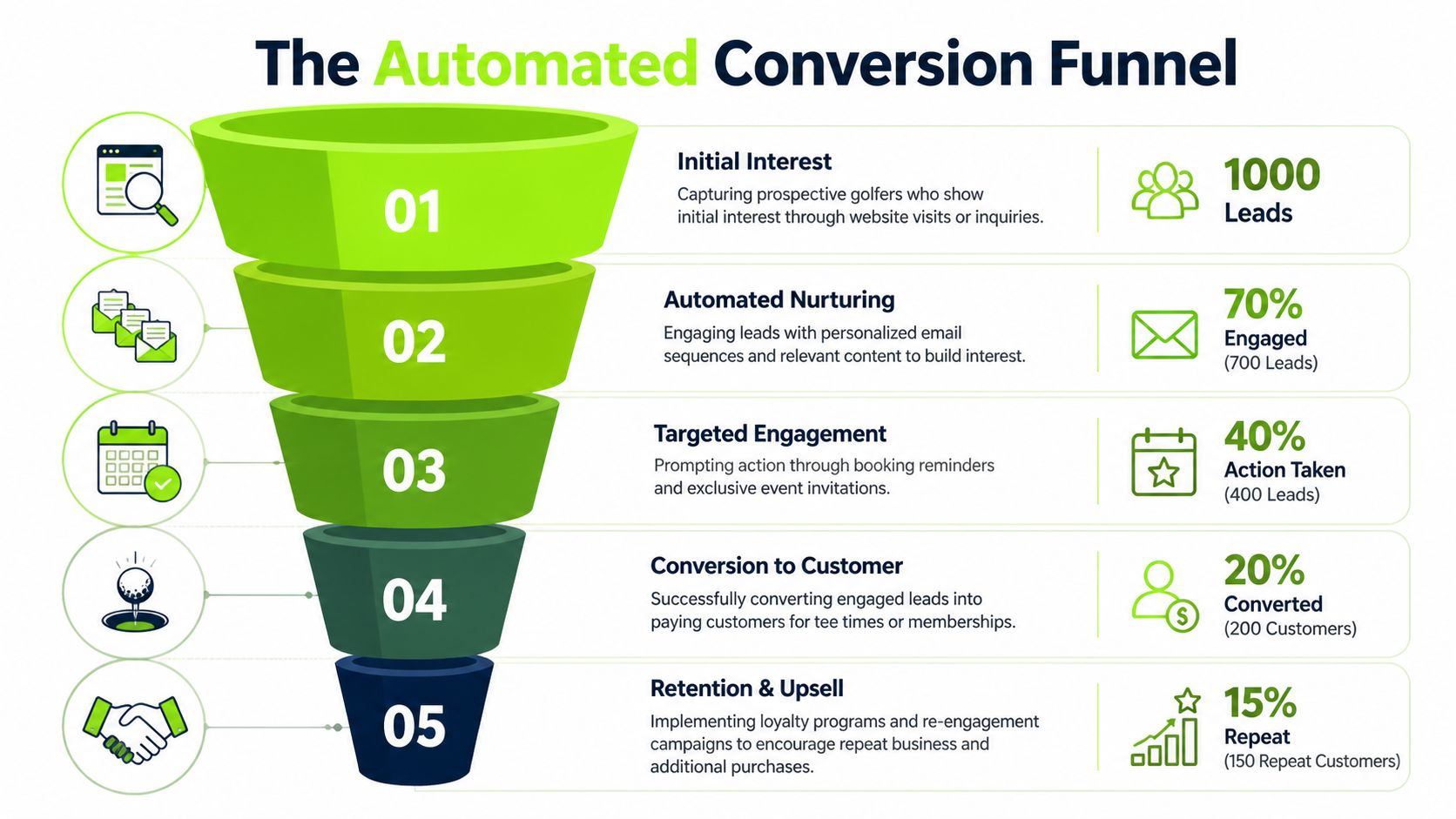
Most clubs know how to answer an enquiry. Far fewer know how to run a consistent follow-up sequence.
That gap is where a lot of peak season revenue disappears. A golfer who has already asked about a tee time, society day, or membership option is not a cold lead. They’ve shown intent. They’ve already raised their hand. The job now is to move them forward while interest is still live.
Speed matters, but consistency matters more
A manual process can work when volumes are low. During peak season it tends to fall apart.
The club office is busy. The pro shop is busy. Managers are handling operations, members, staffing issues, and on-course demands. In that environment, follow-up becomes irregular even when staff are working hard.
A proper conversion engine removes that dependency. It makes sure every lead receives a timely next step, every time.
That usually begins with:
- Instant acknowledgement so the enquirer knows the club has received their request
- A relevant follow-up sequence based on what they asked about
- Internal task assignment only when a human response is needed
- Status tracking so no one has to guess whether the lead is warm, booked, stalled, or lost
What an automated nurture sequence actually does
This isn’t about blasting generic emails. It’s about handling known scenarios with discipline.
For example:
| Trigger | Useful automated response |
|---|---|
| Visitor enquiry submitted | Immediate confirmation with expected next step |
| Booking started but not completed | Reminder with a clear route back to the booking |
| Tee time booked | Confirmation plus relevant pre-visit information |
| Visit completed | Follow-up asking for feedback or promoting the next logical offer |
| Repeat visitor behaviour | Tailored outreach linked to future play or membership interest |
Done well, automation handles the repetitive work that staff rarely have time to do consistently.
Automation is most valuable after the round
One of the biggest missed opportunities is post-visit follow-up. Many clubs treat the played round as the end of the transaction. Commercially, it’s often the start of the primary opportunity.
As HD SportSuite notes in its discussion of club revenue opportunities, many clubs generate visitor traffic during peak season but have no systematic process for converting those players into members, even though they are pre-qualified leads who have already shown willingness to pay to play the course.
That should change the way clubs think about visitor data. The purpose of follow-up isn’t just to confirm the booking. It’s to build a relationship after the booking.
Operational insight: If the club only speaks to a visitor before the round and never after it, it has wasted the most valuable proof point it owns. Actual experience of the course.
Manual follow-up versus system-led follow-up
The contrast is straightforward.
Manual follow-up depends on individual discipline. It varies by staff member, workload, and memory. It often stops at the point of immediate transaction.
System-led follow-up runs in the background. It applies the same standards to every enquiry. It records opens, replies, outcomes, and next actions. Staff step in with context instead of starting blind.
That doesn’t replace human service. It protects it. The best use of staff time is not repeatedly sending basic confirmations or chasing incomplete forms. It’s handling nuanced conversations, objections, and higher-value opportunities.
What clubs should automate first
If a club is starting from scratch, automate the moments where delay causes obvious drop-off:
- New enquiry acknowledgement
- Incomplete booking reminders
- Pre-visit confirmations
- Post-visit follow-up
- Repeat visitor nurture for membership or return play
Those workflows won’t solve every commercial issue, but they close the most common leaks. Once they’re in place, the club can see where the next bottleneck sits rather than guessing.
Beyond the Green Fee Upsells and Member Conversion Strategies
Peak season revenue doesn’t stop at the green fee. Clubs that think only in terms of tee-time income usually miss the wider value of a visitor relationship.
There are two commercial layers to focus on. The first is increasing the value of the visit that is already booked. The second is converting selected visitors into a longer-term relationship with the club.

Raise on-site spend without making it feel pushy
The easiest upsells are the ones that fit naturally into the playing day.
A visitor booking a round may also need buggy hire, food before play, drinks after the round, range balls, or a simple retail add-on. Yet many clubs leave those options to chance. They hope the golfer notices them on arrival rather than presenting them clearly at booking or in pre-visit communication.
Good upselling works when it feels useful, not forced.
Practical examples include:
- Pre-round packages that combine food or coffee with the visit
- Buggy prompts tied to weather, course familiarity, or convenience
- Post-round dining suggestions included in booking confirmations
- Retail visibility through arrival messaging and check-in scripts
The key is timing. Offer too much at once and the booking flow becomes cluttered. Offer nothing until check-in and the club misses easy revenue from golfers who would have said yes if asked earlier.
Use data to identify who is worth deeper follow-up
Not every visitor should receive the same post-visit message.
Some are one-off tourists. Others are local, return more than once, engage with club communications, and clearly fit the profile of a member or regular paying customer. The club should know the difference.
A useful segmentation model often separates visitors by observable behaviour:
| Visitor type | Best next move |
|---|---|
| One-time traveller | Encourage review, referral, or future destination revisit |
| Local occasional player | Promote return visit and relevant open events |
| Repeat green fee player | Introduce member-for-a-day style experiences or trial pathways |
| Corporate organiser or group lead | Offer future event planning support and tailored hosting options |
A CRM becomes more than an admin tool. It lets the club see patterns that staff would otherwise miss.
Membership conversion should be designed, not improvised
Many clubs talk about wanting more members, but they approach visitor conversion casually. A golfer plays twice, maybe three times, and nobody follows up with anything more structured than “let us know if you’d like details”.
That’s weak because it places all the effort on the prospect.
The better approach is to create a progression. For example:
- After the visit, send a useful thank-you and ask about the experience.
- If the golfer engages, invite them to another relevant touchpoint such as an open day, reciprocal-style visit, or hosted introduction.
- If they return, shift the conversation from transactional golf to club fit.
- If interest grows, give them a clear membership path with a named contact and simple next step.
The message should match the behaviour. A repeat local visitor doesn’t need broad promotional copy. They need a reason to see themselves as part of the club.
A visitor who has paid to play your course more than once is no longer a stranger. Treating them like one is usually a process failure, not a demand problem.
What clubs often get wrong
There are a few recurring mistakes:
- They wait too long after the round to follow up.
- They send the same message to everyone, regardless of local relevance or repeat behaviour.
- They push membership too early before the golfer has had enough experience of the club.
- They rely on staff memory to remember who “might be a good fit”.
A proper member conversion pathway should feel like service, not pressure. The club is helping the golfer make a sensible next decision based on demonstrated interest.
That’s especially important at private clubs where culture and belonging matter just as much as price.
Your 12 Week Peak Season Execution Plan
Most clubs don’t need more ideas. They need a calendar and a decision sequence.
Peak season revenue improves when pricing, capture, follow-up, and conversion are installed before the busiest weeks arrive. Trying to fix all of this mid-season usually leads to rushed decisions and patchy execution.
A useful operating measure during this period is Revenue Per Available Tee Time (REVPATT), which calculates total green and cart fee revenue divided by available tee times. As explained in Bobby Jones Links’ overview of golf revenue KPIs, tracking REVPATT helps clubs balance utilisation and rate so they avoid either a full sheet at discounted prices or a half-empty sheet at ambitious prices.
12-week peak season revenue maximisation calendar
| Phase (Weeks) | Strategic Focus | Key Actions Checklist |
|---|---|---|
| Weeks 12 to 9 | Pre-season setup | Audit visitor journey, review tee-sheet access rules, define pricing bands, clean enquiry routes, confirm who owns each lead type |
| Weeks 8 to 5 | Campaign and system launch | Activate targeted traffic sources, simplify landing pages, connect forms to CRM, turn on instant confirmations, prepare staff scripts for pricing and visitor queries |
| Weeks 4 to 1 | Peak demand optimisation | Monitor booking pace, protect premium slots, tighten response discipline, review incomplete bookings, push useful pre-visit upsells |
| Weeks 1 to 4 of peak | Conversion control | Track lead-to-booking movement, check follow-up compliance, tag repeat visitors, trigger post-round nurture, identify likely membership prospects |
| Weeks 5 to 8 of peak | Retention and refinement | Review REVPATT trends, adjust weaker time bands carefully, refine messaging by segment, expand upsell offers that staff can deliver consistently |
| Weeks 9 to 12 of peak | Membership harvest and review | Target repeat visitors with tailored pathways, book hosted visits or conversations, review source quality, document what should remain in place after peak season |
Weeks 12 to 9: Get the plumbing right
This phase is rarely glamorous, but it decides whether the rest works.
Start with the mechanics:
- Audit every entry point for visitor, society, and membership enquiries
- Remove dead ends where the user has interest but no clear next step
- Set response ownership so each lead type has a named handler
- Map the booking journey on mobile as well as desktop
- Decide which data fields matter so you don’t collect noise
If the club still relies on a general inbox with no tracking, fix that before spending more on acquisition.
Weeks 8 to 5: Launch with control
Once the route from interest to enquiry is clean, bring in targeted demand.
This is also the right window to activate the first automation layer. New enquiries should receive immediate acknowledgement. Incomplete bookings should trigger a reminder. Staff should be able to see what happened without searching multiple systems.
Use this period to train the team on practical scenarios:
- a visitor asking why one slot costs more than another
- a caller wanting the best-value time without sounding price-led
- a repeat local golfer who may be a future member
- a society organiser needing confidence and quick answers
Weeks 4 to 1: Manage the premium inventory properly
By now, the club should be close enough to peak demand to make sharper decisions.
Review which time bands are filling naturally and which need support. Hold your nerve on premium inventory. If strong slots are booking, there’s no reason to undermine them with unnecessary concessions.
Manager’s check: Don’t judge pricing by how it feels internally. Judge it by booking behaviour, available inventory, and the quality of demand coming through.
At the same time, tighten follow-up around incomplete actions. Peak season buyers are often comparing options quickly. A delayed reply hands the decision to another club.
During peak season: Focus on throughput and visibility
When the course is busy, the risk is that staff revert to reactive mode.
That’s why dashboards matter. You need a simple view of:
- Open enquiries that still need attention
- Booked rounds by source or campaign
- Repeat visitor signals
- Post-visit follow-up status
- REVPATT direction by period, not just total revenue
This isn’t about turning the club into a call centre. It’s about making sure commercial opportunities don’t disappear because everyone is understandably busy.
After the rush: Turn seasonal demand into ongoing value
The final stage is where many clubs switch off too early. Peak season generated the contacts. The club now needs to work those relationships properly.
Review which visitors returned, which campaigns brought the best-fit traffic, which upsells landed well, and which repeat players may be suitable for a member pathway. Keep the successful nurture sequences running rather than shutting everything down when the first busy spell ends.
How golf clubs can maximise peak season revenue isn’t really a mystery. The formula is clear enough. Price with intent, capture demand properly, follow up without gaps, and turn visitor activity into a trackable pipeline.
If your club wants a more structured way to do that, GolfRep helps golf clubs build predictable pipelines with targeted lead generation, CRM-led follow-up, and automated nurture systems that stop enquiries from slipping through the cracks. The strongest peak season results usually come from better handling, not just louder marketing.
Ready to tap into our proven growth system?