Best Golf Courses England Map: Top Picks for 2026

Beyond the Pin: Turning Map Visibility into Membership Growth
The most popular advice around a best golf courses England map is still too golfer-focused. It usually stops at discovery. Which map looks best, which list feels most prestigious, which regions are worth a trip. For club managers, that misses the commercial point.
Being pinned on one of these maps can create attention, but attention is not the hard part. The harder part is what happens after the click. A prospect lands on your site, opens your contact page, checks visitor options, or asks about membership. If your team replies late, loses visibility of the lead, or relies on inboxes and spreadsheets, that prestige leaks out of the funnel.
That matters more in England because the strongest course reputation is geographically concentrated. Roughly half of England's top-reputation courses are clustered within three broad regions: the Channel Coast, the London belt, and England's Golf Coast, according to the course-mapping analysis behind this top English golf course map. Visibility is concentrated. So is competition.
For clubs, the lesson is simple. Discovery tools can help with driving transactional searches to your business, but they only matter if your handling process is ready to convert the enquiry into revenue.
1. Top100GolfCourses - England Ranking (with Map)
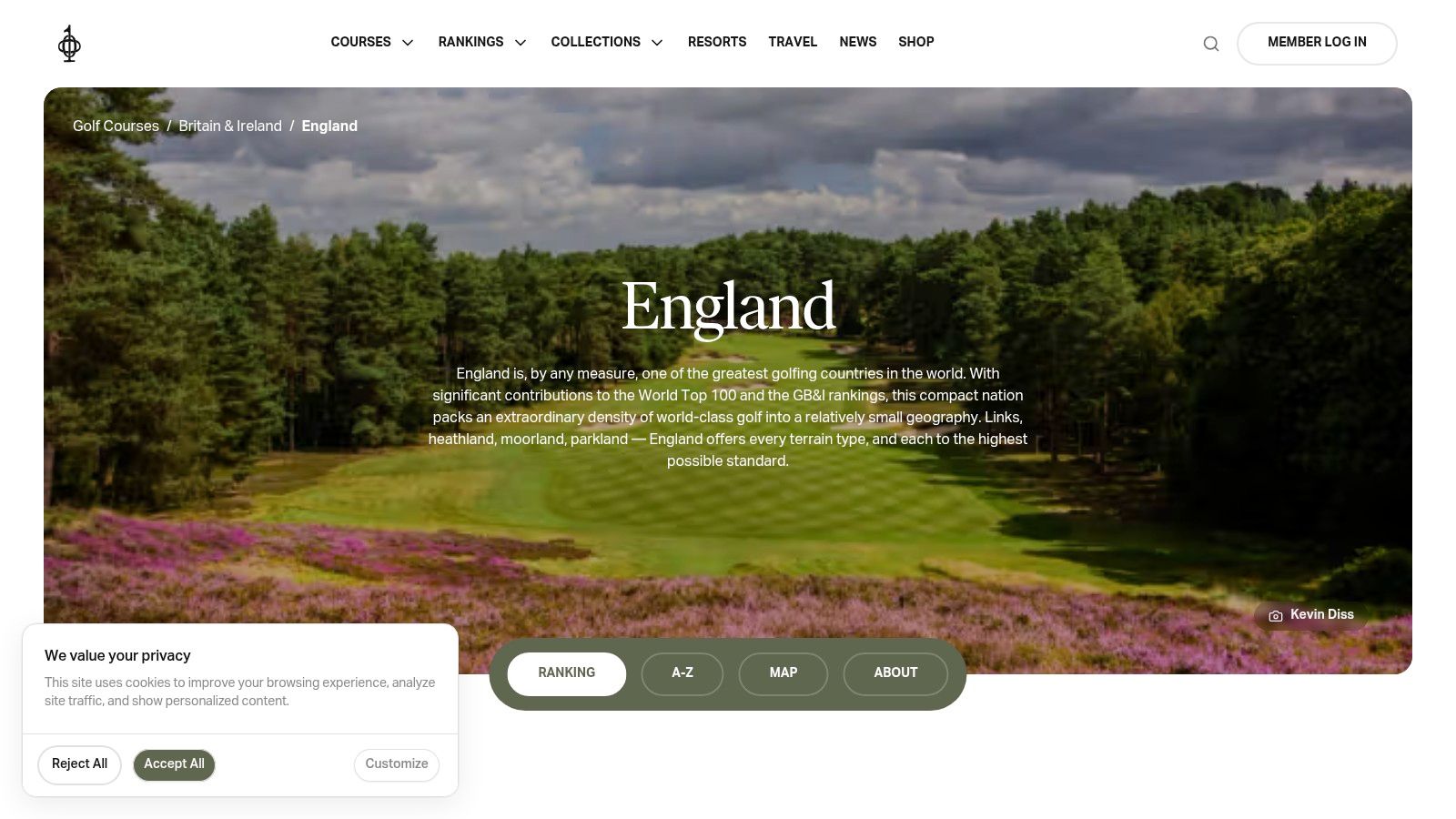
Top100GolfCourses England is the cleanest example of prestige-led discovery. For a manager, that makes it useful well beyond vanity. It shows how aspirational traffic is framed before a golfer ever reaches your website.
The England view is tidy. You get Ranking, A-Z, and Map toggles, plus rich editorial profiles with history, architects, panel notes and imagery. If your club appears here, the enquiry quality is often strong because the visitor has already self-qualified around reputation and course identity.
Where it works
Editorial positioning offers clubs valuable lessons. The platform doesn't try to be a booking engine first. It builds desire, then leaves the club to pick up the commercial task. At that handoff, many clubs underperform.
If your enquiry form is buried, if your membership page is vague, or if response time depends on one staff member being in the office, you won't convert what the ranking helped create. That's why we often point clubs back to the operational side of golf course management systems and process thinking.
- Best feature: The England-only map view makes regional clustering obvious.
- Strong advantage: Editorial context adds status that directory listings usually can't.
- Main limitation: It doesn't solve the enquiry journey for you.
Practical rule: Treat prestige platforms as top-of-funnel demand creators, not conversion systems.
Where it falls short
It is elite by design. That means broad access signals, pricing context and live availability are limited. The update rhythm is also periodic, so it won't reflect commercial changes at club level in real time.
For clubs outside the top tier, it's still worth studying. The best golf courses England map format here teaches a simple lesson. Strong discovery creates interest, but only your own systems turn that interest into booked visits, society rounds or membership conversations.
2. National Club Golfer - NCG Top 100s England
National Club Golfer's England rankings carry strong editorial credibility in the UK market. For clubs that feature, this is third-party validation that can influence serious golfers, visiting parties and even local prospects who want social proof before making contact.
The structure is different from a dedicated all-pins map. You get the England Top 100, individual course write-ups, and location detail on course pages rather than one central interactive map. That sounds minor, but commercially it changes user behaviour. Prospects often need to take an extra step to find your own site, your contact details, or your visitor terms.
Why that extra step matters
This is one of those channels where the lead is often well qualified before it arrives. The person has read the write-up, absorbed the context, and chosen to continue. That usually means the club doesn't need more awareness. It needs better response handling.
Clubs still lose these enquiries because they assume high-intent prospects will wait. They often won't. If the club site is hard to use, if there is no obvious membership route, or if visitor messaging is buried behind PDF downloads, the enquiry stalls.
A useful comparison is the thinking behind getting more revenue from golf club visitors. The issue isn't whether people are interested. It's whether the path from interest to action is clear.
Trade-offs for managers
- What NCG does well: Strong editorial authority, regular surrounding coverage, and clear rationale behind course inclusion.
- What it doesn't do well: No single all-course interactive map, and less filtering than a directory-led platform.
- What clubs should do next: Make sure your own site is ready for someone arriving with intent, not curiosity.
An NCG reader is often closer to a decision than the average website visitor. Handle them that way.
For clubs analysing the best golf courses England map offerings, NCG is a reminder that fragmented discovery still works if your own digital handoff is tight. If it isn't, qualified traffic goes cold faster than most committees realise.
3. Leading Courses - England
Leading Courses England sits in a different category. It blends map discovery, rankings, player reviews and, in some cases, transactional options. For clubs, that's useful because it shows what happens when prestige gives way to practical decision-making.
A golfer looking here is often comparing price signals, facilities, ratings and booking convenience in one place. That is a sharper commercial environment than a pure editorial ranking. It can expose weaknesses quickly.
What this platform reveals about your offer
If your listing attracts views but weak conversion, the problem may not be traffic volume. It may be perceived value, review profile, booking friction, or the way your proposition is presented.
That makes this one of the better tools for managers who want to understand demand at the point where comparison becomes action. It is also a strong reminder that green fee revenue depends on the whole experience, not just course reputation. That is exactly why clubs need a more structured view of golf club green fee revenue and the systems behind it.
- Useful filters: Price, rating and facilities.
- Commercial advantage: Some listings move beyond inspiration into booking or direct enquiry.
- Practical downside: User-review rankings don't match expert-panel prestige.
The operational lesson
Not every top course offers direct online booking through the platform, and that inconsistency matters. If your club does offer a path to action, it needs to be smooth. If it doesn't, your site must do the heavy lifting the moment a prospect clicks through.
This category matters because digital trip planning has become map-led. More than 65% of golfers planning trips use digital maps or course-location tools to build itineraries, according to the background cited in this Where2Golf regional ranking page. Clubs should read that as a behaviour shift, not a travel trend.
For the best golf courses England map search space, Leading Courses is one of the clearest tests of whether your club can convert intent when convenience starts to matter as much as status.
4. England Golf - Official Course Map & Directory
England Golf's official map is the broadest foundation layer on this list. It isn't a curated best-of map. That's exactly why it matters.
For managers, this is less about prestige and more about baseline discoverability. The platform covers affiliated clubs across England and lets users browse markers, filter by club type, and click through to club destinations. That makes it useful for territory analysis, competitor scanning and checking whether your local digital footprint is even visible.
Good for coverage, weak for differentiation
If you want a single place to understand the shape of supply, this is one of the most practical tools available. It is also where many clubs overestimate the value of being listed.
A complete directory does not create preference on its own. A prospect may find you here, but the platform doesn't add much editorial persuasion. It doesn't tell a convincing commercial story for your club, and it won't manage the follow-up after an enquiry lands.
England's course footprint also helps explain why simple visibility isn't enough. Independent geospatial analysis estimates that England is about 0.74% golf course by land area, while Great Britain as a whole is about 0.54%, with Scotland at 0.28% and Wales at 0.34%, according to this golf-land analysis. In a dense market, being present is basic. Standing out is harder.
Five Iron Golf Broadgate Circle
Best use for club managers
- Use it to audit: Your listing quality, outbound links and local competitor density.
- Use it to plan: Catchment overlap and whether your digital messaging matches your club type.
- Don't expect: High-intent conversion on directory presence alone.
This is the map to check before you invest elsewhere. If your official presence is weak, premium ranking visibility won't rescue the rest of the journey.
5. GolfLists - County Rankings with Interactive Maps and Fees
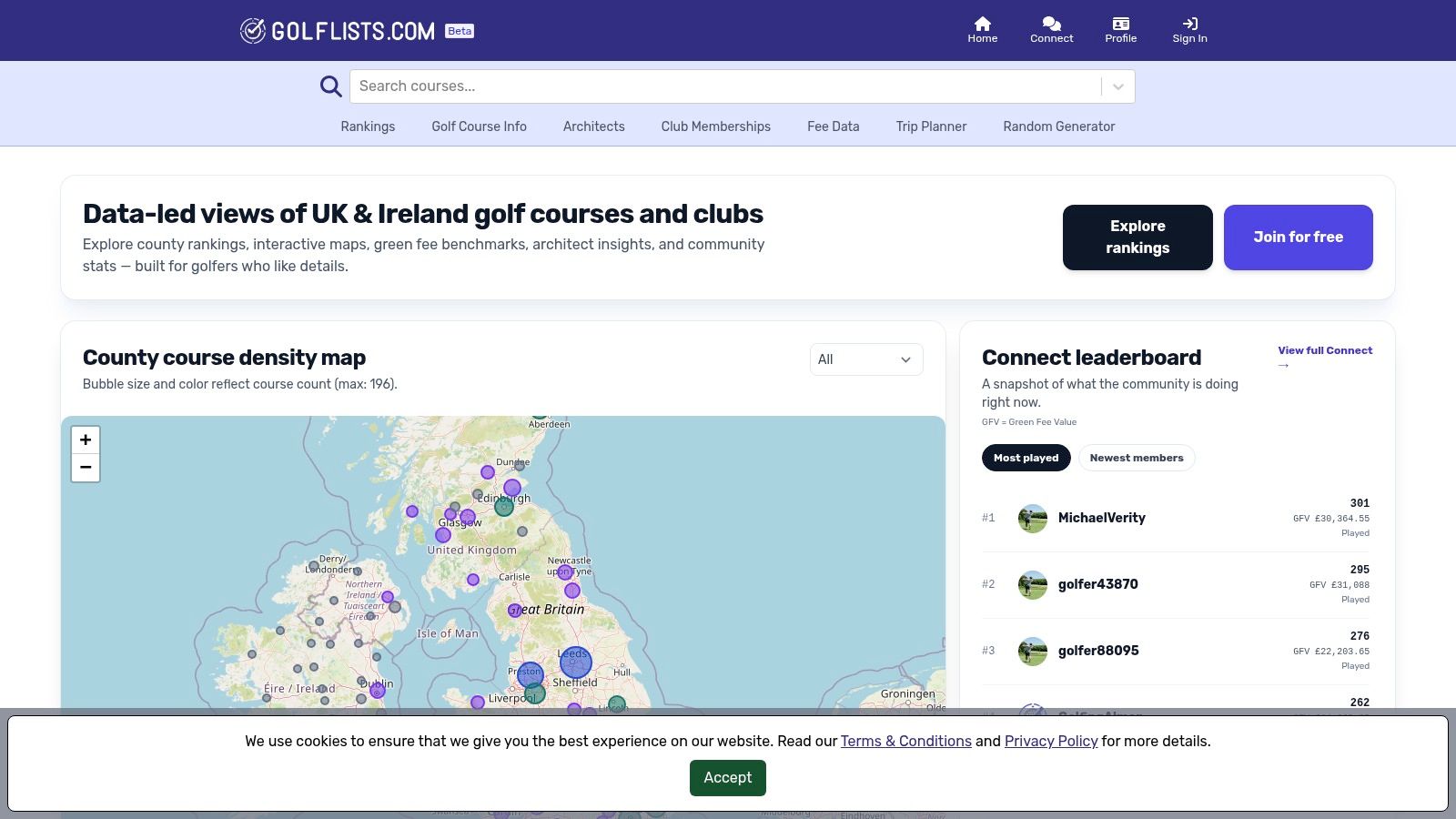
GolfLists is one of the more commercially interesting entries because it moves down to county level. That changes the competitive frame. Instead of broad national prestige, users compare your club against nearby alternatives with visible rank context and fee indicators.
For managers, that's useful because golfers don't always make decisions on national reputation. They often choose within a region, around a route, or against a shortlist. County maps surface that local comparison very clearly.
Why county context matters
GolfLists shows England rank and county rank side by side, and highlights top local options visually. If your fees sit above nearby competitors, your enquiry handling has to justify the difference. If your value is strong, your follow-up needs to make that obvious quickly.
Source tracking is significant. A lead from a county comparison page behaves differently from a lead coming via prestige editorial. The first may need reassurance on value, availability or inclusions. The second may mainly need a fast path to booking or visit scheduling.
Your team shouldn't treat every enquiry the same. Lead source changes the sales conversation.
What clubs can take from it
- Useful strength: Regional decision-making is easier to understand than on national lists.
- Useful signal: Cost and prestige are shown close together, which sharpens price perception.
- Main weakness: It is still maturing, and some data can be patchy.
This matters commercially because access is often the missing layer in top-course discovery. England Golf's 2025 operator access survey found that only 37% of clubs that typically appear in national top-100 England lists explicitly advertise open visitor or society slots on their own websites, versus 76% of non-ranked clubs, as summarised on Top 100 Golf Courses England. That gap is exactly where county-based comparison tools become powerful.
For clubs not sitting at the very top of the reputation ladder, GolfLists creates a practical opportunity. You may not win the prestige contest, but you can still win the accessible, responsive and commercially clear alternative.
6. Haversham & Baker - England Golf Courses Map
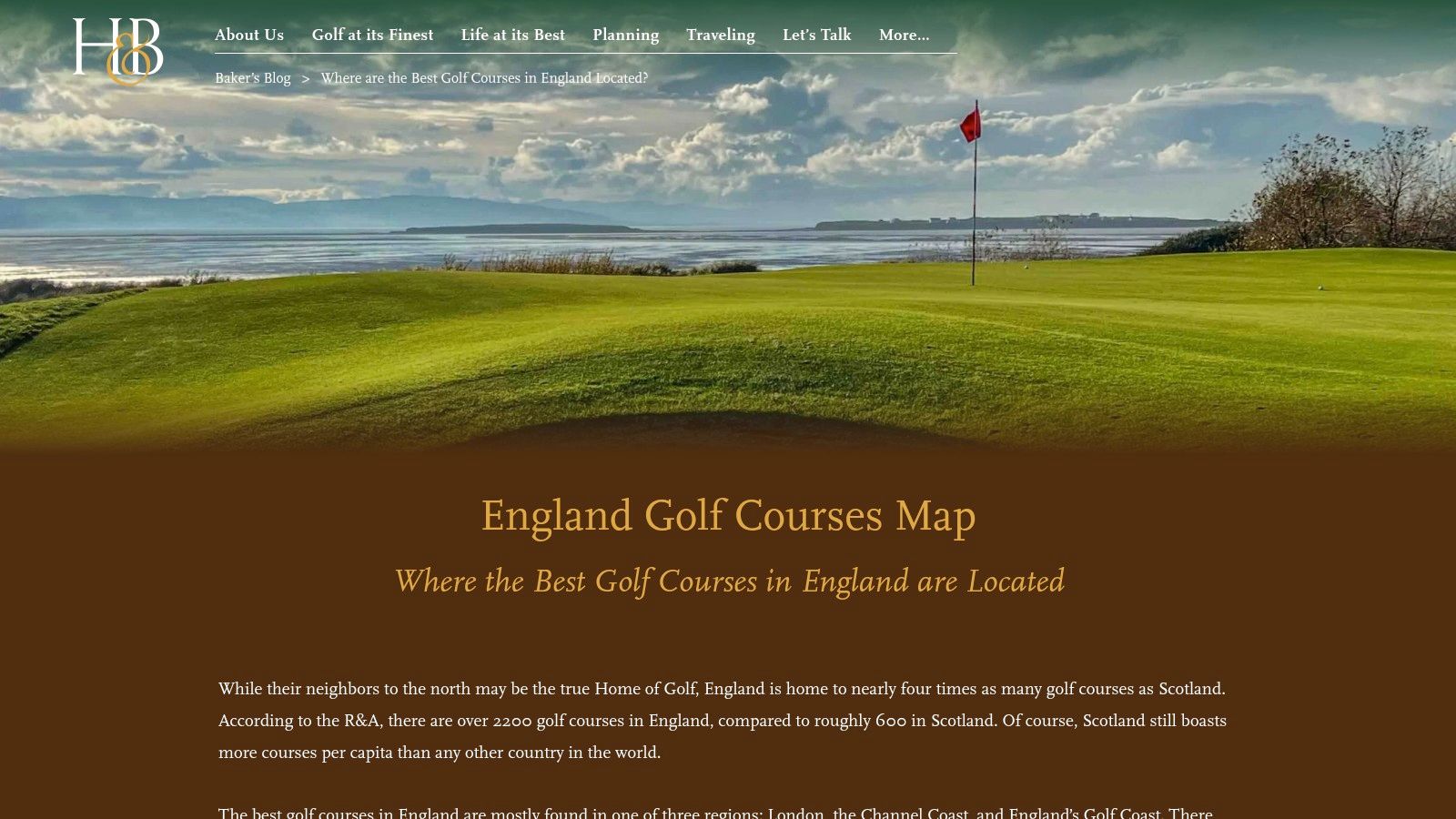
Haversham & Baker's England golf courses map is aimed at the itinerary traveller, not the local browser. That makes it different from the ranking-heavy tools above. It packages marquee venues into a navigable trip-planning view.
For clubs, that means fewer but more valuable opportunities. This kind of prospect is often planning farther ahead, spending more per trip, and comparing your course as part of an experience rather than a one-off round.
Best for understanding premium travel behaviour
The map gives quick visual orientation around notable courses and regional groupings. Editorial summaries support the planning process without becoming a giant directory. That simplicity helps trip planners, especially when they are assembling multi-course itineraries.
The trade-off is coverage and filtering. This is a curated view, not a full market view. So it won't show every competitor or every access route.
Where it becomes commercially useful is in how it frames your club inside a broader journey. Independent golf-travel platforms commonly organise England into a handful of high-level regions, showing how courses slot into itineraries and catchment overlap, as seen in Golf Travellers' England course regions. That is exactly how premium travel leads think.
The lead-handling lesson
These enquiries often don't convert in one call. They need coordination, memory and timely follow-up. If your team still handles premium travel leads through individual inboxes and manual notes, some of them will be forgotten because of how they take longer to mature.
- Best use: Positioning your club within a trip, not as an isolated tee time.
- Commercial upside: Higher intent around experience and itinerary fit.
- Main risk: Long-lead enquiries go cold if nobody owns the follow-up.
This is where CRM discipline matters. Not because technology is fashionable, but because expensive enquiries are easy to mishandle when they aren't ready to book on day one.
7. GeoGolfCourse.co.uk - UK Directory with Mapped Listings
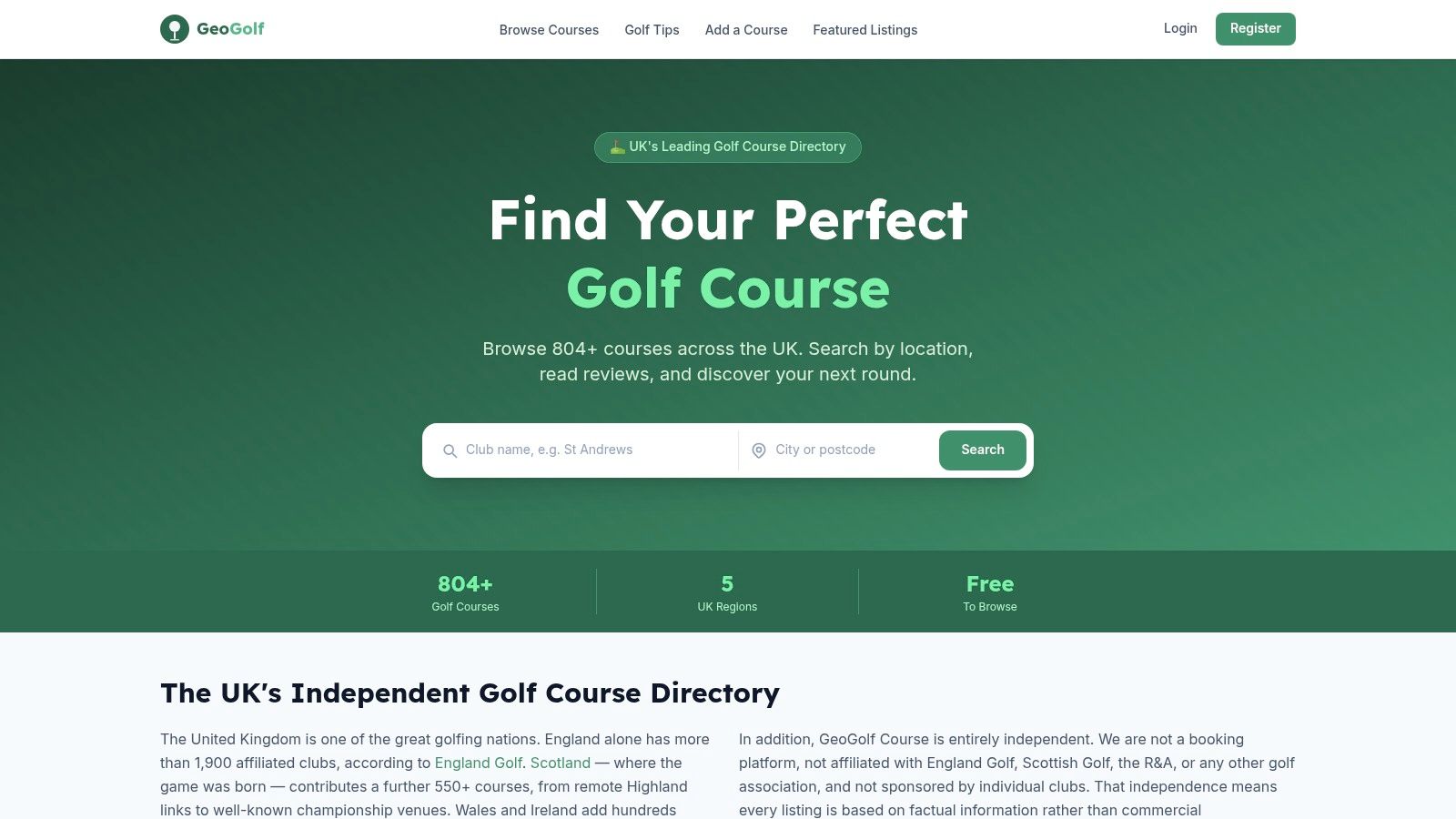
GeoGolfCourse.co.uk is a functional directory rather than a prestige platform. That sounds less exciting, but it serves a very practical role in the best golf courses England map ecosystem. It often sits close to the final click before a user reaches your own website.
You get map pins, course attributes such as style, holes and par, plus phone numbers, addresses and website links. That makes it useful for basic discovery and verification. It also makes it unforgiving. If the user clicks through and your own site is weak, the directory has done its job and the club has failed at the handoff.
Why the handoff matters more than the listing
This kind of platform is where operational weaknesses show up immediately. Slow websites, poor mobile journeys, hidden forms, generic inboxes and unclear visitor options all reduce conversion at the point of highest intent.
That is especially relevant in clustered English golf markets. Where2Golf's England directory organises top courses by region and maps major names such as Royal Birkdale, Royal St George's, Sunningdale, Wentworth and The Belfry within clear southern and coastal corridors in its England rankings directory. Prospects compare quickly in those regions. Clubs don't get much time to impress.
A directory click is not a branding moment. It's a response test.
What this tool is good for
- Practical strength: Centralised course details and useful categorisation.
- Good companion use: Cross-reference it against ranking and travel platforms.
- Clear weakness: No built-in best-course ranking, so quality signals depend on context from elsewhere.
This is the plainest reminder in the list. Third-party visibility doesn't rescue poor internal process. If you want more value from map-led traffic, the club needs instant acknowledgement, clear routing, lead visibility for staff, and conversion tracking that doesn't depend on memory.
Top 7 England Golf Course Map Sources Comparison
| Platform | Implementation complexity | Resource requirements | Expected outcomes | Ideal use cases | Key advantages |
|---|---|---|---|---|---|
| Top100GolfCourses - England Ranking (with Map) | Low, passive editorial listing, no booking APIs | Minimal, keep profile updated and ensure enquiry path on own site | High-prestige visibility; qualified enquiries that require manual conversion | Prestige marketing; showcasing club pedigree to aspirational visitors | Expert-panel credibility; rich editorial profiles; England-focused list |
| National Club Golfer - NCG Top 100s: England | Low, editorial presence, fragmented discovery (no single map) | Minimal, clear contact/booking info on club site to capture readers | High-intent, well-qualified traffic but discovery is fragmented | Third-party validation; media-driven exposure and PR | Strong editorial authority; regular news and contextual updates |
| Leading Courses - England (Map + Rankings + Booking) | Medium, supports filters, reviews and booking links | Moderate, competitive pricing, booking engine and review monitoring | Actionable booking leads and price/facility comparisons | Direct bookings; converting visitor demand and price-sensitive golfers | Interactive filters; crowd-sourced reviews; live booking signals |
| England Golf - Official Course Map & Directory | Low, broad directory listing, no curation layer | Minimal, ensure accurate listing and affiliation details | Broad visibility with low qualification; useful baseline presence | Comprehensive coverage; territory analysis and affiliation check | Official comprehensive coverage across England; useful for planning |
| GolfLists - County Rankings with Interactive Maps and Fees | Medium, county-level ranking and fee indicators | Moderate, monitor green fees and local ranking position | Regional, value-focused enquiries; comparisons of cost vs prestige | Regional trip planning; budget vs prestige analysis | County rankings with fee indicators; regional road-trip planning |
| Haversham & Baker - England Golf Courses Map | Low–Medium, curated itineraries and editorial summaries | Moderate, CRM for nurturing infrequent, high-value leads | Highly qualified but infrequent enquiries for packaged trips | Luxury itineraries; high-value traveller engagement | Curated itineraries; traveller-friendly editorial and regional groupings |
| GeoGolfCourse.co.uk - UK Directory with Mapped Listings | Low, functional data-first directory with site links | Minimal, ensure club website performance and clear contact channels | Quick verification leads; last-click handoff to club site with risk of drop-off | Contact verification; route planning and basic discovery | Centralised contact info; practical course attributes and filters |
From Map Pin to Member Pipeline
The best map resources all prove the same point. Visibility is only the first stage.
England has a large and economically significant golf market. IBISWorld's 2025 industry analysis puts UK golf course industry revenue at about £1.8 billion, with around 1,800 golf clubs operating nationally, as summarised in this UK golf courses industry overview. That scale explains why so many clubs chase attention. It also explains why attention alone isn't enough.
The best golf courses England map search isn't just a consumer behaviour trend. It's a discovery layer that influences where prospects click first, what standard they expect, and how they compare one club with another. Some platforms sell aspiration. Others sell practicality. A few move much closer to transaction. All of them can generate enquiries.
The problem most clubs face isn't a total lack of demand. It's inconsistent handling after demand appears. One enquiry gets answered quickly, another sits unread. A visitor lead gets logged, a membership lead stays in someone's inbox. A society organiser asks a good question, but nobody follows up when they go quiet. The leak is rarely at the top of the funnel. It's in the process after the click.
That's why clubs need systems, not heroics. Fast acknowledgement. Clear lead ownership. Visibility of source. Consistent follow-up. Conversion tracking that shows what happened, not what someone thinks happened. Manual processes feel manageable until volume rises or key staff are away. Then good leads disappear.
The practical lesson from every tool above is straightforward. Use map visibility to understand how your club is discovered. Study how prospects compare you against nearby venues, prestige venues and accessible alternatives. Then fix the handoff on your own side. If your website, enquiry flow and CRM process are structured properly, map-driven interest can become a predictable pipeline rather than a pile of missed chances.
Prestige helps. Pins help. Rankings help.
But clubs grow when somebody handles the enquiry properly.
GolfRep helps clubs turn map visibility, paid traffic and local demand into a structured pipeline that staff can manage. If your club is generating interest but losing track of enquiries, struggling with response time, or relying on manual follow-up, GolfRep can help you build a clearer system for lead capture, nurture and conversion without turning your club into a discount operation.
Ready to tap into our proven growth system?