AI Automation Workflow for Golf Membership Leads

A membership enquiry arrives on a Wednesday afternoon while the general manager is dealing with a staffing issue and the PGA professional is on the course. The prospective member asks about playing at weekends, the cost of joining and whether they can visit before deciding. An AI workflow can acknowledge the enquiry, record the details and prompt the right person to follow up. It shouldn't decide whether to offer a concession or promise that a particular category is available.
That distinction matters. For a golf club, an AI automation workflow isn't a chatbot or an email sequence. It's a controlled process that connects the first enquiry to a CRM record, a human handover, a visit and, if appropriate, a completed membership. The club defines the service; automation helps deliver it consistently.
What an AI Automation Workflow Actually Does in a Club
A chatbot bolted onto a website might answer a question about opening hours. That can be useful, but it doesn't become a membership workflow unless the answer, the enquiry and the next action connect to the club's sales process. If the conversation disappears when the visitor closes the page, staff can't see what was asked or whether anyone needs to act.
A connected workflow handles the operational steps around the conversation. It captures the enquiry, records the golfer's details, classifies the request, creates or updates a CRM record and assigns a follow-up task. If the golfer asks about a trial visit, the workflow might send an approved booking link. If they ask for a price exception, it should route that question to an authorised member of staff.
A Wednesday afternoon, handled properly
The automation can acknowledge the enquiry straight away, ask approved qualifying questions and record useful context such as preferred playing days or the membership category being considered. It can also send a task to the named owner, with the golfer's message and the next action clearly visible.
What it shouldn't do is infer that a golfer is eligible for a category from incomplete information, invent a joining offer or keep sending messages after the person has opted out. Those are not harmless technical errors. They can create confusion about club policy and undermine trust with a local golfer.
A useful test is to trace one enquiry from start to finish. Can staff see where it came from, what the golfer wants, who owns the next action, whether a visit was booked and what happened afterwards? If each answer lives in a different inbox or spreadsheet, the club has disconnected automations, not an end-to-end workflow.
That workflow-first approach reflects how UK small and medium-sized business leaders describe their AI use. Among those using or planning to use AI, 54% applied it to task automation, compared with 45% using it for marketing or advertising, according to a 2025 YouGov poll of UK SME leaders. For a club, the practical distinction is between sending more messages and reliably moving a prospective member through a defined commercial process.
The Four Building Blocks Before Any Tool Is Chosen
Software can't settle who owns an enquiry, what qualifies a lead or when a person should step in. Agree those decisions first. Then choose tools that support the process rather than forcing the club to reshape its commercial practice around a vendor's default settings.
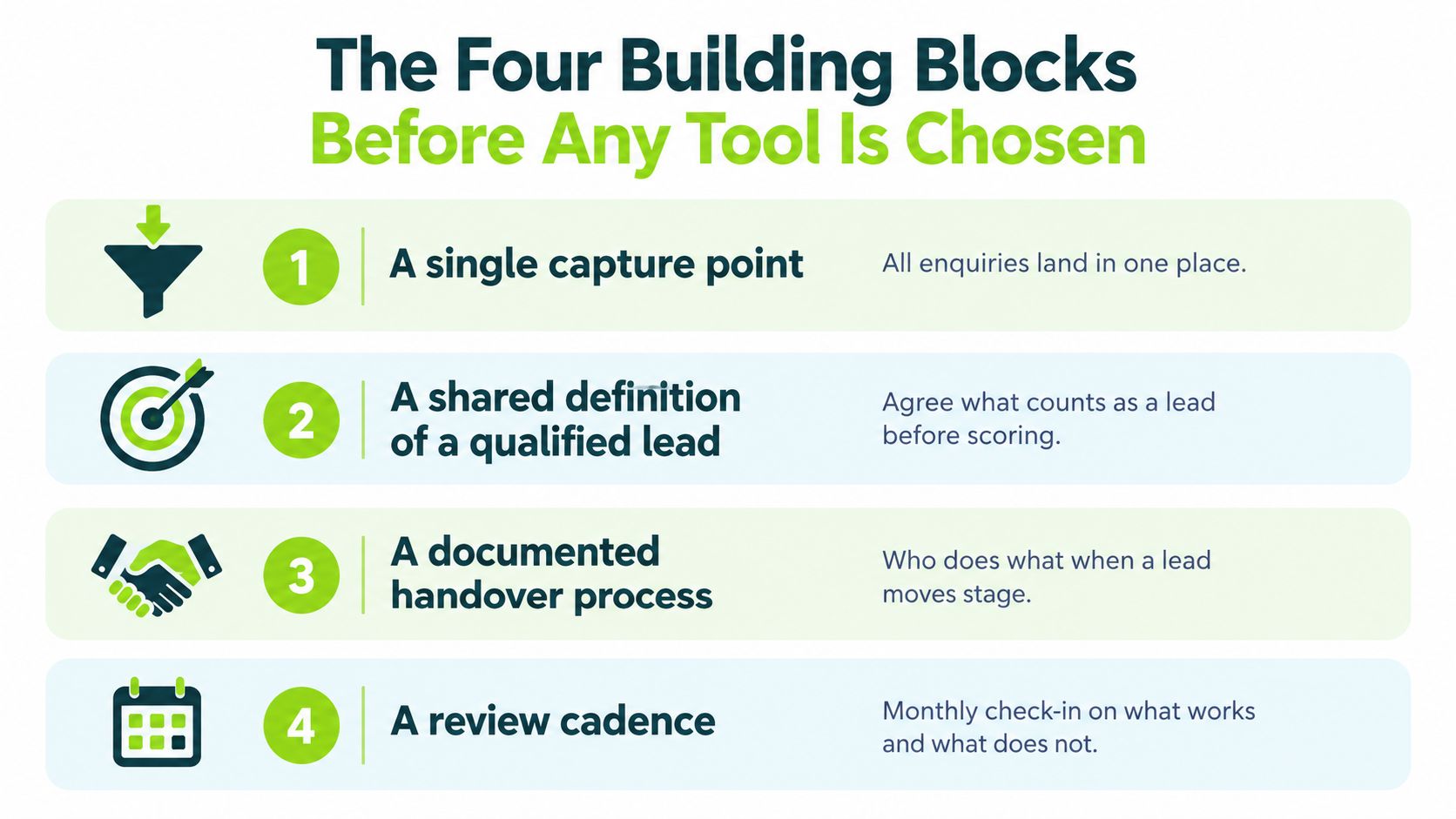
Capture, qualification, routing and follow-up
Capture: Set one reliable destination for membership enquiries, whether they arrive through a web form, email, telephone message or open-day RSVP. If staff have to check several inboxes and manually reconcile records, leads can be missed before AI enters the picture.
Qualification: Decide what staff need to know to make the next useful decision. A golfer asking about full membership and weekend play needs a different conversation from someone interested in weekday visitor golf. Keep the questions relevant and easy to answer.
Routing: Name an owner for each enquiry type. An individual membership question may belong with the membership lead; a society enquiry should go to the person responsible for groups. A workflow that classifies a lead without assigning someone to act has only moved the problem.
Follow-up: Agree the next action and when it should happen. That could mean a staff call, an approved email, a visit invitation or a reminder to review an unanswered enquiry. A cadence should also define when to stop.
A readiness check is straightforward: can the club identify the capture point, agreed qualification criteria, the person responsible for each handover and the next action if the golfer doesn't respond? Any missing answer is a process gap to fix before buying automation. For a fuller view of how CRM supports these handovers, see GolfRep's guide to golf club CRM software.
The management foundation matters too. ONS research found that 88% of firms in the top management-practice decile had adopted at least one advanced technology, compared with 51% in the bottom decile (ONS research on management practices and technology adoption). That association doesn't prove that process documentation causes adoption, but it supports a practical point: clear ownership and regular review make it easier to use technology deliberately. For background on the wider mechanics of automated processes, this automation guide for businesses is a useful companion.
Designing Lead Scoring That a Sales Team Will Trust
A score is only useful if it helps staff choose what to do next. Generic business-to-business scoring often leans on job titles or company size, which tells a golf club little about whether someone is likely to join. Use signals that relate to the club's actual membership decision and sales process.
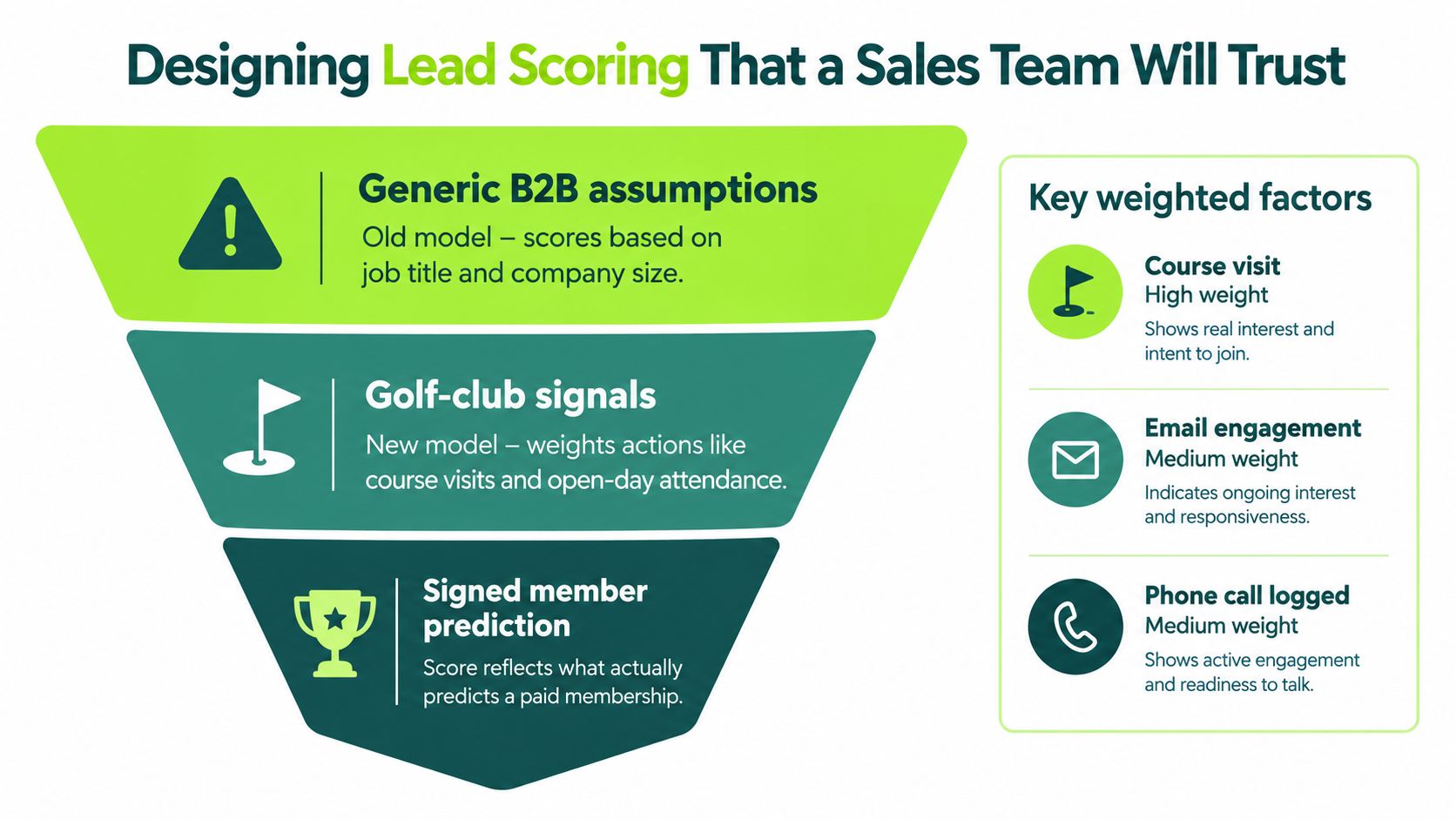
Build the score around three signals
Fit describes whether the membership proposition could suit the golfer. Consider location, the category they're asking about and how often they expect to play. These are conversation prompts, not grounds for an automated rejection.
Intent reflects what the person is trying to do now. Asking about joining fees, a trial round or a specific visit is a stronger reason for a timely human conversation than a general request for a brochure. An open-day RSVP or logged course visit can add useful context, but an email open alone is weak evidence of readiness.
Timing helps staff understand why the golfer may be considering a change at this point. A planned move into the area, an upcoming open day or interest in joining around the start of the season can guide the next conversation. Don't treat timing as certainty; it's a prompt to ask, not an answer to assume.
Translate those signals into actions instead of relying on an opaque number. A strong fit plus a direct question about joining costs can create an immediate call task. A relevant enquiry without a clear readiness signal might receive an approved same-day email and an invitation to arrange a visit. A general early-stage enquiry can enter a measured nurture sequence, with staff stepping in when the golfer responds or books.
Scoring rule: A score should prioritise attention, not make the membership decision.
Test the rules against the club's own outcomes. Review which signals appeared in enquiries that progressed to visits and paid memberships, then adjust the model if it sends staff towards the wrong conversations. Don't present a lead score as a prediction of someone's eligibility or as a substitute for speaking to them.
That boundary is also important legally. The Information Commissioner's Office guidance on automated decision-making explains that UK GDPR Article 22 restricts solely automated decisions with legal or similarly significant effects on people. A score can support a membership conversation, but an authorised person should make decisions about eligibility, access or pricing where the outcome could materially affect an individual. GolfRep's guide to a lead qualification process can help clubs think through the information staff need before the handover.
Triggers, Sequences and Where to Stop Chasing the Lead
A nurture journey should react to what the golfer does, not send messages because time has passed. The club needs clear entry conditions, sensible next steps and reliable exit rules. Without those, an automated sequence can continue after the person has joined or become a poor fit for further contact.
Map the journey from first signal to next action
An entry trigger might be a membership form, a telephone message logged by staff or an open-day RSVP. Each should create or update the same CRM record, with the original source and the golfer's stated interest retained. An open-day RSVP can flag a timely personal contact; it shouldn't automatically be treated as permission to send unrelated marketing.
The first message should acknowledge the enquiry in plain language and explain what happens next. For example: “Thanks for asking about membership. We'll review your question and contact you about the category you're interested in.” If the club can offer a visit booking link, include it only when it's relevant and up to date.
A middle-stage trigger might be no recorded reply after the club's agreed interval, a brochure request or a golfer returning to a membership page. The next contact can answer a likely question or offer a conversation, rather than repeating the first message. When the golfer replies, requests a call or books a visit, assign personal ownership to a named staff member.
Stop the sequence when the person joins, opts out, is marked uninterested by a salesperson or reaches the club's agreed inactivity limit. A fresh enquiry can start a new journey, but the workflow shouldn't treat silence as permission for endless reminders. The diagram's sequence includes example stopping points; clubs should set their own policy and ensure every channel respects consent and opt-outs.
The CRM connection is central. The UK Government's Business Data Survey found that businesses with AI tools integrated into existing systems were more likely to analyse data than businesses without that integration, 62% compared with 30% (UK Business Data Survey). A separate email sequence that doesn't update the membership record can't reliably show whether the golfer booked, visited or joined. For a practical explanation of how one event can trigger the next step in an automation, see Zapier triggers and actions explained. GolfRep also has guidance on golf club email marketing, including how email fits into a wider commercial process.
The Governance Layer That Keeps AI Honest
A club shouldn't have to guess who is accountable when an automated message is wrong. The owner should be a named person, usually the manager responsible for the membership process, with a clear route for staff to flag an error and pause the flow. The technology can carry out assigned tasks; it can't take responsibility for club policy.
Separate low-risk administration from decisions that need judgement. An automated workflow can acknowledge an enquiry, answer an approved frequently asked question, classify a topic, update a CRM record or create a call task. A staff member should review a pricing exception, a complaint response, an uncertain eligibility question or a request involving a sensitive personal circumstance.
Make review part of the service
Keep an audit trail that shows the message received, the automated action taken, the record updated and any staff intervention. Check that the golfer's contact details are accurate, that consent and opt-out status are recorded and that information from forms and the CRM remains consistent. If the workflow uses a category or score, staff need to be able to correct it.
Set a weekly review of a sample of automated conversations. Check for inaccurate answers, missed handovers, inappropriate tone and messages sent after an opt-out. Write down who is contacted when an error appears, who can pause the automation and who approves a restart after a correction.
Accountability stays with the club. An AI tool can draft or route a response, but the club must decide what it is allowed to say and who checks the exceptions.
Customer-facing use makes that discipline especially relevant. An AJG UK AI adoption survey reports that 52% of surveyed businesses use AI for chatbots or personal assistants and 48% for customer service; it also reports that 62% currently measure AI return on investment and 35% plan to (AJG's UK AI adoption risk survey). For a club, counting messages sent isn't enough. Review whether the workflow supports suitable conversations and helps move membership prospects towards visits and decisions, without compromising consent or service quality.
Monitoring the Workflow Once It Is Live
A workflow can look tidy on launch day and still send the wrong task to the wrong person a month later. A short weekly review helps a manager spot drift before it becomes a pattern. Keep the measures visible to the people who can act on them, and don't judge success by message volume alone.
| KPI | What it measures | Target direction | Source |
|---|---|---|---|
| Median first-response time | Time from enquiry capture to the first useful response | Down, without sacrificing accuracy | CRM timestamps or enquiry log |
| Lead-to-appointment rate | The share of enquiries that result in a booked visit or conversation | Up, while checking lead quality | CRM stages and booking records |
| Booked-visit-to-join rate | How often a booked visit progresses to a completed membership | Up, interpreted alongside category and fit | Visit outcomes and membership records |
| Human override rate | How often staff change, stop or correct an automated action | Understand the reasons, then reduce avoidable errors | Workflow logs and CRM activity |
A review routine the club can run itself
Each week, review a small sample of conversations across the main enquiry routes. Check whether the system captured the request accurately, used an approved answer, created the right follow-up and stopped when required. Record errors by type so the club can correct the prompt, rule, source data or staff procedure that caused them.
Set a pause rule before launch. Stop or redesign the workflow if it sends incorrect membership information, misses an opt-out, repeatedly assigns enquiries to the wrong owner or produces a response that could damage the club's relationship with the golfer. There isn't a universal safe error threshold; the club should define its tolerance based on the seriousness of each error. Any consent failure or materially misleading statement warrants immediate attention.
Give the general manager a concise weekly view of the four KPIs, notable errors and outstanding actions. Use the monthly commercial review to consider whether enquiry quality, visits and membership outcomes indicate the actual constraint is in capture, qualification, follow-up or the proposition itself. Teams exploring more autonomous systems may also find this introduction to instrument agentic AI systems useful, particularly for thinking about traceability and oversight.
Putting the Workflow into Practice Over the Next 30 Days
A sensible implementation starts with the club's current commercial constraint, not with a broad promise to automate everything. If membership enquiries are arriving through several routes but nobody can see their status, fix capture and ownership first. If staff already handle enquiries well but can't track visits through to joining, focus on CRM stages and outcome recording instead.
A practical rollout
First, map the existing journey. Write down how a membership enquiry arrives, who sees it, what information is recorded and what happens after the first contact. Identify the handovers where staff rely on memory or duplicated records.
Next, agree the operating rules. Define what the club asks, who owns each enquiry type, which messages are approved and when a person must take over. Include consent, opt-outs and stop conditions.
Then, run one controlled pilot. Start with membership enquiries and connect the capture point, CRM record, follow-up task and reporting. Compare the live process with the club's own baseline, review conversations and correct problems before extending the workflow to visitors or societies.
The case for a focused pilot is practical. UK Government AI adoption research identifies choosing suitable business use cases as the leading implementation difficulty for 39% of firms, ahead of cost at 21% and insufficient AI expertise at 16% (UK Government AI adoption research). A narrow, owned workflow is easier to assess and safer to adjust than a wide rollout.
AI availability isn't the same as an end-to-end membership process. The commercial value comes from connecting the club's existing systems and people around a service that is clear, measurable and accountable.
GolfRep helps golf clubs map and improve the commercial journey from membership enquiry through qualification, follow-up and conversion. If you'd like to identify where your workflow needs stronger ownership or measurement, visit GolfRep.
Ready to tap into our proven growth system?