What Is Revenue Growth Management for Golf Clubs

Most club committees still talk about growth as if the answer is more enquiries. That's the wrong starting point. If a club is already getting interest but losing people between first contact and signed-up member, then the issue isn't reach, it's revenue growth management.
At GolfRep, we look at what is revenue growth management through a club lens, not a retail one. In plain English, it's the discipline of improving net revenue per member by managing pricing, membership structure, category mix, promotions, and lifecycle decisions as one commercial system. That matters because the club isn't just trying to “sell more”, it's trying to capture more of the value already arriving through the enquiry stream.
Rethinking Growth Beyond the Enquiry
A club can spend months arguing about ad spend and still leave money on the table because the enquiry was handled badly. The common mistake is to treat growth as a traffic problem, then ignore what happens after the phone rings or the form gets submitted. In golf, that's where the leak usually sits.
Revenue growth management is different. It's a cross-functional commercial system that looks at pricing, promotions, assortment, and trade investment together, then checks the result at the net revenue level rather than in isolation. That means leaders can see whether a price increase is undone by promo leakage, mix downgrade, or trade-spend dilution, which is exactly the kind of joined-up thinking clubs need when they're setting membership prices, category rules, and package design Buynomics' guide to revenue growth management.
The club version of RGM
For a golf club, the product isn't a tin on a shelf. It's a membership relationship, with capacity limits, churn risk, and local demand shaping every commercial choice. That's why the optimisation target shifts from raw sign-ups to net revenue per member, with attention on which category each member enters, how long they stay, and whether the offer is pulling the right mix of people into the club.
Practical rule: if the club is already receiving enquiries, the first commercial question isn't “How do we get more?”, it's “How do we convert, retain, and grow the value of the enquiries we already have?”
That framing changes the committee conversation. Instead of debating awareness campaigns in the abstract, the club can examine pricing, joining fees, benefit design, response handling, and member lifecycle as connected levers. For a capacity-constrained club, that's where the revenue prize sits, not in chasing more noise.
The Five Levers Translated for Clubs
Practitioner literature on RGM keeps coming back to five levers, and the names matter because they describe a system rather than a loose collection of tactics. BCG identifies brand portfolio pricing, pack-price architecture, active mix management, promotion optimisation, and trade terms optimisation as the core areas BCG's RGM framework. Another guide groups the same logic around pricing, promotions, PPA, trade terms, and distribution mix.
Pricing and portfolio pricing
In club terms, this is the obvious one. It covers full membership fees, joining fees, concession categories, and how the club positions each tier against local alternatives. If the committee changes one price without reviewing the rest of the structure, it's not doing RGM, it's making a tactical move with no view of the whole.
Pack-price architecture
That phrase sounds retail-heavy, but the club equivalent is membership category design. A strong structure makes each option easy to understand and hard to game. If the club has intermediate, flexible, corporate, or lifestyle-style offers, the architecture needs to make sense together, not just look neat in a brochure.
Active mix management
Many clubs underperform. The issue isn't only how many members join, it's which types join. If one category is filling while another is empty, the club may be protecting headline volume while weakening overall yield. The right question is whether the mix supports capacity, culture, and long-term value.
Promotion optimisation and trade terms
Promotions in golf don't always look like retail discounts. They can be trial offers, corporate packages, society terms, guest incentives, or bundled add-ons. Likewise, trade terms map neatly to how a club structures corporate relationships, society deals, and partner arrangements. The wrong approach is to chase short-term uptake at the expense of margin and service consistency.
If you want a practical starting point, review the structure against Golf club pricing strategy and ask which lever is being overused, and which is being ignored. When the pricing sheet is built in isolation from the rest of the commercial system, revenue leakage is usually hiding somewhere else.
Why Most Clubs Leak Revenue Before Tee-Time
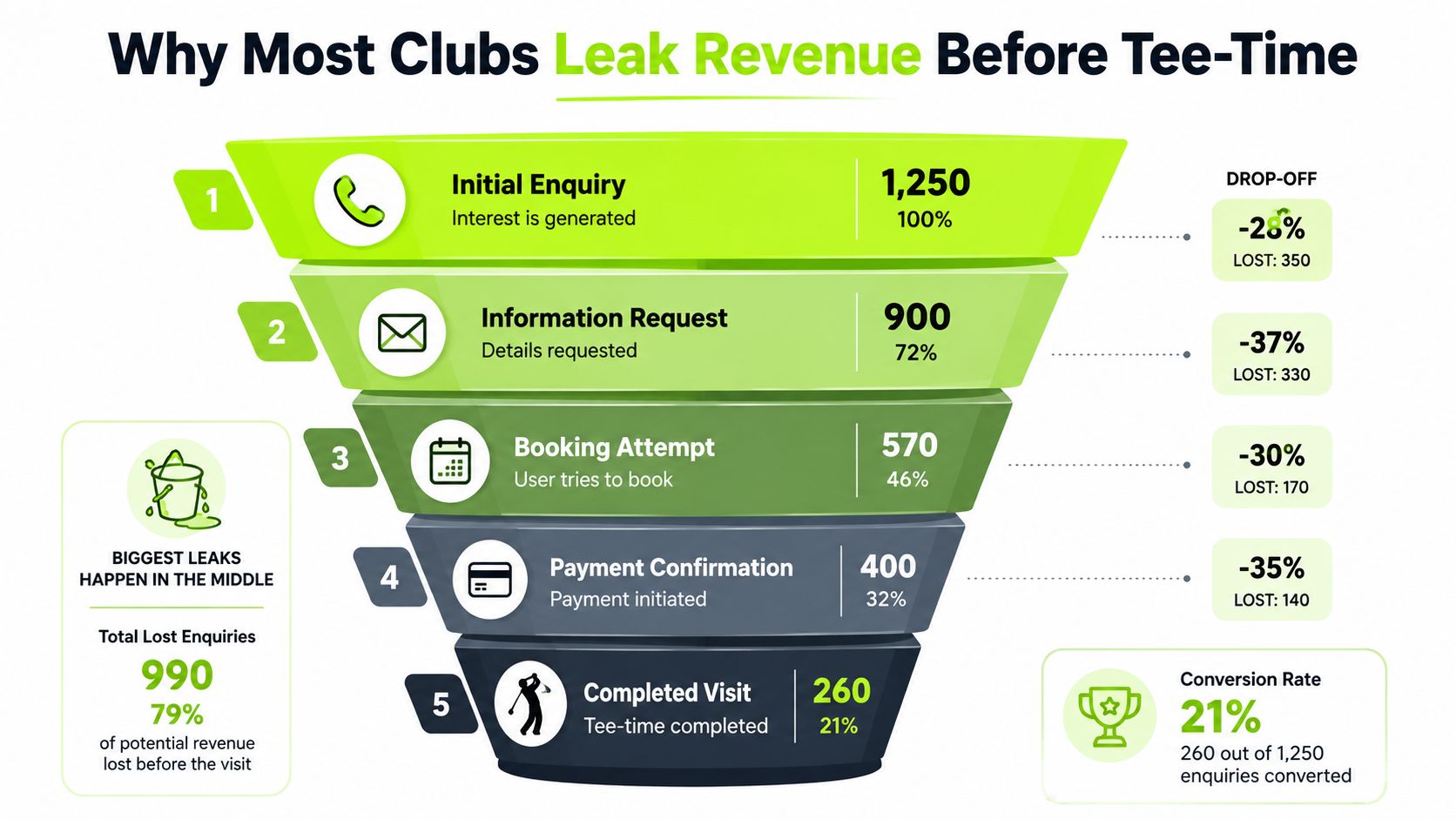
The biggest mistake I see is committees judging the strength of demand without looking at the journey from enquiry to visit. A club can have decent awareness, steady web traffic, and a full inbox, then still lose serious value because nobody owns the response, the follow-up is late, or the next step isn't tracked. That's not a marketing problem. It's an operating problem.
Where the leak usually starts
The first failure is response time. If an enquiry sits in a general inbox while three people assume someone else is handling it, the club loses momentum fast. The second failure is lead visibility, because nobody can say how many enquiries arrived, which ones were contacted, and which ones booked a visit.
That's where CRM discipline matters. Without it, the committee is making pricing and marketing decisions in the dark, because the club can't see where demand is stalling. GolfRep's note on how many golf club enquiries disappear without the club realising sits in that gap between interest and action, where manual follow-up tends to fall apart.
What a better process looks like
A club doesn't need a more complicated funnel. It needs ownership. One person or one system should capture the enquiry, assign it, log the response, and track the visit outcome. If the committee can't see that chain, it can't diagnose whether the issue is the offer, the response, or the sales conversation.
The club should measure the hand-off, not just the headline enquiry count.
That's why pricing changes alone can be cosmetic. If the enquiry path is leaky, a better price might create more interest, but not more members. The operational plumbing has to hold before the commercial tweaks can do their job.
A Six-Stage Roadmap for Private Clubs and Resorts
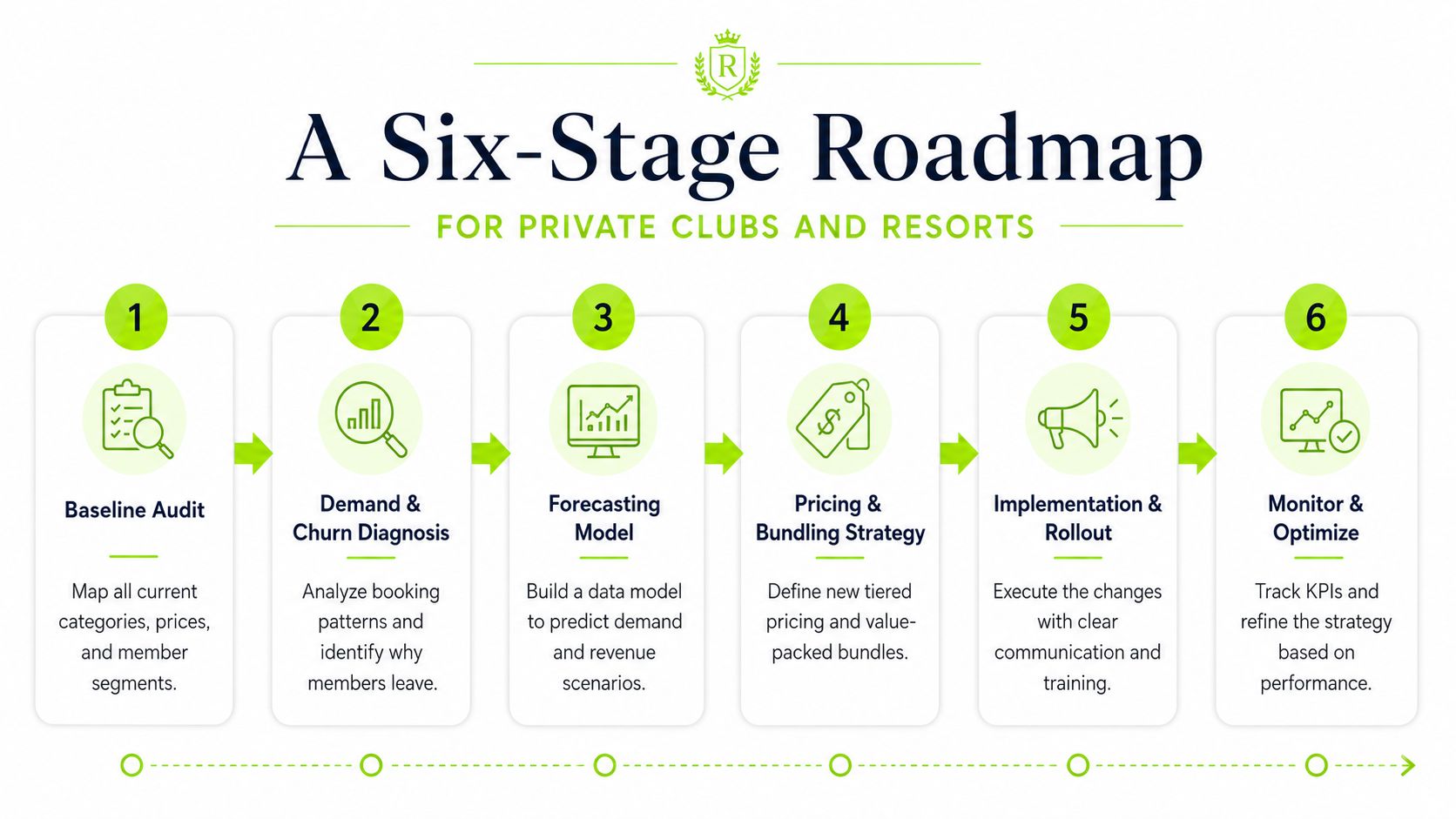
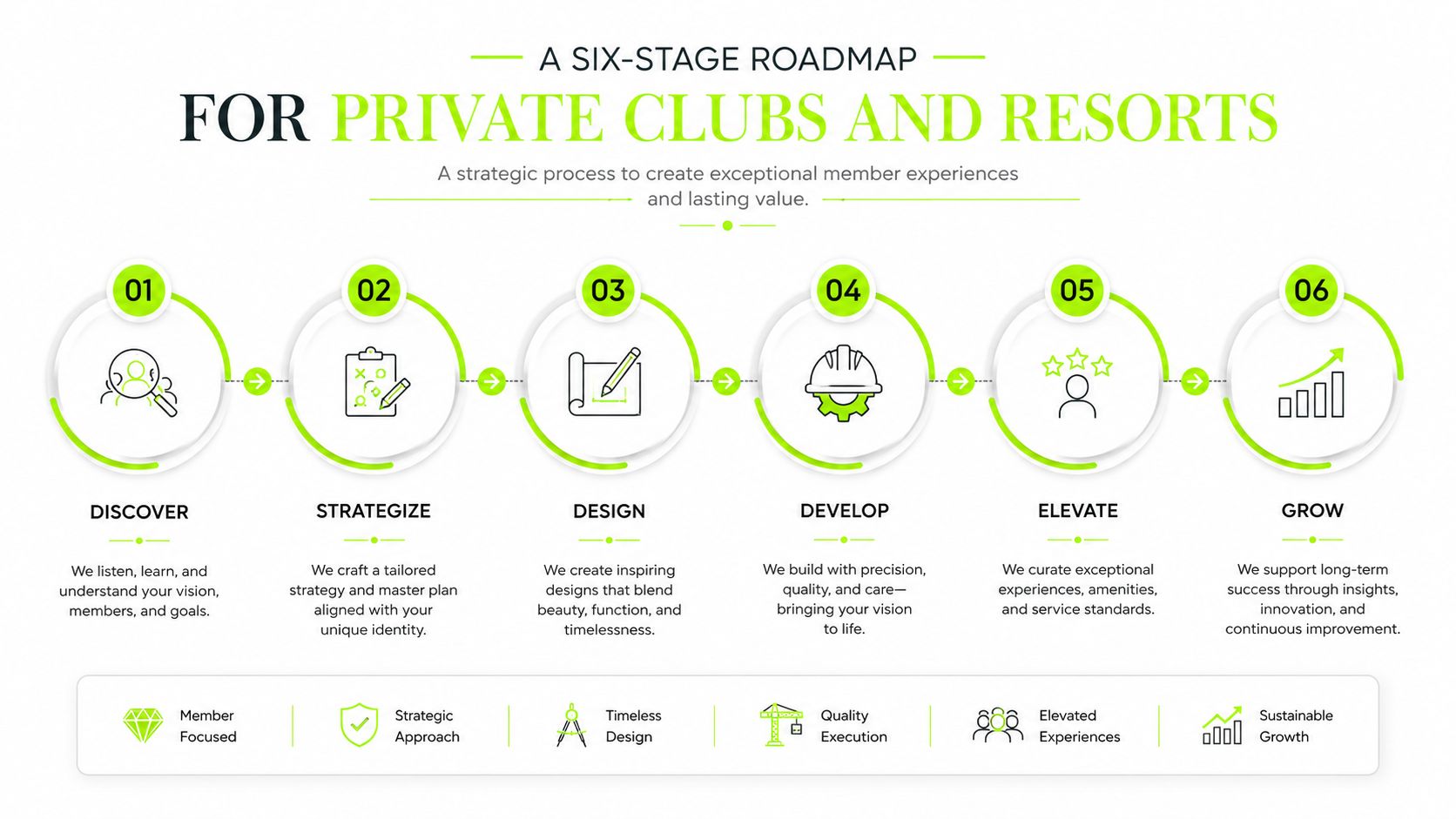
A workable RGM programme starts with the structure already in front of the committee, not with a big brand campaign. The sequence matters because each stage depends on the one before it. If the club rewrites prices before it understands demand patterns, it usually creates more debate than value.
1. Baseline audit
Start with every category, joining fee, offer, and concession currently in play. That includes the obvious membership tiers, but also corporate arrangements, family add-ons, and any legacy deals that have been carried forward because nobody wanted to revisit them. The deliverable is a clean commercial map that shows what the club sells, not what people think it sells.
2. Demand and churn diagnosis
Look at which categories are attracting interest, which ones are converting, and where members are leaving. The committee, operations team, and club secretary need the same picture, otherwise each group will blame a different cause. This is the point where a private club starts seeing whether the issue is pricing, category design, service delivery, or poor follow-up.
3. Package architecture redesign
Now the club can decide what each tier is for. Full, intermediate, flexible, and corporate categories should each have a job to do. If two categories are aimed at the same person, the structure is probably muddy and the sales team will struggle to explain it clearly.
4. Enquiry handling and CRM setup
Marketing, membership, and operations have to stop working in silos. Every enquiry needs ownership, a visible status, and a defined next action. For multi-site groups, a central CRM makes that hand-off far easier because follow-ups can be standardised instead of relying on memory or inbox discipline.
5. Nurture and follow-up automation
Manual follow-up works until a busy week, a committee change, or holiday cover breaks it. Automated reminders, call tasks, and email sequences keep the enquiry alive long enough for a decision. That's not about sounding robotic, it's about making sure warm demand doesn't cool off because nobody chased it.
6. Continuous measurement
Once the system is live, the club needs a rhythm for review. That means checking whether the structure is improving conversion, whether the mix is moving in the right direction, and whether the process is being followed consistently. GolfRep's CRM-enabled approach is one option for clubs that want lead capture, ownership, and follow-up tied together rather than left to manual process.
What Real Club Growth Has Looked Like
Theory only matters if it changes the mechanics of a club. The strongest examples are the ones where the intervention was specific, not vague. Different clubs need different levers, but the pattern is the same, fix the system and the revenue outcome becomes easier to manage.
At Bidston, the turnaround came from a combination of category mix discipline and structured follow-up, which helped move the club away from near-closure and into a stronger recurring base. The important part wasn't just more activity. It was that the club had a clearer commercial structure and a better way of handling the demand that landed.
Addington Palace showed what steady pipeline building looks like when enquiry handling is treated as a process rather than an inbox chore. That kind of discipline is unglamorous, but it gives a committee visibility, and visibility is what stops debates from turning into guesses.
Downes Crediton is a useful reminder that profitable growth doesn't have to be discount-led. A club can grow membership by tightening the offer, clarifying the value, and handling responses properly without training the market to wait for a lower price. That's a much healthier commercial habit.
For multi-site groups, Macdonald Hotels & Resorts showed why a centralised CRM matters. When follow-up can be standardised across sites, the operator doesn't depend on each venue reinventing the wheel. It becomes possible to manage lead ownership, timing, and conversion in a consistent way.
If you want a simple practical example of how clubs think about the social side of member experience, the Ecuadane 19th hole flag is a useful reminder that the offer is never just the round of golf. The club experience includes identity, routine, and the moments around the game that make membership feel worth keeping.
The KPIs That Matter
Website visits, social reach, and newsletter opens are easy to count. They still do not tell a committee whether enquiries are turning into members, whether the club is winning the right mix of categories, or whether pricing is helping net revenue per member. RGM narrows the dashboard to the measures that show commercial behaviour, not just activity.
The core measures
| KPI | What it measures | Target benchmark |
|---|---|---|
| Enquiry to visit conversion rate | How many enquiries turn into booked visits | Track weekly and monthly trends, with the aim of improving the share that reaches a visit |
| Average time to first response | How quickly the club replies after an enquiry | Measure in minutes and hours, not days |
| Net revenue per member | Value generated after category and offer choices | Review by member type and over time |
| Category mix shift | Whether the club is filling the right membership types | Compare the mix against capacity and strategic goals |
| Rolling 12-month churn | How many members leave over a full year | Monitor trends and investigate any sudden movement |
A committee does not need perfect analytics to begin. It needs agreement on which numbers matter, who owns them, and what action follows when one of them moves. Once that shared view exists, pricing conversations usually become calmer because the committee can see whether a change supports conversion or puts pressure on demand.
A working dashboard
A one-page view usually does the job at the start. Put enquiry count, first-response time, visit conversion, current category mix, and churn trend in one place so the secretary, membership lead, and committee are looking at the same commercial picture.
For clubs still building their measurement discipline, Golf club marketing analytics is a useful companion piece because it shows how enquiry tracking feeds commercial decisions. The point is not to produce more reports. It is to make faster decisions about which lever to pull next.
If the club cannot see response time and conversion together, it is not managing growth. It is hoping for it.
Common Pitfalls When Borrowing FMCG Playbooks
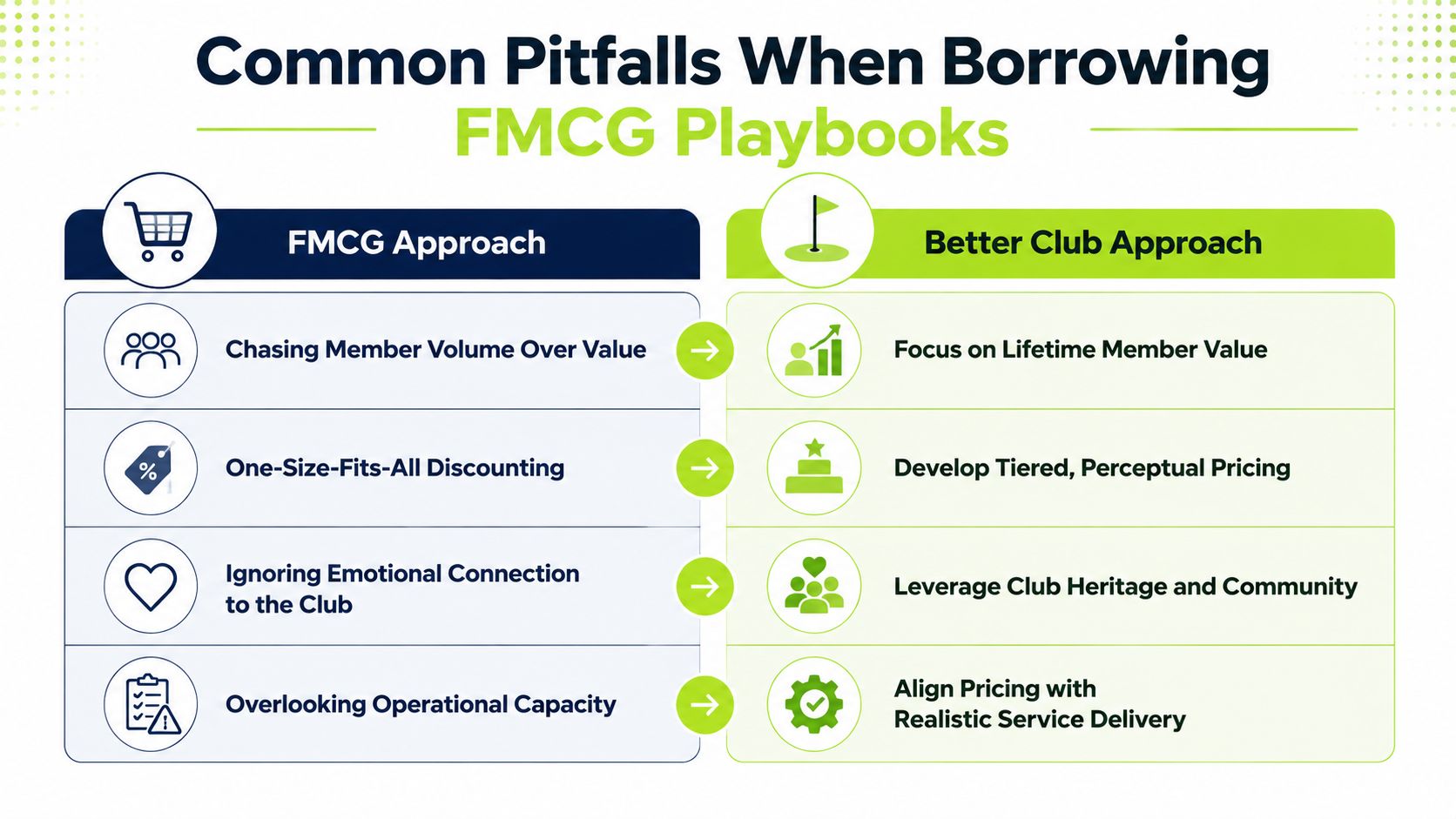
RGM started in FMCG, so it's tempting to copy the language and paste it onto a golf club. That usually goes wrong for predictable reasons. A club is not a supermarket category, and membership is not a one-off basket purchase.
The first mistake is discount-led growth. Clubs often assume lower price equals faster uptake, then discover they've trained prospects to wait for a deal. The second is treating membership like a transaction instead of a recurring relationship, which means churn gets ignored because the first sale looks like success.
The third trap is using CRM as a spreadsheet. If the club can't assign ownership, automate follow-up, and see what happened to each enquiry, the system isn't really a CRM in commercial terms. It's just a list.
The fourth is assuming more advertising will fix a response problem. If the club is already leaking enquiries, extra spend just pours more leads into the same hole.
A simple audit helps here. Look at the last ten enquiries and check how many received a response within an hour. Then check how many were booked, followed up, and converted. That gives the committee a cleaner diagnosis than any abstract marketing debate.
Practical Next Steps for Your Committee
A committee meeting can make progress in 30 days if it stays disciplined. Start with a full audit of current categories and pricing, then measure response time across the last month of enquiries. Identify the single biggest leak, whether that's slow follow-up, muddy category structure, or poor lead visibility, and agree one change to test.
That's the point where a sector-specific partner becomes useful. GolfRep combines lead generation with structured follow-up and CRM systems so clubs can see demand, track conversion, and build a more predictable pipeline. The work is performance-led, and the aim is to fix the commercial system rather than chase isolated campaigns, with a Risk-Free Guarantee used to cover shortfalls where applicable.
If your club wants clearer enquiry handling, better conversion tracking, and a revenue system that fits golf rather than generic lead gen, visit GolfRep and review how the process could work around your current membership structure.
Ready to tap into our proven growth system?