What Is Experiential Marketing for Golf Clubs?

Most advice about experiential marketing gets the order wrong.
Clubs are told to create a memorable event, generate buzz, fill the diary, and let the experience sell itself. That sounds sensible. It also ignores the part that usually decides whether any of it produces membership revenue.
A golf club rarely struggles because nobody is interested. More often, the problem is what happens after interest appears. An enquiry comes in, someone means to reply, a message sits in an inbox, the follow-up is vague, and the prospect moves on. So when people ask what is experiential marketing for golf clubs, the better question is this: how do you turn a strong first impression into a structured membership process?
That matters because an experience on its own is not a growth system. It's a trigger. If the club doesn't capture the attendee properly, qualify them quickly, and follow up with a clear next step, even a well-run event becomes an expensive memory.
The Real Growth Problem Most Golf Clubs Face
Many club managers still assume the main issue is lead volume. Get more people through the gate, run more campaigns, promote more visitor offers, and membership will sort itself out.
In practice, that usually isn't the constraint.
The more common bottleneck is response speed and follow-up discipline. In the UK market, the average response time to membership enquiries remains at 30 hours, and faster response is directly linked to higher enquiry conversion rates, according to The Revenue Club's reporting on response time and conversion. If a prospect asks about joining on Monday and hears back on Tuesday, the club hasn't just delayed a conversation. It has handed momentum away.
More enquiries do not fix a weak process
If a club already takes too long to reply, adding more enquiries usually creates more backlog, not more members.
A lot of committees and management teams still evaluate marketing in isolation. They look at clicks, event attendance, or form submissions. Those things matter, but they don't tell you whether the club can handle demand. If the sales process depends on one busy staff member checking emails between meetings, every campaign has a ceiling.
Practical rule: Don't scale lead generation before you can see, assign, and respond to every enquiry quickly.
That is why experiential marketing needs to be understood properly. It can be excellent at creating interest because it lets people sample the atmosphere, the course, the people, and the value of membership. But if that interest enters a manual process, the commercial benefit drops fast.
The real lever is conversion control
Clubs that grow predictably tend to have a few basics in place:
- Lead visibility: Every enquiry is logged in one place rather than scattered across email inboxes, paper notes, and verbal handovers.
- Fast acknowledgement: Prospects get a response quickly, even if the full conversation happens slightly later.
- Clear ownership: Someone knows who follows up, when, and with what message.
- Tracked outcomes: The club can see which enquiries booked a visit, attended a trial, or became a member.
Without those basics, experiential activity becomes hard to evaluate. You might know the event felt successful. You won't know what it produced.
That is the first correction most clubs need. The question isn't just how to attract attention. It's how to convert it reliably.
Defining Experiential Marketing for Your Club
Experiential marketing is marketing that lets a prospect actively experience your club rather than just hear about it.
That sounds simple, but it separates a useful strategy from a lot of golf club activity that gets labelled as marketing without doing much to change buying intent. A leaflet, a social advert, or a discounted green fee offer communicates information. An experience lets a person feel what membership would be like.
What it is and what it isn't
A standard open day often says, "Come and have a look around."
Experiential marketing says, "Come and take part in something that shows you why belonging here is different."
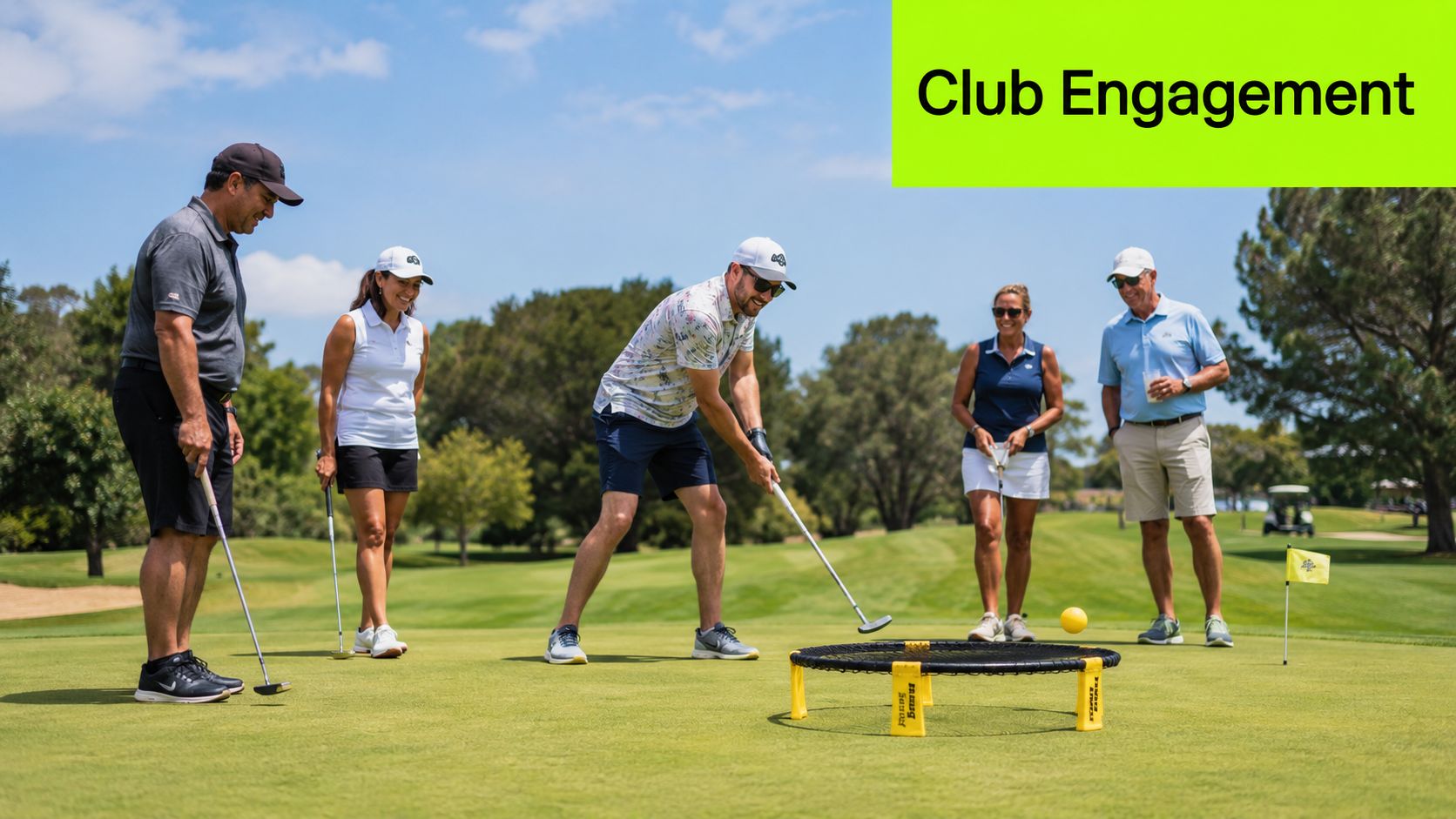
That could mean a short coached session on the range, a course strategy evening with the pro, a mixed social format that introduces the club's culture, or a member-hosted event that lets guests meet the kind of people they'd actually spend time with if they joined.
A useful comparison is this:
| Approach | What the prospect receives | Likely impression |
|---|---|---|
| Traditional promotion | Information about the club | "I understand the offer." |
| Discount-led campaign | A reason to try cheaply | "I might buy if the price is right." |
| Experiential marketing | A lived sample of the club | "I can see myself here." |
That last line matters most for membership sales. Joining a club isn't just a transaction. People are buying routine, identity, relationships, convenience, status, and enjoyment. A proper experience helps them test all of that.
Why golf clubs are well suited to it
Golf clubs already have the raw ingredients. They have a physical environment, social interaction, coaching expertise, food and beverage, competition, heritage, and lifestyle cues. The mistake is reducing all of that into generic marketing messages such as "friendly club", "great course", or "welcoming atmosphere".
Those claims don't land until someone feels them.
A brochure can explain the club. An experience can remove the uncertainty that stops someone joining.
That is why the best experiential work isn't built around giving things away for free. It isn't about turning the club into a discount platform. It's about staging moments that let the right prospect understand the value behind the fee.
A better definition for club leaders
For a golf club, experiential marketing is the deliberate design of an event or interaction that helps a prospective member participate, connect, and imagine belonging.
That includes the activity itself, but it also includes how the club hosts, how staff and members interact, what data gets captured, and what happens afterwards. If those parts are missing, the experience may still be enjoyable. It just won't be commercially organised.
The Core Components of a Memorable Golf Experience
A memorable golf experience doesn't happen because the weather was good and the clubhouse looked presentable. It happens because the club designed the day with intent.
Most weak events look the same. Guests arrive, someone points them towards coffee, there is a quick welcome, a basic activity follows, and people leave with a vague "let us know if you've got any questions". Nothing was wrong. Nothing was strong either.
A more effective experience has structure.
The difference between generic and memorable
Here is the shift clubs need to make:
- Generic event: The club shows facilities and hopes people are impressed.
- Memorable experience: The club guides guests through a sequence that creates participation, relevance, and emotional clarity.
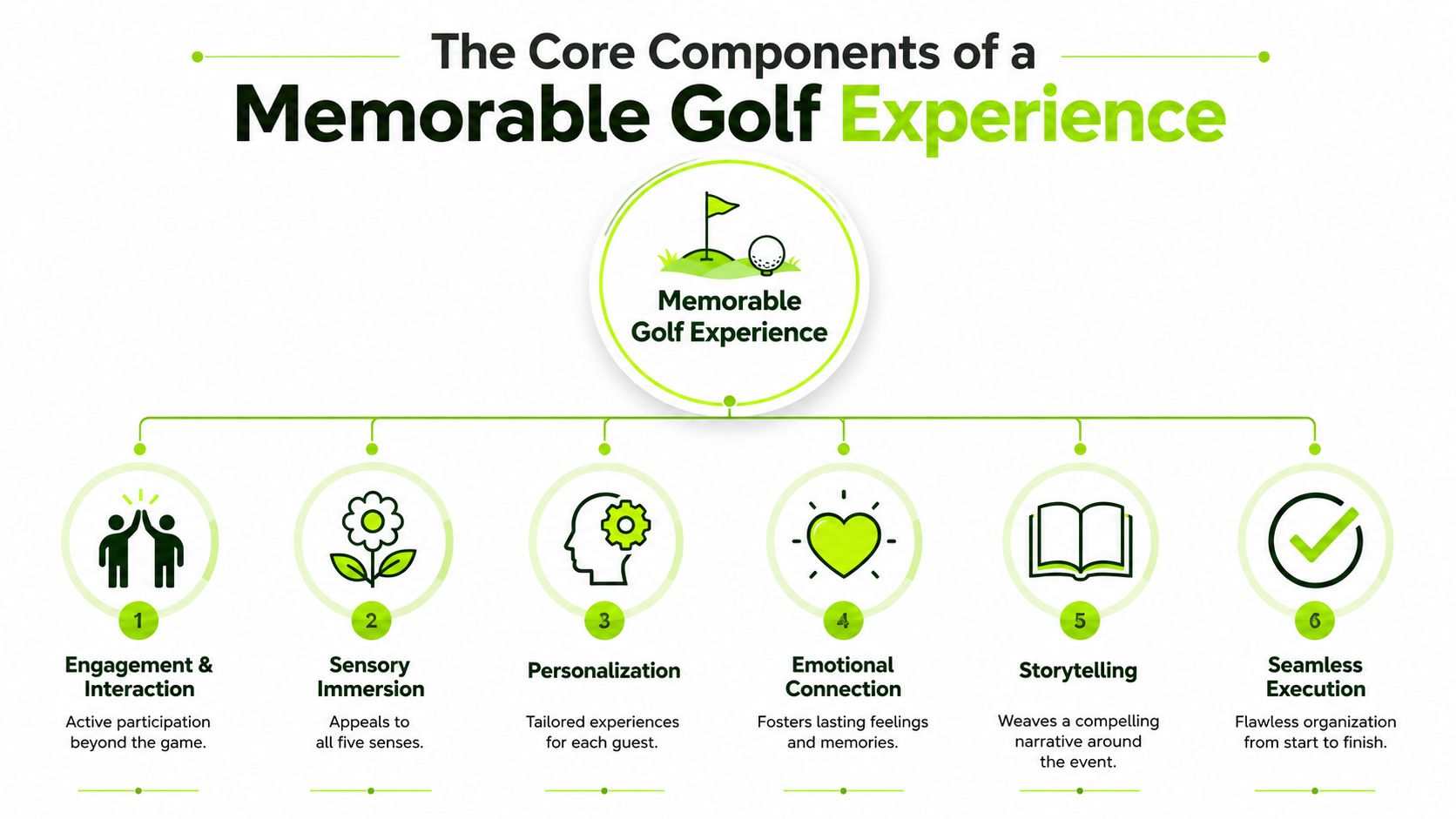
That usually rests on a handful of components working together rather than one big idea.
Six parts that actually change the outcome
Engagement and interaction
Guests need to do something, not just observe. That could be a short skills challenge, a team format, a simulator session, or a coached on-course moment. Passive attendance is weaker than active involvement.Sensory immersion
Golf clubs often overlook this because they assume the setting speaks for itself. It doesn't unless you stage it well. Arrival, presentation, pace, hospitality, sound, food, and visual detail all shape whether the club feels polished or ordinary.Personalisation
A low-handicap player, a lapsed member, a beginner, and a family prospect should not all receive the same journey. Tailoring the experience makes the event feel relevant instead of generic.Emotional connection
People join clubs where they can see a future version of themselves. That often comes from meeting the right members, feeling comfortable, and sensing that they would fit.Storytelling
A strong event has a point of view. It shows what the club stands for. Heritage clubs can lean into tradition and standards. Modern clubs can emphasise flexibility, technology, and community. The story must be consistent.Seamless execution
This is the least glamorous part and often the most important. Sign-in, host allocation, activity timing, data capture, and follow-up cues all need to run cleanly. Sloppy execution damages trust.
Details shape perception
Clothing, equipment presentation, and guest comfort matter more than many clubs think. If you're planning branded event kit or staff apparel, resources on advanced golf hat fabrics are useful because they show how performance materials affect comfort, appearance, and practicality during live events.
The same goes for technology. A modern range experience becomes far more compelling when guests can see ball data, compete in formats that lower the intimidation factor, and move naturally from trial to conversation. Clubs exploring that route should look at this guide to a digital driving range strategy.
Good experiential marketing feels effortless to the guest because the club has done the hard work beforehand.
If one of those components is missing, the event can still be pleasant. If several are missing, it won't be memorable enough to justify proper follow-up.
The Measurable Benefits Beyond Brand Awareness
"Brand awareness" is where weak experiential marketing conversations usually stop. It sounds respectable, but it's often too vague to help a club make decisions.
A golf club doesn't need more activity that is difficult to evaluate. It needs activity that can support membership revenue, stronger retention, and better-quality demand. That is where experiential marketing becomes commercially interesting.
According to Rocket X's UK experiential marketing statistics, experiential marketing delivers a validated 3:1 to 5:1 ROI on every pound invested, and 85% of attendees are more likely to purchase after engaging in a branded experience. For clubs, that matters because membership decisions are rarely made on information alone. A good experience moves someone closer to action before the sales conversation even starts.
It pre-qualifies interest
Traditional advertising often produces mixed intent. Some people enquire because they are curious. Some enquire because they want the cheapest option. Some enquire because they clicked impulsively and know very little about the club.
An experience tends to narrow that field. People who attend, engage, ask questions, and spend time with your staff are signalling stronger intent. They have already invested attention. In many cases, they have started to qualify themselves.
That doesn't mean every attendee becomes a member. It means the club starts later in the trust cycle.
It supports better-fit members
Price-led marketing often attracts people comparing clubs on cost alone. Experiential activity gives you a better chance of attracting prospects who care about environment, standards, community, coaching, facilities, and convenience. Those are often the people who stay longer and fit the club better.
Long-term measurement becomes important. Many clubs still count heads at an event and stop there. That misses the true commercial question. Which attendees booked a visit, progressed to a trial stage, or joined later after a nurture sequence?
The event is not the result. The event is the first measurable stage in a longer buying process.
That same discipline exists in other marketing channels. For example, if you're trying to measure influencer campaign value, the useful question isn't whether people saw the content. It's whether the campaign drove meaningful action. Experiential marketing should be judged the same way.
It strengthens loyalty and advocacy
The value doesn't end at first purchase. Positive brand experiences also influence how people feel about staying connected to a club and talking about it afterwards. That is one reason experiential marketing often outperforms purely promotional activity over time.
For golf clubs, this matters in two ways:
- Prospects arrive warmer because they have already had a positive interaction.
- Existing members can become advocates when the club creates experiences worth inviting others into.
That combination is far more useful than a short spike in enquiries that the team can't handle. If a club wants predictable growth, awareness is only useful when it leads into a trackable path from attendance to conversation to membership.
Practical Experiential Ideas for Golf Clubs
Experiential marketing doesn't have to mean a huge production budget, a celebrity guest, or a one-off spectacle. In golf, the strongest concepts are often simple, well-targeted, and easy to connect to a membership conversation.
The common mistake is trying to run one event for everybody. A better approach is to build specific experiences for specific people.
Four formats that fit real club goals
The TrackMan taster for serious improvers
A club invites local golfers for a short gapping and ball-flight session with the PGA professional. Guests see useful data, get one or two practical coaching insights, and compare indoor and outdoor performance. The objective isn't to sell a lesson package on the spot. It's to position the club as a place for golfers who want to improve and use the range regularly.
The sunset scramble and social evening
This works well for younger professionals, couples, and newer golfers who may find traditional club entry points too formal. The experience combines a low-pressure team format with food, drinks, and hosted introductions in the clubhouse afterwards. The event sells atmosphere more than score.
The behind-the-greens tour
For committed golfers, few things are more persuasive than understanding how the course is maintained and why it plays the way it does. A session led by the head greenkeeper and club team can turn course quality from a vague claim into something tangible. This suits clubs with strong conditioning standards and members who take pride in them.
The family discovery day
Some prospects do not need a hard membership pitch. They need reassurance that the club is usable, welcoming, and relevant to family life. A short-format activity mix, beginner-friendly coaching, and relaxed hospitality can make that clear.
Why these ideas work better than generic open days
Each of those examples does three things at once:
- Targets a clear audience
- Creates active participation
- Opens a natural membership conversation
That is what standard open days often miss. They invite everyone, say very little, and rely on the prospect to do the interpretation.
For clubs wanting more inspiration, this article on interactive event ideas from 1021 Events is useful because it shows how participation changes the energy of an event. And if your clubhouse programme needs to support the same membership journey, this guide to a clubhouse event marketing strategy is worth reading.
The real commercial advantage
Experiential marketing isn't only about the day itself. It shapes what happens after. Positive experiences have a strong effect on loyalty, with 70% of attendees becoming repeat customers after an event and 65% of consumers saying positive brand experiences directly influence their loyalty, as noted earlier in the article.
That matters for clubs because a first event can lead into later visits, guest rounds, lessons, social attendance, and eventually membership. The best experiential ideas create a path, not just a turnout.
A useful event gives people a reason to come back. A strong one gives them a reason to belong.
Turning Event Attendees into Committed Members
Consequently, most clubs lose the return.
They run the event well enough. Guests enjoy it. Conversations happen. A few people say they are interested. Then the data sits on a signup sheet, or in a staff member's phone, or inside a spreadsheet that nobody updates consistently. By the time anyone follows up properly, the energy has gone.
That is why experiential marketing on its own is incomplete. The front-end experience has to feed a back-end system.
What must happen immediately after the event
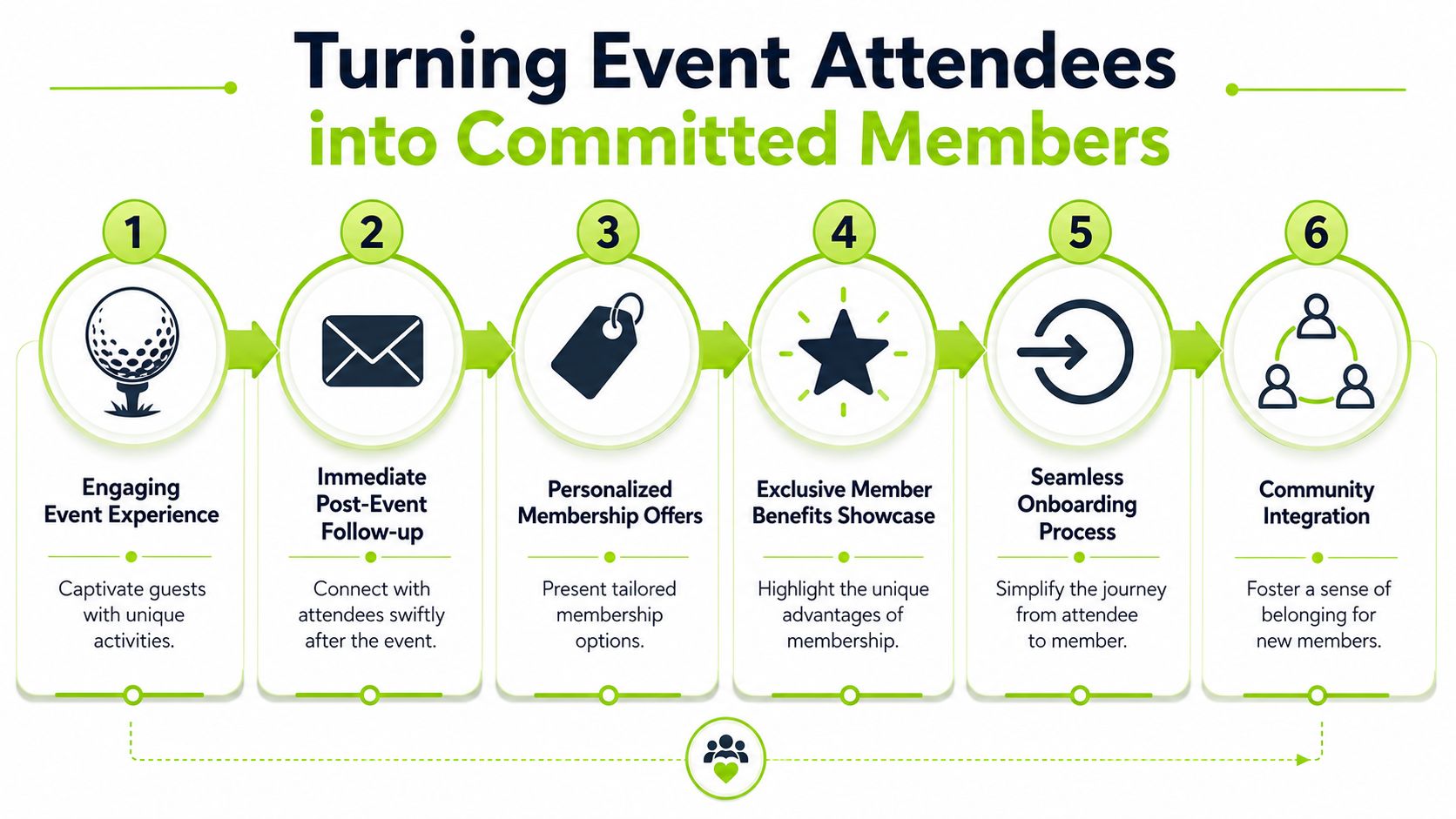
A workable process usually includes these steps:
Capture clean attendee data
Names, email addresses, phone numbers, attendance type, playing profile, and declared interest should be recorded properly, not scribbled down and sorted later.Push that data into a CRM
If the information stays outside the club's system, it becomes hard to assign, segment, and track.Send an immediate acknowledgement
The attendee should hear from the club quickly while the event is still fresh in mind.Trigger the right next step
That could be a tour booking, a follow-up call, a membership information pack, a guest round, or a coaching consultation.Track progression
You need visibility on who responded, who booked, who went quiet, and who needs another touchpoint.
Why speed matters so much
The timing is not a small detail. It changes outcomes.
According to Teamgate's lead response time study, responding to leads within 5 minutes increases conversion rates by up to 100x compared to waiting 30 minutes, and 78% of customers choose the first company that responds to their enquiry. For golf clubs, that should end the idea that manual follow-up is good enough after an event.
A prospect who attends your experience is often comparing several leisure options, not just several golf clubs. If your reply is delayed, someone else can become the first serious conversation.
Operational reality: staff don't fail because they don't care. They fail because manual follow-up depends on memory, time, and availability.
Manual process versus system process
| Follow-up method | What usually happens |
|---|---|
| Manual inbox checking | Delays, missed leads, inconsistent replies |
| Shared spreadsheet | Basic record-keeping, weak accountability |
| CRM with automation | Immediate acknowledgement, clear ownership, tracked pipeline |
The point isn't to replace people with software. It's to make sure good people don't have to rely on memory and spare moments to do important commercial work.
Clubs that want to improve this part of the journey should build around structured follow-up logic, not one-off reactions. A practical starting point is a dedicated golf club follow-up system that connects lead capture, response timing, and nurture.
The event becomes profitable when the process is organised
This is the key connection that gets missed in most conversations about what is experiential marketing.
The event creates intent. The CRM protects that intent. Automation preserves speed. Structured follow-up turns interest into booked visits and sign-ups. If any of those pieces are missing, the club is relying on luck.
That isn't a sustainable way to grow membership.
Building Your Club's Predictable Growth System
Experiential marketing is useful when a club stops treating it as entertainment and starts treating it as part of a revenue process.
A good event can introduce the club properly. It can help prospects feel the difference between your environment and a competitor's. It can attract better-fit members than a generic discount campaign. But none of that matters enough if the club cannot handle the response cleanly and quickly.
That is the wider lesson for golf clubs. Sustainable growth rarely comes from a single tactic. It comes from an integrated system where each stage supports the next. The experience generates interest. The CRM captures it. The follow-up sequence moves it forward. Conversion tracking shows what worked and what did not.
Clubs that still rely on manual replies, scattered records, and informal sales conversations make every marketing idea harder to profit from. Clubs that build systems gain something more valuable than event attendance. They gain predictability.
If you're asking what is experiential marketing, the practical answer is this: it is a way to let prospective members experience your club before they commit. If you're asking whether it works, the better answer is that it works when the club has the structure to convert that interest into revenue.
GolfRep helps UK golf clubs build that structure. If your club wants more than one-off campaigns and needs a clearer path from enquiry to membership, explore how GolfRep combines lead generation, CRM visibility, and automated follow-up into a predictable growth system.
Ready to tap into our proven growth system?