What Is Conversion Optimisation for Golf Clubs?
Conversion optimisation is the systematic improvement of a website and sales journey so more visitors complete a meaningful action, such as an enquiry, booking or membership application. For a golf club, the right unit of analysis is the enquiry-to-member journey, not the website conversion rate on its own.
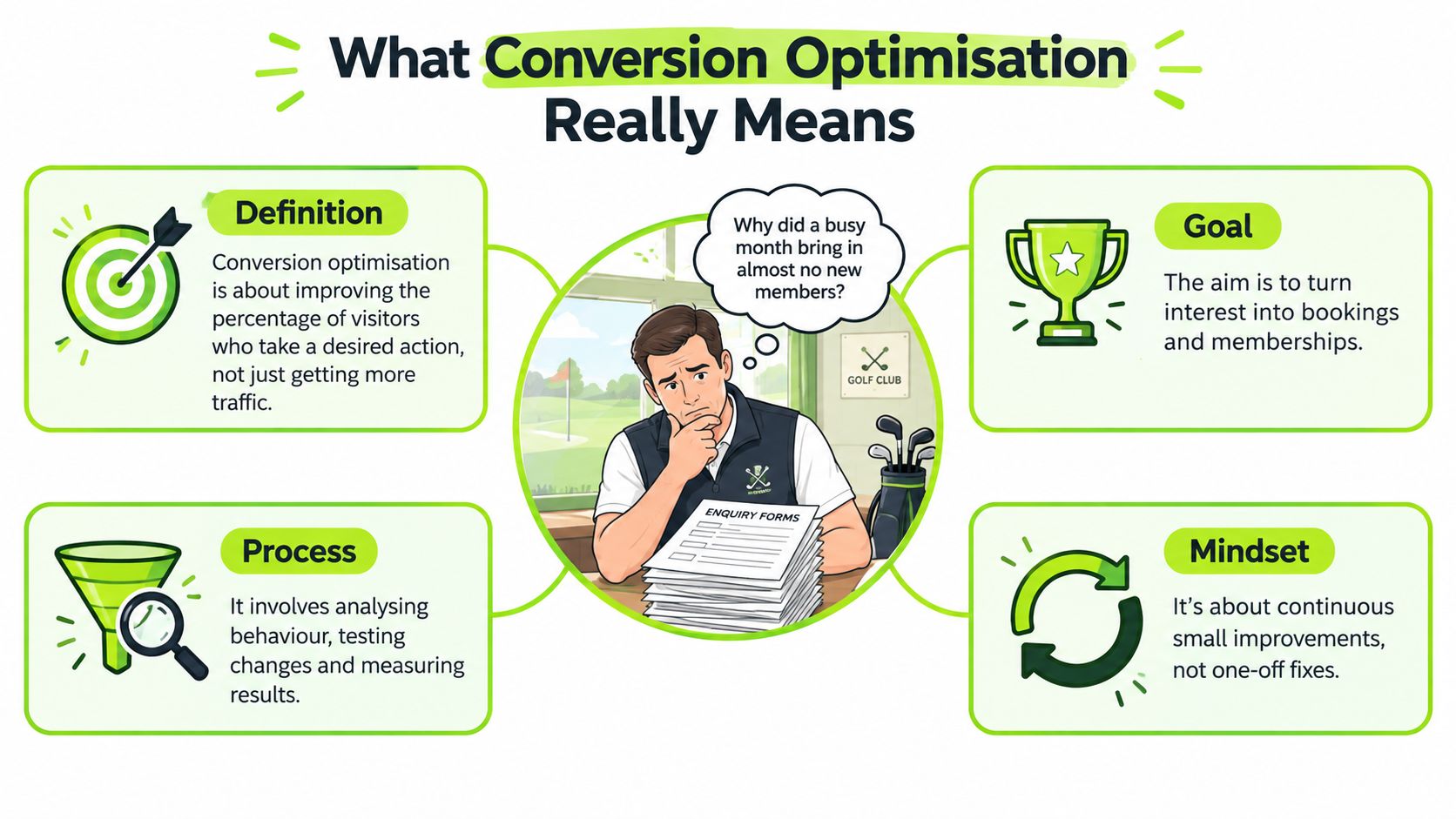
A club manager can have a busy month of website visits and membership enquiries, yet see very few new members join. The website may look modern, the advertising may be generating interest and the forms may be working. Somewhere between that first click and the decision to join, however, prospective golfers are losing confidence, waiting too long, or choosing another club.
That's the practical meaning of conversion optimisation. It's about finding where intent weakens, improving that part of the journey, and measuring whether more valuable outcomes follow.
What Conversion Optimisation Really Means
Conversion optimisation is the disciplined use of data, testing and experience improvements to increase the proportion of visitors who complete a desired action. The action might be buying something online, but for a golf business it's more likely to be booking a club visit, requesting a trial round, submitting a membership application, reserving a tee time or confirming a society booking.
The distinction matters because a golf club usually isn't selling a simple online product. A prospective member may need to compare categories, understand fees, ask about playing rights, meet someone at the club and decide whether the atmosphere suits them. A good conversion system removes uncertainty at each stage instead of merely adding a brighter button to the website.
The Office for National Statistics retail sales time series reported that online sales represented 27.1% of total Great Britain retail sales in 2024, with the quarterly share reaching 26.3% in Q1 and 26.4% in Q2. The figure isn't a golf-club benchmark, but it shows why digital journeys deserve commercial attention. More than one in four retail sales took place through an online channel, so the page, form and booking experience can influence revenue well before a customer speaks to a member of staff.
What conversion optimisation is not
Conversion optimisation overlaps with several commercial disciplines, but it isn't the same as any one of them.
| Discipline | Primary focus | Where CRO overlaps | Golf example |
|---|---|---|---|
| Lead generation | Creating awareness and attracting prospects | CRO checks whether the resulting traffic takes action | Local advertising brings golfers to a membership page |
| Advertising | Buying or distributing attention | CRO improves the destination after the advert is clicked | A campaign leads to a clear trial-round page |
| Website design | Making the site usable and presentable | CRO tests whether design helps people progress | A mobile form is easier to complete |
| CRM | Organising contacts, tasks and communication | CRO measures whether follow-up moves prospects forward | A membership enquiry receives a planned sequence |
| Conversion optimisation | Improving the percentage of visitors who complete a valuable action | It connects all the stages | An enquiry becomes a booked visit, application and member |
A useful explanation of the wider concept is Voicedial's take on sales conversion, particularly its focus on moving prospects from interest towards a completed commercial action. For clubs, that action must be defined in golf terms.
You can think of the relationship between traffic and action as a marketing funnel, but don't stop at the website. A club's funnel includes the receptionist answering a call, the PGA professional arranging a trial round, the secretary explaining membership terms and the team welcoming the visitor afterwards.
Practical rule: If the action you're measuring doesn't connect to a booking, application, joining decision or retained value, it may be useful evidence, but it isn't the commercial conversion.
The Enquiry-to-Member Journey Explained
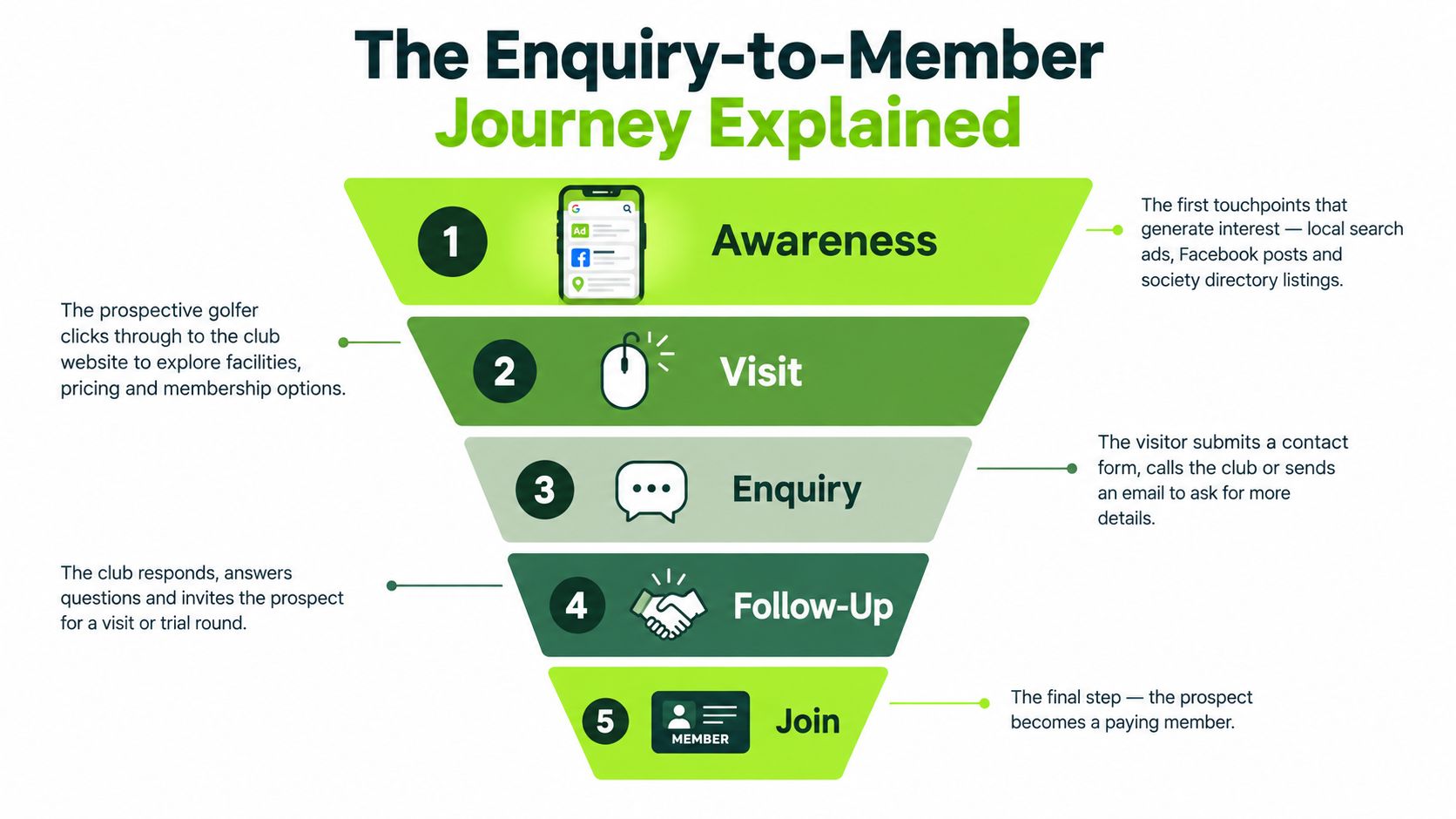
A prospective member rarely moves from advert to joining in one clean session. They may discover a club through a local search, a social post or a society directory, browse the website, return later to check pricing and then make contact after discussing the decision with someone else.
That journey needs clear ownership.
The stages and hand-offs
Awareness
Marketing creates the first opportunity. A golfer sees a local search advert, a Facebook post, a club event or a society listing. The relevant question is whether the message matches the audience. A junior-family offer, a flexible membership option and a corporate golf package shouldn't all send people to the same generic page.Visit
The prospect explores the website. They want to know what the club offers, who it suits, what membership includes and how to take the next step. The page should answer those questions without making the visitor hunt through menus or download several documents.Enquiry
The action may be a form submission, phone call, email or booking request. Each route needs recording. A phone enquiry shouldn't disappear from measurement because it didn't use the website form.Qualification and follow-up
Someone confirms what the prospect is looking for, answers practical questions and proposes a next step. The receptionist, club secretary, PGA professional or membership lead may own different parts of this hand-off, but the prospect shouldn't have to repeat their story to each person.Visit or trial
The enquiry becomes tangible. A tour, trial round, fitting, lesson or society conversation lets the golfer judge the experience rather than relying only on web copy.Application and joining
The club explains the application process, confirms the right membership product and records the outcome. A completed form isn't the end of the commercial journey if the prospect still hasn't joined.Early retention
The first weeks shape whether the new member uses the club and renews. Conversion optimisation should therefore distinguish between a signed application and a member who starts participating.
A prospect might spend two weeks comparing clubs, request a tour, play a trial round and then join after speaking with the membership team. If the club only measures the original page conversion, it can't see which part of that journey created or lost value.
The practical mapping approach is set out in GolfRep's guide to golf club enquiry conversion. Start by writing each stage on a page, naming the owner and recording the hand-off. Then connect website activity with the club's enquiry records and membership outcomes.
The Metrics That Actually Matter for Clubs
A form-fill rate can look healthy while the club's commercial performance remains weak. A visitor may submit an enquiry because the page is unclear, because the club offers a discount that attracts poor-fit prospects, or because the form is easier than finding a phone number. None of those outcomes tells you whether the person is likely to book or join.
A stronger scoreboard separates leading indicators from commercial outcomes.
Leading indicators
These show whether interest is moving through the early stages:
- Qualified enquiry rate: The share of enquiries that fit a relevant membership, visitor, society or event proposition.
- Booked-visit rate: The share of suitable prospects who agree to a tour, trial or meeting.
- Show-up rate: The proportion of booked visits that occur.
- Source and device conversion: Performance by campaign, landing page, mobile or desktop, location and visitor type.
Lagging indicators
These show whether the journey produced value:
- Trial-to-join rate: The share of trial visitors who become members.
- Enquiry-to-join rate: The proportion of relevant enquiries that result in joining.
- First-year retention: Whether newly joined members remain active and renew.
- Revenue per member: The commercial value of the member relationship, including relevant additional spend.
- Payback period: How long it takes for the resulting value to recover the acquisition and sales cost.
The correct unit is the full funnel, including source-level conversion, lead qualification, booked-visit rate, show-up rate, joining rate and recurring member value. A landing-page test should have one defined primary outcome and should be judged against downstream membership results, not just clicks or completed forms.
Commercial benchmark sources place average e-commerce conversion around 3.4%, with mobile commerce around 2.5%, according to Marvyn's UK conversion-rate discussion. Those figures are directional only. A membership decision is a higher-consideration, lead-generation purchase, so applying an online retail benchmark to a private club can create the wrong target.
Build a usable weekly view
A club manager doesn't need a wall of dashboards. A practical report can show:
| Stage | What to record | Useful breakdown |
|---|---|---|
| Enquiry | Volume and qualification | Product, source, device |
| Booking | Visits and trial rounds arranged | Staff owner, campaign |
| Attendance | Visits completed | New or returning prospect |
| Joining | Applications and members | Membership type |
| Value | Revenue and retention outcome | Cohort and acquisition source |
If your club is considering automation for calls or reception cover, compare it with broader guidance on an automated front-office for contractors. The principle transfers well: automation should make ownership and measurement clearer, not create another untracked route.
For the practical tracking layer, GolfRep's conversion tracking setup guide is a useful reference. The essential point is simple. Track the outcomes that a committee would recognise as commercial progress, not only the actions that are easiest for a website platform to count.
Practical Optimisation Moves Clubs Can Make
You don't need to rebuild the whole website to improve conversion. Start with the points where a golfer has intent but still lacks confidence or a clear next step.
Make the first page answer the buying questions
A membership landing page should make the core proposition obvious:
- Membership type: State who the category suits, such as full, flexible, junior, family or weekday members.
- Price information: Show the relevant price or price band where possible, alongside joining requirements.
- Included benefits: Explain playing rights, access, competitions, coaching or other material inclusions.
- Next action: Use a specific button such as Book a Club Visit, Request a Trial Round or Ask About Membership.
“Contact us” asks the visitor to work out what happens next. A clear action reduces that uncertainty.
Keep the main information easy to find on mobile. A golfer checking the club between work and a tee time shouldn't need to pinch, zoom or tap through a PDF to understand the offer.
Reduce friction without removing useful qualification
Ask for the information the team needs to respond well, but don't make a first enquiry feel like a full application. Name, contact details, the relevant interest and a short message may be enough to start a conversation.
Offer equivalent routes. Some prospects will prefer a phone call, some will want to book a visit directly and others will need time to ask questions by email. The website should make those routes visible rather than forcing everyone through one form.
The same principle applies to event and society enquiries. A club planning online registration can use golf event registration and payment tips to think through the information and payment steps without making the organiser's first contact unnecessarily complicated.
Treat accessibility as commercial reach
UK digital-inclusion research indicates that around 15% of people cannot complete foundational digital tasks and a further 6% are completely offline, according to the government's digital inclusion report. A digital-only optimisation programme will therefore exclude some prospective members.
Review the journey with practical tests:
- Keyboard use: Can someone complete the form without a mouse?
- Readable content: Are prices, terms and buttons easy to distinguish?
- Form errors: Does the page explain exactly what needs correcting?
- Telephone access: Is there an obvious route to speak to a person?
- Assisted journeys: Can reception help a prospect complete the next step?
Separate confirmation from sales follow-up
An automated confirmation tells someone that the club received their request. It doesn't replace a useful human response.
Define who owns the first reply, what information they should confirm and which task comes next. A CRM can create a reminder to call, record the outcome of a tour and prompt a trial-round invitation, but the process must distinguish between service messages and marketing nurture.
Consent matters. The ICO's direct marketing checklist says marketing emails and texts must identify the sender, explain how recipients can opt out, and use clear, specific consent based on positive action. Pre-ticked boxes aren't valid.
The ICO also distinguishes service communication from promotional automation. A booking confirmation may help deliver the requested service, while an automated marketing call requires the relevant specific permission under the ICO's direct marketing guidance. Record the permission, channel and suppression status in the CRM.
How Optimisation Changes Enquiry-to-Booking and Sign-Up Rates
Conversion improvements look different depending on what the business sells and where the constraint sits. A visitor venue, private club and indoor facility may all use a form, but the next commercial action won't be the same.
Visitor golf
A pay-and-play venue might find that golfers can't quickly understand tee-time pricing, availability or what happens after an enquiry. The optimisation move could be a page with clearer price information, a shorter booking route and a named response owner.
The relevant measure isn't form completion. It's whether the enquiry becomes a confirmed booking, whether the golfer attends and whether the venue creates a realistic route to a repeat visit.
Membership
A private club may receive plenty of membership interest but discover that many prospects don't match the available categories. Better qualification can ask whether the golfer wants full, flexible, junior or family membership, without making the form feel like an application.
The next improvement may be a structured invitation to a tour or trial round, followed by a planned conversation with the secretary or PGA professional. The club can then compare qualified enquiry-to-join performance by membership product rather than celebrating a higher volume of unqualified contacts.
Societies and events
A society organiser often wants confidence about dates, pricing, food and the day's running order. A dedicated page with a clear package, organiser enquiry route and agreed follow-up owner can outperform a general “Societies” page that leaves the organiser searching for details.
For larger groups, the conversion event may be a confirmed date and deposit rather than a completed online payment. The tracking should reflect that reality.
GolfRep's approved client work illustrates the value of changing the commercial system rather than applying one universal website trick. Lessons associated with Bidston Golf Club, Downes Crediton Golf Club, Addington Palace Golf Club and Macdonald Hotels & Resorts can be understood in that way: clarify the proposition, create an organised path from interest to action, assign ownership and measure the resulting pipeline.
Those examples shouldn't be copied mechanically. A committee-run club may need a simpler process, while a multi-site operator may need centralised reporting and consistent follow-up across locations. The useful question is always: which stage is preventing the right prospects from taking the next step?
Why Faster Websites and Better Ads Are Not Enough on Their Own
A faster website helps, and better advertising can increase relevant demand. Neither fixes a journey where enquiries go to a shared inbox, the secretary receives them days later or a trial round never gets arranged.
England's 2025 club data gives useful context. Club membership reached 750,071, an increase of almost 20,000 members, while junior membership rose by more than 34% to 61,483, according to England golf participation data reported by the Golf Club Managers' Association. Separate findings in the same coverage reported that 30% of golfers said their club had a waiting list and 77% planned to renew the following year.

The lesson isn't that every club has enough demand. It's that the binding constraint can sit in different places. One club may need better local visibility, another clearer membership categories, another a reliable route from enquiry to visit.
Use the largest unexplained drop-off to find yours:
- If impressions and clicks are weak, inspect demand generation and message-market fit.
- If page visits are healthy but enquiries are poor, inspect clarity, trust and friction.
- If enquiries are strong but visits are scarce, inspect qualification, ownership and response.
- If visits happen but joining is weak, inspect the proposition, experience and application process.
- If joining is healthy but early retention is poor, inspect onboarding and member engagement.
Optimisation is therefore a system exercise. Traffic, website experience, reception, sales conversations, consent handling and member experience all affect the result.
Building a Conversion System Your Club Can Actually Run
Start with a baseline for each stage, from source and enquiry through booking, attendance, joining and early retention. Choose the biggest constraint, make one focused improvement, and measure the commercial outcome before moving to the next constraint.
Take this checklist to the next management meeting:
- Baseline: Record stage-by-stage performance by membership product and source.
- Ownership: Name the person responsible for the first response and the next task.
- Consent: Review opt-ins, service messages, marketing permissions and unsubscribe handling.
- Accessibility: Test forms, content, keyboard use and telephone alternatives.
- Segmentation: Separate members, visitors, societies, juniors, families and indoor customers where their journeys differ.
- Review rhythm: Compare enquiry-to-join performance regularly, including first-year retention where available.
Conversion optimisation isn't a one-off redesign. It's the operating rhythm of a commercially aware club, improving the current constraint before attention moves elsewhere.
GolfRep helps UK golf clubs map and improve the path from first enquiry to booked visit, trial, joining decision and recurring revenue, with CRM-based tracking and structured follow-up. If you want to understand where your club's biggest commercial constraint sits, visit GolfRep to start the conversation.
Ready to tap into our proven growth system?