The Golf Club Revenue Growth Playbook

Most golf club growth advice starts in the wrong place.
It says the club needs more leads, more traffic, more visibility, more campaigns. That sounds sensible until you look at what happens inside most clubs. An enquiry arrives by email while the office is busy. A voicemail sits unanswered until the afternoon. A membership form gets forwarded between the secretary, the manager, and a committee member. By the time someone replies properly, the golfer has already visited another club that responded faster and made the next step easy.
That isn't a marketing problem. It's a systems problem.
The Golf Club Revenue Growth Playbook isn't about creating more top-of-funnel noise. It's about building a reliable process that turns interest into visits, visits into members, and members into long-term revenue. That means fixing response time, improving lead visibility, tracking conversion properly, and removing the manual gaps that cause clubs to lose good prospects without realising it.
The clubs that grow consistently don't rely on heroic effort from one staff member. They use a joined-up system. The clubs that struggle usually have demand somewhere in the pipeline, but they can't see it clearly, can't respond consistently, and can't measure where the leak is.
Your Club's Biggest Problem Is Not a Lack of Enquiries
Many committees assume growth has stalled because awareness is low. In practice, the bigger issue is often what happens after interest has already been created.
A prospect clicks an ad, fills in a contact form, or asks about a flexible membership. Then the club handles that enquiry like an admin task instead of a sales opportunity. It sits in an inbox. It gets answered when someone has time. Notes stay in different places. No one knows whether the prospect booked a visit, asked another question, or disappeared.
That process is common. It also wastes revenue.
The real leak sits in follow-up
Most clubs don't have a lead generation problem in isolation. They have a lead handling problem. The enquiry exists. The interest exists. The intent exists. What fails is the handoff.
A busy secretary can't answer every call instantly. A general manager can't personally chase every undecided prospect. A volunteer-run committee can't run a dependable sales process from shared inboxes and memory. None of that is unusual. But if the process depends on availability, it will always be inconsistent.
Practical rule: If a club can't see every enquiry, assign ownership, and track the outcome, it isn't running a growth system. It's reacting.
That distinction matters because reactive clubs misdiagnose the issue. They buy more ads before fixing conversion. They lower prices before fixing response time. They blame the market before checking whether prospects were ever followed up properly.
More leads won't fix a broken pipeline
Pouring more budget into the top of the funnel only amplifies the waste lower down. If the club is already missing calls, replying late, or failing to book visits, more enquiries just create a larger backlog.
What moves revenue is a tighter system with clear stages:
- Enquiry captured: Every lead enters one place, whether it came from Facebook, Google, the website, or a phone call.
- Response triggered: The prospect gets an immediate acknowledgement and a clear next step.
- Ownership assigned: One person knows who needs following up and when.
- Outcome tracked: The club can see whether the lead booked, visited, joined, or went cold.
This is why the strongest clubs focus less on random marketing activity and more on conversion infrastructure.
The opportunity is often already sitting in the database, the inbox, and the missed call log.
Building Your Predictable Enquiry Engine
Attraction still matters. A club can't convert enquiries that never arrive. But the right question isn't "How do we get more leads?" It's "How do we attract the right local golfers into a system that can convert them properly?"
That changes the entire approach.

Start with intent, not reach
A predictable enquiry engine begins with targeting that reflects how people choose a golf club. Local catchment matters. Lifestyle fit matters. The offer matters. The messaging has to speak to the golfer's reason for considering a change.
Some want better access to competitions. Some want a more social club. Some are leaving a crowded municipal option. Some have drifted out of golf and need a low-friction route back in. If the club runs generic adverts about "joining now", it attracts curiosity. If it speaks directly to those motivations, it attracts people with a clearer reason to enquire.
That is why campaign structure matters more than ad volume. Facebook and Google can both produce strong membership demand, but only when the message pre-qualifies the golfer rather than chasing cheap clicks.
The channels should support direct relationships
For larger operators and multi-site resorts, channel strategy affects margin as much as lead volume. Impact Golf Studios' review of golf revenue systems notes that REVPATT should target £25-£35, that 80% direct bookings can reduce OTA commissions by up to 18%, and that ARPR should exceed 60% of rack rate to avoid discount-led erosion.
Those aren't just resort metrics. They reinforce a broader principle for private clubs as well. The closer the club stays to direct enquiry and direct booking behaviour, the more control it has over pricing, experience, and follow-up. The moment growth depends too heavily on third-party channels or one-off promotions, the club gives away margin and loses visibility.
A healthier enquiry engine pushes prospects into the club's own ecosystem. That means direct forms, direct calls, direct tour bookings, and direct follow-up inside a CRM.
Clubs don't need more anonymous traffic. They need more identifiable prospects entering a trackable process.
What usually fails in manual attraction systems
When clubs say their marketing isn't working, the campaigns are often only part of the story. The more common failure points sit just behind the advert.
Typical breakdowns look like this:
- Lead visibility is poor: Website enquiries, Facebook messages, and phone calls live in separate places.
- Response time depends on staff availability: Prospects hear back when someone notices the notification.
- No qualification happens upfront: The club doesn't know if the enquiry is a serious membership prospect or a casual question.
- Follow-up stops after one reply: If the prospect doesn't answer immediately, the trail goes cold.
- Committee reporting is weak: People see spend, but not the journey from enquiry to visit to member.
At this point, many clubs lose confidence in marketing unfairly. The campaign may have created demand, but the internal process failed to convert it.
The enquiry engine has to be designed, not improvised
A reliable engine includes message-market fit, disciplined targeting, and a direct route into the club's sales process. It also needs a way to compare sources and spot which campaigns produce booked visits instead of just raw enquiries.
That is the difference between activity and pipeline.
A useful framework for clubs that want that visibility is this guide on building a predictable revenue pipeline for golf clubs. The key idea is simple. Demand generation only becomes valuable when the club can see where enquiries came from, who followed them up, and what revenue came out the other side.
The Automated Conversion System From Enquiry to Visit
The moment of truth isn't the advert. It's the minute after the form is submitted.
That is where most clubs slow down. A golfer shows interest while they're on their phone, comparing options, and ready to act. Then nothing happens for hours. Sometimes nothing happens until the next day. By then, the urgency has gone.
An automated conversion system fixes that gap by making the first response immediate and the next steps structured.
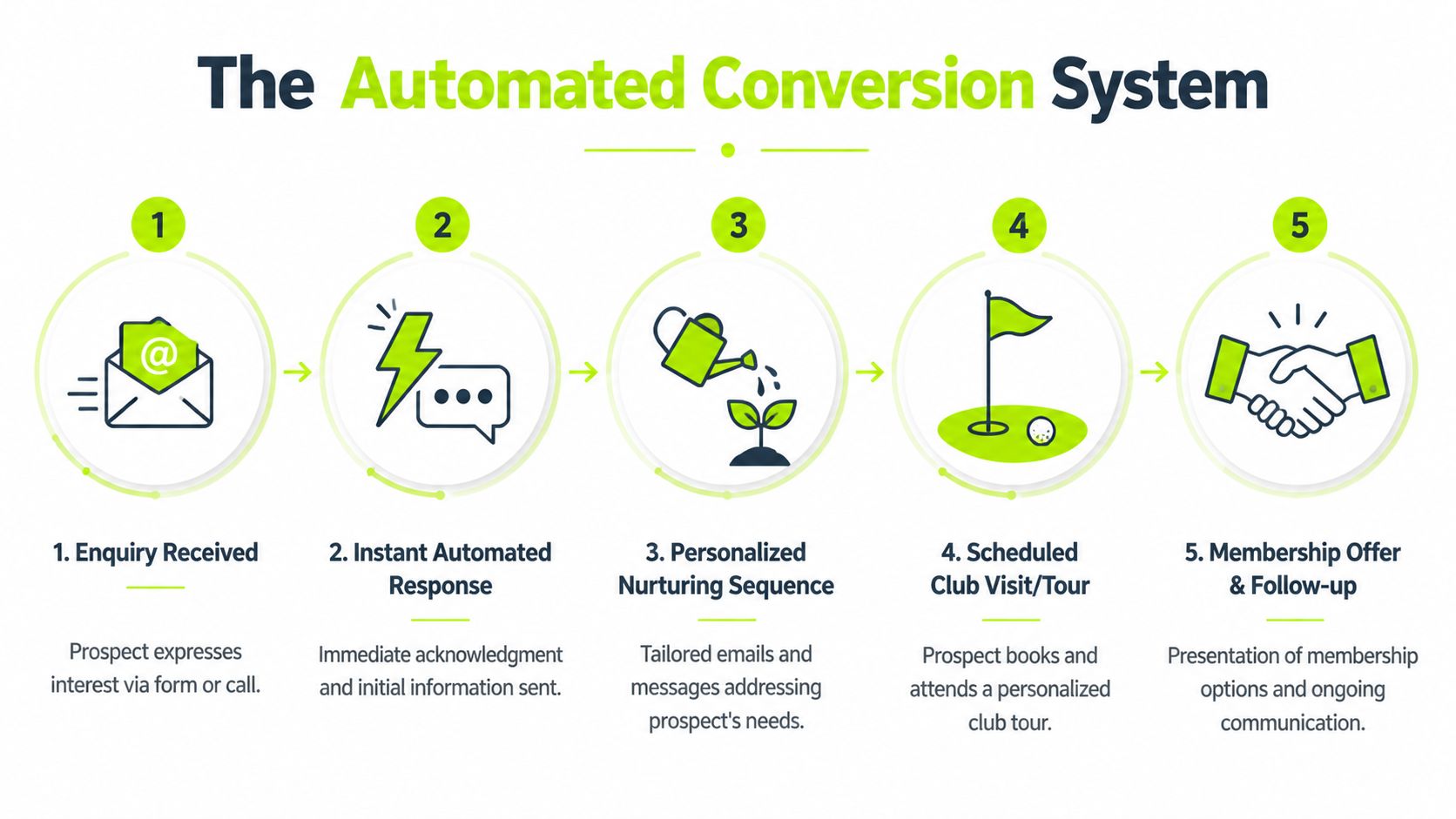
What the ideal journey looks like
A strong conversion system doesn't feel robotic to the prospect. It feels organised.
The golfer submits a form asking about membership, beginner pathways, flexible options, or visitor packages. Within seconds, they receive a confirmation by email or SMS that acknowledges the enquiry and gives them a clear next step. At the same time, their details enter the CRM, the source is recorded, and a follow-up task is created for the relevant person at the club.
From there, the club doesn't rely on memory. It uses a sequence.
Immediate acknowledgement
The prospect gets confirmation that the club has received the enquiry and that someone will be in touch. This removes uncertainty.Useful first-touch information
Instead of a vague "thanks, we'll respond soon", the club sends practical information. That might include membership categories, what happens on a club visit, or who the prospect will speak to.Prompt personal follow-up
Staff then step in for the human part. They call, answer questions, and offer suitable visit times.Visit booking and reminders
The system supports attendance with reminders and internal visibility, so visits don't get lost in a diary.Post-visit follow-up
If the golfer doesn't join on the day, they don't vanish. They enter a nurture sequence with relevant next steps.
Why automation improves the member experience
Some clubs still worry that automation feels impersonal. In reality, poor communication feels impersonal. Silence feels impersonal. Delayed replies feel impersonal.
Automation handles speed and consistency. Staff handle judgement and relationship building.
That division matters because the office team should spend time hosting a club tour, answering a pricing objection, or introducing a prospect to the captain or pro. They should not spend their week trying to remember who filled in a form two days ago.
Operational truth: Automation should do the repetitive work first, so people can do the valuable work better.
The manual process breaks in predictable ways
When conversion depends on inbox management alone, the same issues appear again and again. One person is off. Another person assumes someone else has replied. A prospect receives a short answer but no invitation to visit. Notes from a phone call aren't recorded. By the following week, no one knows what happened.
A simple comparison makes the difference clear:
| Process area | Manual handling | Automated system |
|---|---|---|
| Enquiry capture | Split across forms, inboxes, and notes | Sent into one CRM |
| First response | When staff are free | Immediate |
| Follow-up ownership | Unclear or informal | Assigned and visible |
| Visit booking | Ad hoc | Prompted and tracked |
| Reporting | Retrospective guesswork | Live pipeline visibility |
This isn't about adding complexity. It's about removing avoidable inconsistency.
Pre-qualify before the sales call
Good digital campaigns don't just produce names. They produce context.
That starts with the form itself. Ask questions that help the club understand intent. Why is the golfer interested now? Are they a returning golfer, an active member elsewhere, or completely new? What membership type are they considering? Do they want weekday golf, competitions, coaching, or a social environment?
The point isn't to create friction. It's to make the first conversation better.
A pre-qualified lead allows the club to tailor the response. A younger golfer asking about flexible options shouldn't receive the same follow-up as a retiree asking about competition access. A beginner interested in lessons and community needs a different journey again. Better qualification creates better conversations, and better conversations create more visits.
The CRM is the control centre
Many clubs hear "CRM" and think of a large software project. In practice, a CRM is the place where enquiries become visible and actionable.
It should show:
- Lead source: Where the enquiry came from
- Current status: New, contacted, visit booked, visited, joined, undecided
- Next action: Call, email, reminder, nurture
- History: Every message, call note, and appointment in one place
This is what stops good prospects from disappearing between departments or between days.
Clubs that want to understand how this works in practical terms should look at golf club automation systems through the lens of staff capacity, not software features. The value isn't that automation looks advanced. The value is that it ensures every serious enquiry receives a response and a path forward, even when the office is busy.
The visit is still the hinge point
No automation should replace the club visit. It should protect it.
For most private clubs, the visit remains the key conversion event because that's where the prospect experiences the course, the clubhouse, the welcome, and the culture. The job of the system is to get more qualified people to that moment and make sure fewer of them drop away before it happens.
That is why the playbook puts conversion structure ahead of marketing gimmicks. The club doesn't need cleverer slogans if the core issue is that good prospects aren't being guided to a visit in a timely, organised way.
Nurturing Undecided Prospects and Retaining New Members
Not every good prospect is ready to join the same week they enquire. Some are comparing clubs. Some are waiting for a current membership to expire. Some need a conversation with a partner. Some need more confidence that they'll fit in.
If the club treats every non-immediate decision as a dead lead, it throws away future revenue.

Nurture is not pestering
The best nurture sequences don't pressure people. They reduce uncertainty.
A prospect who has visited but not joined yet usually has one of a small number of concerns. Value. Time. Confidence. Fit. The club's follow-up should answer those concerns naturally through useful communication.
That might include:
- Club life updates: A note about competitions, mixed events, beginner roll-ups, or social evenings
- Relevant proof points: Stories that help the prospect understand who joins and why they stay
- Simple invitations: An open day, a return visit, a lesson taster, or a coffee with the membership team
- Clear reminders: Membership options, joining process, and who to contact with questions
CRM and automation become more human, not less. They allow the club to stay present without relying on someone to remember every name manually.
A prospect who says "not yet" is often asking for better timing, not signalling no interest.
Retention starts earlier than most clubs think
Many clubs separate acquisition and retention as if they are unrelated. They aren't. The experience a golfer has in the first days after joining often shapes whether they settle in, play regularly, and stay.
A new member doesn't only need an invoice and a bag tag. They need orientation. They need introductions. They need confidence that they made the right choice.
That means having a post-join journey that includes practical touchpoints such as welcome messages, key contacts, upcoming events, competition information, and gentle prompts to engage with the club. If that onboarding is left informal, some members integrate quickly while others drift.
Referral should be a system, not a hope
Word of mouth has always mattered in golf. The mistake is treating it as accidental.
According to the referral-focused discussion referenced in this golf membership growth video, UK golf clubs are losing a net 20,000 members annually despite 50,000 new joiners, which makes retention critical. The same source notes that systematised referral programmes are underused and that referred customers typically have a 30-50% higher lifetime value.
That matters because a well-run referral programme does two jobs at once. It helps bring in better-fit members, and it reinforces belonging among current ones.
A practical referral system usually includes:
- A defined ask: Members know when and how to refer someone
- A simple route: A form, landing page, or named contact makes introductions easy
- Tracking: The club can see who referred whom and what happened next
- Follow-through: Referred prospects receive the same structured communication as every other serious enquiry
Traditional clubs can still do this well
There is sometimes a fear that formalising nurture or referrals will make the club feel corporate. It doesn't have to.
The tone can remain warm, local, and personal. In fact, structured communication often protects that character because it ensures every prospect and member receives the same standard of care, rather than only those who happen to know someone already.
For clubs that want a practical model, these lead nurturing best practices for golf clubs are useful when adapted to the realities of committee-led and member-owned environments. The key is consistency. When nurture and referrals are systemised, community growth becomes measurable rather than accidental.
Measuring What Matters With KPIs and Reporting
A golf club can feel busy and still be underperforming. Enquiries are coming in. Staff are answering calls. Tours are happening. Social posts are going out. None of that tells the committee whether the growth system is healthy.
The answer comes from a small set of operational KPIs tied to revenue.

Track the funnel, not vanity metrics
Likes, impressions, and reach have their place, but they don't tell a club whether marketing is turning into members. A useful report follows the path from first contact to joined member and then extends into spend and retention.
The most useful questions are straightforward:
- How many enquiries came in this period?
- How many received a timely response?
- How many booked a visit?
- How many attended?
- How many joined?
- What happened to the undecided group?
- Are newer members spending and engaging after joining?
This approach changes reporting from "what did we do?" to "what happened as a result?"
Membership revenue is only part of the picture
Strong clubs watch total commercial value, not just subscription income. GolfRep's review of private golf club revenue growth in the UK highlights that 87% of UK members' clubs increased bar revenue and that this contributed to an average surplus of £102,000. That matters because growth often comes from a combination of membership, food and beverage, events, and other ancillary spend.
If the club signs up a new member who rarely visits, that member has one value profile. If it signs up a new member who uses the bar, brings guests, enters events, and refers friends, that member has a very different one.
So the dashboard should connect acquisition performance with downstream behaviour.
Board-level view: A growth report should show not only how many members joined, but whether those members are becoming active contributors to club life and revenue.
A practical dashboard for managers and committees
A useful reporting pack doesn't need to be complicated. It does need to be consistent.
| KPI | What it tells you | Why it matters |
|---|---|---|
| Enquiries received | Top-of-funnel demand | Shows whether campaigns and referrals are generating interest |
| Response status | Whether leads are being handled | Exposes operational bottlenecks quickly |
| Visits booked | Sales momentum | Indicates whether enquiries are progressing |
| Visits attended | Real buying intent | Distinguishes curiosity from committed prospects |
| Join rate | Conversion strength | Shows whether club tours and follow-up are effective |
| Undecided pipeline | Future opportunity | Prevents warm leads being ignored |
| Ancillary spend trend | Wider member value | Connects member growth to overall club health |
A dashboard like this gives managers enough visibility to act and gives committees enough clarity to govern sensibly.
Use KPIs to diagnose, not decorate
The mistake many clubs make is reporting numbers without using them.
If enquiries are healthy but visits are low, the issue may be follow-up quality or call handling. If visits are high but joins are weak, the issue may sit in the tour experience, pricing conversation, or offer clarity. If new members join but don't engage, onboarding may be weak.
That is why reporting should sit close to action. The dashboard isn't there to prove activity. It's there to show where the system is losing momentum so the club can fix the right thing.
Putting The Playbook Into Action A Sample Timeline
A full growth system can feel bigger than it is when clubs look at it all at once. In practice, implementation works best in phases. Start by making enquiries visible. Then tighten response and follow-up. Then improve reporting and nurture.
The sequence matters because clubs usually get better results from fixing the middle of the funnel before adding more volume at the top.
A simple ninety-day rollout
The table below shows a practical implementation path for The Golf Club Revenue Growth Playbook.
| Phase | Timeline | Key Activities |
|---|---|---|
| Audit and setup | Days 1 to 30 | Review current enquiry sources, map the existing follow-up process, choose one CRM workflow, centralise forms and lead capture, define pipeline stages, write response scripts for email and SMS, assign ownership for every new enquiry |
| Launch and stabilise | Days 31 to 60 | Launch or refine campaigns for high-intent local prospects, turn on automated first responses, route every enquiry into the CRM, begin structured call follow-up, train staff on visit booking and note logging, review pipeline daily |
| Optimise and expand | Days 61 to 90 | Build long-term nurture for undecided prospects, introduce a formal referral process for members, create weekly reporting for managers and monthly reporting for committees, review tour-to-member conversion, improve onboarding for new joiners |
What to prepare before launch
Clubs often overfocus on ad creative and underprepare the operational basics. Before any campaign goes live, the club should have a small bank of working assets ready.
That usually includes:
- Response templates: Short SMS and email replies that confirm receipt and invite the next step
- Call frameworks: Prompts for staff so first conversations stay consistent without sounding scripted
- Visit booking process: A simple diary method with confirmations and reminders
- Tour checklist: What the prospect should see, who they should meet, and what questions should be answered
- Nurture content: Follow-up emails for undecided prospects and welcome messages for new members
These assets matter because consistency doesn't happen by good intentions alone.
Keep the first version simple
The clubs that get stuck usually try to design a perfect system before using one. A better approach is to install the core workflow first, then refine based on real enquiries.
Start with one clear path for membership enquiries. Make sure every lead enters one system. Make sure the club responds quickly. Make sure visits are being booked and tracked. Then improve the messaging, segmentation, and reporting over time.
That is how clubs move from reactive sales admin to a repeatable revenue process.
Conclusion The End of Guesswork
Golf club growth becomes far more manageable when the club stops treating revenue as a seasonal mystery.
The core issue usually isn't awareness alone. It is the gap between interest and action. Enquiries arrive, but they aren't handled fast enough, tracked clearly enough, or followed up long enough. Once that gap is closed, the club starts to see what was already there. Better visibility. Better conversion. Better retention. Better use of staff time.
The Golf Club Revenue Growth Playbook is built on that logic. Attract the right local prospects. Capture every enquiry properly. Respond immediately. move people towards a visit. Nurture those who need more time. Track what happens. Improve the system based on evidence, not committee guesswork.
That approach is less glamorous than chasing the latest marketing tactic. It is also what works.
Clubs that build these systems create a more predictable pipeline and a calmer operation around it. They stop relying on memory, inboxes, and one person's availability. They replace hope with process.
If your club wants a specialist partner to build that kind of system, GolfRep helps golf clubs create predictable pipelines through lead generation, CRM follow-up, and automation that turns enquiries into visits, members, and long-term revenue.
Ready to tap into our proven growth system?