Maximize Revenue: Sell Tee Times Last Minute

A sunny afternoon looks good from the clubhouse window. The course is in fine condition, the bar could do with a few more covers, and the tee sheet still has holes in it for the next day and the same evening. Most managers know that feeling. The frustrating part isn’t just the empty time itself. It’s knowing that once that slot passes, the revenue is gone for good.
That’s why tee times last minute shouldn’t be treated as a minor operational annoyance. They’re a live inventory problem. A perishable one. If the club relies on staff noticing gaps, posting a quick offer, and hoping somebody bites, it’s leaving too much to chance.
In practice, the issue usually isn’t demand alone. There are golfers willing to play on short notice. The bigger failure is that many clubs don’t have a reliable system to spot availability, reach the right people fast enough, and convert interest before the slot expires. That’s a process problem, not a weather problem or a marketing problem.
The clubs that handle this well don’t just advertise harder. They connect tee sheet data, CRM records, response workflows, and conversion tracking. That’s how an empty afternoon starts becoming a repeatable source of revenue instead of a weekly scramble. If you want a broader view of how booking systems influence performance, this piece on golf tee time books is a useful companion.
Introduction The Hidden Cost of an Empty Tee Sheet
A blank spot on tomorrow’s tee sheet rarely stays isolated. It affects staffing decisions, cart usage, food and beverage spend, and how confidently the club can forecast the week ahead. One missed tee time can become several if the club has no mechanism for recovering cancellations or slow periods quickly.
That’s why clubs often misread the problem. They think, “We need more enquiries.” In reality, many already have enough signals of interest sitting inside the business. Past visitors in the database. Recent green fee guests. Prospects who asked about playing but never booked. Members’ guests who’d come back if prompted at the right moment.
Empty tee times aren’t just unsold golf. They’re missed chances to bring someone back into the club while intent is high.
The cost also shows up in staff behaviour. When the process is manual, the team starts making ad hoc decisions. One person offers a discount over the phone. Another posts on social media. A third forgets to follow up with an enquiry from the day before. The club ends up with activity, but no system.
What an empty slot actually reveals
A repeated pattern of unsold last-minute times usually points to one or more of these issues:
- Poor lead visibility: Nobody can quickly see who is most likely to book on short notice.
- Slow response handling: The club responds when staff are free, not when demand appears.
- No segmentation: Every contact gets the same message, or no message at all.
- Weak tracking: The club can’t tell whether bookings came from email, paid traffic, a partner, or organic demand.
That matters because last-minute revenue only becomes predictable when the club can move from reaction to orchestration. The manager doesn’t need more noise. The manager needs a pipeline.
Why Reactive Discounting Is a Losing Strategy
Friday afternoon. Two fourballs are still open for Sunday, the phone is quiet, and someone in the office suggests knocking 40% off and posting it online. That move can fill a few spaces. It can also teach regular visitors to wait, irritate members who paid full rate with guests, and leave staff guessing which price should apply the next time the sheet looks weak.

That is why reactive discounting fails. It treats a demand problem as a price problem.
According to the methodology and pitfalls outlined in this breakdown of last-minute tee time pricing, a non-strategic approach to dynamic pricing carries a 25% churn risk if changes aren’t communicated properly, and over-discounting can reduce full-price uptake by 8-10%. For a private member club, those costs matter more than one rescued tee time because they affect future booking behaviour, member sentiment, and confidence in your published rate.
Cheap today can cost you tomorrow
The immediate result is easy to see. The second-order effect is where clubs lose margin.
| Approach | Short-term effect | Longer-term consequence |
|---|---|---|
| Deep blanket discount | Fills some empty times quickly | Trains golfers to wait for late deals |
| Unannounced pricing changes | Creates urgency for a few buyers | Frustrates members who feel undercut |
| Repeated heavy offers | Produces bursts of bookings | Weakens confidence in standard pricing |
I see the same pattern in clubs that rely on manual decisions. Staff wait too long to act, then cut too hard because they have no structured way to target the right audience, package the slot properly, or track whether the lower price improved revenue. The slot gets filled, but the club learns nothing useful from it.
That is the weakness. Reactive discounting produces activity without building a system.
Where clubs go wrong
Dynamic pricing can work. Poorly controlled pricing usually does not.
The same source describes a method that applies 30-50% discounts on unsold slots when occupancy falls below 70%, uses premium surcharges up to 20% for high-demand twilight periods, and recommends capping discounts at 40% to protect perceived value. The lesson for club managers is not to copy those numbers blindly. It is to set rules in advance, tie them to occupancy and booking pace, and keep those rules inside a wider conversion process that includes segmentation, CRM tags, and clear reporting.
A club that changes price without that structure usually creates three problems at once:
- It trains delay: Golfers learn that patience gets the better deal.
- It obscures demand: The team cannot tell whether the booking came from true interest, channel performance, or a lower price.
- It creates internal inconsistency: Staff make exceptions on the fly, and nobody can audit what worked.
Member perception matters here as well. Visitor revenue is useful, but private clubs do not operate like pure inventory businesses. If members start to feel that guest access is being pushed at the expense of fairness or tee sheet quality, the commercial decision quickly becomes a retention issue.
What disciplined pricing looks like
The better model uses pricing as one control inside an automated last-minute revenue system.
Set a price floor by daypart. Define which audiences can see late offers. Build rules for when a slot should be discounted, when it should be packaged with range credit or food and beverage value, and when it should be left alone because protecting rate integrity matters more than forcing a sale. Then push those offers through channels you can measure, with the response captured back into the CRM so the club can see who booked, what they responded to, and whether they return at a stronger rate later.
Practical rule: If staff are deciding discounts manually for each open slot, the club does not have a pricing strategy. It has a clearance habit.
Clubs do not lose on last-minute tee times because they adjust price. They lose because they adjust price without audience control, without automation, and without conversion tracking.
Building Your Last Minute Demand Channels
A club can’t recover empty tee times consistently if it has nobody ready to hear about them. The strongest operators build demand channels before the gap appears. Then when a slot opens up, they already know who should receive the offer and how fast they can move.

For most clubs, that starts with owned data. Not broad awareness. Not random social posts. The fastest wins usually come from people who already know the club and just need the right prompt.
Start with your internal database
Past visitors are often the best first audience for tee times last minute. They’ve already shown intent, they know the journey, and they don’t need a long explanation. What they do need is relevance.
Create a standby segment inside the CRM based on recent visitor history, preferred playing windows, and booking behaviour. Keep it simple enough for staff to trust and use. If somebody likes weekday twilight, they shouldn’t receive a Saturday morning alert.
A useful setup often includes:
- Past green fee players: Contacts who already know the course and booking process.
- Dormant enquiries: People who asked about visiting or playing but never converted.
- Flexible regulars: Visitors who tend to book on shorter notice.
- Guests with repeat potential: Players introduced by members who may return independently.
If you’re looking at broader digital demand generation around this, using digital marketing to fill tee times at your golf club adds useful context.
Use local paid social carefully
Local paid social works best when it supports a live inventory strategy, not when it acts as a substitute for one. The club should only promote availability it can fulfil cleanly and profitably. That means tight geography, short windows, and clear booking paths.
A weak campaign says “tee times available this week”. A strong one speaks to the actual buyer and the actual slot. Same-day afternoon availability. Twilight opening after work. A late cancellation on a playable weather day. The best message is usually the one that feels timely rather than promotional.
If a golfer has to message your page, wait for a reply, then call the shop, you’ve already lost speed.
Build local partnerships that can move quickly
Partnerships are often overlooked because they don’t feel like marketing. In practice, they can become one of the cleanest channels for last-minute demand.
Think about nearby hotels, business parks, relocation agents, and corporate contacts who value flexible access. These relationships work when the process is light. One named contact. One booking route. Clear rules on timing and availability. No back-and-forth.
The clubs that get value from partnerships usually do three things well:
- They define what “last minute” means operationally.
- They make booking easy for the partner.
- They track who books and whether those players come back.
That final point matters. A channel isn’t valuable because it fills one gap. It’s valuable because it can be measured, refined, and reused.
Implementing Dynamic Pricing and Smart Packaging
A Thursday at 1:15 p.m. tells you whether your pricing system is working. Two foursomes have cancelled, the weather is still playable, and the shop has about 20 minutes before those times start to lose real value. If the only response is “take 20% off and post it somewhere,” the club gives away margin without learning anything useful for the next gap.
Price needs rules. It also needs context. Clubs that recover last-minute tee time revenue consistently set pricing, packaging, and interval decisions together, then feed the results back into the CRM so the next decision gets better.
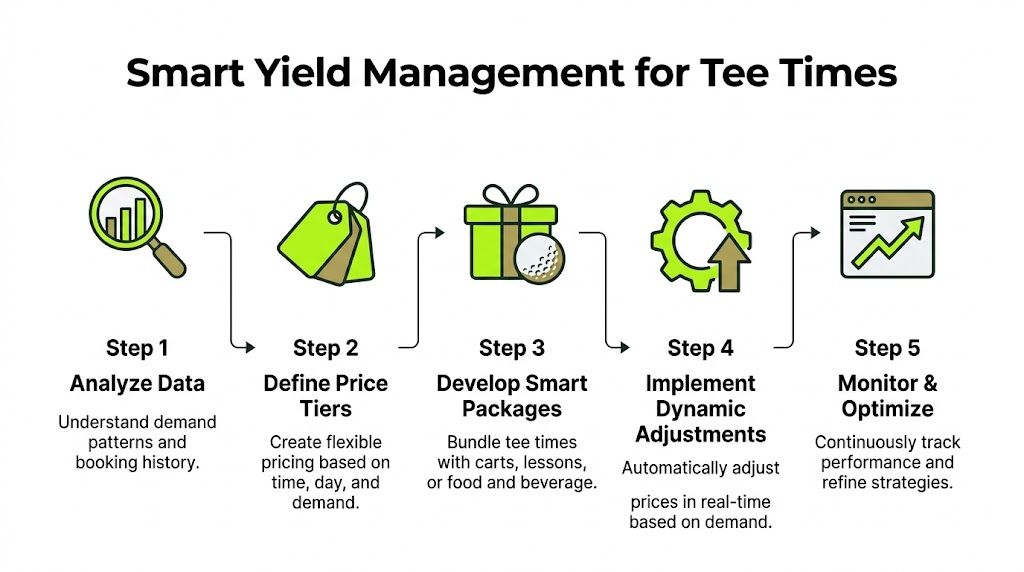
According to the UK-focused benchmarks and analysis in this Cornell-hosted resource, a data-led tee sheet model uses revenue software to test 8 to 14 minute intervals, typically runs 10 to 12 minute gaps during peak demand, and can tighten to 9 minutes for selected last-minute recovery periods. The same Cornell-hosted analysis reports that this setup can deliver 15% higher last-minute utilisation, and that dynamic interval management can improve profits by at least 12%.
Dynamic pricing works when the triggers are specific
A useful pricing rule starts with operational inputs, not instinct from the shop counter. The club should know what the sheet looks like now, how quickly comparable slots usually book, what weather is doing to same-day demand, and whether local events are pushing traffic up or down.
For most clubs, the inputs are manageable:
- Live occupancy on the tee sheet
- Booking velocity by time window
- Daypart demand
- Weather conditions
- Known local events
- Historical cancellation and no-show patterns
Those inputs matter because they stop the common mistake of treating every open slot the same. A soft 8:20 a.m. weekday slot has a different buyer, different conversion window, and different margin profile than a 5:40 p.m. summer twilight time. The pricing logic should reflect that.
Packaging protects the rate card
Last-minute demand does not always need a lower green fee. In many clubs, the smarter move is to hold the rate and increase perceived value around the round.
That keeps the offer saleable without training golfers to wait for a markdown.
The package should fit the slot and the audience. Good examples include twilight golf with a simple food and beverage offer, an early round bundle with breakfast, or a visitor package that adds range balls or buggy use where margin allows. The point is not to make every booking bigger. The point is to preserve the base price and still give the golfer a reason to act now.
I usually advise managers to set package rules before the gaps appear. Decide which add-ons are approved, what margin floor applies, and which audiences can see each offer. That removes hesitation from the decision and stops the team from improvising different deals every weekend.
Intervals are a revenue decision, not just an operations setting
Many clubs leave interval policy to operations and treat pricing as a separate commercial task. That split leaves money on the table.
Intervals determine how much inventory you can sell without damaging pace of play. Wider spacing can protect flow at the wrong times of day, but it can also leave isolated holes that are difficult to recover. Tighter spacing can help same-day utilisation, but only if the course can absorb it cleanly. That is why simulation and post-round performance data matter. The tee sheet has to be configured for both revenue and experience.
A practical operating standard looks like this:
| Decision area | Weak practice | Strong practice |
|---|---|---|
| Pricing | One flat discount rule | Rules tied to occupancy, booking pace, and daypart |
| Packaging | Green fee reduction only | Value-added offers that protect the headline rate |
| Intervals | Fixed all day | Interval settings adjusted for peak demand and recovery windows |
Clubs that want to hold their position at the top end of the market should align these rules with a broader premium tee time strategy for golf clubs. That is how you fill more short-notice inventory without teaching your market that every empty slot will become a bargain.
Automating Outreach and Driving Conversion
It is 11:10 a.m. on Saturday. A twosome cancels a 1:20 slot, the shop is busy, and nobody has time to call down a list of prospects. By 12:30, that inventory is still sitting there. The problem was not demand. The problem was response time, routing, and a booking path that depended on staff having a spare ten minutes.
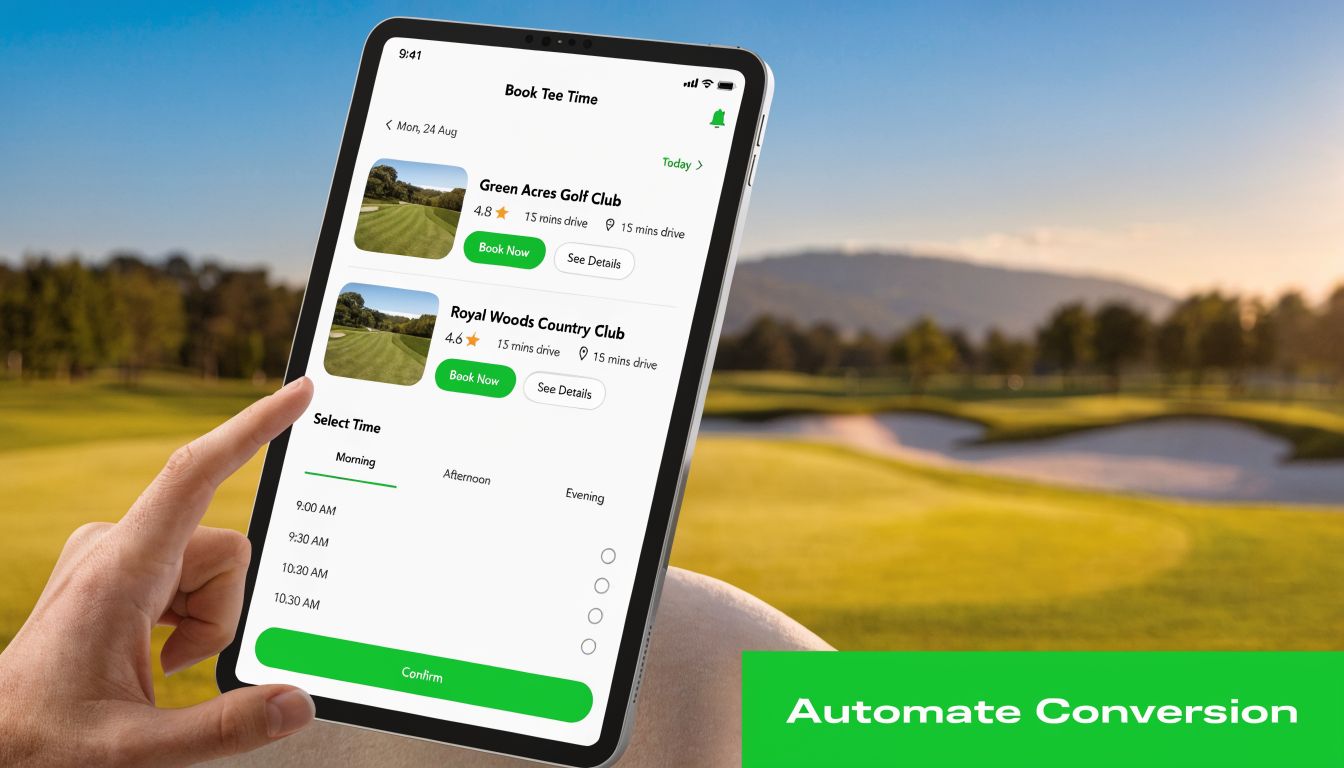
Automation fixes that operational gap. In this golf pass and automation analysis, the provider reports that clubs using 24/7 lead qualification and automated follow-ups convert 28% more enquiries into visits than clubs relying on manual methods. The same analysis reports that multi-site operators using centralised CRM and automation have achieved 90% last-minute slot recovery, compared with 70% for manual processes.
Those numbers matter because last-minute revenue is a systems problem. If the slot opens and the right golfer is not contacted fast enough, the value disappears. If the golfer clicks and lands on a generic booking page, conversion drops again. Clubs that recover this revenue consistently connect inventory, CRM rules, messaging, and attribution into one process.
What the workflow should look like
A workable setup is straightforward, but it has to be defined in advance. Staff should not be writing copy, picking segments, and building links in real time while the clock is running.
Use a flow like this:
- A slot opens inside a defined recovery window.
- The booking system passes the trigger to the CRM.
- The CRM checks audience rules, exclusions, and channel preferences.
- A pre-approved SMS or email goes to the right segment with the exact time and booking link.
- The golfer lands on the offer already loaded in the booking journey.
- The CRM records source, click, booking, and revenue outcome.
Speed matters. Traceability matters just as much.
A lot of clubs build the first half and miss the second. They send the message, but they cannot see which segment booked, which message converted, or whether the booking came from CRM outreach, paid traffic, or direct demand. That makes improvement almost impossible.
Manual follow-up breaks at the worst time
Front-of-house teams are usually trying to do this between other jobs. They are answering phones, checking in golfers, helping members, and handling pace-of-play complaints. Last-minute slot recovery gets treated as a side task, even though it affects the day’s revenue.
The result is predictable:
- Staff spot the gap late
- The message goes out inconsistently
- Replies come back into a shared inbox or personal phone
- Bookings have to be matched by hand
- No one can prove what worked
An automated model removes those failure points. The slot creates the task, the CRM selects the audience, the message is already approved, and the booking path is live the moment the golfer clicks.
Conversion is won after the click
Message performance gets too much attention. The larger gain usually comes from fixing the handoff into the booking engine.
Check each step in the path:
- Message to page: the golfer should land on the exact slot or offer, not the homepage
- Page to engine: they should not need to search again for date, time, or player count
- Checkout: the form should ask only for the information needed to complete the booking
- Confirmation: booking data should pass back into the CRM for future segmentation and follow-up
Short-notice demand is impatient. Every extra field, extra click, or forced site search lowers conversion.
Multi-site groups need central control
At group level, poor follow-up creates two problems. It loses bookings, and it makes performance impossible to compare across venues.
Centralised CRM setup solves that. Head office can set response rules, message templates, exclusions, and attribution standards once, then measure recovery and conversion by site. Local teams still manage the customer experience, but the commercial engine runs to one standard.
That is how clubs turn empty tee times into a predictable channel instead of a weekly scramble. Automation does not replace the team. It protects margin, response speed, and brand control when the team is busy.
Measuring Success Beyond Filled Slots
A full-looking tee sheet can still hide poor commercial decisions. If the club filled last-minute times with weak offers, low-value channels, or untracked bookings, occupancy may improve while margin and future demand get worse.
That’s why “we filled the slot” isn’t enough. The right question is whether the club filled it profitably, repeatably, and in a way that helps future revenue rather than borrowing from it.
The metrics that matter
A useful dashboard for tee times last minute should answer four practical questions.
| Question | Why it matters |
|---|---|
| Where did the booking come from? | Shows which channels deserve more budget or effort |
| How quickly did the lead convert? | Reveals whether response speed is helping or hurting |
| What was the revenue outcome? | Separates healthy fills from low-quality ones |
| Did the golfer return? | Distinguishes one-off rescue bookings from pipeline value |
Source tracking is often the biggest gap. Clubs may know that bookings arrived, but not whether the demand came from CRM outreach, paid social, a partner, or direct website traffic. Without that visibility, every channel starts to look equally useful, which isn’t true.
Occupancy is a lagging indicator
Occupancy tells you what happened after the fact. It doesn’t explain why it happened. If one campaign filled several slots but generated low-value golfers who never returned, that result should be judged differently from a smaller campaign that introduced repeat visitors.
The same applies to pricing. A filled slot achieved by cutting too far may create a poor precedent even if the day’s revenue looked acceptable. Managers need enough reporting to see the trade-off clearly.
A strong reporting routine usually includes:
- Booking source by channel
- Offer-to-booking conversion rate
- Average revenue from the last-minute inventory pool
- Follow-up outcomes for players who didn’t book immediately
- Repeat visit behaviour from last-minute buyers
Good reporting doesn’t just confirm activity. It shows which actions deserve repeating and which ones should stop.
Use measurement to protect the member experience
Measurement isn’t only about sales. It also helps clubs avoid the hidden costs that come with poorly handled recovery tactics.
If member complaints rise after a run of visitor offers, that signal belongs in the same commercial conversation as revenue. If pace of play slips after interval changes, the operations team needs to see that. If one channel fills slots but attracts the wrong fit for the club, that matters too.
Many committee-led clubs often get stuck. They review one visible metric, usually rounds or occupancy, and ignore the operating context behind it. Better measurement creates better decisions because it forces the club to weigh yield, fairness, speed, and fit together.
The goal isn’t endless data. It’s enough clarity to know what’s working, what isn’t, and what the club should do next week instead of guessing again.
Conclusion From Perishable Slot to Predictable Asset
An empty tee time is only unavoidable if the club treats it as a one-off problem. The clubs that recover tee times last minute consistently don’t rely on luck, staff memory, or last-second discounting. They build channels in advance, set pricing rules with discipline, package offers intelligently, automate outreach, and track conversion properly.
That turns a fragile revenue opportunity into a manageable system. It also protects the things that matter most in a private member environment, namely pricing integrity, member trust, and a smoother operating rhythm.
The practical shift is simple. Stop thinking only about how to sell the next empty slot. Start building the process that makes the next hundred easier to fill, easier to measure, and easier to profit from.
If your club wants a clearer system for handling last-minute demand, lead follow-up, and conversion tracking, GolfRep helps golf clubs build predictable pipelines with CRM-led automation and structured growth systems that fit how clubs operate.
Ready to tap into our proven growth system?