Kilspindie Golf Club Membership: Strategic Analysis

Prestige does not fix a weak membership process.
A well-known club can still lose good prospects through slow replies, unclear categories, and vague next steps. That is why the usual advice about chasing more visibility often misses the point. Clubs do not always need more attention. They need a better way to handle the attention they already get, especially as traditional golf marketing advice keeps showing its age.
Kilspindie golf club membership makes a useful case study for that reason. The club has the kind of market position many managers would envy. Heritage. A distinctive East Lothian links setting. A course profile that already attracts interest from serious golfers. Public course references also reinforce that status, noting Kilspindie's long history and classic links character, as noted earlier on Top 100 Golf Courses' Kilspindie overview.
Interest alone does not produce joiners.
From an operator's point of view, the more useful question is whether the public-facing offer does enough work once that interest appears. Can a prospect quickly understand which membership route fits them, what the likely commitment looks like, what happens after enquiry, and who follows up if they hesitate? If those answers are missing or buried, even a sought-after club leaves conversion on the table.
Kilspindie is not being used here as a brochure example. It is a live blueprint for club managers who want to examine their own enquiry flow with more discipline. If a club with this level of pull still exposes information gaps, follow-up risk, or friction in the path to application, the lesson is obvious. Reputation creates demand. Process turns that demand into members.
Why a Great Reputation Is No Longer Enough
A strong reputation still matters. Heritage matters. Course quality matters. Location matters. They all shape first impressions and drive intent. But none of them guarantees that an interested golfer will move cleanly from curiosity to application.
Kilspindie has the ingredients clubs often assume are enough. It is one of the oldest clubs in the world. It sits in one of the richest golfing regions in the UK. It has long-standing credibility as a traditional East Lothian links. That sort of standing opens doors before the sales process even begins.
The mistake many clubs make is assuming demand will organise itself.
Prestige creates enquiry volume, not process quality
A respected name can generate inbound interest without much effort. That often hides operational weakness. If enough people ask about membership, staff begin to believe the club's problem is solved. It isn't.
The moment someone enquires, the club moves from brand position to operational execution. That is a different discipline. A prospect who cannot quickly understand categories, eligibility, next steps, waiting times or value for money doesn't experience the club's history. They experience friction.
A club can be highly desirable and still be hard to join.
That's why old advice about golf marketing feels dated. It treats visibility as the prize. In practice, visibility is only useful if the club can capture, track and follow up on the resulting demand. That broader issue is part of why much of golf marketing is outdated.
The modern risk is quiet lead loss
Most clubs don't lose prospects in dramatic ways. They lose them subtly.
A membership email lands in a shared inbox late on a Friday. A voicemail sits with reception. A website form goes to one person who is off site. A committee member means to reply after the weekend. Another enquiry gets a brochure but no follow-up. Nobody sees the pattern because nobody is looking at the pipeline end to end.
That is why a great reputation is no longer enough. Reputation may attract the golfer, but only a reliable system moves that golfer toward a visit, a conversation and an application.
What actually separates clubs that grow
The clubs that convert well usually do a few unglamorous things better than everyone else:
- They respond quickly: prospects don't wait indefinitely for basic answers.
- They centralise visibility: one staff absence doesn't freeze the entire pipeline.
- They define next steps clearly: prospects know what happens after the first enquiry.
- They follow up consistently: interest isn't left to fade.
- They review conversion points: management can see where prospects stall.
None of this is complicated. It is disciplined.
That is a key takeaway from a club like Kilspindie. A prestigious reputation gets attention. A system turns attention into membership growth.
Deconstructing the Kilspindie Membership Offer
Before any club improves conversion, it has to inspect the offer itself. Not from the committee table, but from the prospect's point of view.
Kilspindie's public structure is useful because it shows both strength and friction in the same example. On the positive side, the categories are recognisable and easy to understand at a high level. Public references show full playing membership at £1,800 per year, 5-day membership at £1,400, and country membership at £800, as noted in this public review of Kilspindie membership information. That gives a prospect an immediate sense of the ladder.

The issue is what happens after that first glance. Public category labels and fees create orientation, but they don't complete the sale.
Clear categories help, but they don't finish the job
For most prospects, category names answer only the first question. They tell people what exists. They don't tell them what fits.
A full membership option usually signals unrestricted access and the strongest connection to club life. A 5-day category often attracts golfers who want weekday flexibility without the cost of a full seven-day package. A country category suggests distance-based suitability for golfers who won't use the club as frequently.
That is sensible. But a serious prospect still wants more.
They will often ask:
- Usage detail: can I play at any time within the category?
- Club life: are competitions included?
- Guests: what does guest access look like?
- Transition: can I move between categories later?
- Practical value: what am I buying besides course access?
If those answers are not visible, the club creates avoidable sales work for itself.
The real product is certainty
A membership page should reduce uncertainty. Many clubs think they are selling prestige, golf, facilities and community. They are. But in practical terms they are also selling clarity.
When clubs don't present that clearly, prospects hesitate for perfectly rational reasons. They may still be interested, but they postpone action because they can't evaluate the fit.
A useful way to audit your own membership page is with a simple comparison.
| Area | What prospects need | What often goes wrong |
|---|---|---|
| Category structure | Clear pathways by type of member | Too many labels with weak explanation |
| Pricing | Visible fee range and obvious positioning | Prices hidden or detached from value |
| Inclusions | Practical explanation of benefits | Assumptions that members already know |
| Next step | Direct route to enquire or visit | Generic contact page with no guidance |
Where friction enters the journey
Kilspindie's case highlights a common issue in private club membership. The headline offer can be strong, but the detail is too thin in public view. That doesn't mean the club lacks value. It means the value is not fully translated into a prospect-friendly format.
Practical rule: if a golfer has to email the club to understand the basics, the enquiry process is already doing work the website should have done first.
Unclear offers distort lead quality. Staff spend time answering basic questions instead of speaking to motivated prospects about joining. Response times slow down. Good enquiries sit alongside low-intent ones. Follow-up becomes reactive rather than structured.
What club managers should borrow from this example
Kilspindie's public-facing structure still gets one important thing right. It shows distinct membership routes instead of presenting one vague invitation to join. That is worth keeping.
The stronger version of that approach is to make each route self-explanatory. A club doesn't need pages of copy. It needs enough specificity for the prospect to self-identify.
Good public presentation usually includes:
- A simple category ladder: enough options to cover real demand, not so many that choice becomes confusing.
- Visible pricing context: not just the fee, but the reason one category sits above or below another.
- Concrete inclusions: playing rights, social access, competition access, guest arrangements, or whatever applies.
- A defined next action: book a visit, request a call, attend an open day, or start an application.
That is where kilspindie golf club membership becomes more than a local search term. It becomes a template for managers to inspect their own club's offer with sharper eyes. The offer doesn't have to be cheaper. It has to be easier to understand.
The Real Challenge From Enquiry to Conversion
Once the offer is strong enough to generate interest, the next problem begins. At this point, most clubs leak value.
Kilspindie's visitor setup points to a high-intent market. Public information shows visitor green fees ranging from £90 to £170, with visitor access after 10am on weekends, according to Scotland's Golf Coast on Kilspindie Golf Club. That combination suggests a club protecting member access while operating in a premium demand environment.
For any club manager, the implication is straightforward. An enquiry into a club like that is not casual noise. It is a valuable commercial event.

Most clubs don't have a lead problem
They have a handling problem.
A typical club receives enquiries through several routes at once. Email. Phone. Website forms. Social media messages. Verbal referrals passed to reception. Visitor enquiries that later become membership conversations. None of that is unusual.
What is unusual is seeing all of those channels in one place with clear ownership.
Without that visibility, clubs run on memory and goodwill. One person knows that Mr Smith wanted a weekday category. Another remembers that someone asked about a trial round. A committee member thinks the prospect has already been called. Nobody can say for certain what happened last, what should happen next, or whether the enquiry is still live.
Manual processes look harmless until they fail
Spreadsheets, inbox folders and handwritten notes can function when enquiry volume is low and staff availability is stable. They become fragile as soon as either of those conditions changes.
Common failure points tend to look like this:
- Shared inbox ambiguity: everyone assumes someone else replied.
- Holiday gaps: the person who normally handles membership is away.
- No follow-up triggers: an initial reply is sent, then the lead goes silent and disappears.
- No pipeline stages: management can't distinguish between fresh, active and stale enquiries.
- No conversion history: the club learns nothing from lost opportunities.
These aren't marketing problems. They are process problems.
Clubs often ask how to generate more leads when they still can't account properly for the ones they already have.
Speed matters, but consistency matters more
Fast responses are important because interest is highest early on. But many clubs over-focus on the first reply and ignore everything after it.
A prompt email that says "thanks, attached is our membership form" is not a conversion process. It is an administrative acknowledgment.
A proper conversion flow does more. It answers likely objections, invites a visit, creates accountability for the next follow-up and gives the club a record of every interaction. That matters especially in a premium membership environment, where prospects often expect professionalism before they commit.
A club doesn't need to sound corporate. It does need to sound organised.
The hidden cost of poor visibility
When lead visibility is poor, several bad outcomes follow at once:
| Operational issue | What the prospect experiences | What the club loses |
|---|---|---|
| Slow response | Uncertainty or reduced enthusiasm | Momentum |
| Inconsistent replies | Mixed messages | Trust |
| No follow-up | Silence | Conversion opportunity |
| No tracking | No shared picture of demand | Management control |
That is why the biggest growth opportunity usually isn't at the top of the funnel. It sits in the middle, between enquiry and decision.
A club with strong demand and weak follow-up can look busy while still underperforming. Staff feel occupied. Enquiries keep coming in. Yet the process remains unstable because no one has turned it into a system.
That is the central lesson in the kilspindie golf club membership example. Desirability increases the value of each enquiry. It doesn't remove the need to manage those enquiries properly.
Systemising Your Follow-Up Process
A good follow-up process is not a script. It is a system with clear stages, clear ownership and clear visibility.
Most clubs already do parts of this informally. They answer enquiries, send information, arrange visits and chase up when they remember. The problem is that informal process depends too heavily on who is in the office and how busy the week happens to be.
A system removes that fragility.
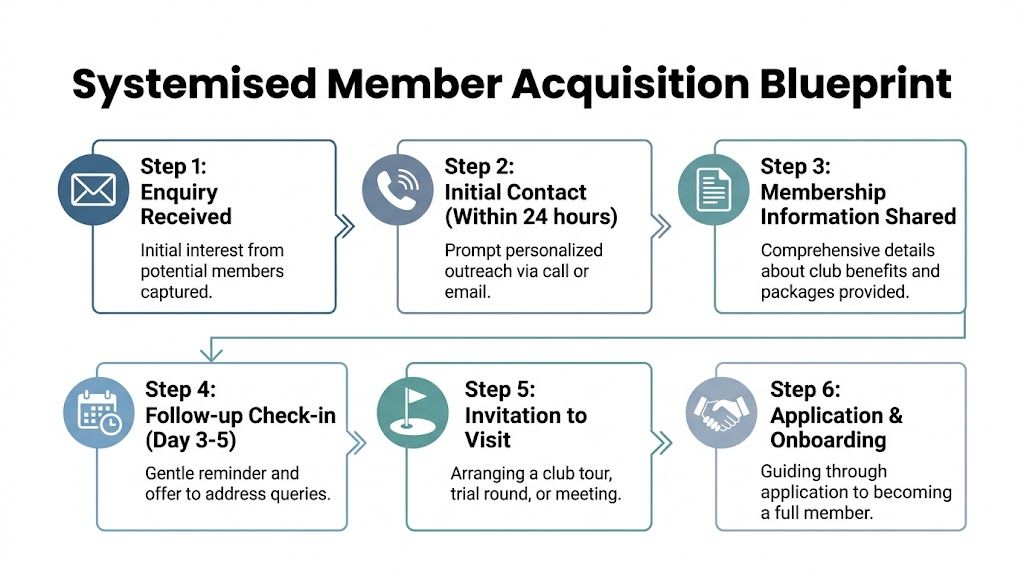
Start with one visible pipeline
The first requirement is a central place to manage membership enquiries. That usually means a CRM rather than an inbox and a spreadsheet.
The reason is simple. A CRM shows who enquired, what category they asked about, what was sent, whether they replied, whether a visit was offered and what should happen next. It replaces memory with shared visibility.
A basic pipeline for membership enquiries usually includes:
- New enquiry received
- Initial response sent
- Qualified for fit
- Visit or call offered
- Visit booked
- Application in progress
- Joined or closed lost
That alone changes management quality. Staff can see workload. Managers can review bottlenecks. Nobody needs to search six places to understand one lead.
Respond while interest is fresh
The first response should do three things well.
It should acknowledge the enquiry. It should answer the most likely practical questions. It should make the next step easy.
That doesn't mean sending a long brochure every time. In many cases, a short and well-structured first response works better. It can confirm the category discussed, outline the next action and offer a phone call or visit.
Operational advice: if your first reply creates more uncertainty than clarity, it slows the pipeline even when it is technically fast.
Clubs that want a practical reference point can review a golf club follow-up system built around response structure, lead tracking and nurture stages.
Build a follow-up rhythm, not a one-off reply
Many prospects won't join after one interaction. That is normal. They may need to discuss cost at home, compare categories, check playing habits, or find time to visit.
Nurture matters. Not aggressive selling. Structured continuation.
A sensible follow-up rhythm often includes:
- Short initial confirmation: sent quickly with membership context and a clear next step.
- A second touch: a check-in after a few days to answer questions.
- A visit invitation: the clearest route from abstract interest to real commitment.
- A decision-stage follow-up: practical help with application, category fit or timing.
The key is consistency. If staff do this only when they remember, performance will swing week to week.
Use automation where it helps, not where it harms
Automation is useful when it handles predictable tasks. It is not useful when it replaces thoughtful human judgment in high-trust moments.
Good use of automation in a membership pipeline includes:
| Best use of automation | Why it works |
|---|---|
| Instant acknowledgement | Confirms receipt outside office hours |
| Information routing | Sends the right details for the relevant membership type |
| Task reminders | Prevents stale leads from being forgotten |
| Visit confirmation messages | Reduces friction around bookings |
Human follow-up still matters when the conversation becomes nuanced. A serious prospect asking about category fit, family use, playing rights or club culture should not feel trapped in a robotic sequence.
Track what staff can act on
Not every metric is useful. Clubs often drown in data they can't use.
The operational questions that matter are more practical:
- How many enquiries are new and untouched today
- How long has each live lead been waiting
- How many prospects have been offered a visit
- Which leads have gone quiet without follow-up
- Which categories generate the strongest intent
That is enough to run a disciplined pipeline.
A systemised process does not make a club impersonal. Done properly, it does the opposite. It gives staff enough structure to respond personally without dropping the ball. That is the difference between being busy and being in control.
Targeting Growth Beyond the Traditional Member
A proper membership system doesn't just tidy up existing demand. It allows a club to pursue segments that often get neglected because manual follow-up is too inconsistent.
Young adults are one of the clearest examples. Many clubs say they want younger members, but their process still assumes the prospect will do most of the work. That usually means static web pages, generic forms and no personalized follow-up.
Public discussion around Kilspindie highlights the importance of this gap. One cited figure notes that only 22% of UK junior golfers retain club membership after age 18, and mentions a 20% conversion uplift target linked to Kilspindie's NextGen Links pilot, as referenced in this Golf Club Atlas discussion. Whether or not a specific club has published outcomes, the strategic issue is obvious. Transition points need structure.

Junior to adult is not one decision
Many clubs treat membership progression as if a junior golfer ages into the next category. That is rarely how it works in practice.
Life changes around that point. Study, work, relocation, budget pressure and changing routines all intervene. If the club communicates only at renewal time, it arrives too late.
A better approach treats progression as a guided journey. The club identifies juniors approaching transition age, segments them properly and begins relevant communication before the decision point becomes urgent.
Different audiences need different pathways
A modern membership system lets clubs build distinct journeys without turning the office into chaos.
For example:
- Junior members nearing adulthood: messages focused on continuity, playing opportunities and realistic next-step categories.
- Young professionals in the local area: communication focused on flexibility, club access and ease of joining.
- Former visitors with repeat interest: specific contact that bridges visitor experience and membership fit.
- Lapsed prospects: polite re-engagement when circumstances may have changed.
This isn't about blasting the database. It is about matching the follow-up to the person.
The right message sent at the right stage beats a generic brochure sent once.
Why clubs miss these segments
The usual reason is operational, not strategic. Staff are already dealing with day-to-day work, so targeted nurture never gets built. The club knows the opportunity exists but lacks a mechanism to act on it consistently.
That is why systemisation matters beyond efficiency. It creates reach. It gives the club the capacity to pursue growth that would otherwise remain theoretical.
A useful internal exercise is to ask three questions:
| Question | Why it matters |
|---|---|
| Which member types do we say we want more of | Clarifies strategic intent |
| Do we have a distinct pathway for each | Exposes gaps in communication |
| Who owns follow-up for those pathways | Prevents drift and assumption |
What kilspindie golf club membership highlights here
The Kilspindie example is valuable because it shows that even clubs with obvious heritage appeal still face modern pathway questions. Traditional strength does not remove transition risk.
For club managers, that should be encouraging. It means the answer isn't trying to become a different type of club. It is building a better process around the club you already are.
If a club wants younger members, remote members, weekday members or returning golfers, it needs more than a category on a price list. It needs a structured route from first interest to confident commitment.
Building Your Predictable Membership Pipeline
Prestige does not create a pipeline. Process does.
That is the useful lesson in kilspindie golf club membership for club managers. A strong reputation can increase enquiry volume and lower initial scepticism, but it does not control response times, follow-up quality, handover between staff, or application conversion. Those are operating decisions. Clubs that treat them casually get erratic results, even when the product is strong.
Predictable growth comes from a sequence that staff can repeat under pressure, not from good intentions during quieter weeks.
Predictability comes from controlled handoffs
In practice, a reliable pipeline rests on five connected parts:
- A clear offer: prospects can quickly see which category fits their playing habits and budget.
- One visible enquiry log: every lead sits in the same place, with notes, status, and next action.
- Fast first response: basic questions are answered while interest is still high.
- Planned follow-up: staff know what to send, when to send it, and who sends it.
- Conversion review: management can see where prospects stall, disappear, or commit.
Miss one part and the rest starts to wobble. A club may generate healthy interest but still lose leads through delay, vague communication, or simple lack of ownership.
Good clubs usually have a sales process problem, not a product problem
I see this pattern often. The course is respected, the clubhouse experience is solid, and the membership categories are sensible enough. Yet nobody can answer four basic questions without checking three inboxes and asking two colleagues: How many live enquiries are active? Which stage is each one at? Who owns the next action? How many are likely to convert this month?
That is not a marketing issue. It is a control issue.
A proper golf club sales pipeline gives the team one working view of demand. That matters because membership growth usually fails in the middle of the process, not at the point of first interest. Prospects enquire, receive one reply, then drift because nothing structured happens after that.
The standard to aim for
A club does not need complicated automation to fix this. It needs a dependable operating rhythm.
If an enquiry arrives today, the team should be able to confirm the following without discussion:
| Needed immediately | Why it matters |
|---|---|
| Who owns the lead | Stops delay and duplicated replies |
| What the prospect wants | Keeps the response relevant to their likely category |
| What the next action is | Maintains momentum after the first contact |
| When follow-up is due | Prevents silent drop-off |
That is the baseline. From there, clubs can improve conversion by adding stage-specific templates, tour invitations, trial experiences, and application prompts. The important point is order. If ownership and follow-up discipline are weak, extra tactics just create more noise.
Kilspindie is a useful case study because it shows the same truth that applies to less famous clubs. Enquiry conversion improves when the club removes uncertainty for staff and for prospects. That is how membership growth becomes repeatable rather than occasional.
Frequently Asked Questions for Club Managers
Clubs often agree with the principle of better follow-up but worry about implementation. Most of those concerns are practical, and they should be. A membership system only helps if the team will use it.
FAQ for Club Managers
| Question | Answer |
|---|---|
| Do we need a full CRM to improve membership conversion? | You need one central system of record. For most clubs, that is best handled by a CRM because it keeps enquiries, notes, follow-ups and status changes together. The important point isn't software for its own sake. It's visibility. |
| Will a system make us feel too corporate? | Not if it's built properly. Good systems remove administrative slippage and give staff more space to have better conversations. Members and prospects usually experience that as professionalism, not coldness. |
| What if our enquiry volume is modest? | A lighter enquiry flow still benefits from structure. In fact, lower volume is often the easiest time to build good habits because staff can adopt process changes without pressure. |
| Who should own membership enquiries? | One named owner should be accountable, but the process should still be visible to others. That way the club doesn't stop functioning when one person is away or overloaded. |
| Should every prospect get the same follow-up? | No. The framework should be consistent, but the content should match the prospect. A weekday prospect, a country member prospect and a junior transition prospect do not need identical communication. |
| Can automation handle the first reply? | Yes, if it is used carefully. Automation is helpful for acknowledging receipt, routing information and prompting next actions. It should support the team, not replace human judgment where trust matters. |
| How do we know if our current process is weak? | Start with a simple audit. Check how quickly enquiries are answered, whether all leads are visible in one place, whether follow-ups are scheduled, and whether management can see which enquiries became members. If the answer to any of those is unclear, the process likely needs work. |
| What should we fix first? | Start with response ownership and lead visibility. If you can't see every enquiry and assign responsibility clearly, the rest of the pipeline will remain unreliable. |
Clubs don't usually need more complexity. They need fewer blind spots.
The most effective membership operations are rarely the most flashy. They are the ones that make good prospects feel seen, informed and guided from the first touch onward.
If your club wants a clearer, more predictable way to turn membership enquiries into applications, GolfRep helps golf clubs build that system properly. That includes lead generation, CRM visibility, structured follow-up and automation that supports the team rather than replacing it.
Ready to tap into our proven growth system?