Playsport East Kilbride Golf: Strategic Model for 2026
Most advice about modern golf growth starts in the wrong place. It tells clubs to chase more traffic, more awareness, more enquiries.
That misses the operational truth.
A venue like Playsport East Kilbride Golf is useful to study not because of its scorecard, but because it shows what happens when a golf business is built around multiple ways for people to enter the brand. For club managers, that raises a harder question. Once interest exists, what system turns that interest into repeat play, coaching demand, retail spend, and long-term customer value?
Beyond the Scorecard What Playsport Reveals About Modern Golf
Playsport East Kilbride Golf is easy to approach as a player-facing venue. You look at the course, the range, the practice offer, and decide whether it suits your game.
A club manager should look at it differently.
Playsport opened to the public on 1 August 2009, and the facility reported more than 3,500 rounds played at launch, according to 18Birdies' listing for Playsport Golf. That matters because it gives us an early signal that South Lanarkshire could support a substantial new golf proposition. It wasn't entering a dead market. It entered with visible demand.
Why managers should ignore the usual review mindset
The common assumption is that a golf facility succeeds if the course is good enough and the range is busy enough. That view is too narrow.
Playsport has been positioned as a significant regional venue rather than a small local range, and that distinction changes the management challenge. A regional venue doesn't just serve golfers who already know what they want. It serves casual users, lesson prospects, short-format players, and visitors comparing convenience against a traditional club experience.
Practical rule: When a facility attracts different types of golf customer, the real task isn't filling the front door. It's identifying who came in, why they came in, and what the next best step should be.
That is why the smarter comparison isn't course versus course. It's operating model versus operating model. Playsport is closer to the kind of venue discussed in GolfRep's thinking on the digital driving range model, where technology, coaching, and accessibility create commercial opportunities that older club structures often fail to organise properly.
The deeper lesson
For managers searching "Playsport East Kilbride Golf", the obvious questions are about golf. The more valuable question is about commercial architecture.
A facility can be popular and still leave money on the table. It can generate traffic and still fail to build a predictable pipeline. Playsport is a good case study because it appears to have built demand around convenience and variety. That makes it useful for any club trying to understand where modern growth now comes from.
Analyzing the Playsport Multi Revenue Model
The strongest strategic feature at Playsport isn't one individual asset. It's the combination.
TripAdvisor's current facility description says the site operates a 56-bay driving range powered by Toptracer, alongside a PGA coaching centre, a 9-hole Heritage Links course, and an American Golf superstore. It also notes an AnyTime Fitness 24-hour gym, which confirms the site has evolved beyond a single-purpose golf venue into a broader leisure complex, as shown on TripAdvisor's Playsport page.
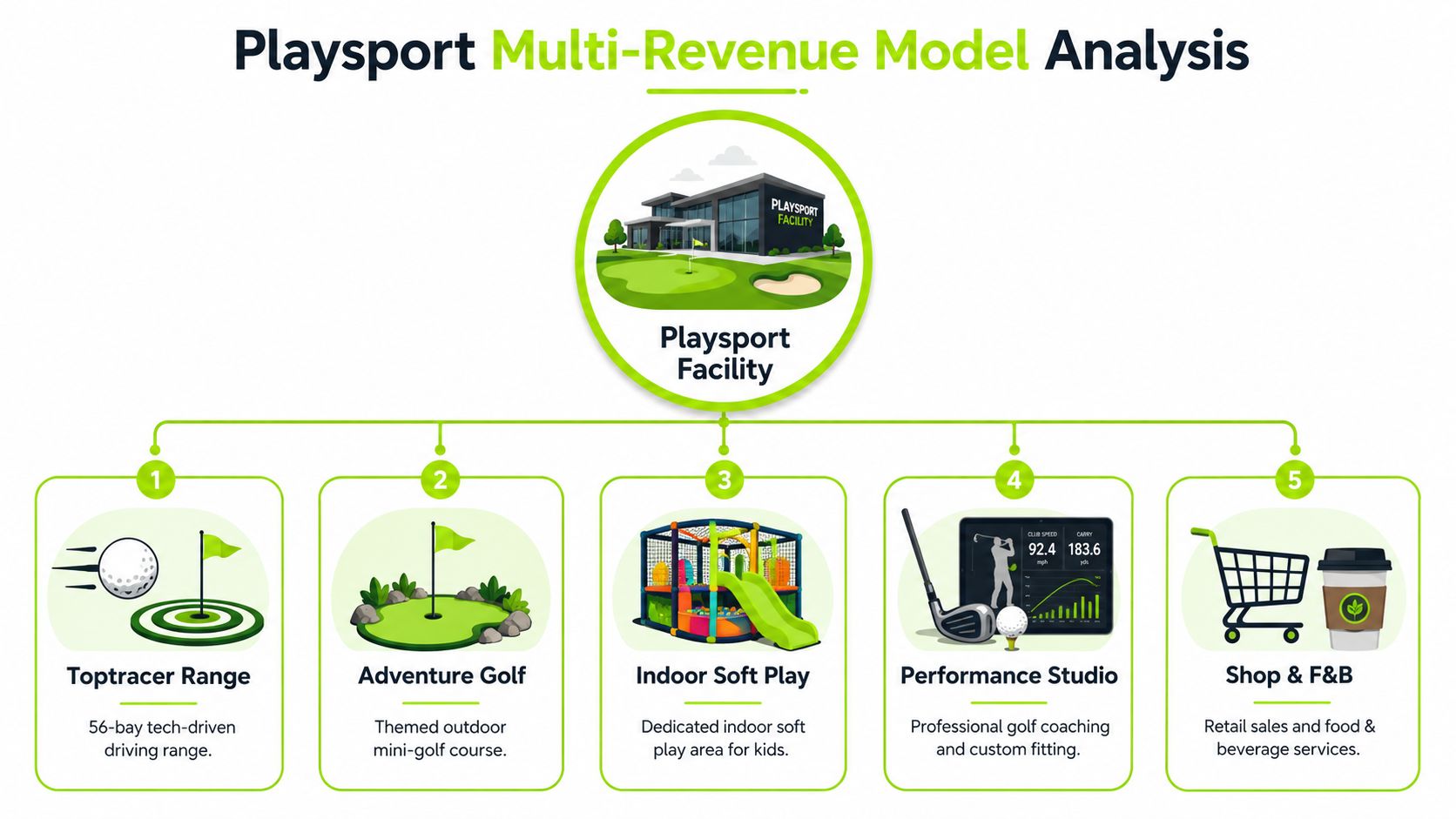
Five entry points change the economics
A traditional club often depends heavily on membership subscriptions, green fees, and bar trade. Playsport's setup points to a different structure.
- Range-led access gives the business a casual, low-commitment entry point.
- Short-course play offers a time-efficient golf option.
- Coaching creates a service-led route into repeat spend.
- Retail captures purchase intent on site.
- Wider leisure use broadens visit reasons beyond golf alone.
That mix matters because each part of the venue can feed another part. Someone may first arrive for the range, then book tuition. A lesson customer may buy equipment. A retail visitor may discover the course. A gym user may become a golf prospect if the environment lowers the barrier.
Diversified assets need coordinated systems
At this stage, many operators stop too early. They see diversified revenue and assume the business model is self-optimising.
It isn't.
A multi-format venue creates more opportunities, but it also creates more handoffs between teams, channels, and customer intents. Reception may hear one type of question. The pro shop hears another. Coaching enquiries arrive through a different path. Online visitors ask practical questions before they commit.
A club that wants to learn from this model should think less about copying the surface offer and more about copying the logic behind it. GolfRep has written about this broader issue in its breakdown of golf club revenue structure, where the central issue isn't just adding revenue lines. It's making sure each revenue line supports the next step in the customer journey.
A multi-revenue facility doesn't reduce management complexity. It increases it. The benefit only appears when the business can connect visitor activity to a clear conversion path.
That is the operational challenge Playsport highlights. Variety attracts attention. Systems determine whether that attention compounds.
The Hidden Challenge High Footfall Versus Low Conversion
High footfall is often mistaken for commercial control.
In reality, a busy site can hide poor conversion for a long time. Staff feel occupied. Bays are full. The car park looks healthy. The venue appears active. Yet the key management question remains unanswered: how many of those visitors are moving into higher-value relationships with the business?
Golfshake's course listing describes Playsport as a high-throughput practice-and-play venue, with a 56-bay driving range and multiple other attractions. It also highlights the operational difficulty of integrating player development and retention programmes without a structured system, as noted on Golfshake's Playsport East Kilbride course page.
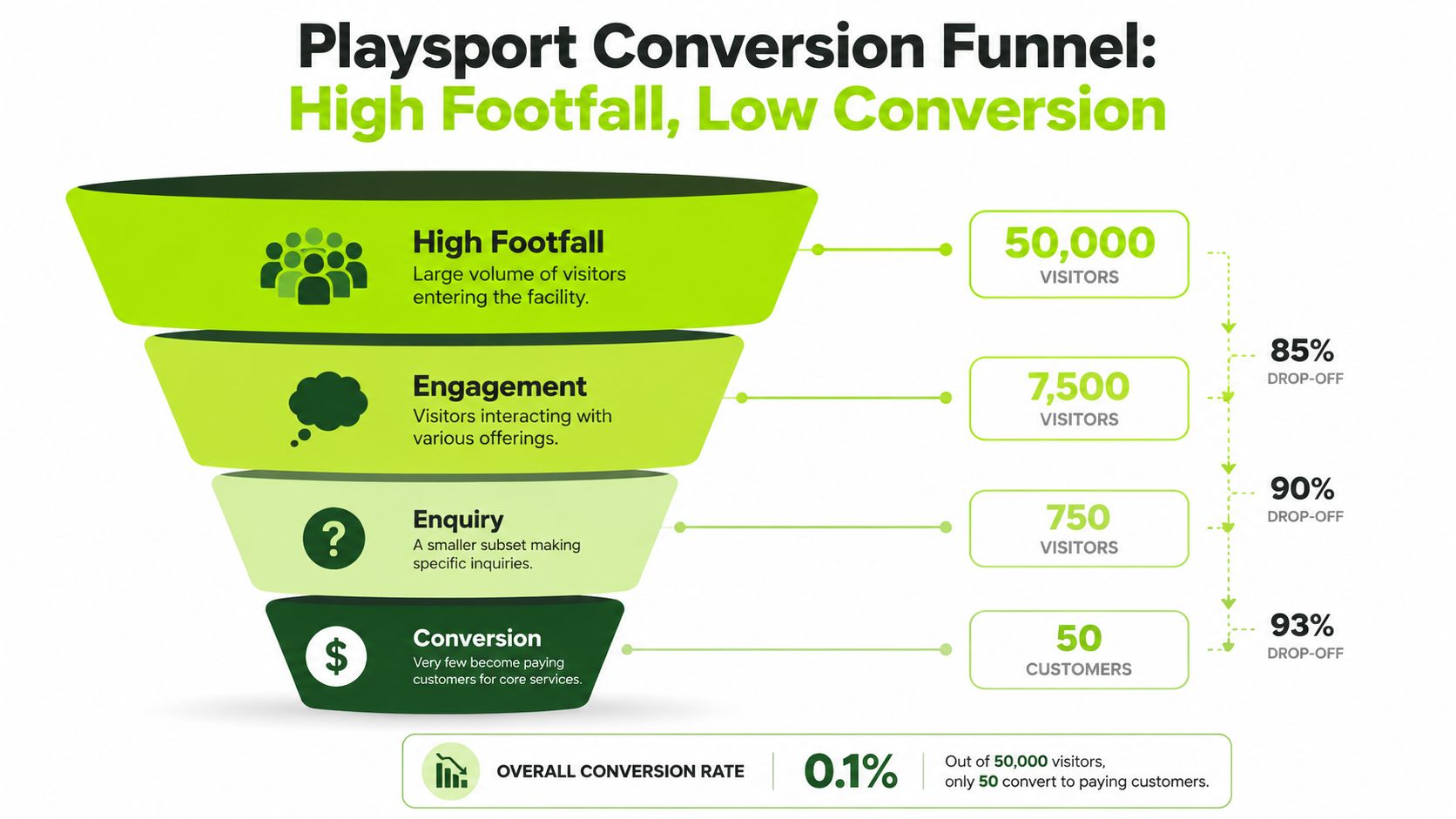
Footfall is not a pipeline
A manager looking at Playsport East Kilbride Golf should separate three things that often get blurred together:
| Stage | What it looks like | Where clubs get misled |
|---|---|---|
| Visit activity | People use the range, course, shop, or leisure offer | Staff assume usage equals loyalty |
| Commercial intent | People ask about lessons, return visits, prices, availability, or membership-style options | Questions are treated as admin, not sales signals |
| Tracked conversion | The business knows who asked, who got a response, and what happened next | No central visibility means leads disappear |
This is the leaky bucket problem in golf operations. The top of the funnel may be strong, but the middle is often unmanaged.
Where leakage actually happens
The losses usually aren't dramatic. They are ordinary.
- A lesson prospect sends an enquiry and doesn't get a fast reply.
- A casual range user asks a member of staff about improving and gets a verbal answer, but no follow-up.
- A short-course visitor compares prices with another venue and leaves because the value case wasn't made clearly.
- A parent or family user experiences part of the site but never receives a relevant golf offer.
None of this looks like failure in isolation. Collectively, it undermines growth.
Busy clubs often think they have a lead generation problem. What they actually have is a lead handling problem that no one has measured properly.
That matters even more in a venue model built on variety. The more ways people can engage, the more chances there are for enquiries to land in different places and die there. The question isn't whether interest exists. It usually does. The question is whether anyone can see it end to end.
Why Manual Enquiry Handling Is a System Deficit
The easiest mistake in golf operations is to treat enquiry handling as admin.
It isn't admin. It's revenue control.
Playsport's own course description says the Heritage Links layout is a stiff but fair 2,307-yard par 32 with 51 bunkers and links features, as shown on the Playsport Scotland golf page. The golf lesson is obvious. On a short layout packed with hazards, imprecision gets punished quickly. The business lesson is the same. In a high-volume venue, imprecise systems create avoidable losses.

What manual handling looks like in practice
Most clubs don't decide to run a weak process. They inherit one.
A prospect fills in a form. Someone checks the inbox later. A team member means to call back. Another enquiry arrives. The phone rings while reception is dealing with a visitor. A staff member gives an answer but doesn't log the interaction. By the end of the week, nobody knows which prospects are warm, which have gone cold, or which service they originally wanted.
That isn't a staffing problem on its own. It's a system deficit.
Four operational weaknesses manual processes create
Slow response time
Enquiries wait in queues shaped by diaries, shifts, and inbox habits rather than customer intent.No lead visibility
If a prospect speaks to reception, coaching, and retail on different days, the business may never connect those touchpoints.Inconsistent follow-up
Strong staff members remember to chase. Busy staff members don't. The process depends on memory.No conversion tracking
Managers can hear that "we've been busy" without knowing what converted.
A practical fix often starts with call routing and front-end structure. For clubs dealing with fragmented incoming calls, a tool such as a telephone auto attendant can help direct people to the right destination faster instead of relying on whoever happens to answer first.
Manual follow-up works only when enquiry volume stays low and staff availability stays stable. Modern golf facilities rarely enjoy either condition.
Clubs that want to move beyond ad hoc handling need a repeatable follow-up process. GolfRep's work on golf club automated follow-up explains the principle well. Speed matters, but sequence matters more. A fast first reply is useful. A structured next step is what converts.
Building a Growth System to Plug the Leaks
Most conversion problems don't start with poor salesmanship. They start with missing structure.
The current content around Playsport highlights a familiar issue in modern golf: a content gap around practical questions on price, booking friction, and value, especially where a facility serves multiple use cases. That matters because many visitors aren't asking whether the venue exists. They're asking whether it fits their time, budget, and intent, a point visible on the Playsport Golf website.
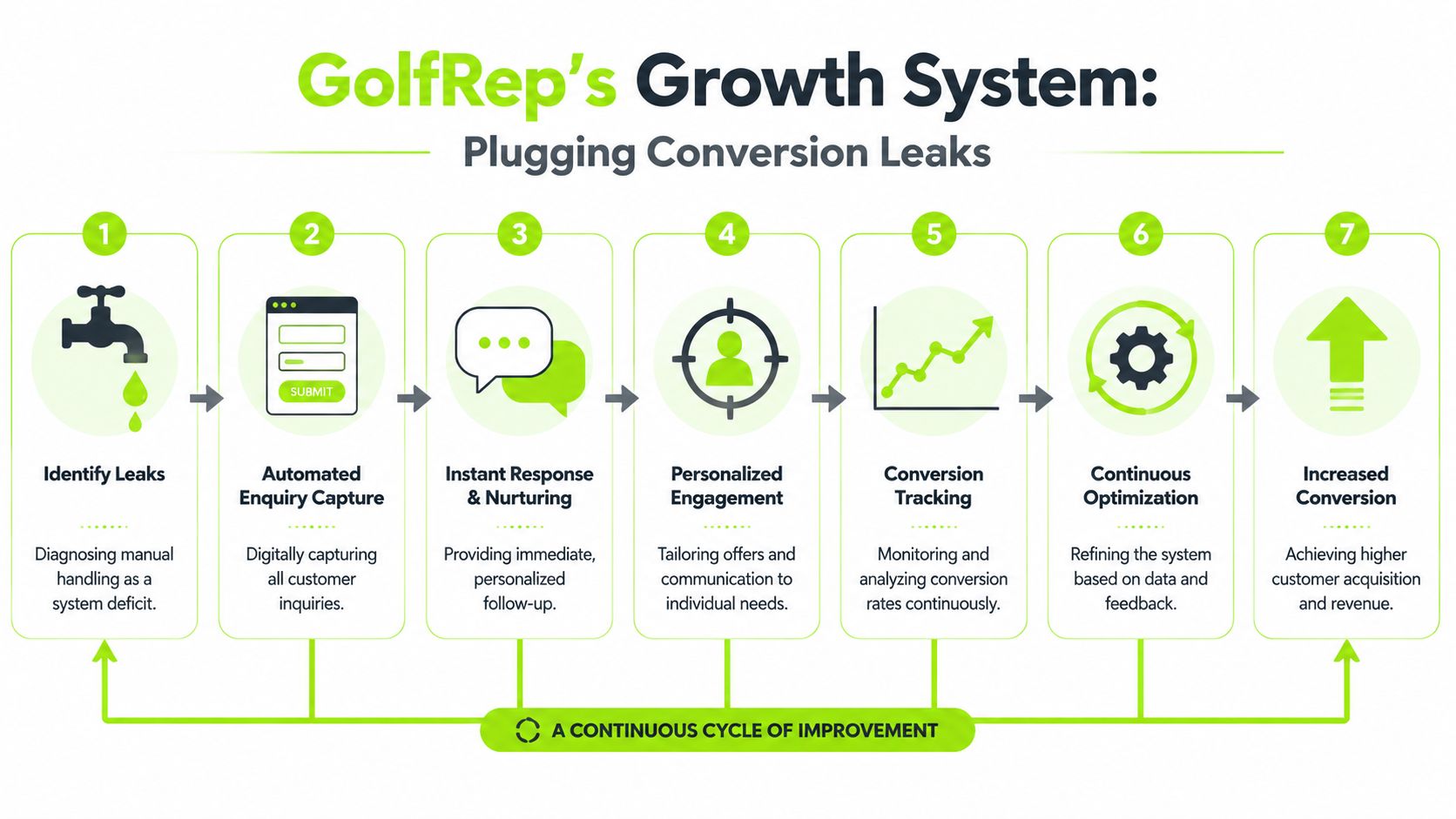
The system clubs actually need
A workable growth system for a club or multi-format venue has to do three jobs at once. It has to capture intent, respond quickly, and show management what happened.
Capture every enquiry in one place
Web forms, phone calls, lesson requests, event questions, and walk-in follow-up details need one home. If data sits in separate inboxes and notebooks, reporting becomes guesswork.Respond with relevance
A range user, lesson prospect, society organiser, and membership lead shouldn't receive the same reply. The first response needs to match the enquiry type and remove the next piece of friction.Track progression visibly
Managers need to see whether an enquiry was answered, whether a visit was booked, and whether revenue followed.
What this changes operationally
A structured system doesn't replace staff judgment. It protects it.
- Reception gains clarity because they no longer need to remember every open conversation.
- Coaching teams get cleaner lead flow because lesson interest is logged and followed up consistently.
- Management gets decision-grade visibility because they can see which channels and offers create booked outcomes.
- Customers get fewer dead ends because the business answers the practical question they asked.
The right information at the right time is not a marketing slogan. It's what removes hesitation.
This is the point where one tool choice matters less than process design. A CRM, automated follow-up, and conversion tracking should behave like one operating system, not three disconnected tasks. GolfRep is one option clubs use for that kind of setup, combining lead capture, structured follow-up, and CRM visibility so enquiries don't vanish between departments.
If a venue like Playsport teaches anything, it's that broad demand creates complexity. A growth system turns that complexity into a manageable pipeline.
Applying These Lessons for Your Clubs Predictable Growth
The value in studying Playsport East Kilbride Golf isn't that every club should copy its format. Most can't, and many shouldn't.
A key lesson is that modern golf growth comes from managing intent properly. Playsport shows what happens when a venue creates several reasons for people to engage. That creates commercial opportunity, but it also creates operational risk if enquiry handling remains informal.
Questions every club manager should ask now
Where do enquiries currently land
If the answer involves multiple inboxes, verbal messages, and staff memory, the process is already exposed.How quickly does each type of lead get a useful response
Not just a reply. A useful response that helps the person take the next step.Can management see the full journey
If you can't track the path from first contact to booking or sign-up, you can't improve it with confidence.
What predictable growth actually looks like
Predictable growth doesn't mean constant discounts or louder advertising. It means your club can handle demand in a controlled way.
For some clubs, that starts with better website content that answers obvious visitor questions. For others, it's tighter call handling, cleaner lead capture, or automated follow-up for lesson and membership interest. In every case, the principle is the same. Don't assume demand converts itself.
Clubs rarely lose growth because nobody was interested. They lose it because interest arrived without a system ready to receive it.
That is the strategic takeaway from Playsport. High-traffic golf businesses don't win because they are busy. They win when they can identify, respond to, and convert the reasons people were busy in the first place.
If your club is generating interest but struggling to turn it into booked visits, lesson demand, or membership conversations, GolfRep helps build the systems behind that conversion. The focus isn't generic promotion. It's creating clear lead visibility, faster follow-up, and a pipeline your team can effectively manage.
Ready to tap into our proven growth system?