Padel Club Paid Ads: A Playbook for Profitable Growth
The most common advice on padel club paid ads is also the least useful. Run some Meta campaigns, add a Google budget, drive traffic, and bookings will follow.
That thinking is too shallow for a club business.
At GolfRep, we come at this from the golf world, where clubs have spent years learning a hard lesson. Demand generation matters, but it isn't the whole job. The core commercial problem usually starts after the enquiry arrives. If a club can't see leads clearly, respond quickly, and move people into the right next step, ad spend turns into activity rather than revenue.
Padel is now at the stage where that distinction matters. Interest is there. Curiosity is there. Trial demand is there. What separates a profitable site from a noisy one is the system behind the ads. If you want a useful outside primer on how paid search and paid social are typically managed, this PPC management services guide gives a reasonable overview of the moving parts. The mistake is assuming management alone solves the commercial challenge.
It doesn't.
A padel club doesn't need cheap clicks. It needs a controlled path from ad to first booking, from first booking to repeat play, and from repeat play to reliable member revenue. That's the same principle that works in mature golf markets, and it transfers well to padel.
The Real Challenge with Padel Club Growth
The easy part is getting attention. The harder part is turning that attention into the right kind of customer.
Many new operators look at paid ads as a volume game. More reach, more traffic, more enquiries. That approach can make a dashboard look healthy while the business underneath stays fragile. A club can be busy without being commercially strong. It can fill popular slots, underperform in quieter periods, and still fail to build dependable recurring revenue.
Demand is not the same as conversion
In club businesses, poor follow-up hides behind good marketing all the time.
A prospect clicks an ad, visits the site, gets distracted, and leaves. Or they submit an enquiry and wait too long for a reply. Or they book once, enjoy it, and never hear from the club again. None of those failures are ad problems. They're system problems.
Busy pipelines don't rescue weak processes. They often expose them.
That's why padel club paid ads should be treated as one part of a wider growth engine. Ads create the chance to win a customer. The post-click process determines whether you do.
Golf learned this earlier
Golf clubs have already gone through a similar cycle. Early digital campaigns often focused on raw lead generation. Over time, smarter operators realised the bottleneck wasn't just awareness. It was what happened between first interest and membership decision.
The same lesson applies here:
- Lead visibility matters: Staff need to know where every enquiry came from and what happened next.
- Response speed matters: A warm lead cools fast if nobody follows up properly.
- Conversion tracking matters: If you can't connect ad spend to booked activity or membership outcomes, you're guessing.
- Structured follow-up matters: Manual chasing works until the team gets busy. Then leads get missed.
Growth systems beat ad campaigns
A strong padel club can use ads to fill trial sessions, drive membership conversations, smooth off-peak demand, and support coaching or events. A weak one runs the same ads and concludes “paid social doesn't work”.
Usually, paid social did its part. The club just didn't have a reliable conversion path behind it.
That's the difference between advertising and a growth system. Advertising gets the click. A growth system controls the journey after the click, measures the outcome, and improves the weak spots.
Foundation First Define Your Post-Click Strategy
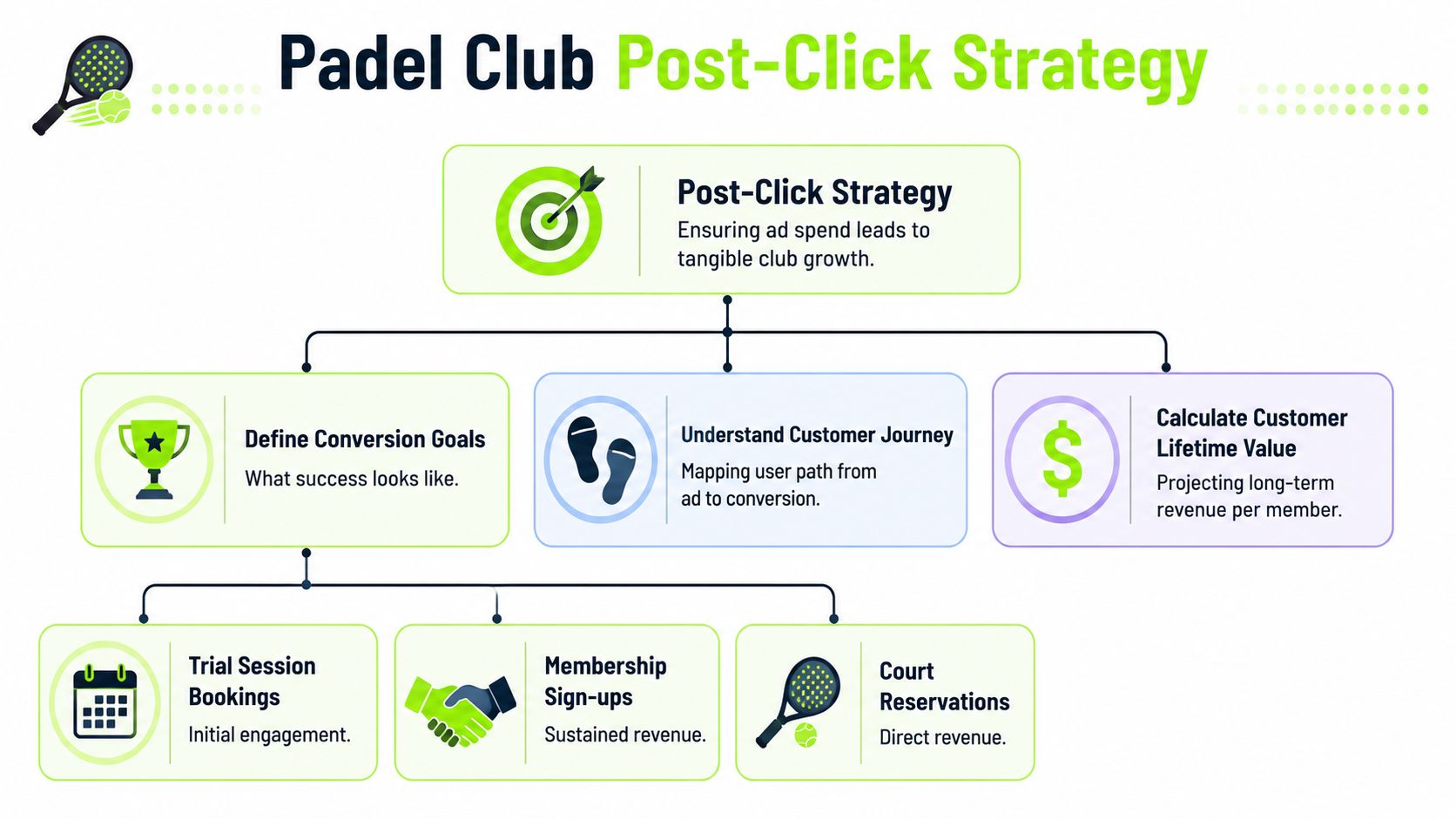
Before you spend a pound on traffic, decide what a successful click is worth to your business.
That sounds obvious, but most padel clubs skip it. They launch with a general “book now” message and send everyone to the same booking page. It feels tidy. In practice, it mixes very different commercial goals into one funnel and makes optimisation harder than it needs to be.
The better approach is to choose the economic outcome you want most.
Start with the business model, not the ad platform
A useful framing comes from a broader discussion of club economics. The operational health of a padel club depends on more than just busy courts. A club can look busy and still fail if revenue depends too heavily on court hire rather than a diversified mix of coaching, leagues, events, and corporate bookings, so the paid-ad objective has to support long-term unit economics rather than vanity activity, as discussed in this padel club viability analysis.
That changes how you plan.
If your problem is empty weekday mornings, optimise for off-peak trial bookings.
If your problem is unstable recurring revenue, optimise for membership conversations.
If your strongest margins come from coaching blocks, leagues, or private events, build campaigns around those paths instead of default court hire.
For a broader view on where enquiries tend to come from in this category, GolfRep's article on padel club lead generation is a useful companion to this point.
Pick one primary conversion goal
Don't ask one campaign to do three jobs.
A simple decision framework helps:
| Club priority | Better ad objective | Better post-click action |
|---|---|---|
| Fill quieter periods | Trial or introductory booking | Book a specific off-peak session |
| Build recurring revenue | Membership enquiry | Speak to the club or claim a membership offer |
| Grow secondary revenue | Coaching, league, or event signup | Register interest in a named programme |
A generic booking page often underperforms because it forces the visitor to work out the offer for themselves. Good padel club paid ads remove that friction.
Build the offer around the next step
A post-click strategy needs a clear promise and a clear action.
That usually means:
- For trial players: A simple introductory session, newcomer game, or guided first visit.
- For potential members: A membership-focused landing page that explains access, benefits, and who it suits.
- For local businesses or groups: A page built around corporate socials, team sessions, or hosted events.
Practical rule: If the ad mentions a specific benefit, the landing page should continue the same conversation, not restart it.
Many campaigns lose money under these circumstances. The ad is specific, but the destination is broad. That mismatch lowers intent, confuses visitors, and creates low-quality enquiries that staff then have to sort manually.
Document the journey before launch
Write the sequence down.
What does the user see in the ad? Where do they land? What form do they complete? What happens next? Who follows up? What counts as success?
If those answers aren't clear before launch, the campaign isn't ready.
Set a Realistic Budget and Track What Matters
Cheap leads are easy to buy. Profitable growth is harder.
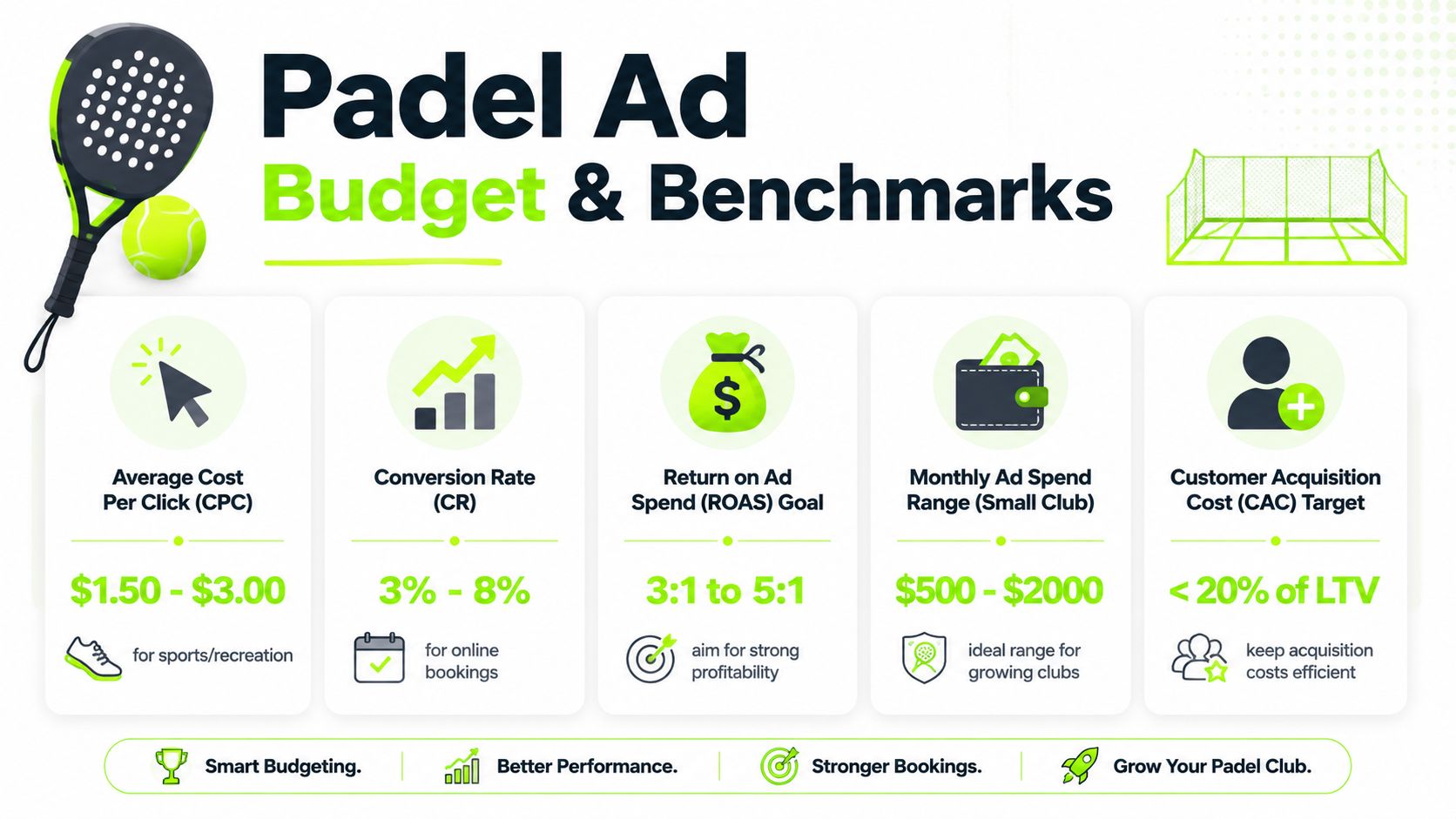
A padel club can spend modestly on Meta, generate a stream of form fills, and still miss the commercial target if those enquiries do not turn into first bookings, memberships, or repeat spend. Budgeting has to start with the revenue model, not the ad platform.
For UK padel clubs, a practical paid-ad benchmark is 5% to 12% of projected annual revenue, with 5% to 7% better suited to established clubs, 8% to 10% for growth-focused operators, and 10% to 12%+ for launches or aggressive expansion, according to this padel marketing budget benchmark.
Budgeting should follow maturity
The same spend level means different things at different stages.
A launch phase usually needs enough budget to create local awareness, generate trial demand, and give the team enough volume to learn which audiences and offers convert. An established club has more options. It may already have strong peak-time demand, referral flow, and a better idea of who turns into members. In that case, paid media can be used more selectively, often around off-peak fill, coaching programmes, or membership pushes tied to capacity.
That is why fixed monthly ad budgets often fail. They ignore occupancy, local competition, staffing capacity, and the value of the customer you are trying to acquire.
A useful reference point comes from golf, where operators have been forced to connect marketing cost to member value for much longer. GolfRep's breakdown of how much golf club marketing costs is focused on golf clubs, but the planning logic applies well to padel. Start with growth stage and revenue objective. Then decide how much spend the club can support.
Track the numbers that reach the bank account
Platform metrics still matter for diagnosis, but they are not management metrics.
The numbers worth reviewing every week are the ones that connect ad spend to commercial outcomes:
- Cost per lead
- Cost per first booking
- Cost per member acquired
- Revenue per acquired member
- Payback period on ad spend
Those last two are where many padel campaigns break down. A club celebrates low lead costs, but no one checks whether those leads become weekday regulars, members, coaching clients, or one-time freebie hunters. The post-click system decides whether the ad budget produces revenue or admin.
Use a simple reporting view
Most clubs do not need a complex reporting stack. They need one weekly scorecard that the owner, manager, and front-of-house team can all understand.
A workable dashboard looks like this:
| Metric | What it tells you |
|---|---|
| Leads generated | Whether ads are creating enough opportunity |
| First bookings | Whether enquiries are converting into action |
| Member acquisitions | Whether the campaign is producing lasting value |
| Source by channel | Which platform is producing better outcomes |
| Revenue by campaign | Which campaigns are producing real commercial return |
If reporting stops at clicks, the club is measuring media activity rather than business performance.
That distinction matters. A low-cost lead can be expensive if the sales follow-up is weak, if the booking journey leaks demand, or if the buyer never matches the club's membership profile. The better habit is to review spend against booked visits, joined members, and revenue collected. That is how mature golf operators judge paid acquisition, and it is the standard padel clubs should adopt early.
Building High-Intent Audiences and Creatives
Once the commercial target is clear, the campaign build becomes much easier. You know who you want, what message they need to see, and what action matters after the click.
The worst audience strategy is also the most common. “People interested in padel within a radius.” That can work at the edges, but it's too broad to rely on by itself.
Build audiences around intent signals
High-intent targeting starts with relevance, not scale.
Good local audience angles often include:
- Racket sport crossover players: People already engaged with tennis or squash are usually easier to educate than completely cold audiences.
- Local professionals and business clusters: Useful when the offer is tied to after-work play, social leagues, or corporate bookings.
- Existing customer data: Past bookers, enquiry lists, and member databases are valuable for retargeting and lookalike modelling where platforms allow it.
- Recent site visitors: People who viewed booking or membership pages but didn't complete the action often need a more direct follow-up message.
The point isn't to pile on complexity. It's to stop treating every prospect like the same prospect.
Creative should look like the club
Padel ads often fail because the creative is polished in the wrong way. Stock sport imagery, generic slogans, and detached branding don't help a local buyer imagine themselves at your venue.
Use real footage where possible. Short clips of actual games, coaching sessions, social play, and the venue environment usually do a better job than designed graphics alone. The ad should answer practical questions quickly. Who is this for? What happens next? Why should someone act now?
A useful pattern is to show the club experience in sequence:
- Arrival and atmosphere
- Play in progress
- Coaching or community moments
- Clear invitation to book or enquire
The ad doesn't need to impress another marketer. It needs to reduce uncertainty for a local buyer.
Match the message to the offer
Creative should change with the objective.
A membership campaign should talk about access, routine, community, and fit.
An off-peak campaign should talk about convenience, availability, and a simple next booking.
A coaching campaign should make progression feel concrete and approachable.
There's evidence that this broader full-funnel approach matters. A UK venue case study reported a huge boost to court bookings, plus a 50% uplift in engagement, 60% more website traffic, and a 35% reduction in bounce rate after targeted paid media and web improvements, which points to the value of combining acquisition with a better on-site experience in this UK padel paid media case study.
What usually doesn't work
A few patterns come up repeatedly in underperforming campaigns:
- Generic offers: “Play padel today” is too vague.
- Weak local context: If the club, location, or use case isn't obvious, intent drops.
- Creative mismatch: Membership ads that lead with casual court-hire visuals confuse the message.
- No audience separation: Beginners, regular players, and corporate buyers shouldn't see the same ad set.
Good campaigns feel specific because they are specific.
The Post-Click Journey From Ad to Automation
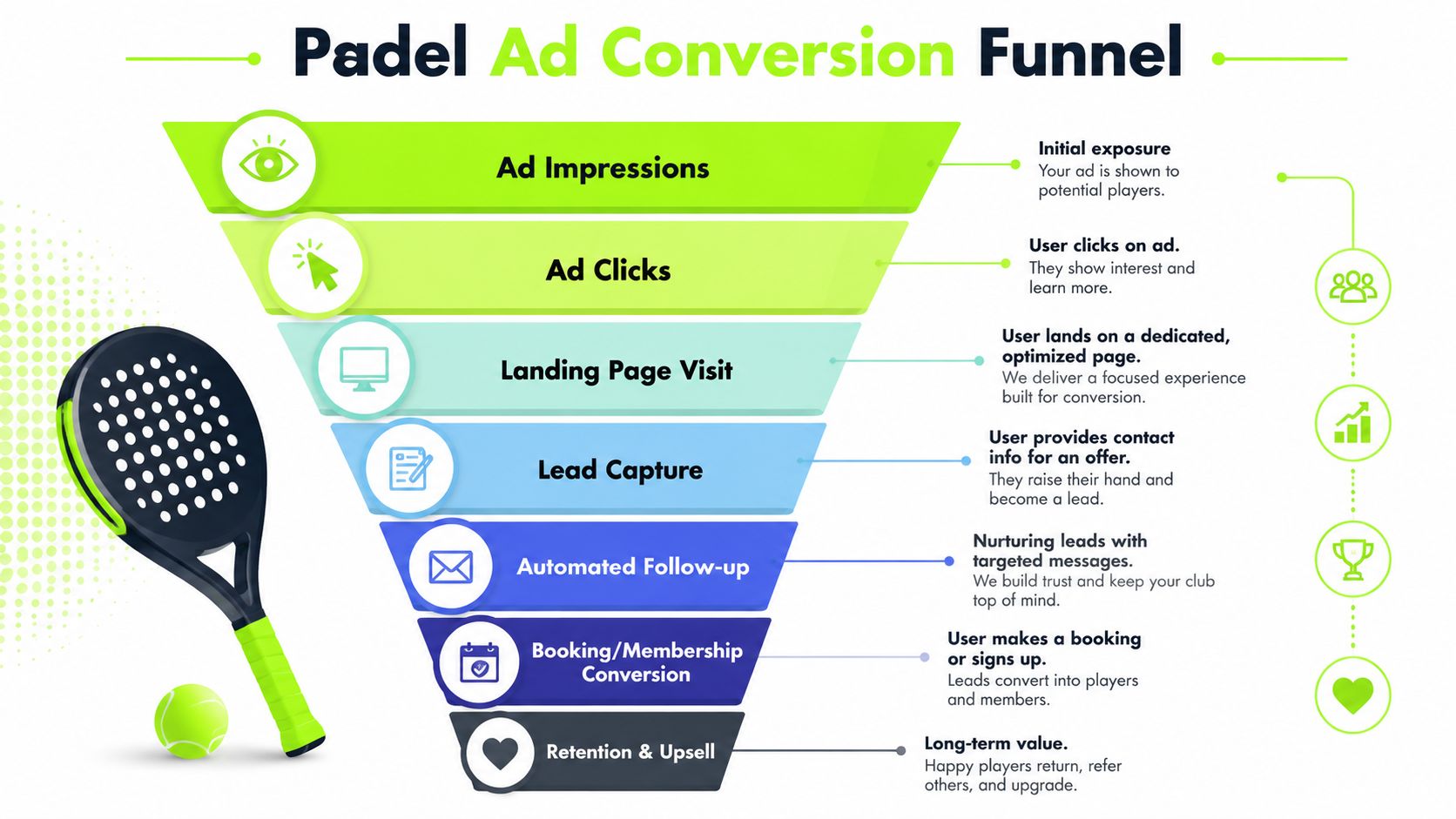
Most wasted ad spend in club marketing happens after the click.
The traffic lands on a homepage, the visitor has too many options, and momentum disappears. Or the lead completes a form and waits in a shared inbox until someone remembers to call. In both cases, the campaign gets blamed for a conversion problem created by process.
Send traffic to a page built for one decision
A landing page for padel club paid ads should be narrow by design.
That usually means:
- A headline that matches the ad
- A short explanation of the offer
- Clear next steps
- A simple form or booking action
- Reassurance elements such as testimonials, venue photos, or FAQs
The homepage has too many jobs. A campaign page should have one.
Automation protects the lead while intent is high
Clubs from the golf side tend to have an advantage, having already seen what happens when staff manage every enquiry manually. It works until the inbox gets busy, the phone rings, or someone is off site.
A stronger setup uses immediate automated follow-up.
That might include a confirmation email, a text message, task creation for the team, and a short nurture sequence if the person doesn't book straight away. The mechanics vary by stack, but the principle is constant. The club should acknowledge and guide the lead while interest is still warm.
For operators looking at how the plumbing fits together, this article on integrating CRM for SMBs is a helpful overview of why marketing automation and CRM need to work as one system rather than separate tools.
The handover from marketing to operations must be visible
A lead isn't useful if nobody owns the next step.
Clubs need clarity on process:
| Stage | What should happen |
|---|---|
| Form submitted | Lead enters CRM with source tracked |
| Immediate follow-up | Automated message confirms the enquiry |
| Sales action | Staff receive a task or notification |
| Nurture | Non-responders get structured reminders |
| Outcome logging | Booking, no show, or membership status is recorded |
A system like this creates accountability. It also makes campaign optimisation possible because you can see where leads are stalling.
For clubs interested in how AI-supported nurture can reduce the manual burden, GolfRep's guide to golf club AI lead nurture shows the general model. In practice, the same logic works for padel when the enquiry flow is mapped properly. GolfRep is one option clubs use for this kind of setup when they want paid acquisition connected directly to CRM follow-up and tracked outcomes.
A lead form without follow-up automation is not a funnel. It's a leak.
Don't separate ads from conversion operations
Agencies often own the traffic and ignore the handover. Club teams then inherit low-clarity leads with little context, delayed alerts, and no nurture support.
That split creates friction everywhere. Marketing says leads were delivered. Operations says nothing converted. Both can be technically right, and the club still loses.
The better model is one owner, or at least one joined-up process, from click to booked action.
Optimising for Revenue Not Just Clicks
A campaign should get better after launch, not just more familiar.
That only happens when you optimise against business outcomes. In the UK padel sector, high-performing paid ad campaigns need a repeat booking rate of over 60% to justify the spend, and stronger operators use CRM automation and referral mechanics so lifetime value exceeds acquisition cost by a factor of 3. Those are the numbers that define whether the campaign is commercially sound, not whether an ad generated cheap traffic.

The weekly optimisation routine
Most clubs don't need constant tinkering. They need disciplined review.
A practical routine looks like this:
- Pause weak creative: If an ad attracts curiosity but not qualified action, replace it.
- Refine audiences: Shift budget towards segments producing better first bookings and member outcomes.
- Review landing page friction: If click volume is healthy but conversion is soft, the page or form is often the issue.
- Track lead quality by source: Some channels produce enquiries that look fine at the top and collapse later.
Retention changes the economics
This is the part many advertisers underplay. The first booking isn't the finish line. It's the start of the full value window.
That's why referral mechanics, reactivation, and member nurture matter so much. If you want a useful commercial lens for thinking beyond one-off acquisition, these NDR growth strategies are worth reading. The terminology comes from software, but the logic applies neatly to clubs. Revenue quality improves when existing customers book again, stay longer, and expand their value over time.
The best ad account in the market won't rescue a weak retention model.
Padel club paid ads work best when they feed a system that knows what a good customer looks like, follows up properly, and keeps improving the path from first click to repeat revenue.
If your club wants a clearer way to connect paid traffic, follow-up, and booked revenue, GolfRep helps clubs build structured acquisition and nurture systems that make enquiries visible, automate response, and track what turns into real membership value.
Ready to tap into our proven growth system?