Indoor Golf Marketing Agency: How to Choose the Right One

A bay sits empty at 3pm on a wet Tuesday. The diary shows one paid booking at 6pm, a lesson enquiry that nobody has answered, and a corporate group that came once in November and never returned. The advert did its job. The rest of the commercial path did not.
That is the test of an indoor golf marketing agency. The first booking is the product you sell today. The money is in what happens after it: the second visit, the lesson block, the league slot, the winter practice habit. If an agency can only talk about clicks and reach, it is solving the wrong problem for a simulator venue.
What an Indoor Golf Marketing Agency Covers
Say the 6pm booking is a group of four who saw a local advert. A week later one of them books a lesson. A month after that, two of them join a midweek league. That path is the work. An indoor golf marketing agency that only buys ads has stopped at the first step.
We organise the path in four stages, because demand without conversion wastes spend, and strong conversion without enough demand cannot grow the business. The first job is naming the stage that limits you.
Attract is paid search for terms such as "golf simulator near me", local social advertising, and hyper-local campaigns that announce a new format or an open day. The job is a booked bay, not a brand impression.
Nurture is a fast answer plus a few qualifying questions: how often they play, the format they want, and the group size. Those answers decide the offer, not a generic follow-up email.
Convert is a booking page that makes the first session easy to buy, a trial offer with a clear price, and a stated next step before they leave the building.
Retain is the repeat prompt, a lesson or league pathway, and a membership enquiry only where it fits. We treat that full path, from the first enquiry through to long-term retention, as one system rather than a media plan with a CRM bolted on.

The test before you hire
Before any fee conversation, ask whether the agency can name the number it expects to move at each stage, and whether it will report on that number every month.
Practical rule: If they cannot name a number for attended sessions, repeat bookings and, where relevant, membership enquiries, they are selling activity, not a commercial outcome.
A useful brief also states your peak and off-peak bay hours, your lesson capacity, and the price you will not discount below. Without those constraints, the media plan will fill the wrong hours.
Segmenting Demand by Intent
Indoor golf is not one audience. GolfMagic's report on England Golf participation puts the picture at approximately 12.6 million adults engaging with some form of golf, including 7.3 million playing traditional 9- or 18-hole golf and 5.3 million on off-course formats such as driving ranges, simulators and adventure golf.
Those 5.3 million people are not "almost members". Many want an hour with friends, a lesson without a handicap, or a team night with food. Treating them as one golfer audience is how venues waste paid traffic on membership creative that the visitor was never going to click.
| Segment | Typical intent | Message and offer | First conversion |
|---|---|---|---|
| Simulator casuals | A fun, weather-proof session with friends | Bay booking with group and off-peak pricing | First booking |
| Beginners and lesson seekers | Learning the game without course pressure | Taster lesson and a course of sessions | Lesson booking |
| Corporate and social groups | Team events, parties and away days | Package with food and drink included | Group enquiry |
| League and regular players | Structured competition and a weekly habit | League entry and a fixed weekly slot | Recurring booking |
| Course golfers and members-in-waiting | Winter practice and possible club membership | Practice pass and a route into membership | Membership enquiry |
Do not share the message
A casual simulator user needs a booking page with group pricing and an off-peak slot. A lesson seeker needs reassurance that no handicap is required and that a taster is low-pressure. A corporate organiser needs a package price, a food option and a named contact. Swap those messages and the click still happens. The booking often does not.
Indoor play removes weather, daylight and the fear of holding up a four-ball. That is why campaigns should be built separately for trial bookings, lessons, corporate events and, later, membership. Our campaigns are built to reach people who match the profile a venue wants, not every adult who has ever held a club.
Every lead form should capture playing frequency, location, preferred format and membership interest. CRM scoring then separates a weekly league prospect from a one-off birthday group. Judge each campaign on the step from advert to booking to repeat visit, not on membership sales that were never the first conversion. The same logic applies when you market golf simulator lessons: the lesson booking is the measure, not a membership form.
Channel Mix for Paid Media, Referrals and Owned Audience
The common assumption is that paid advertising is the growth engine. It deserves a test, not a default budget.
The Hillier Hopkins Golf Clubs Survey Report 2025/26 found that member referrals were the most successful marketing activity for 55% of members' clubs, ahead of social media at 49%, while email campaigns were cited by 23% and advertising by 21%. Those figures come from members' and proprietary clubs, not indoor operators, so treat them as a signal to test, not as your benchmark.

Give each channel one job
| Channel | Best role | Typical entry point | Measure |
|---|---|---|---|
| Paid search | Capture people already looking for a bay or lesson | Booking page with date and price | Cost per booked session |
| Paid social | Create demand for formats, groups and events | Landing page with a short lead form | Cost per attended session |
| Referral and word of mouth | Reduce acquisition cost from satisfied customers | Friend offer on a league or lesson booking | Referred bookings as a share of total |
| Email and owned database | Keep repeat bookings and league fill steady | Segmented sequence by intent | Repeat booking rate |
| Open days and local events | Add new contacts to the database | Registration page with a follow-up sequence | Registrations converted to first booking |
A simple budget rule works better than a blended media plan. Tie every paid campaign to a named landing page and a measured booking. Once a customer has attended twice, test a friend offer on the next league or lesson booking. Open days and hyper-local events should land in the same database, with the same follow-up, or they become one-off spend. We use those events to raise local awareness and to drive secondary revenue, not as a substitute for a booking system.
Paid search catches people who already want a bay tonight. Paid social has to create the reason to come. Referrals cut the cost of the third and fourth customer. Email keeps Tuesday league places filled when the weather improves and novelty fades. If you want a wider view of how service firms structure outbound demand, Flowkon's guide on how to build an agency lead generation system is a useful contrast. For venue-level tactics, our notes on indoor golf marketing ideas stay closer to bay utilisation.
Clicks are a cost. A referred second booking is a margin.
How to Build the Post-Booking Sequence
Automation handles timing. People handle decisions. The sequence below should run without a manager remembering to send it, and it should stop the moment a human needs to judge price, a contract or a start date.
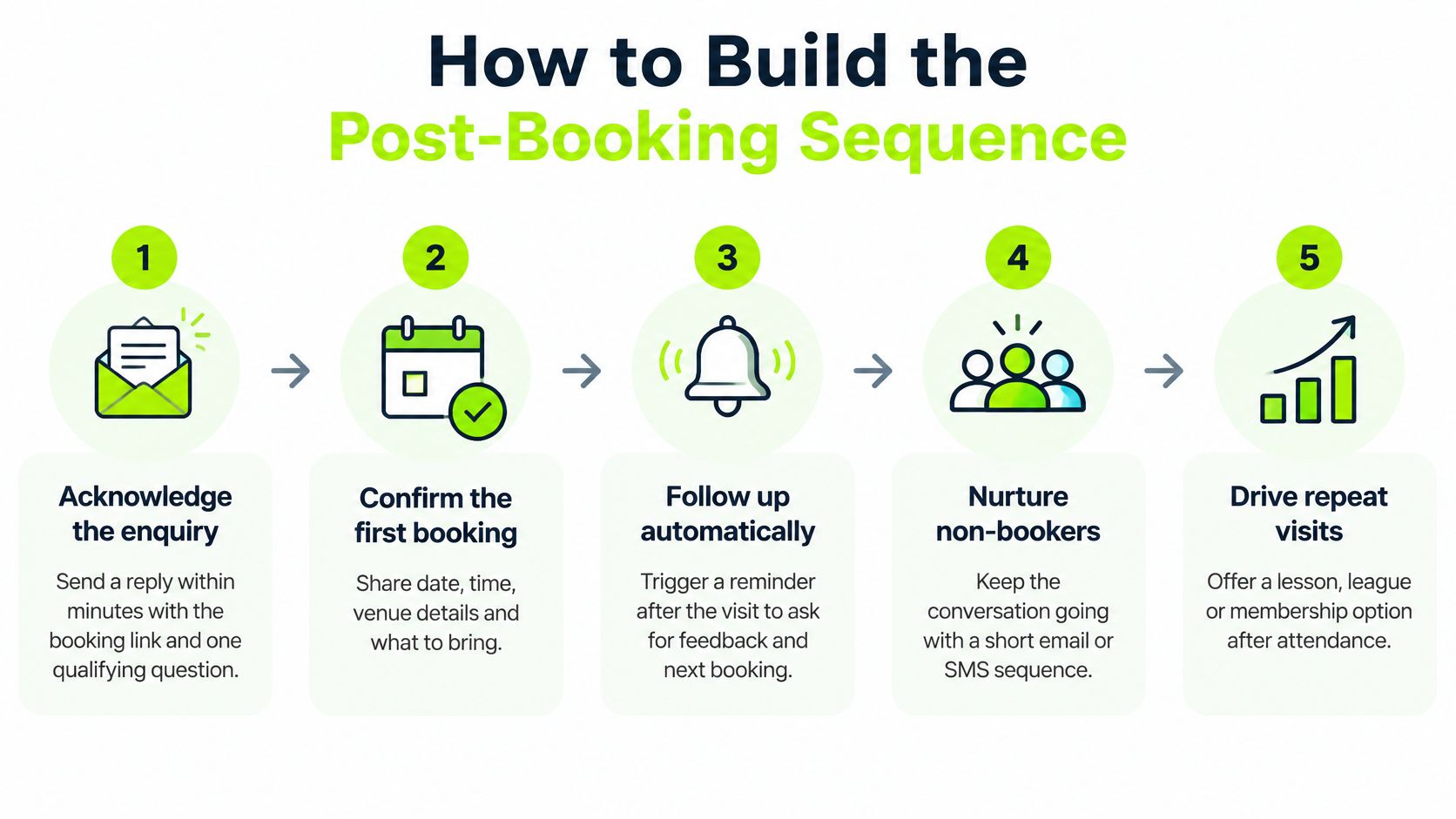
- Acknowledge the enquiry within minutes. Send the booking link and one question on playing frequency. Speed matters because a group choosing between three venues books the one that answers.
- Recover the unbooked enquiry within 24 hours. One reminder, one alternative time. A second chase the next day usually annoys more than it converts.
- Thank them after they attend. Suggest the next session that fits the visit: a lesson for a beginner, a league taster for someone who already plays regularly. The suggestion should match what they just did, not a menu of everything you sell.
- Branch by segment. Simulator casuals get group and off-peak offers. Lesson seekers get a course of sessions. Corporate contacts get a short proposal for a repeat event, with food included if that was part of the first night.
- After two or three visits, send a membership-fit note. Explain the options, the price and what is included. Do this only for people whose visits show a weekly habit.
- Hand over to a named person when someone asks about fees, a contract or a specific start date. That conversation needs judgement, not a template.
- Review the sequences every quarter. Remove any message that does not produce a return visit. A sequence that looks tidy in the CRM and changes nothing in the diary is overhead.
Why the branch matters
A birthday group and a winter-practice regular should not receive the same third email. One wants another social night. The other may want a fixed Tuesday slot. Mixing them trains both to ignore you.
The commercial point of the whole sequence is repeat attendance, which is also the subject of how we approach indoor golf customer retention. Membership is a later offer for a smaller group, not the default closer on email two.
Measuring Revenue, Not Clicks
Busy diaries can hide a loss-making acquisition programme. The measures below show whether a source produces a second visit and, where membership is the aim, a joined member.
| KPI | How to calculate | Why it matters |
|---|---|---|
| Cost per attended session | Spend from a source divided by sessions attended from that source | Shows the real cost of a visit, not a click |
| Lead response time | Minutes from enquiry to first reply, averaged each month | Shows whether follow-up runs to the agreed standard |
| Repeat booking rate | Customers with a second booking within 90 days divided by first-time customers | Shows whether the first visit leads anywhere |
| 90-day revenue per customer | Total spend in the first 90 days by customers acquired from a source | Shows whether acquisition pays back |
| Cost per joined member | Spend from a source divided by members who joined from it | Needed where membership is the goal |
| Referral share | Referred bookings divided by total bookings in the period | Tracks whether word of mouth grows alongside paid media |
Split every row by source. A blended total hides a cheap social campaign that never returns and an expensive search campaign that fills leagues. We recommend source-level reporting for that reason: you need to see what came in, what happened next, and whether the source produced one booking or ongoing revenue.
A worked example, not a benchmark
A campaign spends £1,200 and produces 80 attended sessions from one source. Cost per attended session is £15. If 12 of those visitors book again within 90 days, the repeat rate is 15%. Compare that 15% with the £15 first visit before you scale the spend. If the second visits are lessons at a higher rate, the same £15 looks different from 12 more off-peak social hours.
These figures are an illustration so a manager can see the arithmetic. They are not targets.
The 2025 Golfshake UK survey, based on more than 2,500 golfer responses, reported that 86% of respondents were club members, 50% had belonged to their current club for more than 10 years, and the share paying under £1,000 annually fell from 47% to 41%. The useful lesson for an indoor venue is the same one that survey points to for clubs: the economically relevant figure is value after acquisition and activation, not the cheapest lead.
A monthly report needs four blocks.
- Spend and attended sessions by source, so you can stop a channel that fills the diary at a loss.
- Repeat bookings within 90 days, so the first visit is not treated as the finish line.
- Leads answered within the agreed time, so a slow inbox is visible.
- Cost per joined member, only where membership is the goal of that source.
Website traffic still has a place, as a diagnostic. A practical set of traffic checks for service business websites will show whether the booking page is being found. It will not tell you whether those visits became paid hours. Keep traffic in a footnote of the report, not in the headline.
How to Judge an Agency and Agree the Brief
Most agencies will describe themselves as specialists. Score the evidence and the process before anyone mentions a fee. Give each candidate one to five on every row, then talk to the two with the highest totals.
| Criterion | What good looks like | Red flag |
|---|---|---|
| Golf and indoor experience | Named clients in golf or indoor formats and a clear view of simulator, lesson and league economics | Generic service list used for any local business |
| Campaign build | Brief covers brand, pricing and peak and off-peak capacity before any creative is written | Templated package with no questions about your venue |
| Lead handling | Stated response time, named owner and an agreed follow-up sequence | Leads passed on with no process or owner |
| Reporting | Source-level reports showing enquiries, bookings, attended sessions and revenue | Reports led by impressions, clicks or raw enquiry counts |
| Commercial model | Fees, contract length and performance terms in writing | Vague fees, long lock-in or an unclear guarantee |
| Automation and CRM | Connected CRM with visible automated follow-up you can audit | Automation you cannot see or export |
| Evidence | Verifiable outcomes with named references and measured results | Unsourced claims or case studies with no numbers |
What good looks like in practice
A serious campaign build starts with your prices, your brand and your empty hours. If the first meeting is a slide of ad examples, they have skipped the constraint that decides whether Tuesday at 3pm can ever be profitable.
Lead handling is an operations job. We treat a sales process as an operations discipline, not a marketing afterthought. That means a stated response time, a named owner by role, and a sequence you can open and read. "We will follow up" is not a process.
Reporting should show enquiries, bookings, attended sessions and revenue for each channel. Impressions belong in an appendix. On the commercial model, ask for fees, contract length and performance terms in writing, including what happens if the agreed number is missed.
Automation you cannot export is a lock-in, not a system. Ask to see a live sequence and a sample export before you sign. Evidence should name the venue and the measure. A percentage with no base, no period and no reference is a slogan.
Outside golf, the same test applies to search retainers. Search marketing advice from Riff Analytics is a fair checklist for what a search specialist should show you. Use it as a comparison, then bring the questions back to bay hours, lessons and leagues.
Four checks before you sign
The current bottleneck. Pull your own enquiry, booking and attendance numbers for the last 90 days. If enquiries are scarce, you have a demand problem. If enquiries are plentiful and attendance is not, you have a handling problem. Do not let an agency prescribe media until that split is on the table.
The KPIs and the cadence. Agree cost per attended session, repeat rate and, if relevant, cost per joined member. Monthly is enough. Weekly dashboards full of clicks create meetings, not decisions.
The response standard. Name the owner by role, not by a person's first name that changes in month two. State the minutes you expect for a first reply.
The exit. Write down how data, audiences and automations come back to you if you stop. If that paragraph is missing, you do not own the asset you are paying to build.
I would run a ninety-day test on one channel with a cost per attended session target, scored against the table above, before any wider retainer. Ask two questions in the final meeting. Can they explain how success will be measured before they propose a plan? And, given your enquiry volume, would building the follow-up in-house be cheaper than paying someone else to run it?
GolfRep combines proven marketing systems, AI-driven automation and golf-sector experience, and the work is built as a growth system you can inspect. A short call is the right next step only if the bottleneck in your own numbers matches the kind of system we run.
GolfRep works with golf clubs and indoor facilities on acquisition, follow-up, conversion and repeat revenue, with the first booking treated as the start of the commercial path rather than the end of a campaign. If you want that path mapped against your own bay, lesson and league numbers, visit GolfRep and book a call to see whether the fit is there.
Ready to tap into our proven growth system?