How to Market a Golf Club: Convert Leads to Members

Most advice on how to market a golf club gets the sequence wrong. It starts with channels, campaigns, and creative ideas. More Facebook ads. More social posts. More open days. More offers.
That sounds productive, but it often leaves clubs busy rather than growing. The problem usually isn't a total lack of enquiries. It's that enquiries arrive, sit in inboxes, get forwarded between staff, receive inconsistent replies, or disappear entirely once the first burst of interest fades.
A club can have a respectable website, a decent local reputation, and regular activity on social media and still fail to convert interest into membership. That's the leaky bucket most committees don't see clearly. They approve spend at the top of the funnel while the bottom underperforms.
If you want a practical answer to how to market a golf club, start with a harder truth. Marketing only works when follow-up works. The clubs that grow predictably don't just generate attention. They capture it, organise it, qualify it, and keep it moving until a prospect either joins or clearly drops out.
Shifting Focus from More Leads to Better Conversion
The old model of golf club marketing leaned heavily on local promotion and direct response. That still has a place. But the modern approach is different. It is more data-led, more automated, and far more focused on turning traffic into a usable database that can be nurtured over time, not just contacted once (Hampton Golf on current golf club marketing trends).

A lot of clubs still treat marketing as a series of separate activities. Someone runs an open event. Someone else boosts a post. The pro sends an email. Reception fields a few calls. None of that is useless, but it isn't a system. It relies on memory, goodwill, and spare time.
The leaky bucket problem
If a prospect asks about membership on a Friday afternoon and gets no meaningful response until Monday, the issue isn't lead generation. If three people enquire after a visitors' day and no one can tell you whether they booked a tour, the issue isn't awareness. If a club has no clear view of where enquiries came from, who responded, and what happened next, more advertising only pours more water into a bucket that's already leaking.
Practical rule: Fix enquiry handling before increasing budget.
This is why conversion discipline matters. The best clubs don't think in terms of isolated campaigns. They think in terms of pipeline. Every enquiry should have an owner, a next step, and a visible status.
What better looks like
A stronger approach usually includes these basics:
- Fast first response so prospects aren't left waiting while interest cools.
- Lead visibility so management can see every enquiry in one place.
- Structured follow-up across email, phone, and messaging rather than one reply and silence.
- Simple qualification so staff know whether someone is exploring, comparing, or ready to visit.
- Consistent nurture for people who need more time before joining.
Teams that want ideas on improving response and follow-up logic can also look at practical Voicedial.ai conversion strategies, especially around reducing drop-off after first contact.
Most clubs don't need more random marketing. They need fewer gaps between interest and action. Once that clicks, marketing stops being a monthly scramble and starts becoming a predictable commercial process.
Defining Your Growth Strategy and Audience
A club does not grow because it says it wants more members. It grows when it decides which revenue gaps to fix, which member types fit the club best, and which enquiries are worth pursuing hard.
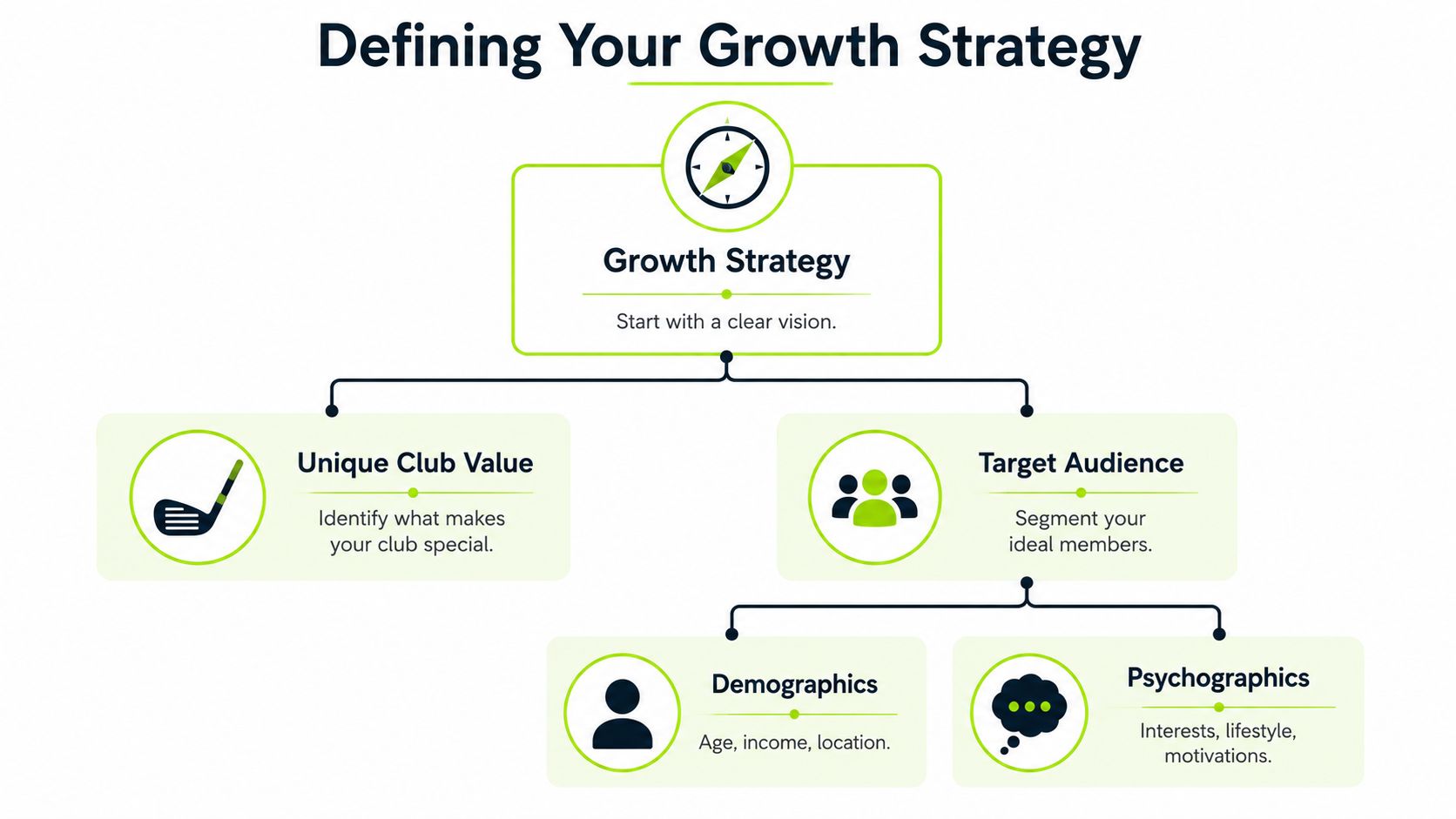
That sounds obvious, yet many clubs still treat strategy as a slogan. "Increase membership" is not a strategy. It gives the team no guidance on pricing, follow-up priority, tour availability, or which objections staff should be ready to handle. If weekday utilisation is weak and Saturday mornings are already under pressure, the right goal may be to attract a specific kind of member who values flexible access, coaching, or social integration outside peak times.
Start with the commercial problem first. Then define the audience.
Define the value properly
Prospects rarely buy a golf club for the course alone. They buy the role the club will play in their week. That could mean convenience before work, a reliable place to bring clients, a better environment to improve, or a club culture where joining does not feel awkward.
A useful value proposition usually falls into one or two clear categories:
- Access and routine for golfers who want regular play that fits work and family life
- Community and belonging for people who care about social connection as much as the golf
- Progress and coaching for players who want to improve and use practice facilities properly
- Status and hospitality for members who host, network, and expect service to match
- Flexibility for golfers who want options rather than a rigid membership model
Write it in plain English and pressure-test it with staff. If the general manager, membership team, and pro shop all describe the club differently, prospects will get mixed messages and conversion rates will suffer.
Segment by intent, not only demographics
Age, income, and postcode still matter. They just do not tell you enough about why someone is enquiring or what will persuade them to visit.
The stronger way to segment is by intent. A club should know whether an enquiry is coming from a serious improver, a socially motivated joiner, a business user, or a local golfer comparing convenience and value. Those groups ask different questions, respond to different offers, and need different follow-up.
| Audience type | What they want | What they need to see |
|---|---|---|
| The committed improver | Better golf, better practice, coaching support | Academy, pro team, competitions, progress |
| The social member | Atmosphere, events, easy integration | Club culture, welcome, mixed calendar |
| The business host | Reliable hospitality and a polished setting | Corporate days, food and beverage, service |
| The time-poor local golfer | Convenience and low friction | Booking ease, proximity, weekday value |
This is also where capacity planning becomes a marketing decision, not just an operations issue. England Golf has highlighted the pressure many clubs face in balancing tee sheet demand, member expectations, and flexible participation patterns across the week (England Golf membership and participation guidance). The practical point is simple. A full Saturday and an empty Tuesday do not call for the same audience, the same offer, or the same sales process.
If your busy periods are already crowded, sending more generic enquiries into the system solves very little. Better-fit enquiries do more for growth than higher lead volume.
Set targets your team can act on
Useful growth targets translate strategy into decisions. They should tell staff what to prioritise and why.
For example, set targets around:
- Member mix, not only total joins
- Qualified visits booked, not only raw enquiries
- Follow-up volume by stage, so warm prospects do not sit untouched
- Use of off-peak inventory, without training buyers to wait for discounts
Clubs that want a sharper plan for attracting the right prospects should review this guide to golf club lead generation strategies, then connect that front-end activity to clear qualification rules and follow-up ownership. Tools such as an AI chatbot for marketing and sales can also help capture intent earlier, especially when prospects are comparing options outside office hours.
Good strategy reduces waste. It helps the club stop treating every enquiry as equal and start building a pipeline around the people it can convert, retain, and serve profitably.
Building Your Lead Generation Engine
Lead generation matters. It just isn't the finish line. A good marketing engine attracts the right local golfers, gives them a clear reason to respond, and pushes every response into one trackable system.
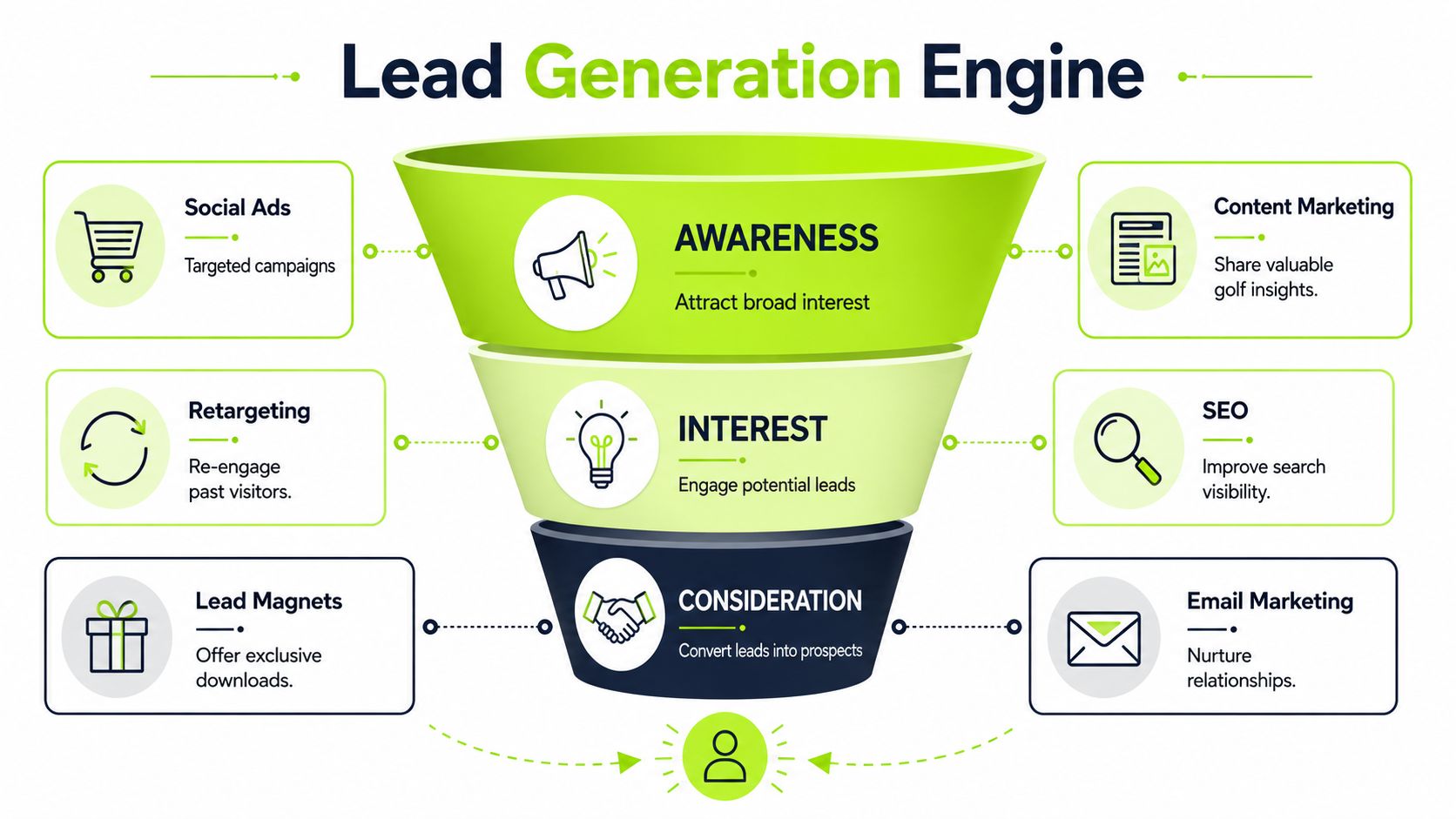
The most practical setup is to treat the website as the central hub, then connect email, paid social, and search activity to a CRM. That matters even more when 59% of UK consumers say they're happy to share data for personalised experiences, which gives clubs permission to build better follow-up around real behaviour rather than guesswork (NGCOA guidance on golf marketing systems).
Your website is not a brochure
Many club websites still behave like digital leaflets. They describe the course, list fees, show a few images, and leave the visitor to work out the next step.
A useful website does more than inform. It directs action. That means clear enquiry forms, membership pages built around distinct member types, visible calls to book a visit, and pages that answer the questions prospects usually ask before they speak to anyone.
A website should also capture intent, not just clicks. If someone visits the membership page twice, downloads information, or starts a form, that activity should feed the system rather than vanish into anonymous traffic.
Build channels that feed the same pipeline
The clubs that market well usually combine several channels, but they don't let them operate in silos.
- Local SEO helps the club appear when nearby golfers search for membership, coaching, society golf, or a place to play.
- Paid social works well when the offer is specific. Trial experiences, open days, membership discovery visits, and beginner pathways tend to outperform vague brand messaging.
- Search ads can capture active intent when someone is already looking for a club in the area.
- Email capture turns casual interest into a database the club can nurture over time.
- Retargeting keeps the club visible to visitors who looked but didn't enquire.
If you want a more detailed breakdown of channel structure and capture mechanics, GolfRep has a practical guide on golf club lead generation systems.
Use automation where human follow-up tends to fail
The weak point in many lead generation setups is the handover after the click. Forms go through. No one sees them quickly enough. Social messages sit unanswered. A prospect asks a basic question outside office hours and gets nothing back until the next day.
That's where tools such as an AI chatbot for marketing and sales can be useful. Not because a bot replaces staff, but because it can capture intent, answer standard questions, and push enquiries into the right workflow when the office is closed or busy.
A lead generation engine isn't a collection of channels. It's a connected route from first interest to visible follow-up.
One option in that category is GolfRep's own approach, which combines advertising with CRM capture and structured nurture for clubs that want a more unified system rather than separate suppliers. The important point is not the vendor. It's that your paid and organic activity should all feed one operational process.
The Conversion System From Enquiry to Member
Golf clubs rarely have a lead problem. They have a follow-up problem.
An enquiry comes in, then the process fragments. One staff member sends an email. Another plans to call later. Someone else has a conversation in the office and never logs it. The prospect experiences that as hesitation, and hesitation costs memberships.

Clubs that grow consistently treat conversion as an operating system, not an admin task. The point is not to chase every enquiry harder. The point is to remove delay, guesswork, and inconsistent follow-up so serious prospects keep moving.
What a working system looks like
Take a familiar scenario. A local golfer clicks a Facebook ad for a membership open day and submits a form asking about category options and availability. In many clubs, that enquiry still lands in a shared inbox and waits for somebody to notice it, decide who should reply, and remember the next step.
A working conversion system sets that path in advance.
The form feeds straight into a CRM. The prospect gets an immediate acknowledgement with a clear expectation of what happens next. The relevant staff member sees the source, the time of enquiry, and the stated interest. A task is assigned automatically. If no visit is booked, the prospect moves into a planned follow-up sequence instead of disappearing into a mailbox.
That structure matters because speed alone is not enough. Clubs also need context. A parent asking about junior membership, a lapsed golfer returning to the game, and a corporate prospect looking for entertaining space should not enter the same generic process.
Analysts at McKinsey have found that faster, more effective lead management is strongly linked to better conversion performance, particularly when businesses respond quickly and use structured follow-up rather than ad hoc handling. The same principle applies here. Golf club sales are slower and more relationship-led than transactional retail, but delay still weakens intent. Clubs reviewing where budget is wasted between enquiry and sale can borrow useful thinking from this CMO's guide to marketing spend optimization.
A practical nurture flow
Very few prospects join after one message. They compare clubs, check timing, talk to family, review budgets, or can get distracted. Good clubs plan for that.
A practical flow usually includes:
Immediate acknowledgement
Confirm the enquiry, set expectations, and give the prospect a simple next step such as booking a call or a club visit.Relevant personal follow-up
Reply based on what the person asked. Generic membership packs slow the process because they force the prospect to do the sorting.Visit or trial invitation
Give the prospect a reason to experience the club. Tours, coffee meetings, trial rounds, and open events help people picture membership in a way emails cannot.Timed follow-up
Continue contact at planned intervals if there is no reply. Useful follow-up works better than repetitive chasing. Category guidance, playing flexibility, coaching, competitions, and social fit all answer different buying questions.Longer-term reactivation
A delayed decision is still an opportunity. Many prospects revisit membership weeks or months later when work, family, or finances change.
Many clubs commonly underperform here. They stop after the first reply and assume silence means no interest. In practice, silence often means the club has not built enough confidence yet.
What staff need to see every day
Staff do not need a complicated sales board. They need a clear daily view of the pipeline.
A useful CRM view shows:
- New enquiries waiting for first contact
- Qualified prospects considering a visit or call
- Booked visits with clear ownership
- Overdue follow-up so no lead goes stale
- Won and lost outcomes with a reason recorded
That visibility changes behaviour. It stops the usual debate about whether marketing is working and exposes the core issue, which stage is leaking and why.
For clubs tightening this part of the process, GolfRep's guide to a golf club follow-up system is a useful reference because it focuses on handover, nurture, and tracking rather than top-of-funnel activity.
The trade-off clubs need to accept
Some committees and managers resist systems because they worry the experience will feel too corporate. That concern is understandable, but it usually protects inconsistency rather than personal service.
A structured process makes communication more relevant. Staff can see what the prospect asked, what has already been sent, what happened on the last call, and what should happen next. That means the golfer interested in flexible access gets the right membership explanation. The parent asking about junior pathways gets information that helps. The prospect who visited last week gets a timely follow-up while the experience is still fresh.
Better conversion is not about adding pressure. It is about removing friction between interest and decision.
That is the shift many clubs miss. Marketing does not become predictable when more enquiries arrive. It becomes predictable when every enquiry enters a system designed to turn attention into visits, visits into conversations, and conversations into memberships.
Measuring What Matters and Optimising for Growth
If a club can't see what happens between enquiry and membership, it will default to vanity metrics. More reach. More impressions. More likes. Those numbers may be comforting, but they don't tell a manager whether marketing is producing commercial outcomes.
Golf clubs are generally advised to keep measurement focused on around 8-10 key metrics and set clear targets, such as improving performance by 20% within a defined timeframe (SimpleKPI guidance for golf club KPIs). That discipline matters because too many numbers create confusion, while too few hide weak points in the journey.
The KPI set that actually helps
You don't need a dense spreadsheet. You need a manageable view of the pipeline.
A useful club dashboard often includes:
| KPI | What it tells you |
|---|---|
| Enquiry volume | Whether campaigns and referral sources are generating interest |
| Lead source | Which channels produce serious prospects, not just traffic |
| Response status | Whether new enquiries are being handled consistently |
| Enquiry to visit rate | Whether initial follow-up is strong enough to create real intent |
| Visit attendance | Whether booked prospects actually turn up |
| Visit to member conversion | How well the club sells the in-person experience |
| Time in pipeline | Where decisions are stalling |
| Lost reason | Whether pricing, timing, category fit, or weak follow-up is the issue |
| Retention view | Whether the type of member being acquired is the right fit |
What not to overvalue
A post can perform well and still produce no members. An ad can attract clicks from the wrong audience. A website page can get traffic without generating a single qualified conversation.
Manager's test: if a metric doesn't help you decide where to improve follow-up, budget, or staffing, it probably isn't central.
Optimisation becomes practical rather than abstract. If paid social creates enquiries but few visits, the issue may be qualification or message match. If visits are happening but join rates are weak, the problem may sit with the sales conversation, the offer, or the club experience itself.
For clubs thinking more rigorously about allocation and efficiency, this CMO's guide to marketing spend optimization is a helpful broader read on tying spend to outcomes rather than activity.
If you want to pressure-test whether your numbers are telling the truth, GolfRep also has a useful article on the real ROI of golf club marketing. The key principle is simple. Measure the funnel, not the noise around it.
Building Your Predictable Growth Pipeline
The clubs that market well aren't necessarily the clubs that do the most. They are the clubs that make interest visible and manageable.
That means defining a clear growth strategy, targeting the right audience, building channels that feed a central system, and running disciplined follow-up until a prospect reaches a decision. It also means treating measurement as a management tool, not a reporting exercise.
A lot of golf marketing still assumes the answer is another campaign. Sometimes it is. More often, the larger opportunity sits inside the enquiries you already generate but don't yet handle with enough speed, consistency, or visibility.
If you're serious about learning how to market a golf club, stop thinking only about promotion. Start thinking about pipeline. The quality of your follow-up process shapes the quality of your growth far more than most clubs admit.
The practical trade-off is straightforward. You can continue relying on inboxes, memory, and uneven staff capacity, or you can build a system that turns interest into a repeatable commercial process. One produces occasional wins. The other gives management confidence.
Predictable growth rarely comes from doing more marketing in the loose sense. It comes from building a process that makes every worthwhile enquiry count.
If your club is generating interest but not converting enough of it, GolfRep helps clubs put structure around that gap with lead capture, CRM visibility, and follow-up systems built for membership growth. It's worth reviewing your current process and asking a simple question: where does an enquiry go cold today?
Ready to tap into our proven growth system?