Golf Club Marketing Agency vs Doing It Yourself: A Guide

Most advice on golf club marketing starts in the wrong place. It asks how to get more leads, more traffic, more attention.
That's backwards.
For most clubs, the main leak isn't at the top of the funnel. It's what happens after someone enquires. A prospect fills in a form, sends an email, calls the office, asks about membership, and then gets a delayed reply, a vague answer, or no structured follow-up at all. At that point, it doesn't matter how good the advert was.
The agency versus DIY debate only becomes useful when you ask the right question. Not who can post on Facebook. Not who can build a nicer landing page. The question is who can build a repeatable system that turns interest into revenue.
The Question Most Golf Clubs Get Wrong
Many club committees still think marketing is mainly about visibility. They want more people to know the club exists, more followers, more website visits, more enquiries.
Visibility matters. It just isn't the bottleneck for most clubs.
A useful benchmark comes from UK small business behaviour. The Federation of Small Businesses reported that 80% of small businesses had a website, but only 36% were using paid online advertising via this UK benchmark on in-house vs agency capability. That gap matters because owning a website is not the same thing as running a proper acquisition system.
Presence is not a pipeline
A golf club can have a decent website, a few social posts, and a member who “looks after marketing” on the side. That may create some awareness. It does not create consistency.
A predictable pipeline needs more than a web presence. It needs:
- Clear offers that match real buyer intent
- Working conversion paths on forms, calls, and landing pages
- Lead visibility so no enquiry disappears into a shared inbox
- Fast response processes so interest is handled while it's still live
- Follow-up structure so prospects don't go cold after one contact
Most clubs don't have a lead problem. They have a handling problem.
Practical rule: If your club can't say exactly how enquiries are logged, assigned, followed up, and converted, you don't have a marketing system. You have activity.
What the decision should actually be about
When committees compare a golf club marketing agency vs doing it yourself, they usually compare cost first. That's understandable, but it's incomplete.
The operational question is sharper. Can your team run the whole chain from first click to signed membership, consistently, without relying on memory, goodwill, or spare time?
If the answer is no, then DIY isn't really a strategy. It's a patch.
Defining Your Two Paths DIY vs a Growth Partner
Committees often label this as a marketing choice. It is really an operating model choice.
DIY means the club takes responsibility for the full chain. Someone has to plan campaigns, build pages, write emails, manage spend, check tracking, answer enquiries, assign follow-up, and keep prospects moving until they join. If those jobs sit across three people with other priorities, the club does not have an in-house system. It has scattered tasks.
What DIY really means
A serious in-house setup has to cover all of this:
- Channel planning across search, social, email, and the website
- Content production for adverts, landing pages, emails, and club updates
- Budget control for paid campaigns and seasonal pushes
- Tracking setup so the club can see where enquiries came from
- Lead handling once an enquiry arrives
- Reporting tied to enquiries, visits, and conversions rather than vanity metrics
That workload is heavier than committees expect. The visible part is the campaign. The hard part is what happens after someone fills in a form or requests a callback.
Video can support that effort if the club is producing membership explainers, event clips, or captain updates. In that case, it can help to explore Taja AI's video optimization guide, especially if your team wants stronger reach from content it is already filming.
What a growth partner should actually do
A growth partner should not be judged on ad output alone. Judge it on whether it gives the club a repeatable way to capture, route, track, and convert enquiries.
That means tighter campaign execution, but it also means cleaner handover into the club's sales process. Enquiries should be visible. Ownership should be clear. Follow-up should not depend on who happened to check a shared inbox that morning.
A club reviewing a specialist golf growth model for enquiry handling and conversion should ask a blunt question. Does this partner improve commercial control after the lead arrives, or does it just send more names into the same weak process?
More leads do not fix a poor follow-up process. They expose it.
The practical distinction
DIY gives the club control, but it also gives the club the full burden of execution. Every delay, every missed callback, every untracked form, and every stale prospect stays in-house.
A growth partner should reduce that operational drag. The club still needs staff to speak to prospects, host visits, and close memberships. The partner should make sure those staff are working from a clear process instead of chasing inboxes, patching spreadsheets, and guessing which enquiry came from which campaign.
Core Comparison The Real-World Trade-Offs
Committees usually compare DIY against an agency on fees. That is the wrong comparison.
The useful comparison is operational. Which option gives the club a reliable way to generate demand, handle enquiries fast, and turn interest into revenue without creating more admin for an already stretched team?
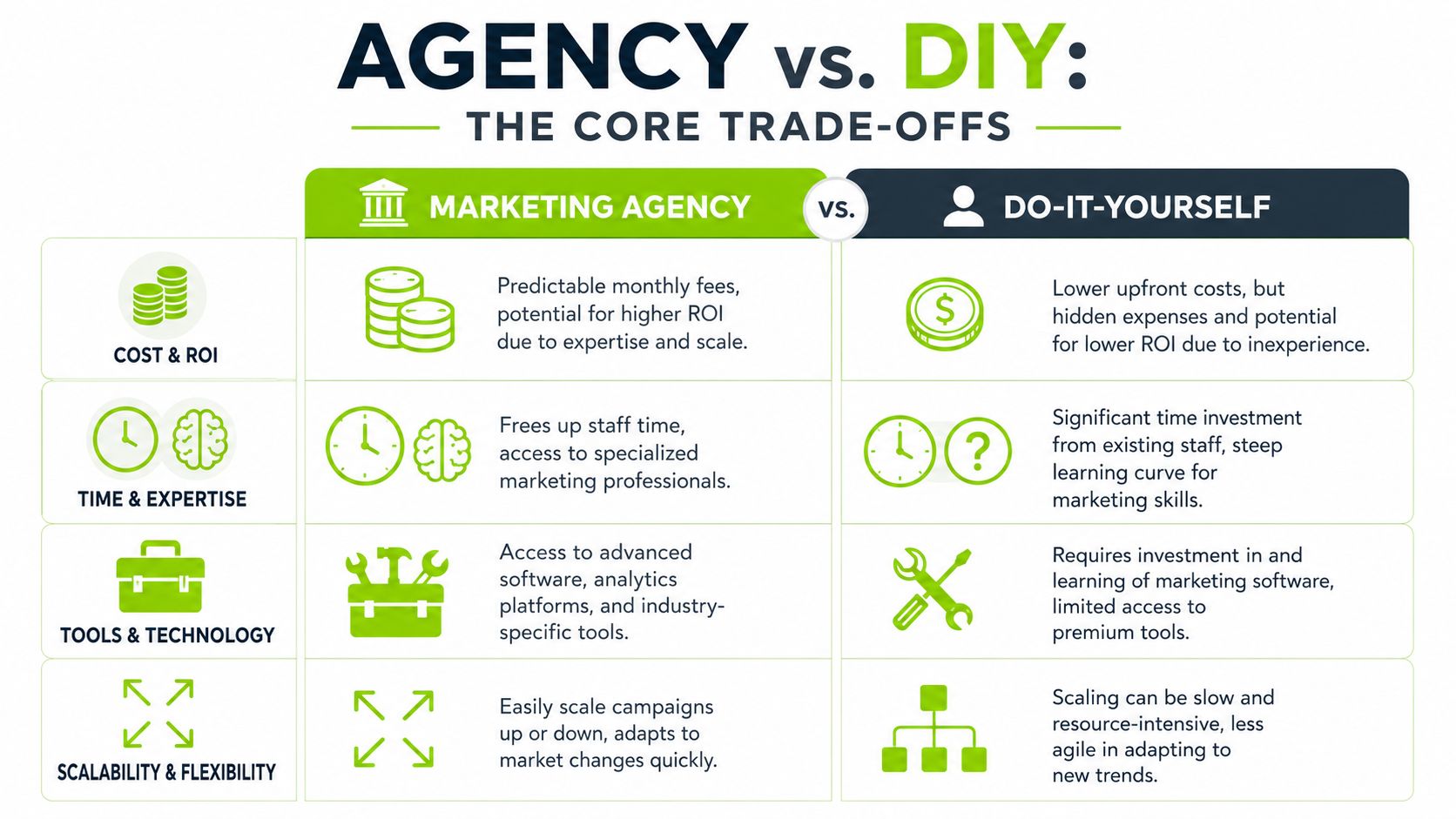
| Criterion | DIY Marketing Approach | Growth Partner Approach (e.g., GolfRep) |
|---|---|---|
| Cost control | Lower visible upfront spend, but staff time, software, and missed follow-up often sit off the books | Clear external cost, with fewer hidden operational gaps if delivery is structured |
| Time demand | Falls onto managers, secretaries, membership staff, or volunteers already stretched | Frees internal time by moving execution, testing, and reporting out of the club |
| Skill coverage | Depends on whoever is available internally | Wider specialist coverage across paid media, tracking, landing pages, and nurture |
| Tool access | Often pieced together or skipped entirely | Usually includes established systems and reporting processes |
| Enquiry handling discipline | Commonly manual, inconsistent, and dependent on individuals | More likely to be documented, visible, and process-led |
| Seasonal scaling | Hard to ramp quickly when demand changes | Better suited to adjusting spend, creative, and follow-up volume |
| Measurement | Often limited to surface metrics | More likely to track conversion actions and commercial outcomes |
| Risk | Lower fee risk, higher execution risk | Higher fee commitment, lower delivery risk if the partner is competent |
The visual summary below captures the same trade-offs in simple form.
Cost is wider than the invoice
DIY often wins the first discussion because the external fee disappears from the budget line.
That logic breaks down quickly. If the club saves money on agency fees but loses enquiries through slow replies, weak tracking, or inconsistent follow-up, it has not saved money. It has just hidden the cost inside staff workload and missed sales. Clubs that want a better grip on this gap should review a golf club enquiry conversion process built around response speed and follow-up discipline.
A growth partner costs more in cash terms. The question is whether that spend reduces wasted demand, improves response handling, and gives the committee clearer commercial visibility.
Time breaks the DIY model first
Internal marketing plans rarely fail because the club lacks ideas. They fail because nobody has enough uninterrupted time to run campaigns properly and stay on top of incoming enquiries.
One staff member is covering visitors. Another is answering membership questions between other duties. A committee member approves creative late. Reporting slips. Follow-up becomes reactive. The club still believes it has a lead generation problem when it has a capacity problem instead.
That distinction matters.
Skills and tools decide whether DIY is realistic
DIY works if the club already has capable people and clear ownership. Without that, it becomes a patchwork of part-finished tasks.
The club needs practical coverage in five areas:
- Search and SEO so the club appears when prospects are actively looking
- Paid social and paid search so demand can be generated deliberately
- Content creation that matches the club's market position and offer
- Conversion tracking so enquiries can be traced back to source
- Follow-up management so leads are answered, logged, and progressed
A partner should bring those disciplines together. If it only supplies ads and reports, the club is still left with the most commercially sensitive part of the job after the click.
If you're comparing outside suppliers, broad directories can help you sense-check how agencies position their services before you start conversations. NotFair's agency comparison is one way to review different models.
The cheapest route often creates the most waste.
Golf clubs need flexibility, not just promotion
Golf demand shifts with seasonality, weather, joining windows, open events, and internal pricing decisions. A club cannot afford a marketing setup that only works when everything is quiet.
DIY can support basic visibility. It usually struggles when the club needs to launch quickly, change offers, increase spend, keep message quality high, and respond properly to a spike in enquiries at the same time.
That is why the agency versus DIY decision should be made on execution capacity, not preference. If the club cannot respond quickly, track properly, and follow up consistently, more marketing activity will expose the weakness rather than fix it.
The Hidden Challenge Handling Enquiries Effectively
Most clubs lose money in the gap between enquiry and response. Not in ad setup. Not in graphic design.
The UK digital advertising market reached £29.6 billion in 2023, showing how firmly customer attention has moved online, according to this summary of the shift toward digital acquisition. For golf clubs, that means you're not competing in a casual environment anymore. You're competing in a professionalised one where buyers expect quick, joined-up follow-up.
The process below is the part most clubs underestimate.
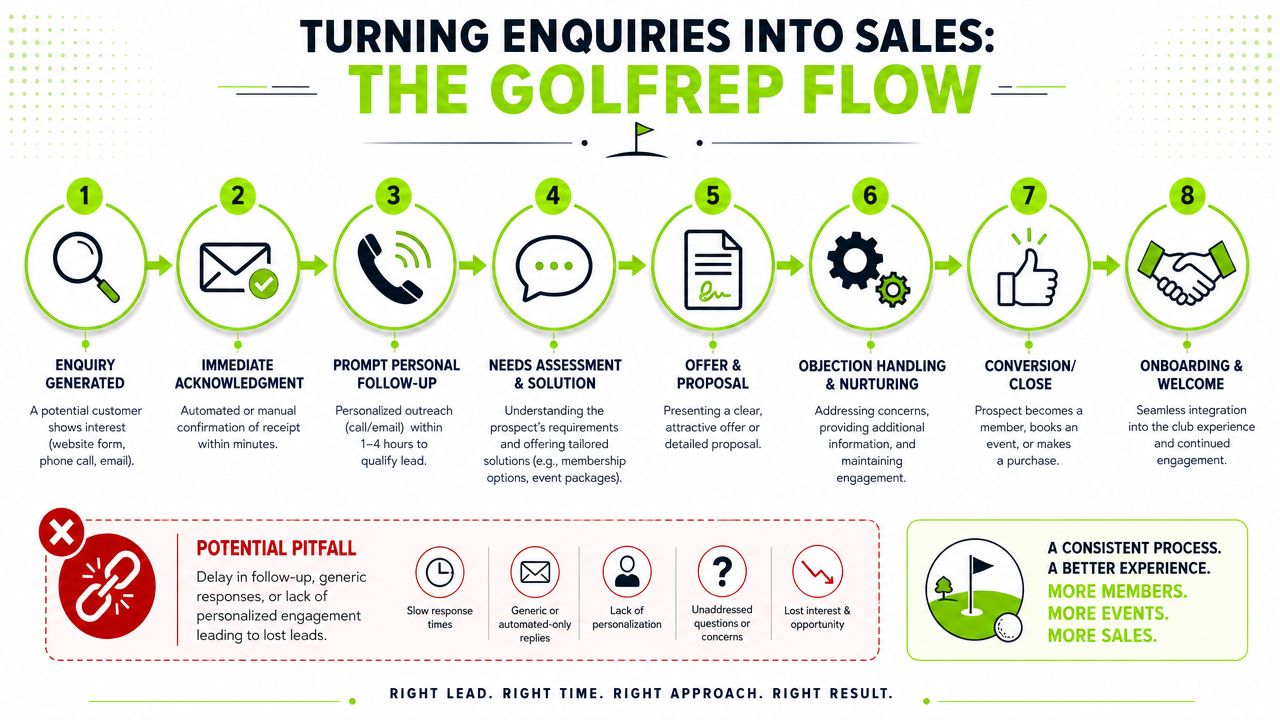
An enquiry is the start of sales
A membership enquiry is not a result. It's an opportunity.
If the club treats it as a completed marketing success, standards slip immediately. No one owns the next action. Messages sit in inboxes. Calls go unlogged. A prospect asks a direct question and gets a generic response.
That's why clubs need:
- Immediate acknowledgement so the prospect knows the enquiry landed
- Prompt personal follow-up from someone able to help
- Clear qualification to understand timing, budget, and fit
- Visible lead status so the team knows what happens next
- Structured nurture for prospects who aren't ready on day one
A lot of clubs still manage this manually. That works until volume increases, a staff member is off, or multiple enquiries arrive at once.
Lead visibility beats guesswork
Most committees think in terms of lead generation. Commercially, lead visibility matters more.
Can anyone in the club see every open enquiry? Can they see who responded, what was said, whether a visit was booked, and which prospects have gone quiet? If not, your conversion rate depends on memory and individual effort.
That's why clubs looking to tighten this part of the process should pay attention to golf club enquiry conversion systems, not just campaign ideas.
Fast follow-up matters, but visible follow-up matters too. A quick reply that nobody tracks is still a weak system.
Where both DIY and agencies often fail
DIY teams often struggle here because the same people who run the club are also expected to chase enquiries properly.
Generic agencies fail for a different reason. They generate leads, then stop at the handover. The club gets a spreadsheet, a form notification, or a monthly count. What happens after that is treated as someone else's problem.
That split is artificial. If the goal is new members, post-enquiry process is part of marketing performance.
How Automation Changes the Decision
Automation has changed this conversation, but not in the way most clubs think.
Some committees assume AI makes DIY easy. It doesn't. It makes system design more important.

AI helps when the process is clear
The Office for National Statistics reported that 18% of UK businesses were using at least one AI technology in 2024, via this discussion of AI and the DIY versus expert decision. For golf clubs, the practical use isn't generic content generation. It's systemisation.
That includes:
- Instant lead qualification when an enquiry lands
- Automated follow-up so nobody waits for a manual reply
- CRM integration so every interaction is logged
- Nurture sequences that keep prospects engaged over time
- Attribution clarity so the club knows what produced the enquiry
The benefit is obvious. The setup isn't.
Automation can reduce admin and increase complexity
A club can use automation to remove repetitive work. That's useful. But someone still has to design the workflows, define ownership, write the messages, set the triggers, connect the CRM, and monitor what breaks.
That's why “we'll use AI and do it ourselves” is often too simplistic. The question isn't whether software exists. The question is whether your team can implement it properly and trust it.
If you want a broader view of how these systems are being applied outside golf, marketing automation for service businesses gives a helpful reference point.
The decision has shifted
The old choice was in-house or outsourced.
The choice now is who can build and maintain an automated commercial process without losing lead quality, response quality, or reporting quality. Clubs exploring automation systems for golf club growth should judge them on reliability and visibility, not novelty.
For many clubs, automation doesn't eliminate the need for specialist help. It exposes how much specialist setup was needed in the first place.
Your Decision Checklist Which Path Is Right for Your Club?
A committee can settle this quickly if it answers the right questions accurately.
Most clubs don't need a long strategy document to make the choice. They need a sober audit of time, skill, discipline, and process.

Questions that decide it
Use this checklist in a committee meeting or management review.
- Do we have dedicated time each week? If marketing and follow-up only happen when the office is quiet, DIY won't stay consistent.
- Do we know who owns each enquiry? Shared inboxes and informal handovers are warning signs.
- Can we track source to outcome? If you can't connect campaigns to visits, applications, or joins, decision-making will stay vague.
- Can we respond quickly and properly? Fast matters, but so does relevance. Prospects need useful answers, not templated brush-offs.
- Do we have the required skill mix in-house? Not enthusiasm. Actual working ability across paid media, content, landing pages, tracking, and follow-up.
- Can we scale during key selling periods? If demand rises, can the club increase activity and maintain quality?
- Do we have a nurture process? Many prospects won't join on first contact. If there's no follow-up sequence, they're likely to drift.
- Can the committee judge performance clearly? If reports rely on vanity metrics or anecdotes, the club is steering blind.
How to interpret the answers
If most answers are a confident yes, DIY may be perfectly reasonable. That tends to suit clubs with modest growth ambitions, strong internal discipline, and someone who has full ownership of both marketing execution and enquiry conversion.
If several answers are unclear, delayed, or dependent on one overworked person, the club has a systems problem.
Committee test: If your current process would break when one key staff member goes on holiday, it isn't robust enough.
A useful rule of thumb
DIY works when the club already behaves like a small commercial team.
External support makes more sense when the club wants consistent growth but runs marketing and follow-up through goodwill, shared responsibility, and manual admin.
Next Steps and When a Growth Partner Is the Answer
Some clubs can manage this themselves.
If your club has stable demand, limited growth ambition, capable internal staff, and a disciplined process for handling every enquiry, DIY can be enough. In that case, keep it simple, stay measured, and make sure someone owns follow-up from start to finish.
But many clubs are not in that position. They want membership growth, more visitor revenue, or a steadier pipeline, yet they still rely on fragmented admin, delayed replies, and weak visibility after the lead comes in.
That's when a growth partner becomes the sensible answer.
Not because external help is fashionable. Because the club needs a proper system. One that connects lead generation, response handling, tracking, nurture, and conversion into a process the committee can review and improve.
A specialist model such as GolfRep fits when a club recognises a hard truth. The problem usually isn't a lack of interest in the market. It's a lack of structure inside the club to turn that interest into booked visits, applications, and new members.
If that sounds familiar, don't ask whether you need more marketing.
Ask whether you finally need a working pipeline.
If your club wants a clearer view of where enquiries are being lost, GolfRep helps golf businesses assess the full path from lead generation to follow-up and conversion, with a focus on systems, visibility, and predictable pipeline management rather than marketing activity alone.
Ready to tap into our proven growth system?