How Paid Advertising Is Changing Golf Club Marketing
Most advice about golf club marketing still starts in the wrong place. It starts with traffic, reach, or getting more enquiries.
That sounds sensible until you look at what happens inside many clubs. An advert runs. A prospect fills in a form. An email lands in a shared inbox. Someone means to call them back after the morning rush, after the competition admin, after the member issue at the desk. By then the enquiry has cooled, the prospect has looked elsewhere, and the club blames the advert.
The advert often isn’t the problem.
How Paid Advertising Is Changing Golf Club Marketing has less to do with buying more clicks and more to do with what happens after interest is created. The clubs that grow steadily don’t treat paid media as a standalone activity. They treat it as the front end of an operational system that captures, routes, follows up, and tracks every genuine membership opportunity.
That’s the shift many clubs still miss. Paid advertising can create demand, but it can’t rescue a weak enquiry process. If staff can't see leads clearly, respond quickly, and move prospects towards a visit or conversation, more ad spend just creates more leakage.
The Hidden Growth Problem Most Golf Clubs Face
A lot of clubs think they have a lead generation problem when in reality, they have a lead handling problem.
The pattern is familiar. Enquiries come in through the website, social media, email, or a campaign landing page. Then they get handled manually, often by whoever happens to be available. There’s no clear ownership, no structured follow-up, and no reliable way to see which prospects are still active. That’s where momentum gets lost.
For committee-led clubs and busy management teams, this usually isn't caused by a lack of effort. It’s caused by fragmented systems. One person checks Facebook messages, another checks the office inbox, someone else keeps notes on paper, and no one has a clean view of the full pipeline.
Interest is often there. Process is the weak point
Many clubs already generate enough signals of demand to grow. The issue is that those signals aren’t turned into a repeatable process.
That’s why broad advice about driving more enquiries often falls short. Clubs can spend more on Meta, Google, or local promotion and still feel no real improvement if the underlying process remains manual. This is one reason many golf clubs struggle to attract new members in a predictable way. The challenge isn't always visibility alone. It’s what happens once visibility produces interest.
Practical rule: If a club can't say exactly who contacted them last week, who replied, who booked a visit, and who went quiet, more advertising won't fix the core problem.
The cost of missed follow-up is higher than most clubs realise
A missed enquiry doesn’t just mean one lost conversation. It often means wasted ad spend, lost staff time, and a poor first impression for a prospective member who was actively interested enough to reach out.
That’s why modern club growth is operational. Good marketing now depends on response time, lead visibility, and consistent follow-up. The clubs that perform well don’t rely on memory or goodwill. They rely on systems.
The New Paid Advertising Landscape for Golf Clubs
Paid advertising used to mean local paper placements, sponsorship boards, leaflet drops, or occasional magazine adverts. Those channels still have a place in some clubs, but they’re hard to measure and even harder to optimise.
Digital paid advertising is different because it lets clubs choose who sees the message, when they see it, what they click on, and what happens next. That level of control is what has changed the game.

Search, social, retargeting, and what they actually do
A simple way to understand the current context is to think in terms of intent.
| Channel | What it’s good for | Common mistake |
|---|---|---|
| Google Search Ads | Reaching people actively looking for a golf club, membership, lessons, or visitor golf in your area | Sending traffic to a generic homepage |
| Meta Ads | Building awareness and interest among local audiences who may not be actively searching yet | Using broad creative with no clear next step |
| Retargeting | Re-engaging people who visited the site or clicked before but didn’t enquire | Running it without a proper landing page journey |
| YouTube or video placements | Showing the club experience visually and building familiarity | Treating video as branding only, with no conversion path |
Search ads are the closest thing to catching a golfer with raised hands. They’re already looking.
Social ads work differently. They interrupt attention, so the offer, creative, and audience targeting need to do more work. For many clubs, this is why Meta ads work so well for golf club membership campaigns. They allow local targeting, strong visual storytelling, and structured enquiry capture if the campaign is built properly.
Traditional promotion wasn’t useless. It was just harder to control
A flyer through the door might create awareness, but you won’t know who looked at it, who acted on it, or which message was effective. A newspaper ad may support the club’s local presence, but it doesn’t tell you which audience segment responded.
Digital channels let clubs test those assumptions.
- Audience control: Clubs can target by location, interest, stage of awareness, and previous site behaviour.
- Message control: Different audiences can see different offers, imagery, and language.
- Journey control: Traffic can be sent to a dedicated page built for one purpose, not a general website.
- Follow-up control: If integrated correctly, every enquiry can trigger immediate action.
Paid advertising isn’t just media buying anymore. It’s audience selection, message testing, conversion design, and follow-up infrastructure working together.
Why old habits create poor results in new channels
The biggest mistake clubs make with digital ads is copying offline thinking into online environments.
They boost a post, send visitors to the homepage, use a generic contact form, and wait. That approach usually creates weak enquiries and poor reporting. It also makes staff believe paid advertising “doesn’t work”, when the underlying cause is a campaign never structured to convert.
Digital advertising works best when each part has a job. The ad gets attention. The landing page captures intent. The CRM logs the lead. The follow-up moves the prospect forward.
Without that chain, clubs don’t have a growth system. They just have adverts.
Why Generating More Enquiries Can Be a Costly Mistake
More leads do not fix a weak sales process. They expose it.
A club can spend more on Facebook, Google, or Instagram and still end up with fewer memberships if the post-enquiry process is loose. That is the part committees often miss. The campaign looks active, the inbox looks full, and the monthly report shows interest. Meanwhile, response times slip, ownership gets blurred, and good prospects go cold before anyone speaks to them properly.

Volume without process creates operational strain
Clubs often diagnose the wrong problem. They look at poor results and question the advert, the budget, or the channel. In many cases, the actual constraint sits after the form submission.
If staff are handling enquiries from shared inboxes, paper notes, missed calls, and social messages with no common workflow, higher lead volume creates backlog rather than growth. A process that feels manageable at five enquiries a week can fall apart at fifteen. The team starts reacting instead of following a clear sequence. Follow-up becomes inconsistent. Reporting becomes guesswork.
That has a direct commercial cost. Paid traffic keeps arriving, but the club cannot work each opportunity properly.
The bottleneck is usually after the click
Golf clubs rarely lose paid leads because someone saw an advert. They lose them because the prospect entered a system with too much friction.
The first few hours matter most. A prospective member wants a clear answer, a named contact, and a sensible next step. If they have to wait two days for a generic reply, enthusiasm drops quickly. By then they may have contacted another club, parked the decision, or lost confidence that anyone is taking their enquiry seriously.
This is why response discipline matters more than raw lead count. An enquiry has the highest value at the moment it is made, not three days later when someone finally finds time to call.
Visibility matters as much as speed
A fast reply helps, but it is not enough on its own. Clubs also need to know what is happening with every lead.
Managers should be able to see, without chasing staff or checking multiple inboxes:
- Where the lead came from
- What the prospect asked for
- Who owns the next action
- Whether a reply has been sent
- Whether a call, visit, or trial has been booked
- What outcome was recorded
Without that visibility, the club is relying on memory, not process. That is usually the point where marketing gets blamed for poor performance, even though the failure happened in follow-up.
A paid enquiry is only the start of the sales opportunity. The result depends on how the club handles the next conversation.
Weak handling lowers standards across the club
There is a second-order problem here. When enquiry volume rises and the handling process stays manual, standards often drop elsewhere too.
Front-of-house staff get interrupted. Membership teams switch between admin and follow-up without priorities. Existing members feel the pressure at the desk or on the phone. Internal frustration builds because marketing appears to create extra work instead of producing visible outcomes.
That is why golf club enquiry conversion processes deserve more attention than headline lead numbers. The clubs that grow consistently are usually not the ones generating the most enquiries. They are the ones that respond quickly, track properly, and move prospects from interest to visit to decision with less friction.
What to fix before increasing spend
Before adding budget, test the handling system under pressure.
A practical review should cover a few basics:
- Check every entry point: Website forms, phone calls, social messages, email enquiries, and referral requests should enter one visible pipeline.
- Assign ownership: Every lead needs a named staff member responsible for the next action.
- Set response rules: Decide what happens immediately, later the same day, and after no reply.
- Use standard follow-up templates: Staff should not write every message from scratch.
- Record outcomes properly: The club should know which leads booked, stalled, withdrew, or joined.
When those basics are in place, paid advertising starts to perform like a system instead of a gamble. Without them, more enquiries can become an expensive way to reveal operational weakness.
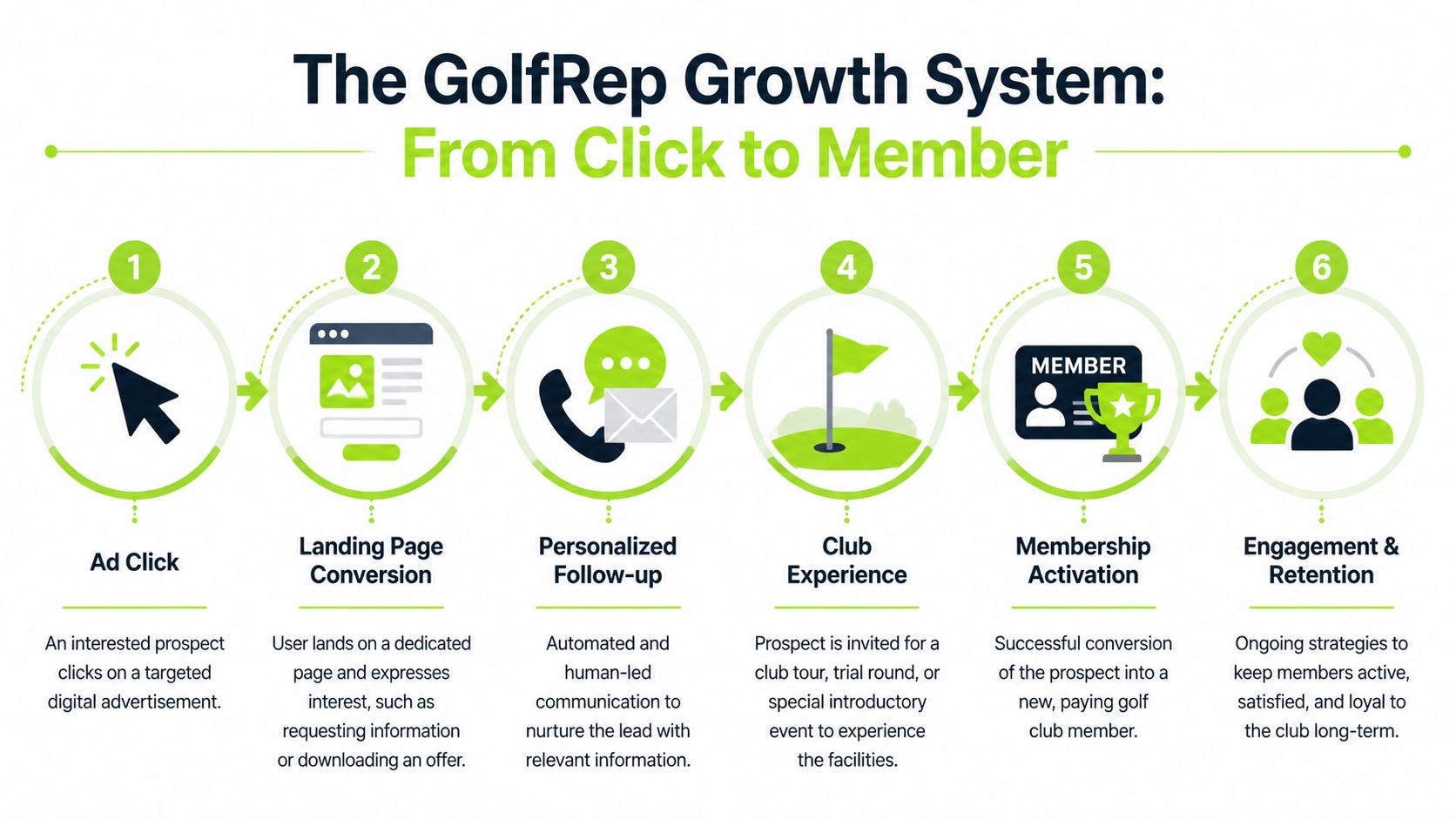
The GolfRep Growth System From First Click to New Member
Paid advertising becomes commercially useful when it connects to a system, not when it operates as a separate campaign.
That system starts before the click, because the message, audience, and offer need to match. But the key difference appears after the form is submitted. That’s where clubs either create momentum or lose it.
What an integrated journey looks like
A prospect sees an advert on Facebook or Instagram. The advert is specific. It speaks to a local golfer who may be considering membership, a trial round, or a club visit. They click and land on a page designed for one job only, not a homepage with ten competing options.
The landing page gives them enough confidence to act. It answers the obvious questions, shows the relevant value, and presents a clean form. Once they submit, the process should continue automatically.
That means the enquiry is pushed into a CRM straight away. The prospect receives a prompt acknowledgement by email or SMS. A staff task is created so someone knows a response is needed. If the lead came from a specific campaign, that source should be visible inside the record.
The CRM is the control centre
Without a CRM, clubs often operate blind. They have fragments of information, but not a reliable pipeline.
A useful CRM for a golf club doesn’t need to be flashy. It needs to do practical things well:
| CRM function | Why it matters in club operations |
|---|---|
| Lead capture | Stops enquiries sitting in disconnected inboxes |
| Source tracking | Shows whether the lead came from Meta, search, referral, or another route |
| Task assignment | Makes ownership clear |
| Status tracking | Shows if the lead is new, contacted, booked, or lost |
| Notes and history | Prevents repeated questions and confused handovers |
When clubs implement this properly, they stop depending on staff memory. They can see what’s happening, what’s stuck, and what needs attention today.
Operator insight: The best follow-up systems don't remove the human touch. They protect it by making sure staff have context, timing, and clear next actions.
Automation should support staff, not replace them
Some clubs hear “automation” and assume cold, robotic communication. That’s not the goal.
Good automation handles the repetitive admin around the conversation. It sends an immediate acknowledgement, confirms receipt, shares the right next step, and reminds staff when action is due. That protects the prospect from silence and protects the team from dropped balls.
Human follow-up still matters. A prospective member often wants reassurance, local detail, and a sense of the club’s culture. But staff shouldn’t have to build every part of that journey manually from scratch.
A strong post-enquiry flow often includes:
- Immediate acknowledgement so the prospect knows their enquiry was received.
- Internal alerting so the right staff member can act quickly.
- Scheduled follow-up if no reply is logged.
- Nurture messaging that keeps the prospect engaged before a visit or call.
- Clear status updates so anyone involved can see progress.
Nurture flows are where many clubs recover lost opportunities
Not every prospect is ready to join immediately. Some need time. Some are comparing clubs. Some enquire during a busy week and go quiet even though they’re still interested.
That’s where nurture flows earn their place. Rather than letting the lead disappear, the club can send useful, timed communications such as membership information, answers to common questions, an invitation to visit, or a reminder about the next suitable step.
This isn’t about bombarding people. It’s about staying visible without depending on someone to remember every lead manually.
A club visit should be treated as a conversion event
Many clubs focus heavily on the initial enquiry and not enough on the visit, trial round, or introductory meeting.
Operationally, that’s a mistake. The visit is often the turning point. It’s where interest becomes intent. For that reason, the system should treat booked visits as a major milestone, not an informal side note.
If paid advertising is feeding enquiries into a CRM, then the club should be able to see which leads reached that stage and which didn’t. That creates the basis for proper conversion analysis later.
Measuring What Matters for Sustainable Club Growth
A campaign can produce plenty of clicks and still be commercially poor.
That’s one of the biggest reasons clubs get frustrated with paid advertising. They’re shown activity metrics, but not business metrics. Impressions, link clicks, and social engagement might suggest the campaign is “performing”, yet the club still can’t answer the only question that matters. Did this produce members and revenue?

Vanity metrics versus management metrics
Vanity metrics are useful for diagnostics, but they are not decision metrics.
A club manager or committee needs numbers that connect marketing to operations and revenue. That means looking beyond platform dashboards and into the actual pipeline.
| Vanity metric | Useful for | Not enough on its own because |
|---|---|---|
| Impressions | Checking whether ads were delivered | Visibility doesn’t equal intent |
| Clicks | Measuring attention and relevance | Traffic can be poor quality |
| Likes and comments | Gauging light engagement | Social approval doesn’t book visits |
| Video views | Testing creative interest | Watching isn't the same as enquiring |
The more useful metrics sit further down the journey.
The numbers clubs should actually watch
A disciplined measurement setup usually tracks the following:
- Cost per lead: How much spend was required to generate a genuine enquiry.
- Cost per booked tour or visit: Whether the club is turning leads into real appointments.
- Lead-to-visit conversion: How effectively staff are moving prospects forward.
- Lead-to-member conversion: Whether the club’s sales process is working.
- Cost per member acquisition: The clearest view of whether paid advertising is commercially sensible.
These aren’t abstract marketing terms. They’re operating metrics.
If cost per lead looks acceptable but cost per booked visit is weak, the issue may be response handling. If visits are happening but memberships aren’t closing, the issue may sit in the club experience, pricing communication, or sales conversation. Good tracking tells you where the friction is.
Clubs don't need more reports. They need reporting that shows where revenue is being won or lost.
Attribution needs to be good enough to guide action
Perfect attribution is rare in golf club marketing. People may click an advert, visit the site later, speak to a friend, then submit a form days after first seeing the campaign.
That doesn’t mean clubs should give up on tracking. It means they should build a practical attribution model that is consistent enough to inform decisions. If each enquiry enters the CRM with a source, date, status, and outcome, patterns become visible quickly. You can see which campaigns bring qualified interest, which ones stall, and where handover problems appear.
Better measurement improves budget decisions
Once clubs can track the journey from first enquiry to membership outcome, budget decisions become more rational.
Instead of asking “Should we spend more on ads?”, the better questions are:
- Which channel is producing qualified enquiries?
- Which audience is booking visits?
- Where are leads dropping out?
- What message creates better conversations, not just cheaper clicks?
Those questions move the conversation away from marketing theatre and towards commercial discipline. That’s where sustainable growth starts.
Paid Advertising in Action Real-World Club Success
The principles sound straightforward on paper. They become more convincing when you see how differently they apply across real clubs.
One club may need revival. Another may need consistency. A multi-site operator may need central oversight without losing local responsiveness. The paid advertising system should adapt to those realities rather than forcing every venue into the same shape.
When a club needs recovery, not just promotion
Some clubs aren’t trying to optimise a healthy pipeline. They’re trying to rebuild confidence and create one.
In that setting, paid advertising works best when it supports a broader reset. The campaign has to present a compelling local reason to look again, but it also has to plug into proper follow-up so that renewed interest doesn’t go to waste. That’s particularly important when a club is coming back from a difficult period and every enquiry carries more weight.
A recovery scenario usually demands clarity over polish. Prospects want to understand what’s changed, why the club is worth considering again, and how easy it is to take the next step.
When a premium venue needs a steadier pipeline
At stronger clubs, the issue is often different. The brand may already be respected, but enquiry flow is inconsistent.
In those cases, paid advertising is less about shouting louder and more about smoothing demand. The system needs to identify the right local audience, maintain presence, and create a repeatable route into booked visits or membership conversations. Prestige alone rarely creates predictability. A club can have a strong reputation and still lose opportunities through weak follow-up or poor pipeline visibility.
Multi-site groups need central control and local execution
Large operators face a different operational challenge. They need reporting, consistency, and automation across several venues, but they also need each site to respond in a way that feels local and informed.
That usually means centralised CRM infrastructure, shared reporting standards, and local staff workflows that make follow-up manageable. Without that structure, paid advertising can generate interest at scale while each venue handles leads differently. The result is inconsistent conversion and no clear picture of what the group is buying.
The same ad platform can support very different growth models. What changes is the operational system behind it.
What these clubs tend to have in common
Although the club types vary, the strongest outcomes usually share a few traits:
- They define the next step clearly: Not “contact us for more information” but a specific action such as a visit, call, or trial experience.
- They remove inbox chaos: Leads are visible in one system, not buried across channels.
- They follow up consistently: The process doesn’t depend on one staff member having a quiet afternoon.
- They review outcomes, not just ad activity: The campaign is judged by progression and conversion.
That’s why paid advertising in action rarely looks like a clever advert in isolation. It looks like a disciplined process that turns interest into movement.
Your Roadmap to a Predictable Membership Pipeline
More ad spend will not fix a weak membership pipeline. For many golf clubs, it exposes the problem faster.
The practical route is to sort the post-enquiry process first, then add paid acquisition into a system that can handle demand. That feels less exciting than launching campaigns straight away. It produces better outcomes.
Phase one audit your current enquiry process
Run your own mystery shop.
Submit a membership enquiry through the website. Send a direct message on Facebook or Instagram. Call the club outside busy hours and track what happens next. Then review the experience as if you were a serious prospect comparing three clubs in the area.
Ask direct questions:
- How long did it take to get a response?
- Was the reply useful, or was it generic?
- Did one person clearly own the enquiry?
- Was there a next step, such as a visit or call?
- Could a manager see that lead without asking staff to search for it?
This exercise usually exposes the underlying constraint. It is rarely the advert. It is the delay after the enquiry, the vague reply, or the fact that nobody can tell where the lead now sits.
Phase two choose one system of record
If enquiries are spread across inboxes, paper notes, spreadsheets, and social messaging, fix that before increasing ad budget.
The club needs one system where every lead is logged, assigned, and tracked. In practice, that usually means a CRM with workflow tools rather than a basic contact list. It should record source, notes, status, follow-up dates, and outcome.
Use a simple test. If a membership enquiry can come in and disappear from view, the system is too weak to support paid advertising properly.
Phase three define the follow-up standard
Software helps. Process converts.
Write the minimum follow-up standard for every membership enquiry and keep it realistic enough for the team to follow every week, not just during a quiet period. Decide who responds first, how quickly they respond, what the message includes, and when the next contact happens.
A workable standard often includes:
- Immediate acknowledgement by email or text.
- Named staff follow-up within an agreed timeframe.
- A clear invitation to book a visit, call, or membership discussion.
- Nurture communication for prospects who are interested but not ready yet.
- A final outcome tag so management can review what happened.
Clubs often skip this step because it feels operational rather than strategic. It is the strategy. If follow-up depends on memory and goodwill, enquiry volume becomes a burden instead of an asset.
Phase four launch one integrated campaign
Start with one controlled test.
Choose one audience, one offer, and one destination page. Local membership campaigns on Meta are often a practical starting point because clubs can control geography, message, and spend. Search can work well too, especially where prospects are already looking for membership options.
The campaign needs to feed straight into the CRM, send an acknowledgement, and create a task for the right staff member. Without that chain, the campaign is only generating names, not creating a usable sales process.
Key takeaway: Keep the campaign small enough to manage and connected enough to measure properly.
Phase five review the middle of the funnel
A lot of clubs review two numbers only. Leads in. Members out.
That misses the section of the pipeline where conversion is usually won or lost. Management should look at how many enquiries became real conversations, how many conversations became visits, and how many visits turned into members. A sharp drop at one stage shows where the process needs work.
In golf club marketing, that middle section is usually the truth serum. It shows whether paid advertising is feeding growth or feeding admin.
Phase six build campaigns around segments, not assumptions
Different prospects need different handling after the click.
A returner to golf may need reassurance about pace of play, confidence, and fit. A premium buyer is more likely to judge course standards, membership culture, and service. A lapsed member may respond to familiarity and a specific reason to come back, but only if the follow-up reflects their history with the club.
As noted earlier, the market has become more competitive and less forgiving of generic messaging. Broad targeting and broad follow-up waste budget. Clubs get better results when the ad, the enquiry form, and the follow-up process match the type of prospect they are trying to convert.
Phase seven make reporting useful to managers and committees
Reporting should help a decision get made.
The club doesn’t need endless charts. It needs a clear view of enquiries, response handling, booked visits, conversions, and the stage where leads are stalling. If a committee cannot understand the report quickly, the reporting is too complicated.
A useful monthly view should answer three things:
| Question | Why it matters |
|---|---|
| How many genuine enquiries came in? | Shows whether campaigns are generating interest |
| How many progressed to visits or serious conversations? | Tests whether follow-up is working |
| How many converted into members? | Connects marketing activity to revenue |
Phase eight scale only when the system holds
Discipline matters most in this situation.
Clubs often see early traction and want to increase spend, widen targeting, or add more campaigns. That only works if the team is already responding consistently, the CRM is clean, and reporting shows where every lead is moving.
Scale should follow control. If the process is still inconsistent, extra spend will magnify the same weaknesses and make performance harder to diagnose.
Predictable membership growth does not come from finding one clever advert. It comes from building a joined-up system that captures demand, follows up properly, and shows management what is converting. Paid advertising matters, but the post-enquiry process is what turns it into revenue.
If your club wants a clearer, more predictable way to turn advertising into booked visits and new members, GolfRep helps golf clubs build that full pipeline. From lead generation to CRM follow-up and conversion tracking, the focus is on creating a system your team can run, measure, and improve.
Ready to tap into our proven growth system?